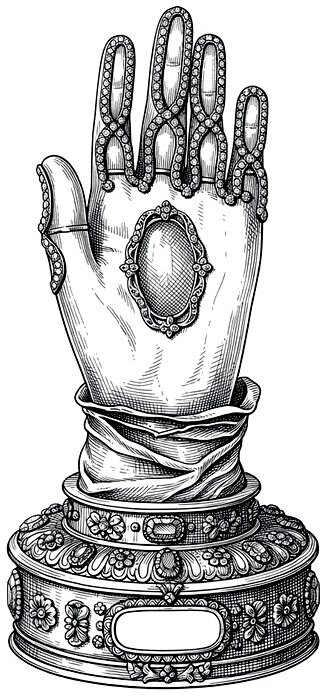
In Asunción, the capital of Paraguay, a chapel keeps a human heart. Catholics honour the bodies of saints as holy relics, and this heart is one of them. A heart-shaped case of gilded metal has held it since 1696. Behind its crystal panes, the dried organ still shows a puncture wound from an arrow. The heart fills almost all of the inside and shows on one side the wound made by an arrow. A crown topped by a cross and two crossed palm branches stands on the capsule, and the Latin inscription on its base calls it “the wondrous heart of the venerable Father Roque González de Santa Cruz, of the Society of Jesus, killed for Christ in Paraguay on 15 November 1628.”
The men who killed Roque González burned his body. According to the first Jesuit accounts, the heart survived the fire, and before the killers threw it in, the heart spoke to them.
A priest from Asunción
Roque González was born in Asunción in 1576. As a boy in Asunción, he learned the language of the native Guaraní people. He became a Catholic priest in 1598. The bishop wanted to make him his deputy in the cathedral, but Roque refused the post, and in 1609, at thirty-three, he joined the Jesuits.
Within months the Jesuits sent him out as a missionary. The Jesuits gathered scattered Guaraní families into planned mission towns called reductions. Priests taught them farming, crafts and the Christian faith in these settlements. A modern Catholic reference work counts nine such villages that Roque founded between 1611 and 1628. One of them, Itapúa on the Paraná River, grew into the Paraguayan city of Encarnación.
In 1628 he went east across the Uruguay River into what is now the Brazilian state of Rio Grande do Sul. With him was Alonso Rodríguez, a young Jesuit from Zamora in Spain. On 31 October they entered a district called Caaró, or “house of wasps”. A local chief agreed to receive them. The priests raised a cross on 1 November, All Saints’ Day, and named the village after the feast. A third Jesuit, Juan del Castillo from Belmonte in Spain, had been left in charge of another new village on the Ijuí, a river of the same region that flows into the Uruguay.
The paye of the Ijuí
The most powerful man in that country lived on the Ijuí. The most powerful man in that valley was Ñezú. He was a paye, a traditional Guaraní healer and spiritual leader. People revered him for his magic and his power over unseen spirits called tupichúa.
In the Guaraní tongue, the word pay meant father. The people used it for Catholic priests as well as their own spiritual leaders, putting both figures on equal footing.
At first Ñezú welcomed Roque. He built a church for God and a house for the priests, Montoya writes, and Juan del Castillo stayed in his village. Teschauer adds that he never sent away his many wives or gave up his magic. Then a man who had left the missions came to Ñezú. A fugitive from the missions warned Ñezú that the newcomers were destroying their old freedom. The priests crowded people into villages and forbade ancestral customs. Ñezú held power over forest beasts and winds, but soon he too would have to obey the priests. The speaker urged him to strike first and kill the missionaries.
Ñezú sent word across the region to kill the priests. The attack order at Caaró went to Carupé, a local chief who had accepted the mission.
Fifteenth of November 1628
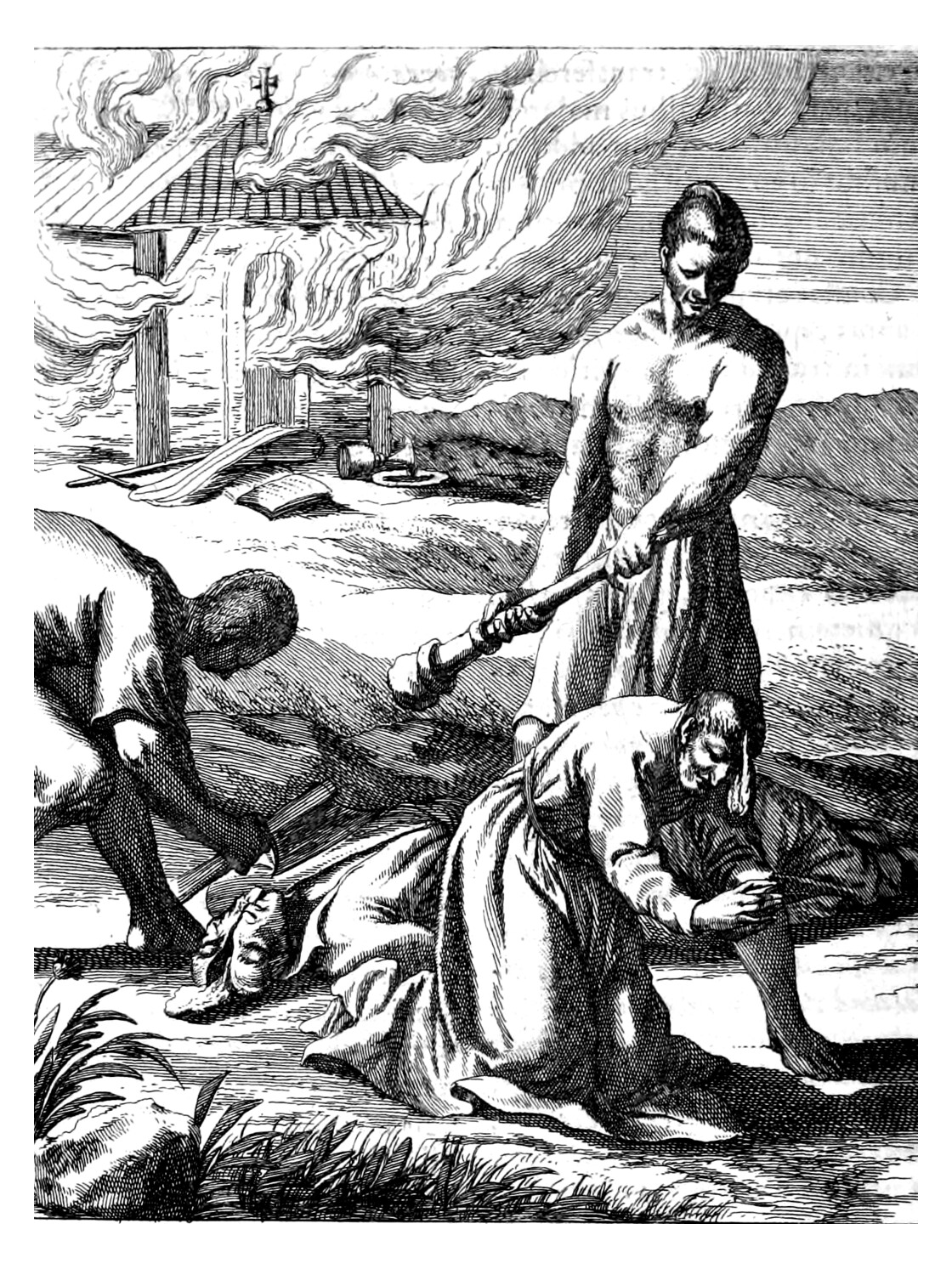
On 15 November 1628, Roque gathered the people to hang a church bell. After celebrating Mass, he bent over to tie the clapper into the bell. Carupé gave a sign to an attacker named Maraguá, who struck Roque on the head with a heavy wooden war club. The blow crushed his skull.
Alonso Rodríguez ran out from his hut when he heard the shouts. The attackers cut him down at the chapel door. They tore up vestments, broke the chalice and burned the wooden cross. They also destroyed a painting of the Virgin Mary that Roque had carried from village to village and called la Conquistadora, the Conqueress. An old chief who rebuked them for the killing was beaten to death. Two boys who served at the altar got away and ran to warn the other missions.
Two days later, on 17 November, Ñezú’s men came to Juan del Castillo on the Ijuí. They asked him for iron axe heads and fishhooks, the presents the missionaries gave, and as soon as he had handed them over they tied his arms. The warriors called him a sorcerer. They dragged him four kilometres over stony ground and killed him with heavy stones.
Then Ñezú put on the priest’s vestments and had the baptised children brought to him. At baptism the priests had placed salt on the tongue and anointed the chest and back with holy oil, and Montoya says Ñezú scraped those places to wipe the sacrament away. In Teschauer’s fuller account, he washed the children’s heads with sand, scraped their tongues and chests with a shell, poured water from a gourd over their feet and asked the crowd, “Don’t you think I am a real god and know how to baptise well?”
The voice in the fire
The attackers had thrown the dead priests onto a fire. Early Jesuit chronicles report that the next day, a voice spoke from Roque’s heart. It warned the killers that while they had broken his body, his soul was safe in heaven, and retribution would follow. The attackers cut open his chest and took out the heart. Maraguá shot an arrow through it, then tossed it back into the flames. The heart did not burn. Christian chroniclers later compared this voice of forgiveness to that of Saint Stephen, who prayed for his executioners.
Fifty-three captured attackers reportedly confirmed the miracle during later interrogations. Guaraní soldiers from older missions, supported by cavalry from Corrientes, captured them weeks later. A military council sentenced the leaders and twelve warriors to death. Jesuit priests had pleaded to spare their lives, but their appeal was rejected. Carupé was hanged, and Maraguá was executed on the spot where he had killed Roque. All the prisoners declared that they had acted out of hatred of the Christian religion and attachment to their old beliefs, and Maraguá said that he had heard Roque speak after his death.
Ñezú escaped across the Uruguay River on a makeshift raft. He lived for years among non-Christian villages. Portuguese slave raiders from São Paulo finally captured him in 1644.
From Rome to Asunción
In the early 1630s the Jesuits of Paraguay sent the heart, sealed in an oval wooden box, to the head of their order in Rome. On 9 October 1696 a notary in Rome broke the seals in front of witnesses, found the heart with two labels naming Roque González and saw it moved into the gilded capsule described above.
The heart stayed in Rome until September 1928, when Jesuits brought it to Buenos Aires. In the Catholic Church, candidates are first beatified as blessed, then canonized as full saints. Pope Pius XI beatified the three martyrs in 1934. Since 1960, the heart has rested in the Chapel of the Martyrs at the Cristo Rey school in Asunción. Pope John Paul II canonized Roque González and his companions there in 1988. Pope Francis prayed before the heart when he visited Asunción in 2015. Paraguay keeps Roque’s feast on 15 November, and the Jesuits remember the three martyrs together on 16 November.
The other father
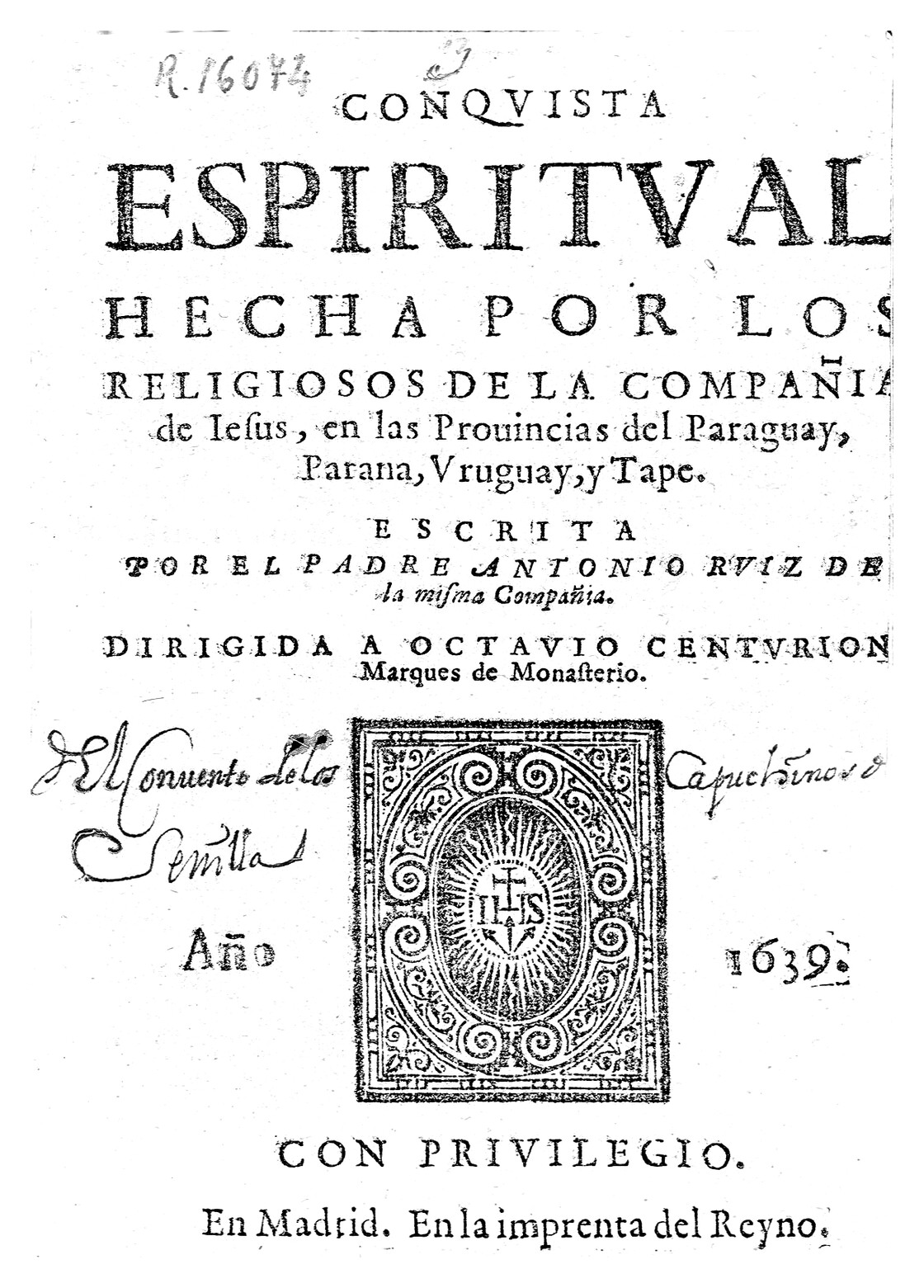
Everything known about Ñezú comes from the men he fought. Montoya, Nieremberg and Tanner were Jesuits writing the lives of their own martyrs, and Teschauer’s biography was reissued in 1928 for the three-hundredth anniversary of the deaths. The witnesses to the voice in the fire were prisoners, several of whom were later put to death. Mission chronicles portrayed Ñezú as an agent of the devil who claimed supernatural control over the sun.
The same pages, read from the other side, also record what Ñezú was defending: life in the forest instead of a planned village, a household with many wives, the standing of a paye whom the jaguars and the winds were said to obey, and a rite of his own to undo the priests’ baptism. Each side at Caaró took the other’s priest for a sorcerer. The Jesuits wrote of Ñezú as a magician in the devil’s service, and the men who dragged Juan del Castillo over the stones called him a sorcerer dog. Whether a voice truly came from the fire rests solely on testimonies recorded by the victims’ fellow Jesuits during a trial.
Montoya mentions one more object from that morning. The bell that Roque was tying when the club came down was kept by the Jesuits as a relic, though by then, he writes, the people of Caaró had cut a good piece off it to make points for their arrows.