Nature and Science.

Did the Moon Set Women's Cycles in the Stone Age?

Notched Bones and Modern Data

The paleolithic lunar calendar and menstrual cycle evidence, checked: what notched Ice Age bones can and cannot show, and what diaries, sleep monitors and app data say about periods and the moon.

Did the Moon Set Women's Cycles in the Stone Age? Notched Bones and Modern Data
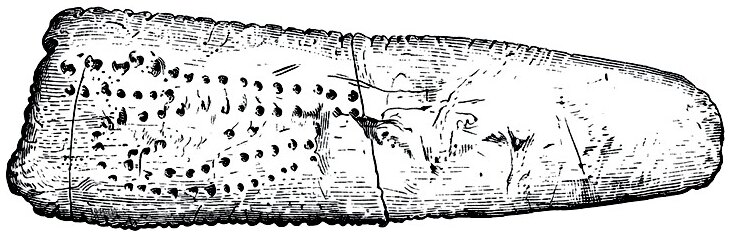
House engraving Blanchard plaque, Aurignacian engraved bone from the Abri Blanchard, Sergeac (Dordogne), after a photograph by Marie-Lan Nguyen, Musée d'Archéologie nationale, via Wikimedia Commons (public domain).

Long-term diaries show that some women’s periods keep time with the moon for stretches, and that the link looks weaker under electric light. Whether women in the Stone Age noticed it is a harder question.

Some writers say Stone Age women counted the moon against their own cycles. What survives is a handful of pitted and notched bones, some more than 30,000 years old. A few researchers read the marks as counts of the moon, and one writer asked whether a woman had kept such a count.

What does the paleolithic lunar calendar and menstrual cycle evidence show?

The evidence comes in two kinds that hardly touch: archaeologists have marked bones and carved stones whose meaning has to be guessed. Chronobiologists, the scientists who study the body’s inner clocks, have measurements from living people. No bone records a period, and the diaries cover a few decades of modern life.

The numbers explain why the idea keeps coming back. The moon takes about 29.5 days to go from new moon to new moon. In a study of more than 600,000 cycles logged in a fertility app, the average menstrual cycle lasted 29.3 days.

Where does the 10,000 BC story come from?

A popular history of Wicca, the modern pagan religion, dates the discovery to around 10,000 BC. It states it as plain fact: “At this time, women found out that their bodies were in tune with the lunar phases, and they worshiped the Goddess deity.”

No reference stands behind the date, and no find from that time speaks of women’s bodies. The belief itself is far older than Wicca. In the fourth century BC Aristotle wrote that periods begin “towards the end of the month”, when the moon wanes.

Did You Know?

Aristotle also recorded what the know-it-alls of his day made of the timing: “the wiseacres assert that the moon is feminine, because the discharge in women and the waning of the moon happen at one and the same time.”

Is the Blanchard plaque a moon calendar or just a tally?

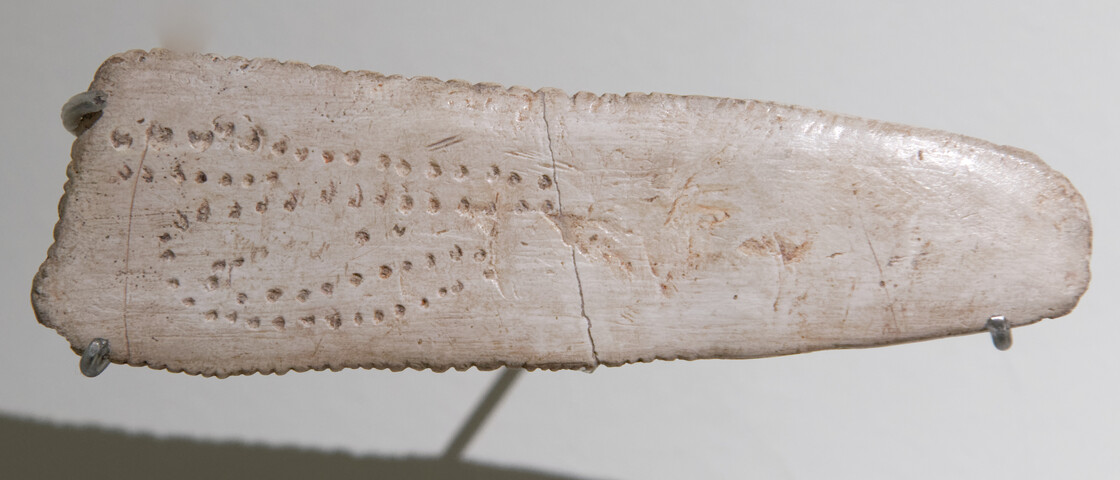
The Blanchard plaque is the most famous of the bones read as moon counts. It is a flat piece of bone about ten centimetres long, from a rock shelter in the Dordogne in southwest France, and more than 30,000 years old. Someone pressed 69 small pits into one face, in a line that snakes back and forth.
A pale, tapering bone plaque on a museum mount, with rows of small round pits on its left half and a finely nicked edge
The Blanchard plaque. Look at the left half: the pits run in rows that turn back on themselves, the line Alexander Marshack read as about two and a half months of moon phases. Photograph by Marie-Lan Nguyen at the Musée d’Archéologie nationale, Saint-Germain-en-Laye, via Wikimedia Commons, public domain.

An American researcher, Alexander Marshack, studied the pits under a microscope. He saw that the tool point and the stroke changed some 24 times along the line. To him that meant the marks were added over a long time, with different tools. He read the winding line as the moon waxing, full and waning over about two and a half months. His book The Roots of Civilization carried the idea to a wide public.

The main objection is that rows like these can be made in one session with a single tool. An archaeologist argued this in 1989, after cutting his own rows of marks into bone and stone and comparing them under the microscope.

Some researchers also read rows of dots in cave paintings as moon counts. In 2024 three experts on prehistoric art checked those readings and found “multiple theoretical and methodological weaknesses” in them.

Who first tied the notches to women’s bodies?

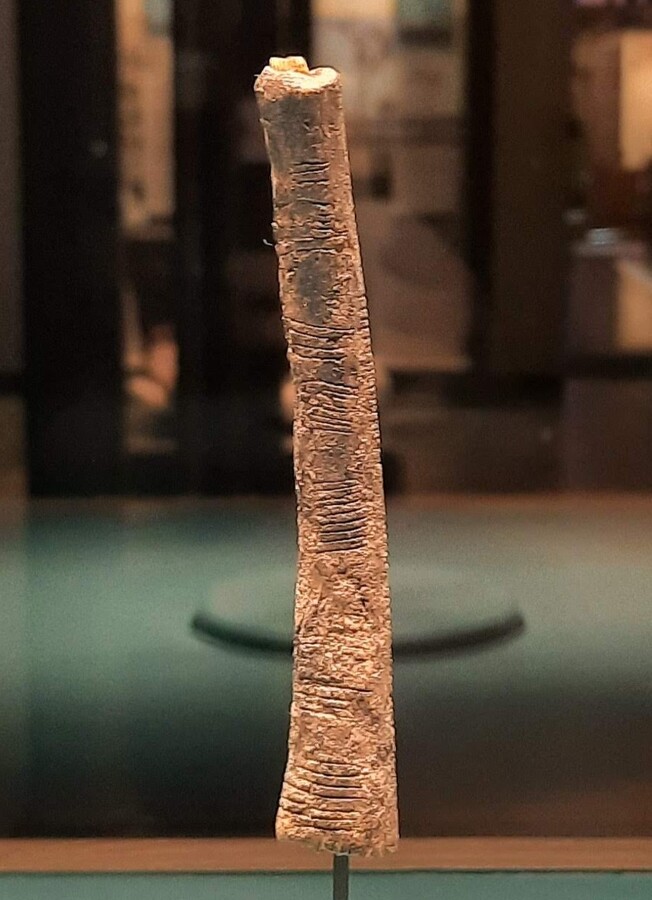
The idea that a woman kept such a count is newer and came from historians of mathematics. Their main example is the Ishango bone, a notched bone handle from central Africa, about 20,000 years old. Marshack read its notches as a lunar calendar of six months. In 1992 a writer on African mathematics suggested that its maker could have been a woman tracking the moon against her own cycle.
A long, slightly curved dark bone standing upright in a museum case, with groups of short parallel notches cut across it
The Ishango bone in its case in Brussels. The notches sit in separate groups along the shaft. Marshack read them as a six-month lunar count, and Claudia Zaslavsky asked whether a woman had kept it. Photograph by Joeykentin, Royal Belgian Institute of Natural Sciences, via Wikimedia Commons, CC BY-SA 4.0.

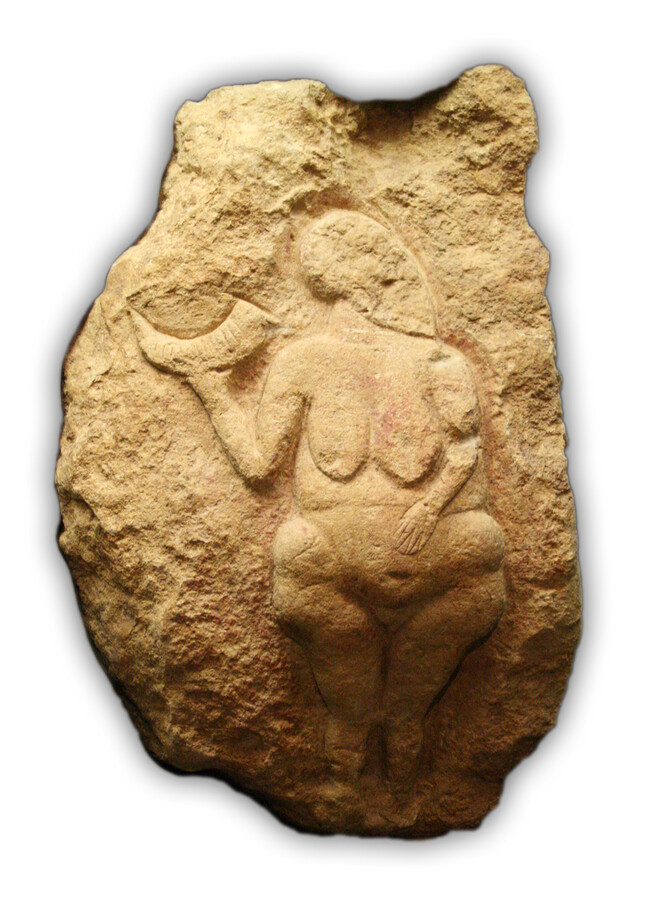
A carving from the Dordogne draws the same reading. The Venus of Laussel is a limestone relief of a woman, about 25,000 years old and 46 centimetres high. She holds up a horn cut with thirteen notches. Some writers see thirteen lunar months in them, or the number of cycles in a year. Her other hand rests on her belly.
A limestone relief of a full-bodied woman holding a curved horn up beside her head, her left hand on her belly
The Venus of Laussel, about 25,000 years old. The horn in her raised right hand carries the thirteen notches. Some read them as lunar months or cycles in a year, and nothing on the relief settles which. Photograph by the Commons user 120, Musée d’Aquitaine, Bordeaux, via Wikimedia Commons, CC BY-SA 3.0.

The pairing of moon and women turns up again in much later religions. In Peru the Inca honoured a moon goddess, Mama Quilla, who watched over menstruation and childbirth.

Do menstrual cycles follow the moon?

Menstrual cycles do follow the moon in some women, now and then. The best evidence comes from 22 women in Germany who noted down every period for many years, some for as long as 32. A team at the University of Würzburg compared their dates with the moon.

For stretches of time, a woman’s period kept starting at about the same phase of the moon. The team calls such a stretch being in step with the moon. It happened only in cycles longer than 27 days, close to the 29.5-day lunar month. With age and with light at night, cycles grew shorter and lost the link.

Younger women were in step more often: just under a quarter of the recorded time for women of 35 or younger, against about a tenth for older women.

A follow-up in 2025 compared diaries from before and after 2010, the years when LED lighting and smartphones spread. Before 2010 the cycles were clearly linked to the full and new moon. Afterwards the link showed up mostly in January.

For that leftover January link, the team suspects a second force besides light, gravity. Every January the moon and the sun pull on the Earth more strongly than in other months. The lead researcher added a warning: “Our findings show a correlation between these two phenomena. We were unable to establish a causal link.”

Large data sets give a weaker answer than the diaries. A period-tracking app company checked 7.5 million cycles and found start dates falling “randomly throughout the month, regardless of the lunar phase.” A 2024 medical study of 311,064 cycles found a faint lunar rhythm, and a much stronger weekly one.

Did You Know?

In that 2024 study of 311,064 cycles, periods started most often on Thursdays and Fridays.

What did the 2021 moonlight sleep study find?

Sleep seems to show the moon’s effect more clearly than periods do, and it points to light as the link. In January 2021, on the same day and in the same journal as the Würzburg paper, a team in Seattle published wrist-monitor data from 98 Toba/Qom people, an Indigenous people of northern Argentina. Some of their communities had electric light and one had none. The team also tracked 464 students in Seattle.

In every group, people went to bed later and slept less in the nights before the full moon. Those are the nights when the moon lights the early evening. Total sleep swung by 46 to 58 minutes over the lunar month, depending on the community, and bedtimes moved by about half an hour. The effect was strongest where there was no electricity.

Both 2021 teams point at light. The sleep researchers think moonlight once kept people active in the early night, before the full moon. In their reading, lamps and screens now do the same job on every night of the month. The Würzburg team found in 2021 that light at night shortened cycles and broke the link. Its 2025 follow-up saw the link fade after LEDs and smartphones arrived.

If that is right, people who lived by firelight and moonlight would have felt the moon more than we do. The Würzburg team says as much in its 2021 paper: “We hypothesize that in ancient times, human reproductive behavior was synchronous with the Moon.”

Nobody has measured a Stone Age cycle. The Blanchard plaque lies in the national archaeology museum at Saint-Germain-en-Laye, its 69 pits still winding back and forth across the bone.

The Sources

Every statement in this report rests on these.

  • Anonymous, ‘History of Wicca’, undated online text (the 10,000 BC claim).
  • Aristotle, History of Animals, Book VII, chapter 2, translated by D’Arcy Wentworth Thompson, Oxford: Clarendon Press, 1910. https://penelope.uchicago.edu/aristotle/histanimals7.html
  • Alexander Marshack, The Roots of Civilization: The Cognitive Beginnings of Man’s First Art, Symbol and Notation, New York: McGraw-Hill, 1972; revised edition, Mount Kisco: Moyer Bell, 1991.
  • Francesco d’Errico, ‘Palaeolithic Lunar Calendars: A Case of Wishful Thinking?’, Current Anthropology 30, no. 1 (1989): 117-118, doi:10.1086/203721.
  • Alexander Marshack and Francesco d’Errico, ‘On Wishful Thinking and Lunar “Calendars”’, Current Anthropology 30, no. 4 (1989): 491-500, doi:10.1086/203773.
  • Alexander Marshack, ‘The Taï Plaque and Calendrical Notation in the Upper Palaeolithic’, Cambridge Archaeological Journal 1, no. 1 (1991): 25-61.
  • April Nowell, Paul Bahn and Jean-Loïc Le Quellec, ‘Evaluating the Evidence for Lunar Calendars in Upper Palaeolithic Parietal Art’, Cambridge Archaeological Journal 35, no. 1 (2025): 38-55, first published online 2024, doi:10.1017/S0959774324000155.
  • Daniel Rosenberg, ‘Marking Time: Alexander Marshack and Ossified Time’, Cabinet 28 (Winter 2007/08). https://www.cabinetmagazine.org/issues/28/rosenberg.php
  • ‘Magdalenian Bone Calendars’, in Encyclopedia of Time, SAGE Publications. https://sk.sagepub.com/ency/edvol/embed/time/chpt/magdalenian-bone-calendars
  • ‘Les collections de l’abri Blanchard’, Paléo (OpenEdition), on the 1910-1912 excavation and the dispersal of the finds. https://journals.openedition.org/paleo/3019
  • Claudia Zaslavsky, ‘Women as the First Mathematicians’, Women in Mathematics Education Newsletter 7, no. 1 (January 1992).
  • Wikipedia, ‘Ishango bone’ and ‘Venus of Laussel’, en.wikipedia.org, accessed 8 October 2026.
  • Ministère de la Culture, ‘Solutrean sculpted wall art’ (Laussel reliefs, Gravettian, about 25,000 BP). https://archeologie.culture.gouv.fr/sculpture-prehistoire/en/solutrean-sculpted-wall-art
  • Vincent Gaffney et al., ‘Time and a Place: A luni-solar “time-reckoner” from 8th millennium BC Scotland’, Internet Archaeology 34 (2013), doi:10.11141/ia.34.1; University of Birmingham press release ‘The beginning of time’, 15 July 2013.
  • Leandro Casiraghi, Ignacio Spiousas, Gideon P. Dunster, Kaitlyn McGlothlen, Eduardo Fernández-Duque, Claudia Valeggia and Horacio O. de la Iglesia, ‘Moonstruck sleep: Synchronization of human sleep with the moon cycle under field conditions’, Science Advances 7, no. 5 (2021): eabe0465, doi:10.1126/sciadv.abe0465; University of Washington press release via Newswise, 27 January 2021.
  • Charlotte Helfrich-Förster, Sandra Monecke, Ignacio Spiousas, Thomas Hovestadt, Oliver Mitesser and Thomas A. Wehr, ‘Women temporarily synchronize their menstrual cycles with the luminance and gravimetric cycles of the Moon’, Science Advances 7, no. 5 (2021): eabe1358, doi:10.1126/sciadv.abe1358; University of Würzburg press release, 2021.
  • Charlotte Helfrich-Förster et al., ‘Synchronization of women’s menstruation with the Moon has decreased but remains detectable when gravitational pull is strong’, Science Advances 11, no. 39 (2025): eadw4096, doi:10.1126/sciadv.adw4096; University of Würzburg press release, September 2025.
  • Winnifred B. Cutler, ‘Lunar and menstrual phase locking’, American Journal of Obstetrics and Gynecology 137, no. 7 (1980): 834-839, doi:10.1016/0002-9378(80)90895-9.
  • S. P. Law, ‘The regulation of menstrual cycle and its relationship to the moon’, Acta Obstetricia et Gynecologica Scandinavica 65, no. 1 (1986): 45-48, doi:10.3109/00016348609158228.
  • Clue, ‘The myth of moon phases and menstruation’, helloclue.com, 2016, updated 2019 (company analysis, not peer-reviewed).
  • René Ecochard, Rene Leiva, Thomas P. Bouchard, Agathe Van Lamsweerde, Jack T. Pearson, Joseph B. Stanford and Claude Gronfier, ‘The menstrual cycle is influenced by weekly and lunar rhythms’, Fertility and Sterility 121, no. 4 (2024): 651-659, doi:10.1016/j.fertnstert.2023.12.009.
  • Jonathan R. Bull et al., ‘Real-world menstrual cycle characteristics of more than 600,000 menstrual cycles’, npj Digital Medicine 2 (2019): 83, doi:10.1038/s41746-019-0152-7.
  • Blanchard plaque, photograph by Marie-Lan Nguyen, Musée d’Archéologie nationale, Saint-Germain-en-Laye, via Wikimedia Commons, public domain (inline image and cover reference).
  • Ishango bone, photograph by Joeykentin, Royal Belgian Institute of Natural Sciences, Brussels, via Wikimedia Commons, CC BY-SA 4.0.
  • Venus of Laussel, photograph by the Wikimedia Commons user 120, Musée d’Aquitaine, Bordeaux, via Wikimedia Commons, CC BY-SA 3.0.

Filed under moon · lunar calendar · menstrual cycle · chronobiology · Paleolithic · Blanchard plaque · Ishango bone · Venus of Laussel · Alexander Marshack · moon and sleep · artificial light · Wicca.

Pass this report on: Pinterest · Facebook · by Letter · Copy the Address


Questions from Readers

I. Are the marks on the Blanchard plaque really a moon calendar, or just a tally?

Nobody can say for sure. The plaque is a piece of bone more than 30,000 years old from the Dordogne in France, with 69 small pits in a winding line. Alexander Marshack studied the pits under a microscope, found many changes of tool and stroke, and read the line as the moon’s phases over about two and a half months. Francesco d’Errico answered in 1989 that rows of marks like these can be made in one session with one tool. A 2024 review of moon readings of the dots in Ice Age cave art found them too weak to explain that art.

II. What did the 2021 Science Advances studies find about sleep, periods and the moon?

Two papers appeared on the same day. The sleep study by Leandro Casiraghi and colleagues tracked 98 Toba/Qom people in Argentina and 464 students in Seattle with wrist monitors. Everywhere, people went to bed later and slept less in the nights before the full moon, and the effect was strongest without electricity. The period study by Charlotte Helfrich-Förster and colleagues used years of diaries from 22 women. Cycles longer than 27 days fell into step with the moon now and then, and lost that link with age and with light at night.

III. Where does the date 10,000 BC for the discovery of the lunar-menstrual link come from?

It comes from popular histories of Wicca, which say that around 10,000 BC women found their bodies were in tune with the moon and began to worship a goddess. The text gives no source, and no find from that time says anything about menstruation. The idea that periods follow the moon is much older than Wicca: Aristotle reported it in the fourth century BC. The oldest bones read as moon counts are far older than 10,000 BC, and their reading is disputed.

IV. Why does the link with the moon fade under modern lighting, and what does that mean for prehistoric people?

Both 2021 teams point at artificial light. The sleep researchers think moonlight once kept people awake in the early night and that lamps now do this every night of the month. The period researchers found that light at night shortened cycles and broke the link. In a 2025 follow-up they saw the link weaken after LED lighting and smartphones spread around 2010; since then it shows up mostly in January. They call it a correlation and say they could not prove a cause. People who lived by firelight may have felt the moon more, but no one has measured a Stone Age cycle.

The Weekly, by Post

Every Tuesday the week’s reports in a few lines, and one book from our press. Free, and you may leave at any time.


More from Nature and Science

What Was Tutia? The Zinc Oxide in an Alchemy Recipe for Antimony Oil The Giant Blue Eyeball of Pompano Beach, 2012Whose Eye Washed Ashore? The Baltic Sea Anomaly ExplainedWhat the Divers and the Geologists Found Smoking Lamp Meaning on ShipsWhy a Whole Crew Lit Its Pipes at One Flame

All 57 reports in Nature and Science ☞


From Our Own Press