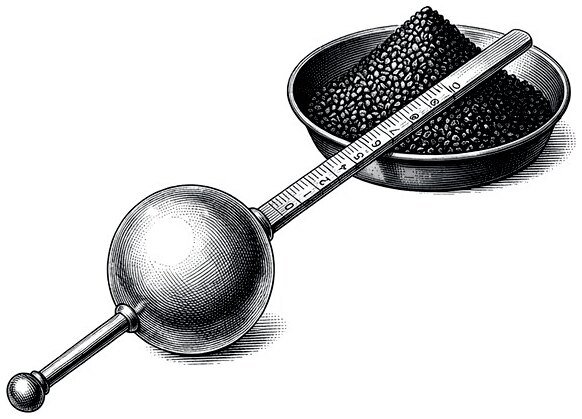
The story turns up in books of sea lore and in many articles about rum. Sailors, it goes, poured their rum over gunpowder and put a flame to it. If the powder flared, the rum was “proof”. If the powder only fizzled, someone had watered the rum.
“Proof” was the old British yardstick for the strength of spirits. Proof spirit held about 57 percent alcohol; stronger spirit was “above” or “over proof”, and weaker spirit was “below” or “under proof”.
Older records tell the story differently. Spirit dealers on land used the gunpowder proof, and chemists were calling it unreliable before 1800. Customs officers and the Navy’s suppliers measured spirit with hydrometers, floats that sink deeper in stronger spirit, and from 1866 the Royal Navy issued its rum below proof on purpose, at about 54.5 percent alcohol.
How did sailors test rum with gunpowder, according to the story?
A book of mermaid lore from 2013 gives the short version. “The term proof,” it says, “came from sailors who would put gunpowder into the rum. If it ignited, the rum was 100 proof, or at least 57 percent alcohol. If not, someone had watered down the rum.” The old British scale counted strength in degrees of proof, a measure of alcohol content, and proof spirit stood at 100 degrees. So “100 proof” and “proof” mean the same thing, spirit of about 57 percent alcohol.
Naval writers add a person who did the testing. In Nelson’s Blood, a history of naval rum published in 1982, Captain James Pack gives the job to the purser, the officer in charge of a ship’s food and drink, whom the sailors called the “pusser”. According to Pack, the purser tested the rum “by a rough rule of thumb method said to have been invented at the Royal Arsenal”: the rum was mixed with a little water, and a few grains of black gunpowder were added.
A dictionary of sea words from 1993, Peter Jeans’s Ship to Shore, places the test on land, in the Navy’s victualling yards, the supply yards where the rum was treated before it went out to the ships. It also gives three results instead of two. Gunpowder that caught fire meant “proof”, powder that exploded meant “over-proof”, and powder that failed to burn at all left the spirit “under-proof”.
The three versions disagree on who tested the rum and where, so the place to start is the test itself.
How did the gunpowder proof work?
The clearest description is in a chemistry textbook of 1831 by Thomas Thomson. He brings the test up while explaining “a peculiar language” that had “crept into use among the spirit-dealers”, and in his account the dealers do the testing, with no word about sailors.
Before anyone could measure alcohol exactly, Thomson writes, “the dealers were in the habit of employing a very rude method of forming a notion of the strength.” A measured amount of spirit “was poured upon a quantity of gunpowder in a dish and set on fire.” If the powder was still dry enough at the end of the burning, “it took fire and exploded”. If the water in the spirit had wetted it, “the flame of the alcohol went out without setting the powder on fire.”
The test works because burning alcohol leaves its water behind. Rum, like every spirit, is a mixture of alcohol and water. It is made strong by distilling, the old art of boiling a liquid and catching the vapour, which reaches back to the alchemists of Alexandria (see Mary the Jewess: The First Woman of Chemistry). As the flame eats up the alcohol, the water stays in the dish. Strong spirit leaves too little water to soak the powder, while weak spirit leaves enough to wet it through.
“This was called the proof,” Thomson goes on. “Spirits which kindled gunpowder were said to be above proof, those that did not set fire to it were said to be below proof.” His test has two results where the dictionary of 1993 has three. Thomson also saw its weak point: “a smaller quantity of a weaker spirit might be made to kindle gunpowder, while a greater quantity of a stronger might fail.”
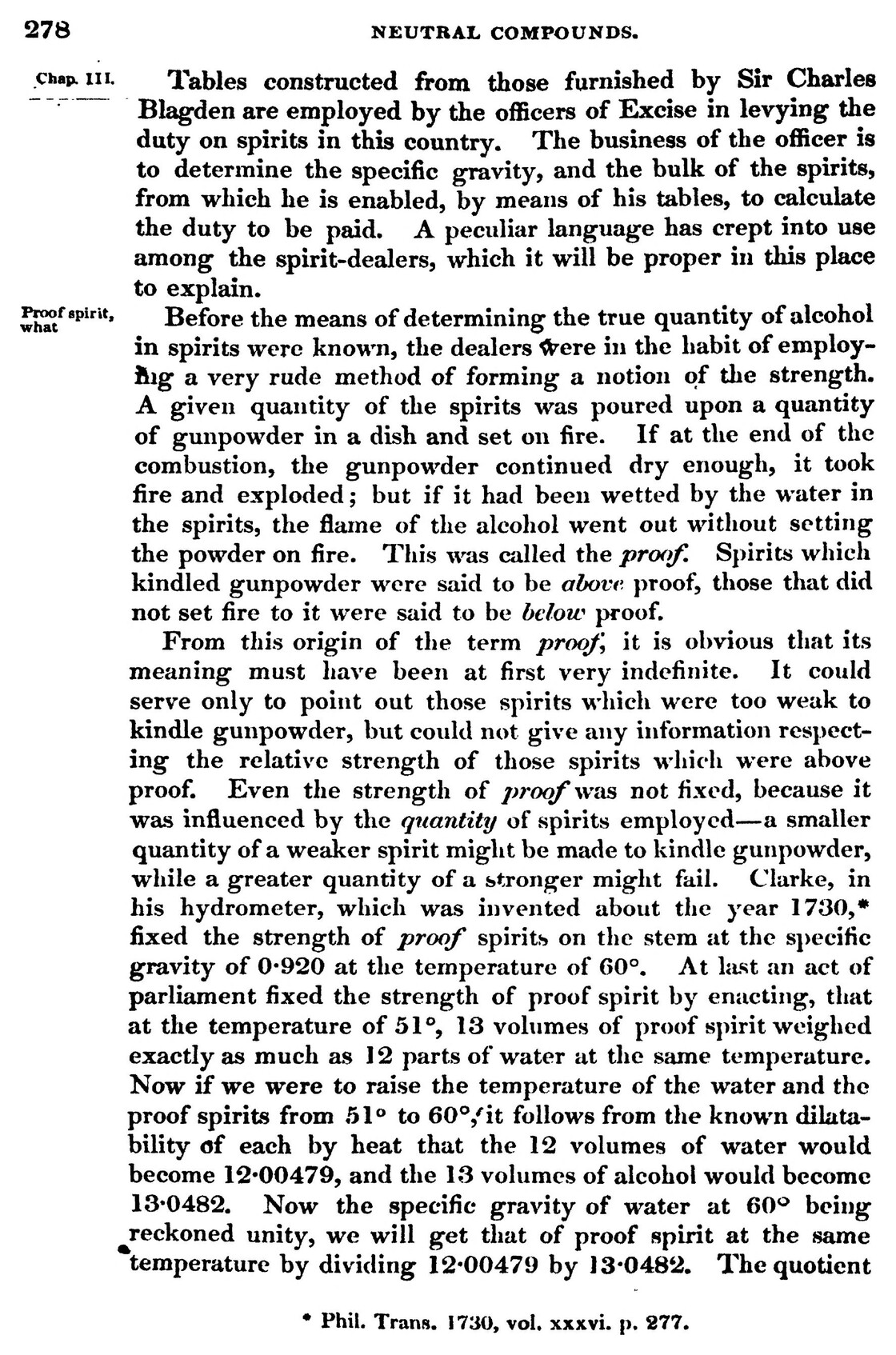
Thomson’s paragraph on the gunpowder proof travelled. American papers and magazines reprinted it almost word for word, from Hunt’s Merchants’ Magazine in 1848 to Scientific American in August 1858 and a Louisville daily in 1863.
Why did chemists call the test false?
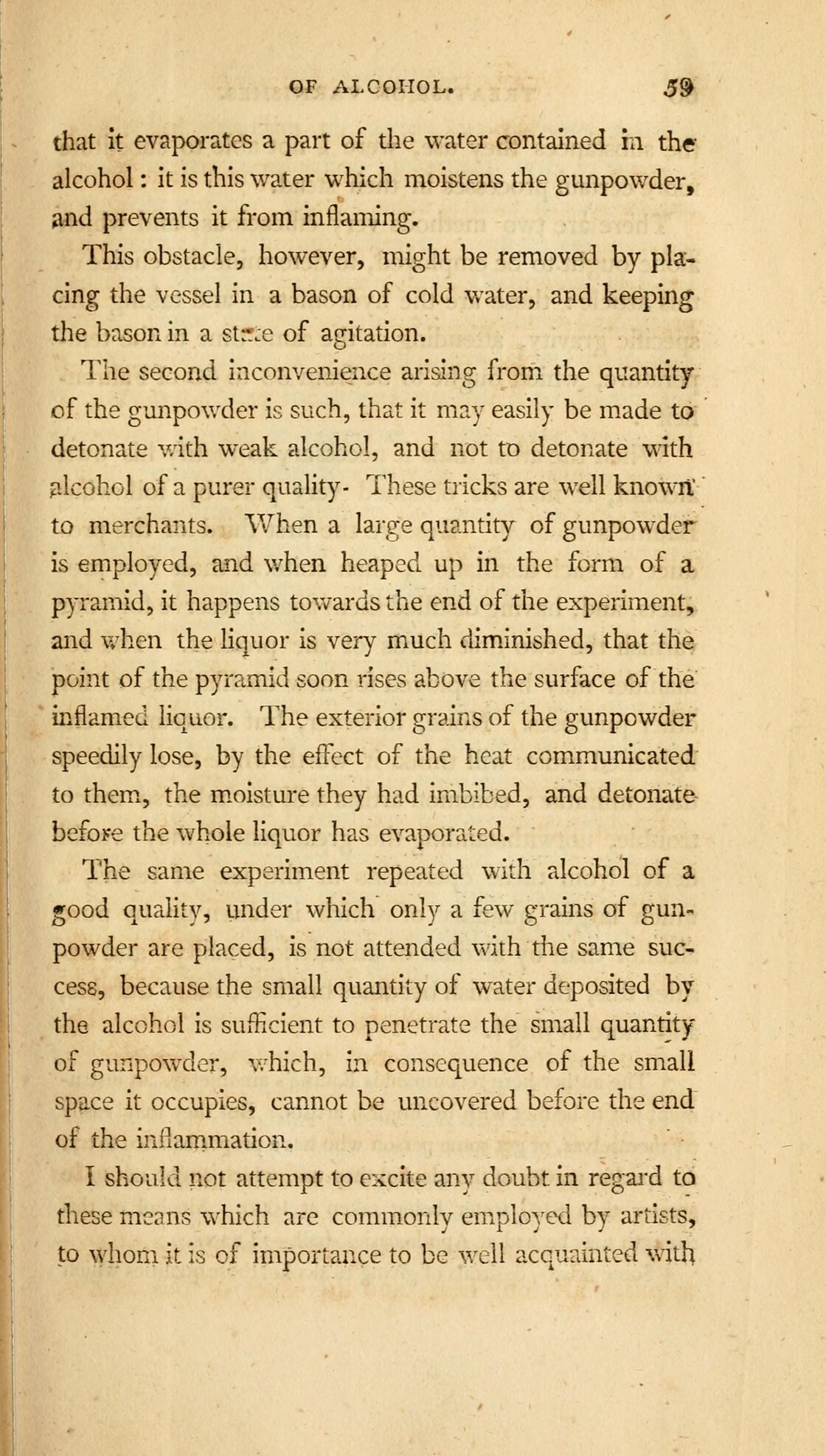
The trouble was the amount, and chemists had said so long before Thomson. A French chemistry course by Antoine-François de Fourcroy, translated into English in 1785, describes the test and rejects it in the same paragraph: “This proof is false and deceiving.” When a lot of spirit is poured on the powder, the water left by the burning “moistens the powder”, which then “will not kindle”. When only a little weak spirit burns on top, the powder catches.
The chemist Pierre-François Tingry wrote for varnish makers. They needed strong alcohol, because weak alcohol, in Tingry’s words, “is improper for the composition of varnish.” In his Painter and Varnisher’s Guide, published in English in 1804, he notes that an earlier French author on varnish had recommended the gunpowder proof, and that the proof “has been found to be insufficient.”
He names two ways it goes wrong. A thick metal dish gets hot and boils off part of the water, so the powder can fire with weaker spirit. The second is the amount of powder, and here Tingry speaks of cheating: the test “may easily be made to detonate with weak alcohol, and not to detonate with alcohol of a purer quality. These tricks are well known to merchants.”
The cheat used a large heap of powder shaped like a pyramid. Towards the end of the burning, the tip of the heap rose above the shrinking pool of spirit. The heat dried the grains on top, and they went off “before the whole liquor has evaporated”, so weak spirit passed. Good spirit poured over only a few grains could fail the other way, because its small share of water was enough to soak them.
What did the Board of Customs and Excise and the Victualling Board actually prescribe?
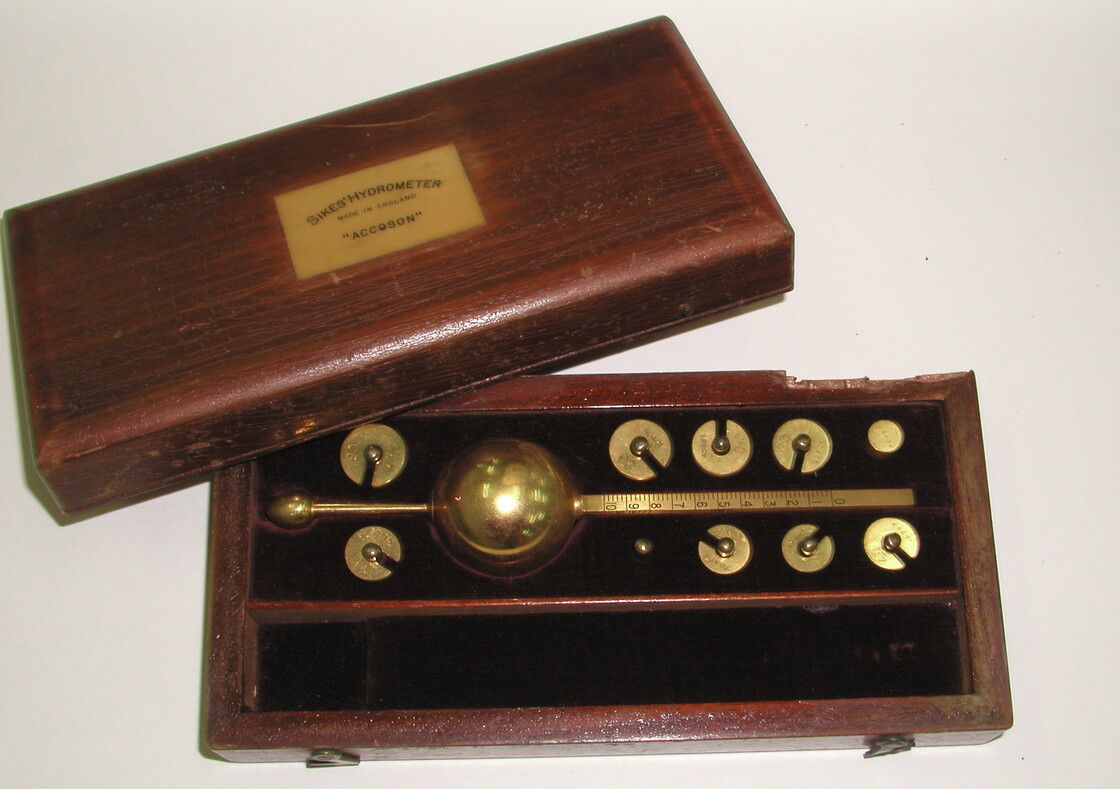
The officers who taxed spirit had a better tool long before Tingry wrote. Customs officers checked spirit coming into and going out of the country, while Excise officers collected the duty on it. Both came to use the hydrometer, a weighted float with a marked stem. Alcohol is lighter than water, and a float sinks deeper in a lighter liquid, so the stronger the spirit, the deeper the float goes, and the marks on the stem show how strong it is.
Around 1730 the Royal Society’s journal, the Philosophical Transactions, described a new hydrometer made by a Mr. Clarke. He built it “for the Use of those that deal in Brandies and Spirits”, so that they could tell “by Inspection, and without Trouble” whether a spirit was “Proof, above Proof, or under Proof, and exactly how much above or under”. The journal added that it would be “of great Use to the Officers of the Customs, who examine imported or exported Liquors.”
The Navy’s own suppliers used it too. The Victualling Office was the board that bought and stored the Navy’s food and drink. The drinks historian Matt Pietrek, who works from original Navy documents, quotes an advertisement for Clarke’s float: the Victualling Office used it to check the strength of the brandy it bought for the fleet. He also quotes a letter of 1776, written during the American Revolution to the British commander Guy Carleton, which enclosed “a Description of the Hydrometer for trying the Strength of Rum”.
An Act of Parliament of 1787 then made Clarke’s float the legal measure: all spirits were to count as the strength it showed when an Excise officer tested them. In 1816 a new Act replaced it with the instrument of Bartholomew Sikes, an Excise officer who had died in 1803.
From 5 January 1817 the law defined proof spirit by weight: at 51 degrees Fahrenheit, proof spirit had to weigh exactly twelve-thirteenths of an equal measure of distilled water. Measured by volume, as bottles state it today, that is about 57 percent alcohol. Britain kept proof as its measure until 1 January 1980, when it switched to percent alcohol by volume.
How strong was the Navy’s rum, and where does 55 percent come from?
The Navy’s rum came to the sailors with water in it, on purpose. In August 1740, in the West Indies, Admiral Edward Vernon ordered his captains to stop serving rum neat. The daily half-pint “a man”, his order says, should “be every day mixed with the proportion of a Quart of Water to every Half-Pint of Rum”. Vernon wore a waistcoat of a cloth called grogram and was known as “Old Grog”. The mixture took his nickname and became grog.
The rum in the cask stayed strong. A Royal Navy letter of 1965 explains that proof spirit “is 57% spirit and 43% water by volume”, and that “Service rum was issued at about this strength until 1866”. Then the Navy fixed a lower figure. The Royal Navy’s Victualling Manual of 1939 records it with its date: “the issuing strength is 4.5 under proof. This latter strength was fixed on the 19th February 1866.”
On the British scale proof spirit counts as 100 degrees, and weaker spirit counts down from there. Four and a half under proof is 95.5 degrees, which means the rum held 95.5 percent of the alcohol in proof spirit. With proof spirit at about 57 percent alcohol, the rum came to about 54.5 percent. That is where the “fifty-five percent” of navy rum comes from. By the old definition, then, the Navy’s rum from 1866 on was below proof, and in Thomson’s account the dealers gave that name to spirit that did not set fire to the powder.
The last daily tot of rum in the Royal Navy was poured on 31 July 1970, later called Black Tot Day. A Ministry of Defence signal of 17 December 1969 had announced that “in the interests of safety and efficiency in the Fleet the rum issue should be abolished”.
Was gunpowder proof a Royal Navy regulation or a myth?
Matt Pietrek writes that he has “yet to find any mention from a 1700s- or 1800s-era source describing a gunpowder test onboard a ship.” The Admiralty papers of 1939 and 1965 speak in degrees of proof, the language of the hydrometer. Even Pack, who gives the test to the purser, hedges: the method was only “said to have been invented” at the Royal Arsenal.
The test and its place on board are two separate questions, then. Spirit dealers used the test and a French author on varnish recommended it, although chemists from Fourcroy in 1785 to Thomson in 1831 warned that the amount of powder could decide the result. Warships carried both gunpowder and rum, so a purser or a suspicious crew could have tried it at sea, but no record that one did has turned up so far.
What the record does show is a sentence printed in a supply manual in 1939: “the issuing strength is 4.5 under proof.”


