In South Slavic folk belief the fairies, called vile, were dangerous when a person offended them. People could offend them by stepping into the ring where they danced, by staring at what they kept hidden, or by telling others what they had seen. The punishment was a sickness that could last a lifetime, or sudden death, and people blamed it on a fairy’s arrow. In 2013 a Croatian woman named Sonja put the old rule into one line: “If you see them, you don’t.” The village records below suggest how to read it: if you see the fairies, you behave as if you had seen nothing.
She said it in Zagreb to the ethnologist Marina Tkalčić, who was doing fieldwork among modern pagans for her diploma thesis. Sonja belonged to the Croatian Native Faith community, in Croatian Rodnovjerje, a small modern group that builds its faith on the old Slavic beliefs from before Christianity. She explained how the fairies were seen then and now, and she spoke of the faery ring, the circle in the grass where the fairies were said to have danced:
“If you see them, you don’t; if they catch you looking at them, you don’t talk about them, young people today have the need to see them. Our ancestors feared seeing them or coming upon a faery ring, even if there were no faeries but only markings of a faery ring. Today’s generations mostly really want to have some kind of contact with faeries and woodland entities.”
In the old legends, she went on, there was fear, and in the pagan communities of today that fear has been replaced by curiosity. The older records say what the ancestors were afraid of.
Why are fairies dangerous in folklore?
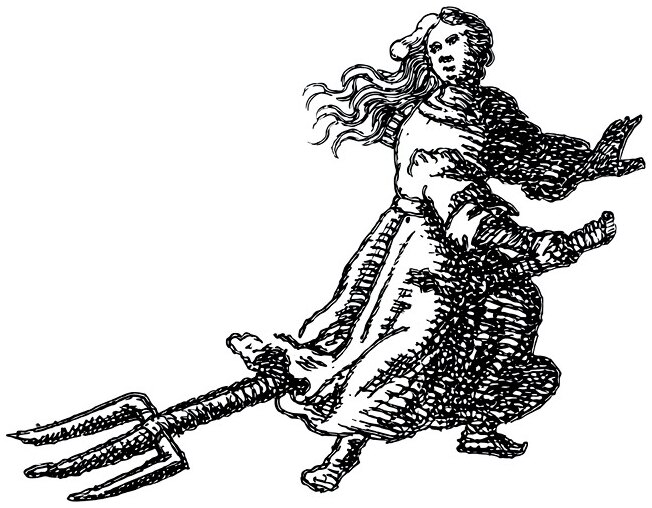
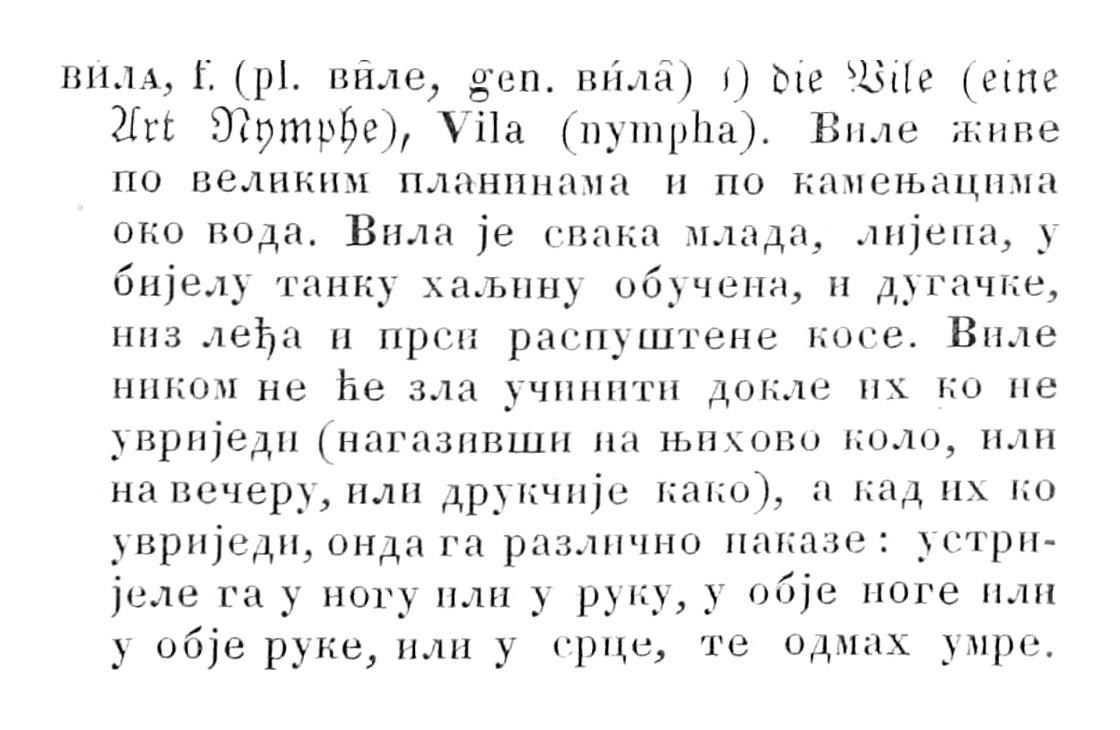
The fairies of the Balkans are the vile (singular vila). In 1852 Vuk Karadžić, the Serbian scholar who collected the songs and words of his people, described them in his dictionary in a few lines. Every vila is young and beautiful, he wrote, dressed in a thin white gown, and her long hair hangs loose over her back and breast. The vile live on high mountains and in rocky places near water.
The vile do no harm to anyone, Vuk went on, until someone offends them, for example “by stepping on their kolo”. The kolo is the round dance of the Balkans, and the word also meant the ring on the ground where the fairies had danced it. Whoever offended them was punished in various ways, and the weapon was a fairy’s arrow: the vile “shoot him in the leg or in the arm, in both legs or in both arms, or in the heart, so that he dies at once.”
The village reports collected after Vuk speak of the same arrow when a person suddenly fell ill or slowly wasted away, and several of them name the same offence as he did, a step onto the ring.
What happens if you step into a fairy circle?
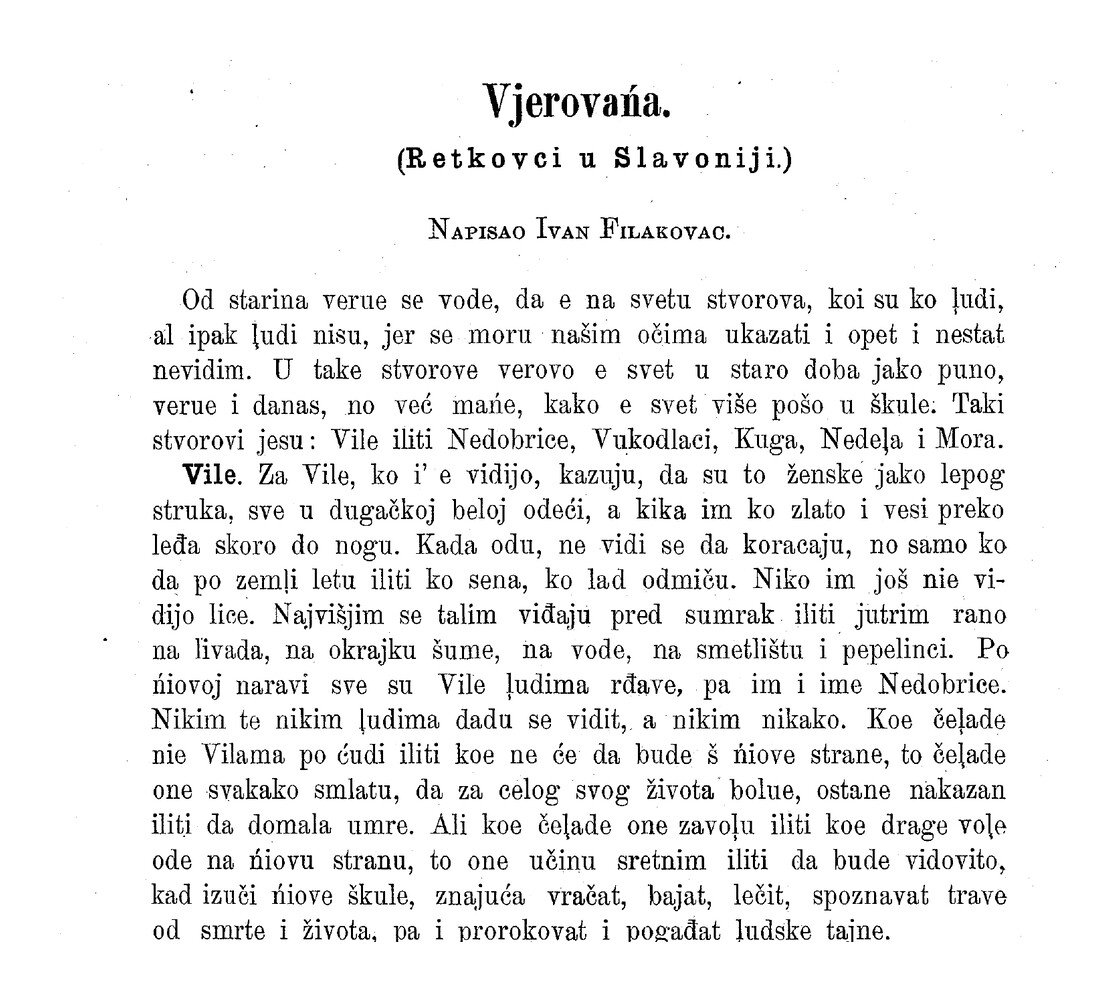
A place where the vile had danced was easy to find, people said. In Retkovci, a village in Slavonia in eastern Croatia, Ivan Filakovac wrote down in 1905 what his neighbours believed. At a fairy dance, people said, one could hear a bagpiper playing for the vile. On the next day one could see a large circle of trampled grass, especially on a meadow not yet mown. In its middle was another trampled spot, where the piper had stood. Around the ring lay white foam on the grass, which people called fairy spittle.
The Serbian ethnologist Tihomir Đorđević (1868-1944) gathered notes on such beliefs for decades, from across the South Slavic lands, and his study of witches and fairies was published in 1953. According to his material, a fairy circle was about twenty metres across. In the village of Trnavci, in the Kruševac district of Serbia, it was a circle in the meadow where the grass grew thinner and shorter. In Slavonia people said the place could be recognised because mushrooms grow all around it. Botanists today know such rings well, and our article on why fairy rings kill the grass in autumn follows the fungus underneath.
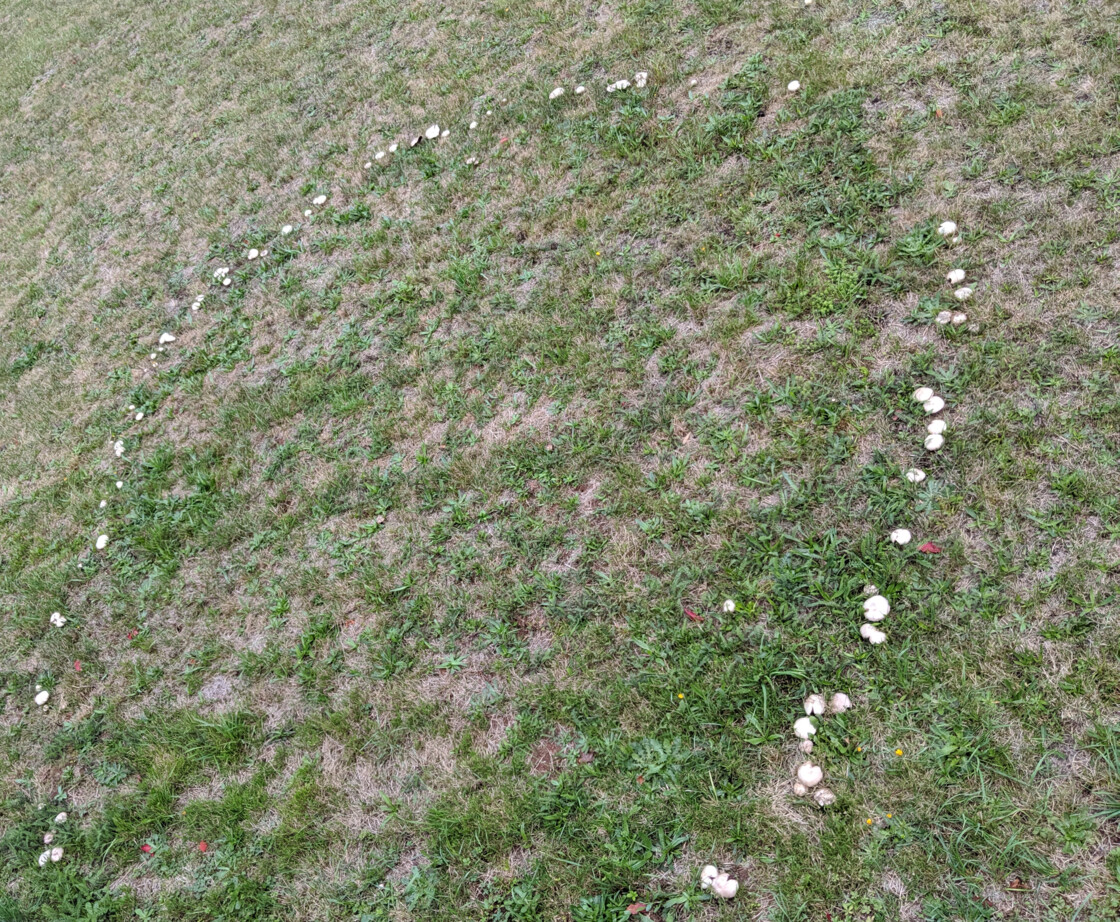
In Serbia the rule was that a person must not step onto a fairy kolo. In Poljica, a region of Dalmatia, people said that the vile would strike down whoever did. He would fall ill and wither until he lay in his grave, and “there is no cure for one whom the vile strike down.”
In Bukovica, a district of northern Dalmatia, the answer depended on the foot. A report of 1865 said that a man who stepped into the ring with his left foot could recover, if a priest was called at once, but one who stepped in with his right foot recovered only with difficulty. In 1917 the local collector Vladimir Ardalić wrote down the opposite: it is worst for the one who steps “with the left foot upon the fairy kolo, that is, where they have danced during the night.” So the two reports come from the same district, about fifty years apart, and they disagree about which foot was the dangerous one.
The fullest case comes from Kuči, a tribal region in the mountains of Montenegro. On Mount Ključ there was a fairy ring twenty cubits wide, about ten metres across. It stayed green all year, with a spring called Vilina voda, Fairy Water, in its centre. A man once rode toward that spring inside the ring, and his horse fell under him, so that he barely got away. At home the horse died within days, and the man withered on one side of his body from head to foot.
His illness lasted five years, and in that time he spent half of what he owned on priests and monks, and on village sorcerers and sorceresses. In the end these found in their books that the vile had shot him with an arrow. So his household carried him up to the fairy water and left him there.
Three times he called out as loud as he could: “I implore you by kumstvo, vile, my sworn sisters, by heaven and earth, by forest and water, and by all the springs in this mountain, heal me!” Kumstvo is godparenthood, and by calling the vile his sworn sisters he claimed them as kin. The vile took pity on that bond, the account says, and healed him with mountain herbs.
Vuk Karadžić’s dictionary has a word for the mushroom of the fairy ring: vilovnjača, “a large mushroom of the kind said to grow on a fairy circle”.
Why was it dangerous just to see a fairy?
After the ring, the second offence was looking at them. In Retkovci, Filakovac wrote, nobody had ever seen a vila’s face. “To some people they let themselves be seen, to others never at all.” Those who had seen them described women of beautiful figure in long white clothes, with braids like gold, who seemed to glide over the ground like a shadow without taking a step.
Many villages said the vile had one flaw they wanted hidden: their feet. Around Lovreć, in the Imotski district of Dalmatia, the vila was a proud maiden in a white veil, “only she has feet like donkey hooves. Therefore, one must not look at her feet.” In Zaostrog, on the Dalmatian coast, the vile had hooves like a horse and always hid them. If a man saw a vila there, or if she asked him what he had seen on her, “it must never be said that he saw that she has hooves, for she would gouge out his eyes for that.”
In Bukovica a man who saw that a vila had the legs of a mule was neither to marvel at it nor to laugh. “They say that one man laughed at them, and they seized him and tossed him over the hills from one’s hands to another’s.”
Telling others was the third offence. In Poljica the vile were vengeful “if you oppose them or reveal that you have seen them.” On the island of Cres, a person whom the vile had helped had to swear never to tell anyone, and if he broke his word they took revenge. Sonja’s sentence of 2013 fits these old rules: whoever sees the vile acts as if he had seen nothing, and whoever is caught looking keeps quiet about it afterwards.
Could seeing a fairy also bring luck?
The same records also say that seeing a vila could be good luck. In Bukovica, Ardalić noted in 1917 that whoever “sees a vila by chance is fortunate.” On the next page of his report, as Tkalčić quotes it, he wrote that the vile “can do as much good as evil in the world.” In Herzegovina people said: “Blessed is he who sees a vila, and she caresses him and takes him under her wing.” Such a man became a vilenjak, a fairy’s favourite, stronger than other men and safe from every evil spirit. When he was in the worst trouble he called on the vila, and she helped him. In Bukovica, at least, the two beliefs fit together: meeting a vila by chance brought good fortune, but laughing at her legs got a man thrown over the hills.
Yet the same record from Herzegovina goes on: “Woe to him with whom the vile become angry. It is enough for a vila merely to look at a man, a youth, a woman, or a maiden, and she strikes them down with her arrow.” In Retkovci the vile were called nedobrice, the not-good ones, and yet Filakovac wrote in the same paragraph that those they loved learned from them to heal and to know the herbs of life and death. The women and men who claimed such teaching appear in church records as early as 1634, as our story of two herbalists who learned from the fairies shows.
In the songs and tales Đorđević collected, the vile are especially skilled at healing eyes. He thought the skill probably came from a belief recorded by the Miladinov brothers, collectors of Bulgarian folk songs: “they like to blind people.”
How did people protect themselves from fairies?
People protected themselves mostly by leaving the vile alone. In Samobor, a town west of Zagreb, people remembered that the old folk knew how to respect the vile and never disturbed them. “If they accidentally encountered them, they would merely cross themselves, for the vile are of God, and would move away to the other side so as not to disturb them.” They avoided every place where the vile gathered, and never spoke ill of them.
The other protections were the rules already told: keep off the ring, look away from the feet, and neither laugh nor tell. When the harm was already done, people in Bukovica called a priest at once, and the sick man on Mount Ključ appealed to the vile as his sworn sisters. Prayer alone did not always help, because in Retkovci a man seized by two vile clung to a wayside cross and prayed, and still died eight days later. His full story appears in our entry on the nedobrice.
What do modern pagans say happens in a fairy ring?
Sonja was not the only member of her community who spoke to Tkalčić about the vile on 1 August 2013. A man she calls Filip, a pseudonym, was a Krijesnik of the group, a keeper of its sacred fire. He called an encounter with the fairies his “grave mistake” and would not describe it in detail. From his account, Tkalčić wrote, he had met entities that drew him in with their energy, and that energy had harmed him.
Filip explained the harm with a comparison from electricity. The fairies, he said, are curious more than evil, and they feel neither love nor hate. To get those feelings they draw people in, and the people cannot bear it:
“So, they are not bad so much as they simply do not understand that we cannot join them in the ring, because their energy charge and ours are like chalk and cheese. We are 12 volts to them, and they are a generator unit of 50 000 volts for us, we are too weak for them. And then, when a person inadvertently enters their ring, let’s call it a ring, they mostly lose because our bodies cannot take such a strong energy charge.”
He called the same experience “weird” and, in the same breath, “actually great”. Then, he said, he got frightened and put up a barrier between himself and “the energy world of entities”, because he was “too green”, too inexperienced, for it. What happened to him he kept to himself, and the paper gives no more than these lines. Like the old folk of Samobor, he moved aside.
Ivan Filakovac, the collector from Retkovci, had such a story in his own family, and it holds both things Sonja said her ancestors feared: the fairies themselves and the markings of their ring. His father told him that as a young man he had kept the pigs, and his brother the cattle, at the farmstead.
One night, when the moon shone as bright as midday, the father heard bagpipes, and his heart pulled him toward the dance, so the two brothers ran to it. Then they understood that the vile were dancing this kolo: under an oak on the far side of the water, white women were dancing in a ring, hard to make out, and no piper was to be seen. The caps fell from their heads with fright, and they ran back. Another time the father went under that oak by day, and there he saw the grass trampled in a circle like a big wheel, like the wheel of a watermill.