Myths and Folklore.

The White Lady Ghost of Dresden's Hofkirche and the Guard Who Drew His Sabre

In the 1840s a white lady appeared in Dresden's Catholic court church. A guard struck it with his sabre, and a priest was said to have fallen.

The White Lady Ghost of Dresden's Hofkirche and the Guard Who Drew His Sabre
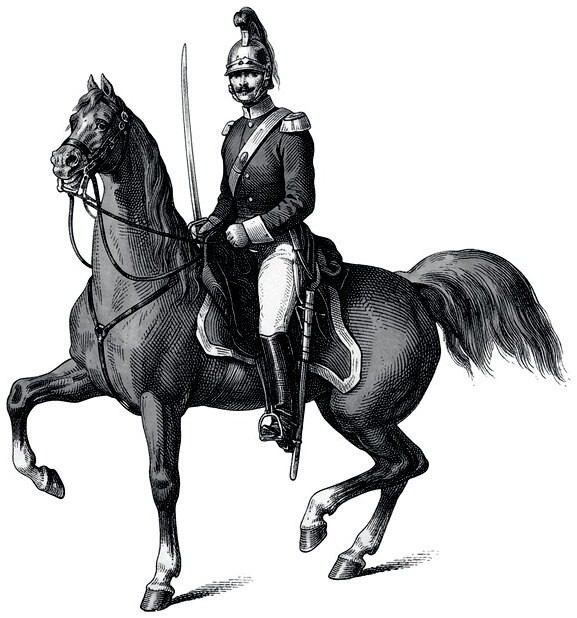
House engraving after Ferdinand von Rayski, Der Gardereiter, c. 1835-1840, Bayerische Staatsgemäldesammlungen inv. 8857, via Wikimedia Commons (public domain).

In the 1840s people saw a white figure in the Catholic court church of Dresden, the capital of Saxony. It slipped past the box where the royal family sat and went down the stairs to the crypt. The court posted a mounted guardsman there with his sabre drawn and orders to strike if the figure gave no answer. He struck, and the ghost sank to the floor whimpering.

Court rumour said the ghost was a priest in disguise, who hoped to frighten the king into throwing out Saxony’s constitution. That document put tight limits on the Catholic Church.

Who was the white lady ghost of Dresden’s Hofkirche?

Nobody gave her a name or a backstory. Germans called such a figure the Weiße Frau, the White Lady, and several princely houses had one walking their palaces, often before a death in the family. The most famous is the White Lady of the Berlin palace. Rudolf Kleinpaul’s 1898 study of folk belief puts the Dresden figure right next to her, as one more case.

She walked the Katholische Hofkirche, the Catholic church of the Saxon court. It went up beside the royal palace in the eighteenth century, and a covered bridge over the street links the two buildings.
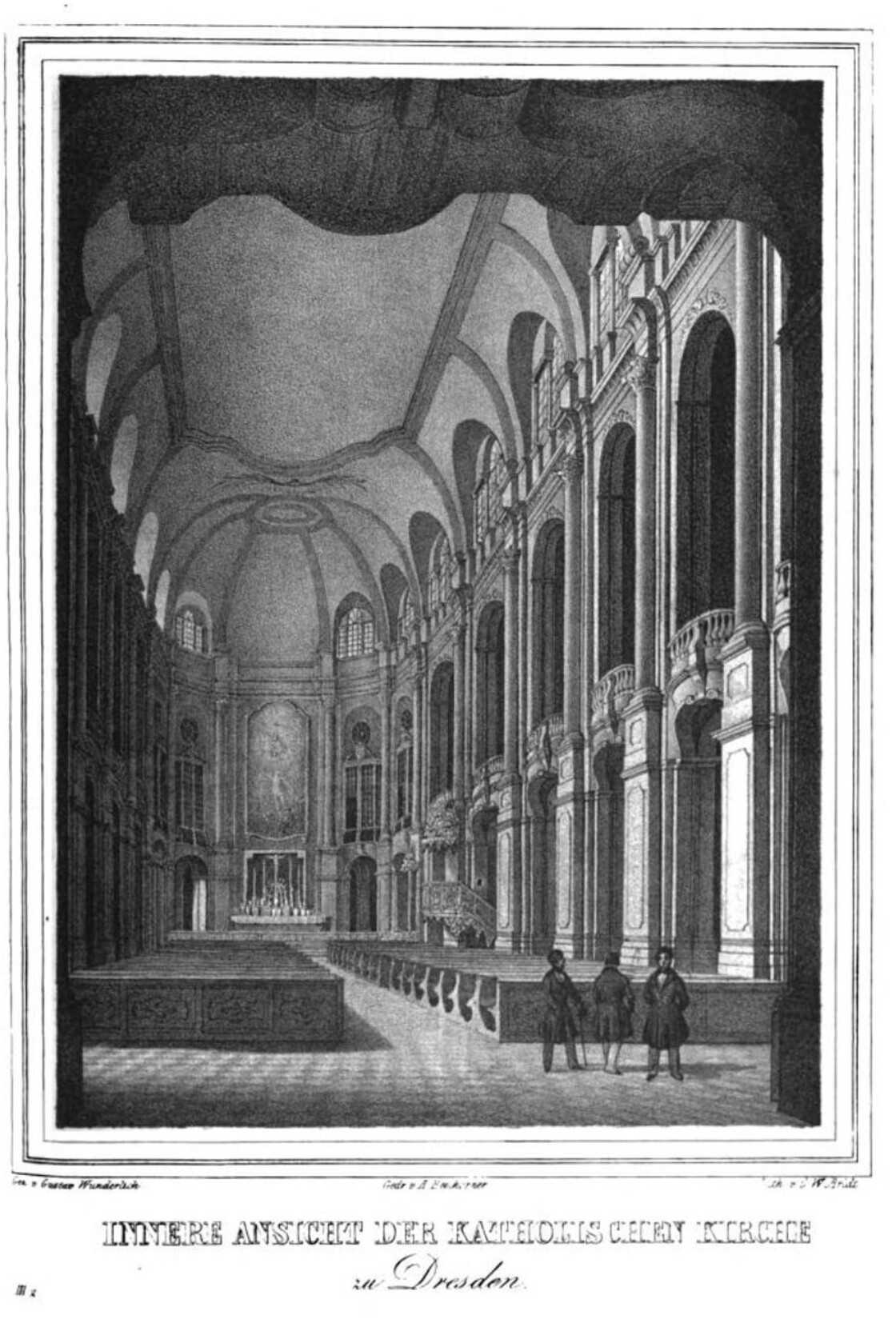
Lithograph of a tall church interior with a vaulted ceiling, rows of pews, an altar with a large painting at the far end, and galleries with balconies along the right wall; three men in top hats stand in the foreground
The church as it looked around the time of the sighting, with galleries and balconies along the upper walls of the nave. The caption at the foot reads ‘Innere Ansicht der Katholischen Kirche zu Dresden’, the same name the 1898 account uses. Lithograph by Eduard Sommer, c. 1840, from Das Vaterland der Sachsen, vol. 3. Wikimedia Commons, public domain.

The royal family sat in boxes raised above the nave, and the royal crypt, with generations of the ruling family, lies under the church. The ghost’s route therefore ran past the living rulers in their gallery and down into the vault of their dead.

Did You Know?

Saxony had a Catholic court over a Protestant country. Augustus the Strong became a Catholic in 1697 to win the crown of Poland. His son then built the Hofkirche, and the royal family stayed Catholic while most of their subjects did not.

What happened when the guard drew his sabre?

To stop the figure, the court stationed a trooper of the mounted Guard, the Gardereiter, inside the church in front of the royal box. He was to challenge it with his blade drawn and strike if it would not answer.
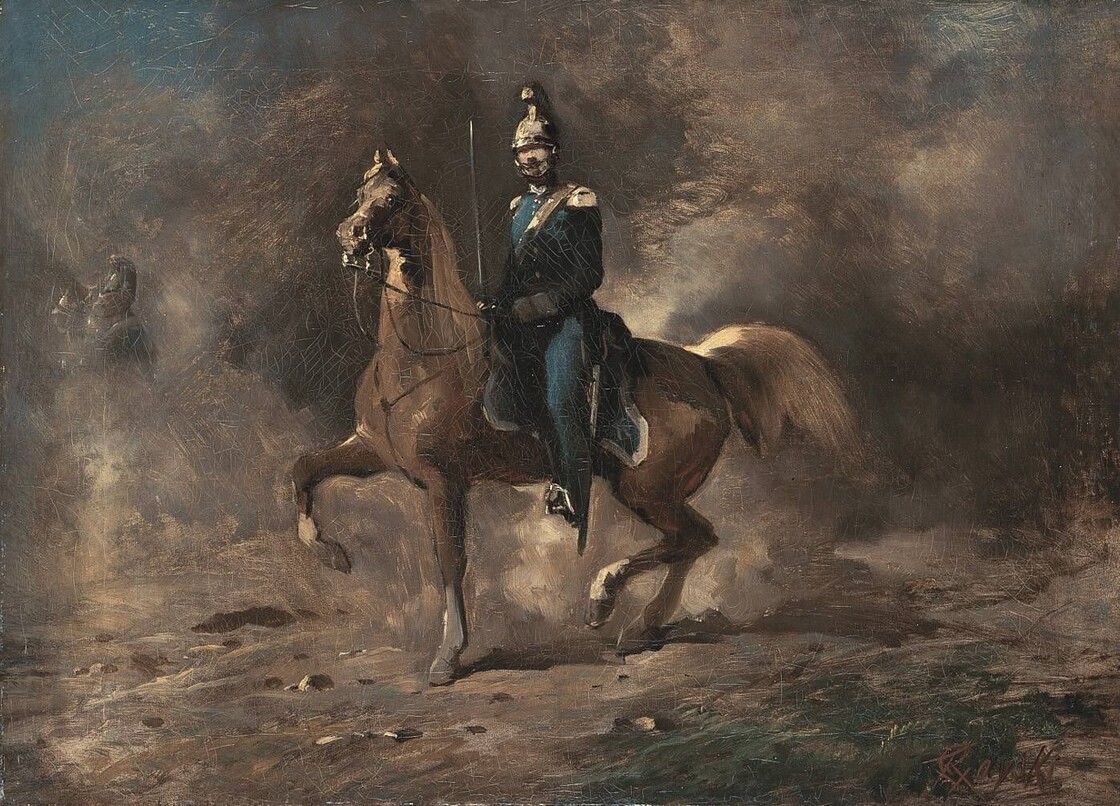
Oil sketch of a cavalryman in a crested helmet and dark blue coat on a chestnut horse, holding a sabre upright, against a smoky brown background
A Saxon guardsman of the same years, sabre raised: the kind of soldier posted in the church. Ferdinand von Rayski, Der Gardereiter, oil, c. 1835-1840. Bayerische Staatsgemäldesammlungen, Munich, inv. 8857, via Wikimedia Commons, public domain.

The guardsman did strike, and the book gives the result in one plain line: the ghost sank down whimpering. That is all we have of the scene. Nothing says whether the figure bled or where anyone took it, and the guardsman has no name.

Kleinpaul adds that the sentry stood by the box just as Napoleon had once posted armed guards outside his bedroom, during his own alleged brush with a palace ghost.

Why would a priest fake a ghost at the Saxon court?

The rumour gives the priest one motive: he wanted the king to withdraw Saxony’s constitution. Friedrich August II had signed that document himself in 1831, before he took the throne, so the ghost was aimed at the man whose name stood under it. He was a Catholic, like the rest of his house.
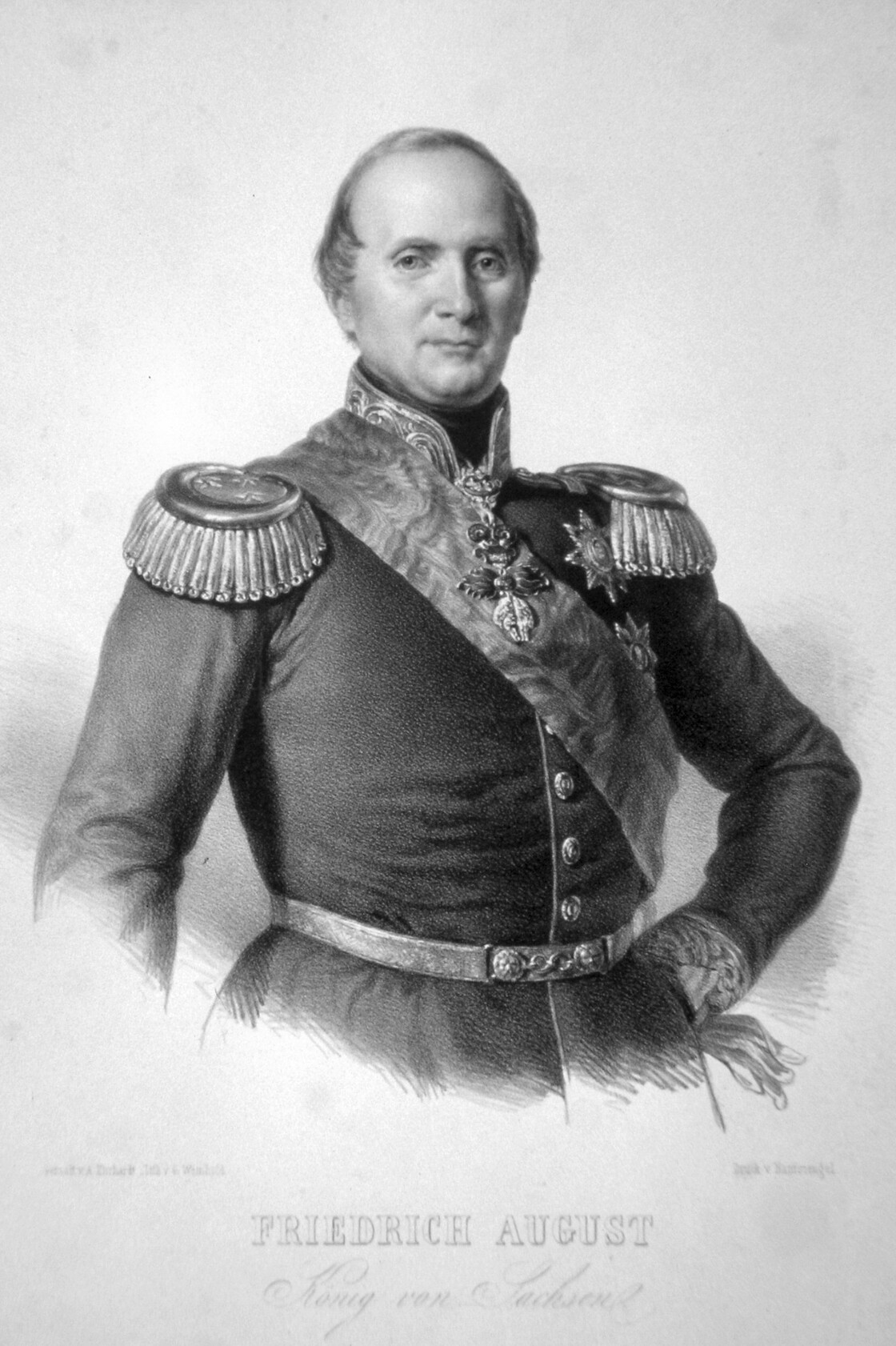
Lithograph portrait of a balding middle-aged man in a dark military tunic with heavy epaulettes, a sash and orders, his left hand on his hip
Friedrich August II, King of Saxony from 1836 to 1854. Before he became king, he had signed the 1831 constitution himself. Lithograph by G. Weinhold after a painting by A. Erhardt, c. 1850, Austrian National Library. Photograph by Peter Geymayer, Wikimedia Commons, public domain.

The charter guaranteed freedom of conscience. It also banned Catholic orders such as the Jesuits and kept church oversight in Protestant hands. A Catholic priest could well have resented those limits, though that is our reading, since no record gives his name or his own words.

Did You Know?

Religious tensions in Saxony ran high in the 1840s. When the king’s Catholic brother visited Leipzig in August 1845, protests broke out and troops fired into the crowd, killing eight people.

The Leipzig shooting shows how raw the question of the Catholic court was in those years. A story about a priest dressed as a ghost suited that mood, which is one more reason to handle it with care.

Is the story documented in archives, or is it only legend?

Only one printed source tells it: Kleinpaul’s Die Lebendigen und die Toten (“The Living and the Dead”), from 1898. He gives no names, passes on the priest’s identity as rumour, and files the tale among staged ghost pranks. He sets it beside an older court story, in which an imperial confessor supposedly dressed up as a ghost to frighten an earlier Saxon elector and was seized and thrown out of a castle window.
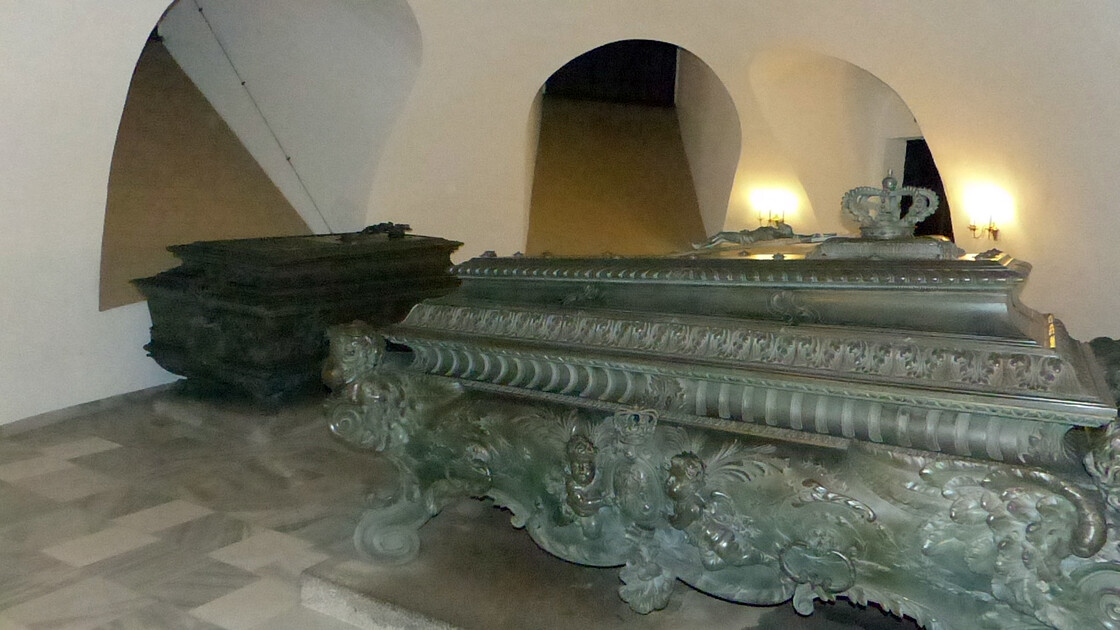
Two large ornate metal coffins in a white vaulted crypt room, the nearer one with a crown on its lid and cherubs on its base
The kings’ vault in the Wettin crypt below the Hofkirche. In front are the coffins of Johann of Saxony and his wife Amalie Auguste. Photograph by Bernd Gross, 2016, Wikimedia Commons, CC BY-SA 4.0.

People dressed up as White Ladies elsewhere too. In Berlin the guards arrested two fake ghosts, a soldier and a kitchen boy, and the boy was whipped while still wearing the white dress. Those cases do not prove that the Dresden priest existed, but they show how familiar the trick had become. Whether the Saxon court archives mention the incident is still an open question.

The crypt at the foot of those stairs later received the king himself. In August 1854, on a trip to Tyrol, Friedrich August II fell from his carriage and was kicked by a horse, and ten days later he was buried below the church where the guard had struck.
The Sources

Every statement in this report rests on these.

  • Rudolf Kleinpaul, Die Lebendigen und die Toten in Volksglauben, Religion und Sage, Leipzig: G. J. Göschen, 1898, chapter II (‘Todesengel’), section 2 (‘Die Weisse Frau’), pp. 116-119. Bayerische Staatsbibliothek, call no. H.g.hum. 130 ky, digitised as bsb11864649.
  • Verfassungsurkunde für das Königreich Sachsen vom 4. September 1831, signed by King Anton and Friedrich August, Duke of Saxony; text as published by the Sächsische Landeszentrale für politische Bildung (§§ 32, 41, 56, 57 and the closing formula).
  • Anton Ziegler, Gallerie aus der österreichischen Vaterlandsgeschichte in bildlicher Darstellung, Vienna (covering events up to the accession of Emperor Ferdinand I in 1835), section ‘Joseph I. bis zum Jahre 1711’. Wienbibliothek im Rathaus, digital copy.
  • ‘Friedrich August II. (Sachsen)’, German Wikipedia, accessed 14 October 2026.
  • ‘Katholische Hofkirche’, German Wikipedia, accessed 14 October 2026.
  • ‘Joseph I. (HRR)’, German Wikipedia, accessed 14 October 2026.
  • ‘Weiße Frau’, German Wikipedia, accessed 14 October 2026.
  • ‘Leipziger Gemetzel’, German Wikipedia, accessed 14 October 2026.
  • Eduard Sommer, ‘Innere Ansicht der Katholischen Kirche zu Dresden’, lithograph, c. 1840, from Das Vaterland der Sachsen, vol. 3; Wikimedia Commons, public domain.
  • Ferdinand von Rayski, Der Gardereiter, oil, c. 1835-1840, Bayerische Staatsgemäldesammlungen, Munich, inv. 8857; Wikimedia Commons, public domain (also the reference for the cover engraving).
  • G. Weinhold after A. Erhardt, Friedrich August II, King of Saxony, lithograph, c. 1850, Austrian National Library; photograph by Peter Geymayer, Wikimedia Commons, public domain.
  • Bernd Gross, ‘Königsgruft in Wettiner Gruft Hofkirche Dresden (01)’, photograph, 2016, Wikimedia Commons, CC BY-SA 4.0.

Filed under White Lady · Weiße Frau · Dresden · Hofkirche · Katholische Hofkirche · Saxony · Friedrich August II · Saxon constitution 1831 · fake ghosts · Rudolf Kleinpaul · Joseph I · Augustus the Strong · German ghost legends.

Pass this report on: Pinterest · Facebook · by Letter · Copy the Address


Questions from Readers

I. Who was the white lady seen in the Dresden Hofkirche?

She was a figure in white seen in the Catholic court church of Dresden in the 1840s, under King Friedrich August II of Saxony. She slipped past the royal box, where the king’s family sat during services, and went down the stairs to the crypt of the royal house. The one account of her, printed in 1898, gives her no name and no earlier story. It treats her as one more appearance of the White Lady, the ghost who was said to haunt German princely houses.

II. What happened when a guard attacked the ghost with a sabre?

A trooper of the mounted Guard was posted in front of the royal box. His orders were to call out ‘Halt, who goes there?’ with his sabre drawn, and to strike if no answer came. He did strike, and the ghost sank to the ground whimpering. The account does not say whether the figure was hurt or who the guardsman was.

III. Why would a priest fake a ghost at the Saxon court?

The 1898 account says the ghost is said to have been a Catholic priest who wanted to move the king to withdraw the new constitution. That constitution dated from 4 September 1831, and Friedrich August had signed it himself while he shared the government with his uncle, before he became king. It banned the Jesuits and any new monasteries from Saxony. It also required the minister for church affairs to be a Protestant. Those clauses would give a Catholic cleric a motive. That is a reading: no source names the priest or states his grievance.

IV. Is the story documented in archives, or is it only legend?

The episode is known from one book: Rudolf Kleinpaul’s study of folk belief about the dead, printed in Leipzig in 1898. He names nobody and cites no source. The priest part is told as hearsay. No earlier printed version is known so far, and whether the Saxon court papers mention it is an open question. The setting is real: the church, its royal box and its crypt exist, and so do the king and the 1831 constitution.

The Weekly, by Post

Every Tuesday the week’s reports in a few lines, and one book from our press. Free, and you may leave at any time.


More from Myths and Folklore

Kiehtan and HobbamockWhat the Pilgrims Wrote About Wampanoag Religion BlåkullaHow Swedish Witches Flew to the Devil on Maundy Thursday Mile VampirovićA Vampire's Son in Serbian Folklore Why Was the Corner Behind the Stove Called "Hell"?

All 84 reports in Myths and Folklore ☞


From Our Own Press