In Hindu myth the gods and the demons once churned an ocean of milk. They stirred it the way a farmer churns cream into butter, because they hoped to win amrita, the drink of immortality. A popular book on sacred plants, Plants of the Gods, adds hemp to that story. Cannabis, the book says, rose from the churning as one of the drinks of the gods, and when the demons tried to seize the amrita, the gods stopped them and named the plant Vijaya, “victory”, in memory of their win.
How old is that story in the texts? The name Vijaya for hemp is on record from about 1050. Hemp and the churning first appear together in one Sanskrit verse that an official of British India translated in 1894 and could not date. That verse gives a different reason for the name: the plant grants victory in the three worlds. None of the older texts quoted below tells the version in which the demons are beaten.
What does the Vijaya cannabis myth of the churning of the ocean say?
The book was written by the botanist Richard Evans Schultes and the chemist Albert Hofmann, and its chapter on hemp is called “The Nectar of Delight” in English. It gives two Indian origin stories. In the first, amrita dripped down from heaven and cannabis sprouted where the drops fell. In the second, the gods churned the ocean of milk with the help of the demons, and cannabis was one of the drinks that came out of it. The plant, the book goes on, was consecrated to Shiva, the great ascetic god of Hinduism, and was the favourite drink of Indra, the king of the gods.
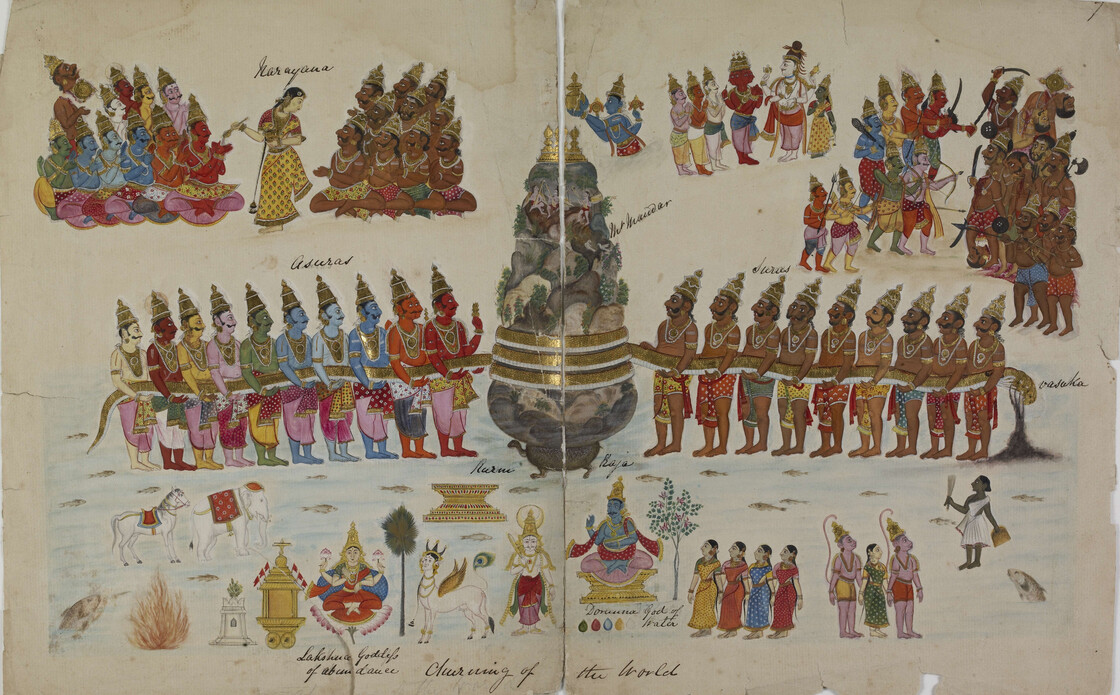
The churning itself is one of the best-known Hindu myths, and the epic Mahabharata tells it at length. The gods and their rivals, the asuras, who play the demons in this story, took Mount Mandara as their churning stick and used the serpent Vasuki as the rope to turn it. The asuras pulled at the serpent’s head and the gods at its tail, and the mountain turned in the sea until its trees were torn out by the roots.
The gums of many trees and herbs ran into the water, and the milky sea began to yield clarified butter, though still no nectar. Then the treasures came up one after another: the moon, the goddess Lakshmi dressed in white, wine, a white horse and a jewel for Vishnu, the god who preserves the world. After them Dhanvantari, the physician of the gods, rose from the sea with a white vessel of nectar, and later a great elephant came up, which Indra took for himself.
The churning went on, and at last a poison called Kalakuta rose and spread over the earth like fire and smoke. Its smell stupefied the three worlds, which is how Hindu texts name the whole of creation. Then Shiva swallowed the poison and held it in his throat, and the epic says he has been called Nilakantha, “blue-throated”, ever since.
Now the asuras wanted the nectar for themselves. Vishnu took the form of a beautiful woman, and the asuras, bewitched by her, handed her the vessel, which she passed on to the gods. A great battle followed by the sea, and when the gods had won it, they set Mount Mandara back in its place and gave the vessel of nectar into safekeeping. The serpent rope, Vasuki, is a king of the Nagas, the snake beings of Hindu myth described in our bestiary entry on the Naga.
In this telling no hemp comes out of the sea, and none of the treasures is called Vijaya. A South Indian painting from about 1820, now in the British Museum, shows the scene with the mountain standing on a tortoise. Its catalogue lists the treasures the painter placed on the shore, among them the horse, the elephant, sacred basil and Lakshmi, and notes that the list “varies according to the texts”.
Where does hemp first appear in Indian texts?
The oldest Indian text with the word for hemp is the Atharvaveda, one of the four Vedas, the ancient collections of sacred hymns of India. Hymn 6 of its eleventh book is a long prayer for relief.
Verse by verse it calls on gods, day and night, animals, seasons and even demons, and each verse ends with the same line: “let them free us from distress”. Verse 15 turns to the plants. It puts Soma, the sacred plant whose juice the Vedic priests pressed for their offerings, at the head of all plants, and then names four more: darbha, a sacred grass; hemp; barley; and saha, which an old commentator explains as “a kind of herb”. In William Dwight Whitney’s 1905 translation it reads: “The five kingdoms of plants, having Soma as their chief (çréṣṭha), we address; the darbhá, hemp, barley, sáha”. Then comes the same closing line.
Hemp, the Sanskrit bhanga, stands in this row as one name among others. The verse tells no story about it and gives it no other name. George Grierson, the British magistrate and tax collector of Howrah near Calcutta, read the passage in 1894 and wrote that the hemp plant is there “mentioned simply as a sacred grass”. In 1957 two Indian researchers, I. C. and R. N. Chopra, left even the plant open: whether the word then meant the true cannabis plant or some other sacred grass was, they wrote, “an open question”.
Why is cannabis called Vijaya?
Vijaya means “the victorious” in Sanskrit, and it is an old word, but it named more than one plant. For a government inquiry into hemp drugs in India, Grierson searched all the Sanskrit and Hindi books he could reach for the hemp plant, and he warned that “whenever the word vijayā is used, it is doubtful whether the hemp plant is meant, or the yellow myrobolan, as the word means both”. The yellow myrobalan is a medicinal plant of Indian healers, called haritaki in Sanskrit.
That doubt hangs over the first Vijaya he found, in a work by the writer Varahamihira from about the year 504, where it is a plant used in the rites of a bathing festival. Grierson thought it “probably” meant hemp. The first case he trusted comes about five hundred years later. Around 1050 the medical writer Chakrapanidatta listed five names for the hemp plant. These were Vijaya, “victorious”; Trailokyavijaya, “victorious in the three worlds”; bhanga; Indrashana, “Indra’s food”; and Jaya, which also means “victorious”. Grierson thought these names showed that people already knew the plant as an intoxicant.
Grierson found hemp in an Indian comedy of around 1500, a farce called the Rogues’ Congress. Two wandering devotees of Shiva bring a quarrel before a corrupt judge, who wants a deposit before he will rule. One of them hands over his bag of ganja, the strong form of hemp that is smoked. The judge takes it pompously, sniffs it greedily, takes a pinch and praises it as a sleep-bringer that also sharpens the wits and gives a healthy appetite.
Did the Sushruta Samhita really prescribe cannabis for leprosy?
Plants of the Gods says that the medical work Sushruta claimed hemp cured leprosy. The Sushruta Samhita, to give the book its full name, is one of the classical works of Indian medicine, and Grierson dated it “before the eighth century A.D.”. He listed the places in it where he had found hemp, and leprosy is not among them. He found bhanga once, in a list of drugs against phlegm, which Indian medicine counts among the humours, the fluids of the body. He found vijaya twice, in a cure for a cold with diarrhoea and in a drink against fever, and in both places he thought the word probably meant the yellow myrobalan.
The full English translation of the book, by the translator Kaviraj Kunja Lal Bhishagratna, came out in several volumes, and the third, printed in Calcutta in 1916, holds these chapters. In the cold chapter the patient is to “take Vijayâ (Haritaki)”, and the fever drink has “Vijayâ (Haritaki)” as well, so the translator read both lines as myrobalan. He knew the other meaning too, because his glossary lists Vijaya as Cannabis sativa.
In 1957 the Chopras cited the same three uses from Sushruta, against phlegm, cold and fever. They called them all cannabis, dropping Grierson’s warning. Leprosy is missing from their list as well.
Which text first ties hemp to the churning of the ocean?
Grierson did find a cure for leprosy in his search, and it stood together with the churning and the name in one verse from a list of medicines called the Rajavallabha, written by a physician named Narayanadasa. Grierson did not know when the book was written. He knew it was quoted in a Sanskrit encyclopedia, the Shabdakalpadruma, and that it was “believed to be ancient”. In his list, which runs in order of time, he still placed it among the books of the seventeenth century. His translation reads:
“Indra’s food (i.e., ganja) is acid, produces infatuation, and destroys leprosy. It creates vital energy, the mental powers, and internal heat, corrects irregularities of the phlegmatic humour, and is an elixir vitæ. It was originally produced, like nectar, from the ocean by the churning with Mount Mandara, and inasmuch as it gives victory in the three worlds, it, the delight of the king of the gods, is called vijayā, the victorious. This desire-fulfilling drug was obtained by men on the earth, through desire for the welfare of all people. To those who regularly use it it begets joy and destroys every anxiety.”
“Elixir vitæ” is Latin for an elixir of life. Nearly every piece of the modern story sits in these lines: hemp comes out of the churned ocean like the nectar, it destroys leprosy, it is the delight of the king of the gods, who is Indra, and it is called vijaya. The verse explains the name by the victory the plant grants “in the three worlds”, and no demons are beaten in it.
Why is bhang offered to Shiva on Maha Shivaratri?
Demons do appear in the same government report of 1894, in a second note written beside Grierson’s. Its author, J. M. Campbell, was a colonial official in Bombay, and he wrote down what Hindus around him believed about bhang, the drink made from crushed hemp leaves. “To the Hindu the hemp plant is holy,” his note begins, and “a guardian lives in the bhang leaf.”
He records two stories that bind the plant to Shiva. In one, Shiva was “on fire with the poison churned from the ocean”, the Kalakuta he had swallowed, and was cooled by bhang. In the other, the god withdrew to the fields, angry about trouble in his family, where the shade of a plant cooled him and he ate its leaves. For these two benefits, Campbell writes, bhang is called Shankarpriya, “the beloved of Shankar”, which is another name of Shiva.
Campbell also gives two origin stories that come closer to the churning. In one, the nectar from the ocean needed something to purify it, and Shiva made bhang from his own body for that purpose. In the other, some nectar dropped to the ground and the hemp plant sprang up from it.
Campbell explains the name Vijaya in his own way. Bhang, he writes, overcomes “the demons of hunger and thirst”, so that ascetics can pass days without food or drink, and it also drives away panic and madness. In times of war, he adds, Shiva’s linga, the stone that stands for the god, should be bathed in bhang.
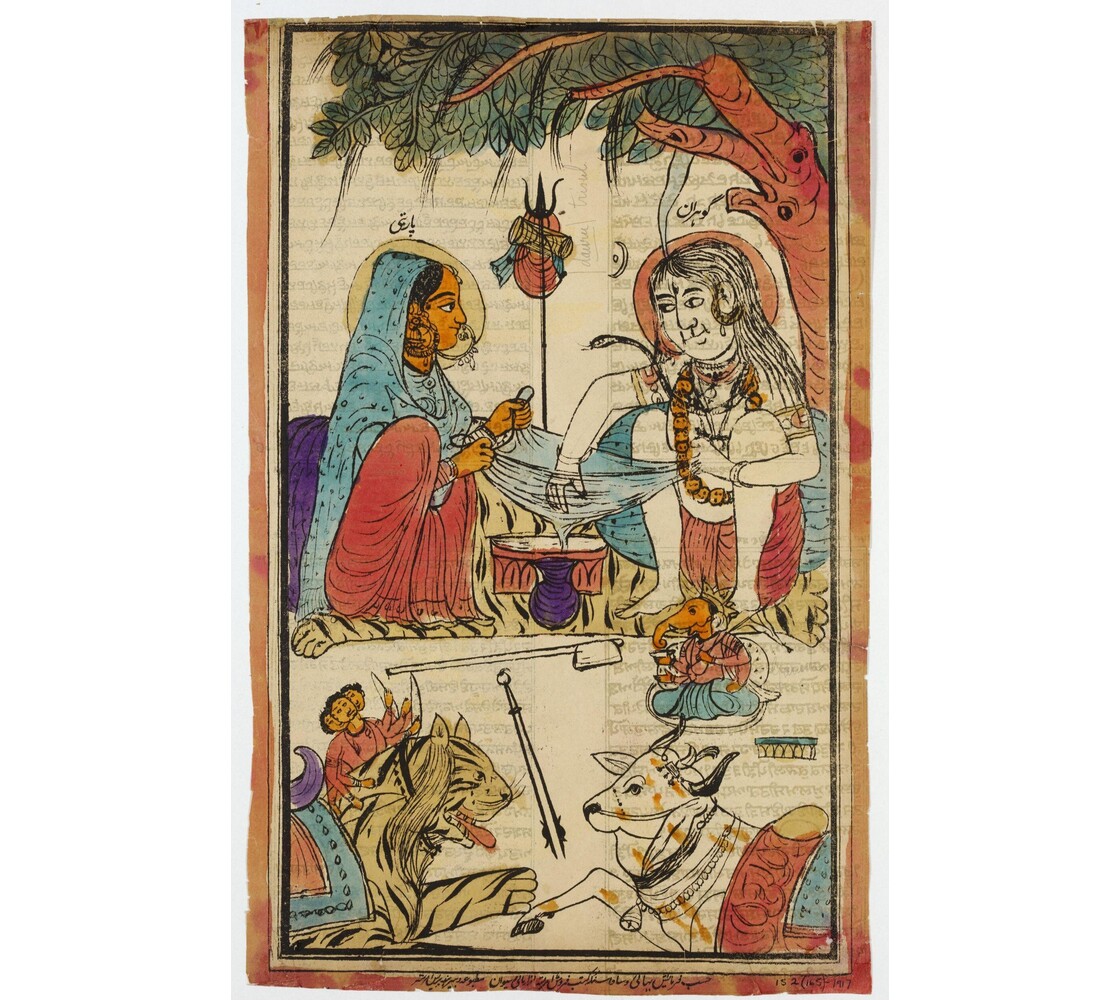
Campbell takes the rule for the festival night from a Tantra, one of the later ritual handbooks of Hinduism. According to the Meru Tantra, he writes, people should offer bhang to Shiva and pour it over his linga on Mondays, on certain monthly days of Shiva, “still more on the Mahashivratri or Shiva’s Great Night”. That night falls on the fourteenth day of the waning moon in the month of Magh, in January or February. In Bombay, he adds, such rites were seldom held except in two temples, Bhuleswar and Babulnath. The Chopras wrote in 1957 that on Shivaratri drinks with bhang were poured over the linga all night.
Campbell lists the small daily customs around bhang in Bombay. Whoever woke and looked into liquid bhang would be freed from the nightmares and evil spirits that had entered him during the night. Meeting someone who carried bhang was a sure sign of success, and a man who trod on a bhang leaf could expect nothing good to come to him.
When the Chopras retold Campbell’s origin stories in 1957, they wrote that Shiva had brought the plant out of the ocean “when all the gods churned it”, although in Campbell’s note Shiva makes bhang from his own body. The demons beaten at the churning, the heart of the version in Plants of the Gods, appear in none of these older texts. Campbell’s demons are hunger, thirst, panic and madness, which bhang drives out of the drinker. In Bengal, the Chopras noted, people offered a bhang drink to family and guests on Vijayadashami, the final day of Durga Puja, the great festival of the goddess Durga. The Tantric drink called vijaya has its own page in our news note on Tantric cannabis rituals.
In the Bombay temples Campbell knew, the bhang offered to Shiva was plain, without pepper or spice, mixed with water, milk or sugar, and poured over the linga. Before drinking or smoking, Campbell noted, devotees dedicated the cup to the god with the words “lena Shankar, lena Babulnath”: take it, Shankar, take it, Babulnath.