In an old Tibetan chronicle, Langdarma, the last king of the Tibetan empire, calls his people together and asks them why famine and plague have struck his capital. When they cannot tell him, he gives the answer himself. A Chinese princess, he says, was an expert in geomancy, the art of reading the shape of the land, and she used it against Tibet. She built Buddhist shrines on one mountain to hold it down, hammered a wooden spike into another, and cut a third, a mountain in the Yar-lung valley called Me-sna-gdong, “at the neck”. That cut, the king says, is why Tibet has famine.
A later chronicle, the Clear Mirror of 1368, tells the same deed of a different princess, who has a different reason for it. Neither text says where exactly the mountain stood, and the oldest Tibetan records contradict the later story at its centre.
Who pierced the Me-sna-gdong ridge in the Yar-lung valley?
The scene comes from a passage near the end of a chronicle called the sBa bzhed, which the scholar Janet Gyatso translated into English in 1987. The king, whose Tibetan name is written gLang dar ma, has summoned “all of his subjects who are not ill”, because his capital is suffering from famine, plague and crop loss. He blames the new religion, Buddhism.
“What’s the reason?” he asks. “We don’t know,” they say. “Well I know,” he replies. “There was a Gnod-sbyin devil called Kong cong the Chinese.” Gnod-sbyin is the Tibetan word that Gyatso renders as “devil”, and Kong cong is the chronicle’s name for the Chinese princess, who appears in other Tibetan texts as Kong jo or Kongjo. According to the king, she brought “the inauspicious god known as Sakyamuni”, that is, the Buddha. She went to the top of Mount Sumeru, the mountain at the centre of the world in Buddhist belief, and destroyed the gods there. Then, the king goes on, she destroyed Urgyan, a kingdom in the Swat valley, then Magadha in India, then China. “Then she went to Tibet, and being an expert at geomancy, she did geomancy.”
The king then lists what she did to the land, mountain by mountain, and he speaks of each mountain as the body of the animal it resembles. The first is lCags-po-ri, the Iron Hill in Lhasa, which “looks like a white lioness leaping into the sky”. On the lioness’s twenty-one spine bones the princess set twenty-one stupas, the dome-shaped shrines of Buddhism, “as acupuncture pins”. She pressed down the head with a black stupa of nine levels and built a temple on top of the skull. If she had not done that, the king tells his people, “(we) would have conquered India.” The second is a Red Mountain, dMar-po, which looks like a tiger entering a mouse’s nest, and into its nose she hammered a wooden spike.
The last mountain on the list stands in Yar-lung, the valley of the kings: “She cut off Mt. Me-sna-gdong at Yar-lung, which looks like a rice sprout, at the neck. If she hadn’t done that, Tibet wouldn’t have a famine.”
Why would cutting a mountain bring famine?
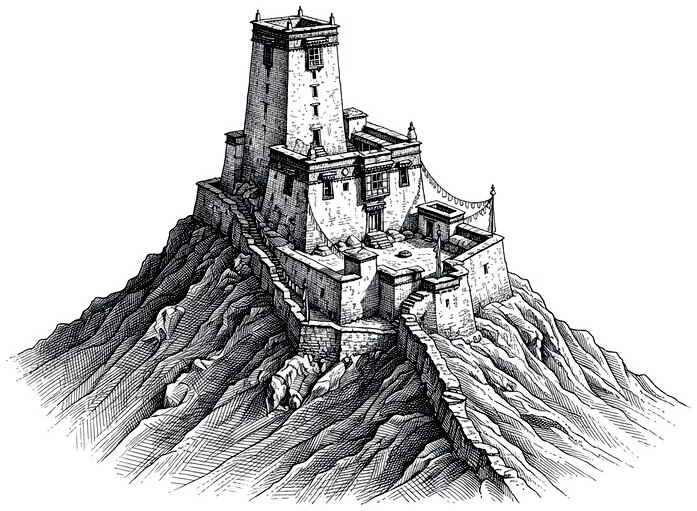
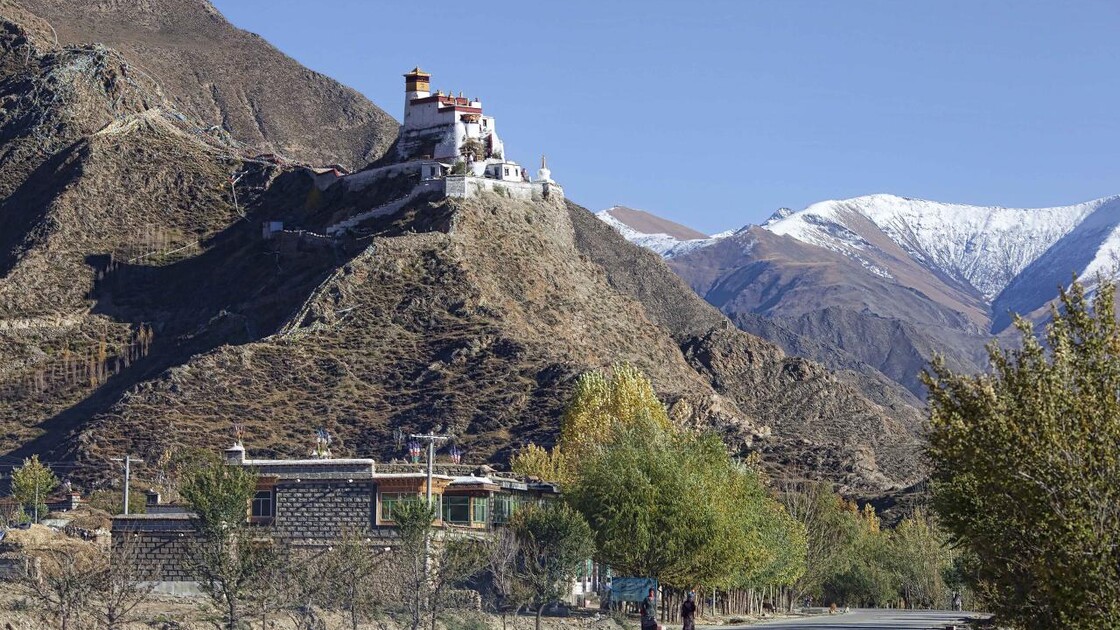
The Yar-lung valley, usually written Yarlung today, lies in southern Tibet, where the Yarlung Chu river runs into the great Tsangpo. Together with the neighbouring Chongye valley it was the seat of the early Tibetan kings. Tradition calls Yumbu Lhakhang, a small palace on a ridge there, the first building in Tibet. So the king’s charge names a mountain in the heart of his own family’s land.
To see why a cut there could mean hunger, it helps to know how Tibetan writing pictures the land. Gyatso describes “a very Tibetan proclivity to image features of the landscape, on both small and large scale, as animated.” A spirit may live in a lake, a mountain may itself be a god, and the outline of a hill can be taken as the body of the being it looks like. In this way of seeing, a mountain shaped like a lioness is a lioness, and a ridge shaped like a sprouting rice plant is that plant, so a cut through its neck stops it from growing.
The best-known example of this view is the srin-mo, a demoness whose body is the whole land of Tibet. She lies on her back, and temples have been built on her limbs to hold her down. In the Buddhist tellings it is the Chinese princess Kongjo who reads her geomantic charts and discovers the demoness, and the Tibetan king’s temples then pin her in place. Langdarma’s speech turns that story around. He keeps the pins and the living land beneath them, but in his mouth the pinning is an attack on Tibet.
Gyatso points out what the king leaves untouched. “Despite gLang dar ma’s diatribe, he does not quarrel with the basic perception that the land of Tibet is constituted by beings,” she writes, nor with the idea that buildings set on top of them affect them. He objects only to the specific buildings, the gods inside them, and their locations. Whether a temple on a mountain protects the land or wounds it was, in her words, “really a question of opinion or perspective”. A text of Bon, the other old religion of Tibet, even boasts of disrupting and suppressing the earth beings with its own buildings.
The princess’s name in these stories, Kong jo, was originally a title. It comes from the Chinese gong zhu, which means “princess”, so the name alone does not tell you which Chinese princess is meant. Two of them married into the Tibetan royal house, about seventy years apart.
Who was the king, and why did he blame China?
Langdarma ruled for only a year or a year and a half, around 841 and 842. Later Buddhist histories remember him as the king who persecuted Buddhism and reversed the policies of the kings before him, although Gyatso notes that one much older manuscript portrays him as a supporter of Buddhism. After his death the empire broke apart in civil war.
The sBa bzhed itself was put together long after him. It is named after the sBa clan, a noble family at the royal court, and its authors are unknown. Most of it tells how Buddhism came to Tibet under King Trisong Detsen, who ruled in the second half of the 8th century. Its last pages tell of the Indian teacher Atiśa, and from that the historians conclude that the text as we have it was written after the middle of the 11th century, some two hundred years after Langdarma. Gyatso translated from the edition that the French scholar Rolf Stein published in 1961, which reproduces a handwritten copy made in Lhasa.
The reason the king points at China has to do with where Buddhism was thought to come from. Pasang Wangdu and Hildegard Diemberger translated the dBa’ bzhed, a sister chronicle of the sBa bzhed, and they note that in this period Buddhism carried “a strong Chinese connotation”. In one passage the religion is simply called “the doctrine of China”. They describe Langdarma as an anti-Chinese “nationalist”, a word they put in quotation marks themselves, who saw the Buddha statue brought by the Chinese princess as an ominous symbol of Chinese power. The historian Samten Karmay adds a second motive: the king opposed the growing wealth and power of the Buddhist monasteries because he feared they would weaken the state.
Blaming disasters on the new religion was older than Langdarma, at least in the chronicles. The dBa’ bzhed tells how King Trisong Detsen, one of Langdarma’s predecessors in the 8th century, was taught the Buddhist doctrine. Then a royal palace was flooded, the castle of Lhasa was struck by lightning and burnt, and a great famine and epidemics struck people and animals. The great ministers called the disasters the result of practising the doctrine, so the king gave it up for a while and sent his teacher Śāntarakṣita back to Nepal.
Which princess cut the mountain?
Two Chinese princesses really came to Tibet as brides. The first, Wencheng, was a girl of the imperial family sent in 641, who died in 680. The second, Jincheng, an adopted daughter of the emperor Zhongzong, arrived in 710, when her future husband was only seven years old, and died in 739. Gyatso identifies the “Kong cong” of Langdarma’s speech as Wencheng, the princess who in the Buddhist stories discovers the demoness.
The Clear Mirror, a chronicle written in 1368 at Samye monastery, gives the mountain-cutting to the second princess, Jincheng, whom it calls Kyimshing Kongjo. In this version she bears the king a son, the future Trisong Detsen. A senior queen named Nanam Zang, of the Tibetan Nanam clan, grows jealous, declares, “I also carry the king’s successor,” and takes the baby for her own. Kongjo bares her breasts and weeps, and she petitions the ministers and the king, but Nanam Zang refuses to give the child back.
So the princess decides: “It is difficult for the baby to benefit me at this juncture. I shall therefore destroy this land of Tibet!” She studies “the geomancy of the mountains” and goes to work on them one after another. To cut off the royal line, she draws a wheel with her own menstrual blood on the summit of what the chronicle calls “the king’s life-force mountain”. She blocks the “nose” of the ministers’ life-force mountain with molten bronze, and she severs the joined “tails” of two mountains named Tiger Mountain and Snow-lion Mountain. Then comes the deed that Langdarma’s speech laid on the first princess: “In order to cause famine, she cut the ‘roots’ of Mena Mountain at Yarlung, which resembled tender shoots of rice.” Mena is written Me sna in Tibetan, which is the first part of the name Me-sna-gdong.
When all this is done, the boy’s first birthday arrives, and the families of both queens, from China and from Nanam, come to a feast for his first steps. His father adorns him with ornaments, puts a golden cup of rice beer in his hands and sends him off to give it to his uncle: “By this we will determine who is your true mother.” The child, just able to walk, says: “I, Trisong Detsen, am a nephew of the Chinese. I do not understand my uncles from Nanam.” Then he sits down in the lap of his Chinese uncle, and his mother is overjoyed.
The Clear Mirror’s princess also aims at disease. To bring leprosy to Tibet, it says, she removed the “bill” of Mangkhar Mountain, which looked like a great eagle soaring in the sky.
Where is the mountain, and was it ever cut?
For the place, both chronicles give only the words “at Yarlung”. The king’s speech names Me-sna-gdong and its rice-sprout shape, and the Clear Mirror names Mena and its tender rice shoots, but a village, a year, a tool or a worker appears in neither of them. The scholars quoted here do not identify the mountain on the ground either, so the texts leave open whether anyone ever dug into a real ridge in the Yarlung valley.
The two versions also disagree about the injury and about the reason for it. In the sBa bzhed the mountain is cut “at the neck”, while in the Clear Mirror the princess cuts its “roots”. In the earlier text a foreign devil comes to destroy Tibet with her religion, and in the later one a mother takes revenge on the land where her child was taken from her. Both of them explain the famine through the shape of that one hill.
What do the oldest records say about the wronged princess?
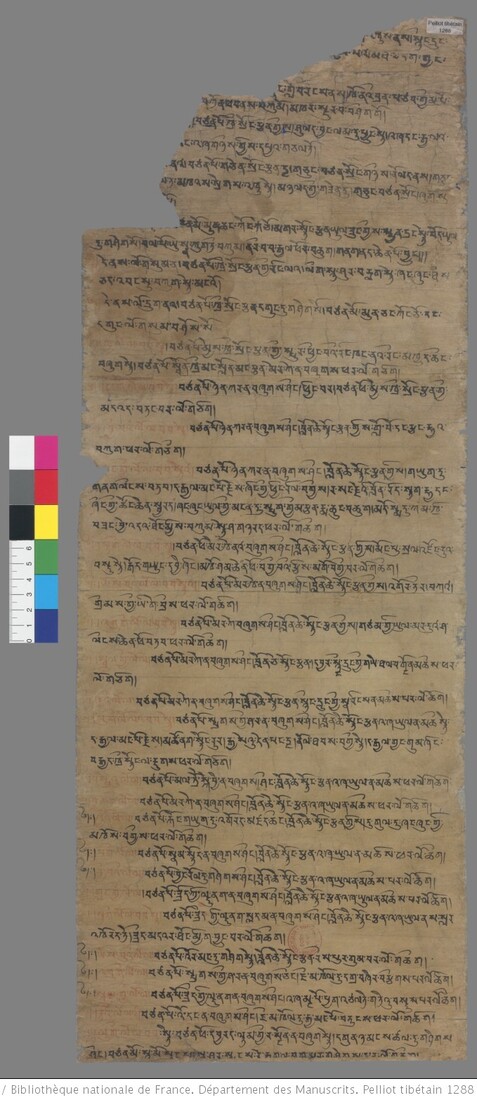
Among the oldest Tibetan writings that survive are manuscripts from a sealed cave library at Dunhuang, on the old Silk Road in western China. They include the Old Tibetan Annals, a year-by-year record of the empire. Wangdu and Diemberger set the story of the stolen baby against these documents.
The Dunhuang cave library also preserved the oldest version of another Tibetan royal story: the death of King Drigum, whose corpse a water spirit swallowed. We told it in Dri gum btsan po’s Corpse and the Invention of the Tibetan Tumulus.
According to the Dunhuang documents, Trisong Detsen was born in 742. The Chinese princess Jincheng had died three years earlier, in 739, so by these records she cannot have been the mother whose baby was taken. The documents name his mother as the Tibetan queen Mangmoje, a woman of the Nanam clan. That is the clan of Nanam Zang, the queen whom the Clear Mirror of 1368 accuses of taking Kongjo’s baby.