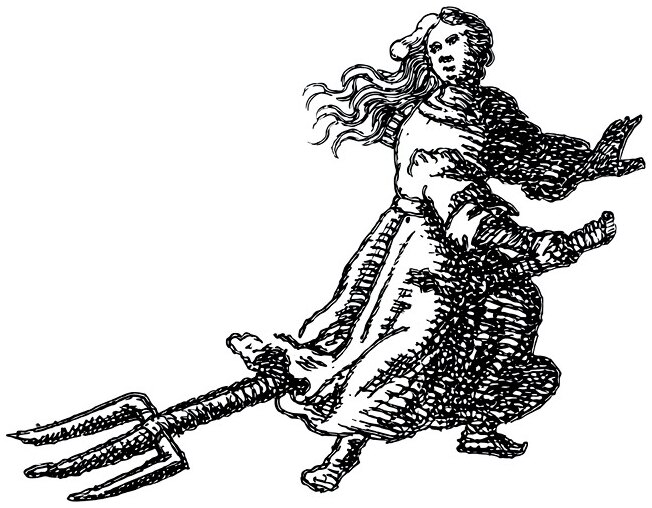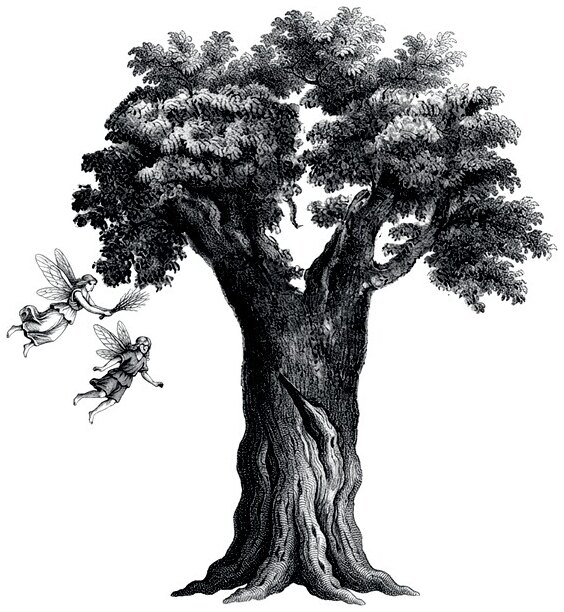
Ljejuvica is a Dalmatian word for a witch in flight, and it survives in one place: a footnote on page 345 of the tenth volume of the Arkiv za povjestnicu jugoslavensku, printed in Zagreb in 1869. The author, Luko Zore from Cavtat, set down what people along the Dubrovnik coast told him. Witches, they said, turn into ljejuvice and fly at night across the sea to Apulia, where they hold council under a walnut tree.
In one paragraph Zore covers the flight across the sea, the danger to small children and the amulets the priests handed out. The witches cross the Adriatic to settle the questions of the coming year under the walnut, and they can drain a sickly infant with a look. One of them who has not married yet goes by another name, morica, because she lies on people while they sleep. Zore closes the note with a complaint about the parish priests, who he says keep these beliefs alive by handing out blessings in a sealed booklet whenever villagers ask.
Zore wrote the word down and moved on. The same flight was recorded again and again along the coast between 1859 and 1908, in other collections and under other names, and not one of them used his noun.
What Does Ljejuvica Mean?
The sentence in the footnote reads:
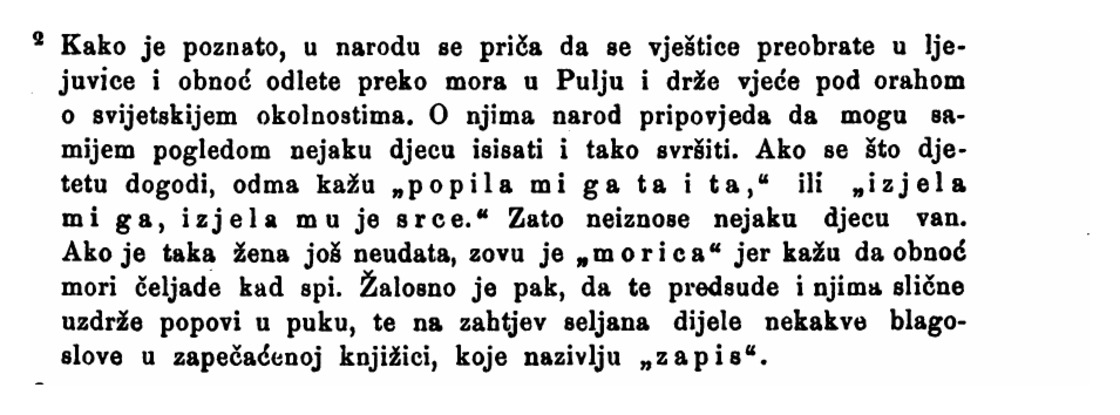
Kako je poznato, u narodu se priča da se vještice preobrate u ljejuvice i obnoć odlete preko mora u Pulju i drže vjeće pod orahom o svijetskijem okolnostima.
In English: As is known, it is told among the people that witches turn into ljejuvice and fly by night across the sea to Pulja, and hold council under the walnut tree about the circumstances of the world.
A vještica is the woman in the village, the neighbour whose eye you avoid on the way down to the boat. A ljejuvica is what she becomes over open water in the dark. The plural is ljejuvice.
Zore gives no etymology, and the word does not appear a second time in the South Slavic collections of the period. Krauss read the Arkiv closely and cited its fifth volume for the same belief without ever using the noun. The Zbornik volumes that recorded the flight in far more detail between 1896 and 1908 call the flyer a vještica throughout.
A Fishing Book with a Witch in the Footnote
Zore’s article is called “On fishing in the Dubrovnik area, with additions from the rest of our coast,” and it belongs to the third section of the volume, Običaji, customs. Its forty-eight pages deal with fishing: which fish live by the stone and which by the sand, and the proverbs a boat’s owner uses on a sleeping crewman. He quotes one of those proverbs and suspects it was translated from the Italian: Ko spi, ne hita ribe, who sleeps does not catch fish.
The witches sit in his section on presentiments and superstitions in fishing. Fishermen had a working method for an unlucky person, and it was mostly avoidance. If the person was a woman they called her a vještica, if a man a vješturko, and the practice was to carry the gear down to the boat another way so the two of you would not meet. If a meeting could not be avoided, you greeted her as kuma, godmother, and once greeted that way she could do no harm. To be rid of her you told her to go u Pulju pod orah, to Pulja under the walnut, and that counted as half the trouble dealt with.
Zore was in his early twenties when the volume appeared, a philologist from Cavtat who had studied in Vienna. He spent his working life in schools at Zadar, Dubrovnik and Kotor, and later ran the gymnasium at Cetinje.
The greeting was the defence. Along the Dubrovnik coast a fisherman who had to speak with a woman he suspected of being a witch addressed her as kuma, godmother. Zore notes that once she had been greeted that way she could do no harm. In another footnote he adds that hunters held the same belief, and took a side path to avoid meeting the wrong person.
“Neither Wood Nor Stone”: What a Witch Said Before She Left
Ten years before Zore’s footnote, the Arkiv had already printed the belief, from the other end of the same coastline. Volume V, 1859, in a run of answers to questions the society had sent out to its correspondents. The reply came from the Makarska district, on the coast between Split and Dubrovnik, and the man who wrote it signed himself B. Petar Kadčić Peko.
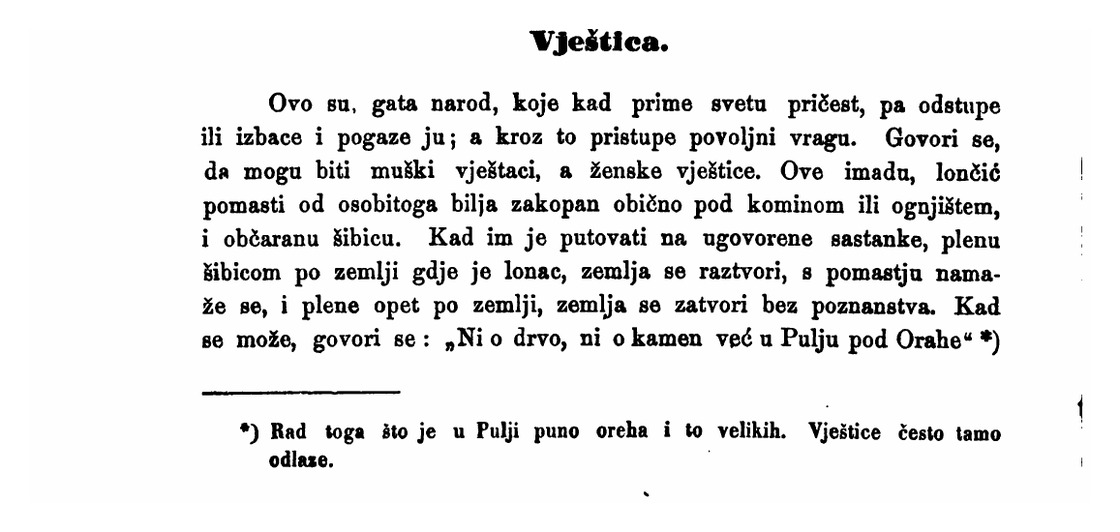
His witches keep a small pot of ointment made from particular herbs, buried under the hearth, and an enchanted switch. When they mean to travel to an agreed meeting, they strike the ground with the switch where the pot lies, the earth opens, they smear themselves with the ointment, and they strike the ground again. The earth closes behind them and nobody notices a thing. As they leave, they say:
Ni o drvo, ni o kamen već u Pulju pod Orahe.
Neither on wood nor on stone, but to Pulja under the walnuts. A witch in flight must not come down on a hard surface. If she gets the words wrong and hits wood or stone, woe to her. A footnote under the line gives the reason in plain terms: Rad toga što je u Pulji puno oreha i to velikih, Vještice često tamo odlaze. Because there are many walnuts in Pulja, and large ones, the witches go there often.
The full night flight was written down much later, at Vrhgorac, and printed in the first volume of the Zbornik za narodni život i običaje Južnih Slavena in 1896. The informant I. Ujević gives the same mechanics with more detail. A girl who is a mora becomes a vještica once she marries. At night she takes a switch, strikes the hearth, and a pot of fat comes out of it. She greases herself, a black ram appears, she climbs on its back and says the line: neither wood nor stone, but to Pulja under the walnut. Thousands of them collect at the other end and argue over whose heart will be eaten and where the hail should be laid down. They fly naked ahead of the hail, which is why villagers fired their guns into a coming hailstorm, aiming to bring a witch down before the crop was flattened.
The walnut was not the only meeting place. Krauss records that the witches of Croatia met on the mountain Klek above Ogulin, and the witches of Syrmia at an old walnut tree near the village of Molovina. The Dalmatian coast fought the Klek gatherings with wax bullets fired into thunderstorms, a practice recorded in Klek and the Wax Bullets.
The Walnut Tree on the Other Side of the Sea
Lay the Italian and Croatian material side by side and the flight has one destination. Benevento, a city inland from Naples, had a walnut tree that witches were said to gather under. Krauss quoted Jacob Grimm on it: the Neapolitan streghe assemble under a walnut tree near Benevento, the people call the occasion the Beneventan wedding, and a sacred tree of the Lombards had stood in that place.
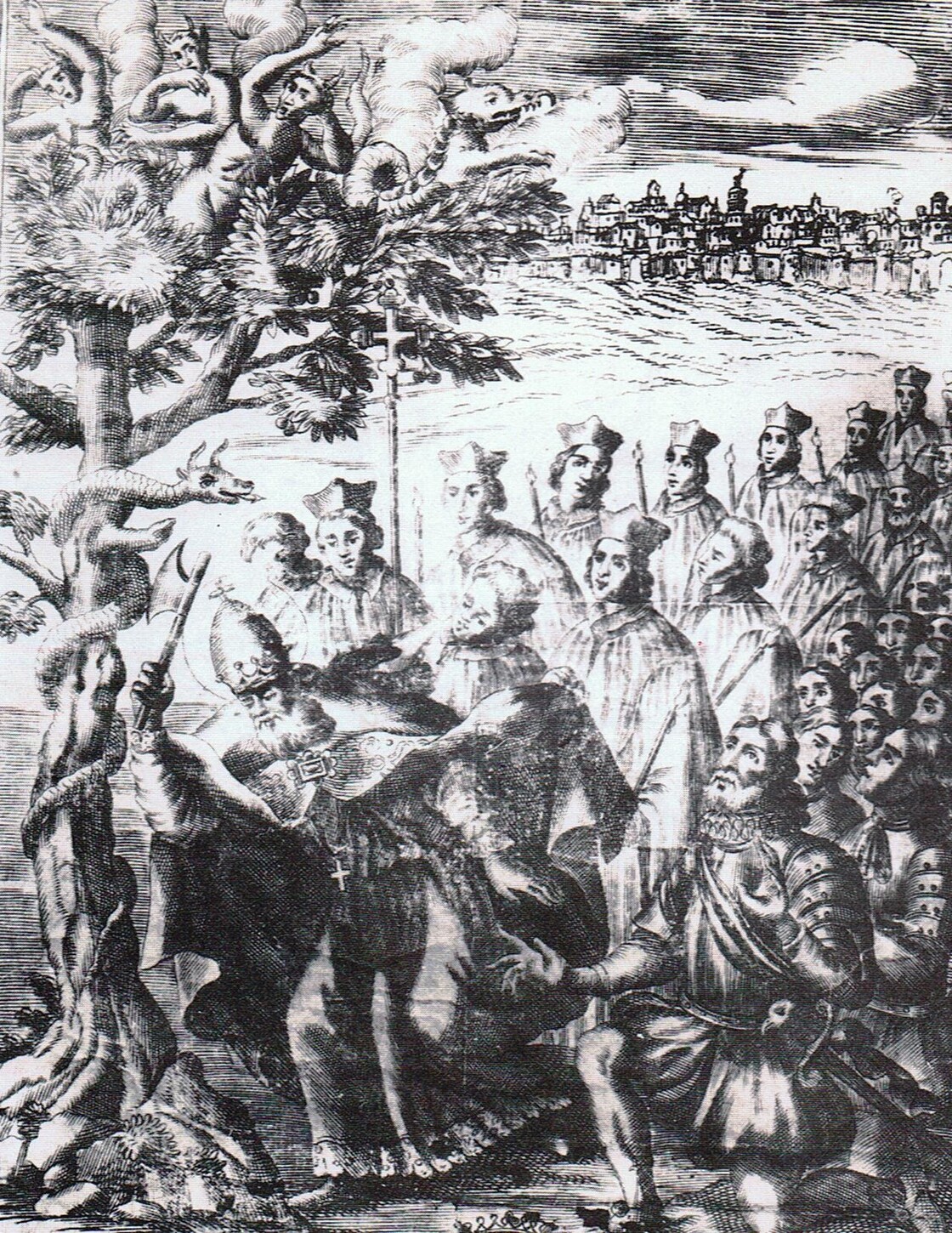
The Lombard part comes with the city’s founding legend. Barbatus, bishop of Benevento from 663 and a saint of the seventh century, is said to have cut down a walnut tree the Lombards held sacred and to have melted a golden viper into church plate. The oldest version of that story, the Vita Barbati, was written down in the ninth or tenth century.
The tree that the witches used appears in the records later than the saint, and in a court. The trial of Matteuccia de Francesco at Todi in 1428, one of the earliest Italian witchcraft trials whose acts survive, has her confessing that she greased herself and flew to the walnut tree of Benevento. The acts give the destination without an explanation attached, and they are the earliest surviving record of it.
The tree kept its reputation into the seventeenth century. Pietro Piperno, chief physician of Benevento, wrote a treatise on it, in Latin with a preface dated February 1634 and then in Italian in 1640, and the book went through more than one printing. The Slavic side of the same flight path has a literary first that Krauss was the one to notice: the Ragusan poet Ivan Gundulić, writing in the 1620s, put a witch on a goat in the night sky in the second canto of Osman. Krauss judged that detail Italian rather than local.
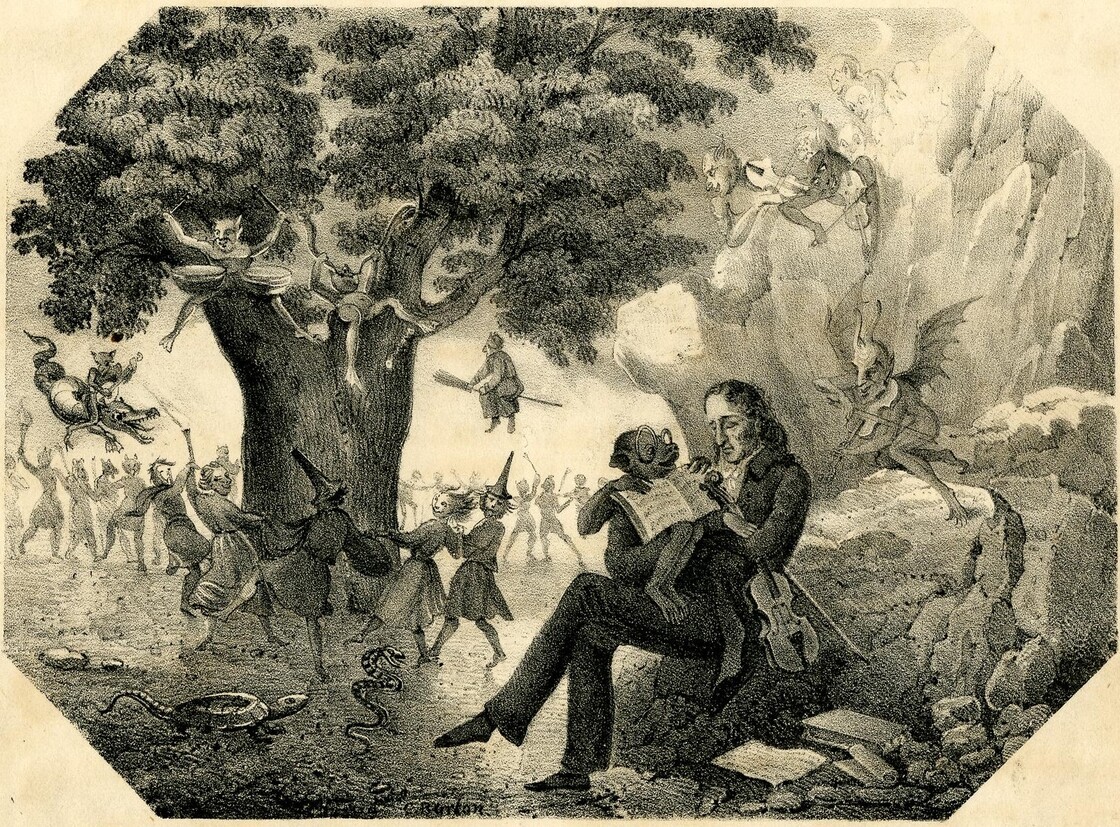
Gundulić began Osman in 1621, but the epic was printed only in 1826, in Dubrovnik, almost two centuries after the poet’s death.
The Girl Was a Morica Until She Married
Zore’s footnote contains a second name, and the later collections fill it out. A woman of the flying kind who had not married yet was called morica, because she mori, she lies on a sleeper and presses the breath out of him. Marriage changed the classification without changing the woman. From Vrhgorac in 1896: a girl who is a mora is a vještica once she is a wife. From Konavle in 1908: when the girl-morica marries in church, she becomes a vještica.
Her nearest relative is the Mora, the night hag of the Slavic and Germanic north who rides sleepers and gave English the word nightmare. The married form is the vještica. On the Dalmatian coast she is a stage of life: unmarried, she is the weight on your chest at night, and married, she flies. The Mare and the Mora have their own history elsewhere on this site, and Zore’s footnote runs on the same division of labour between the two names.
The Sealed Booklet the Priests Handed Out
Zore’s footnote ends on the parish priests. Žalosno je pak, da te predsude i njima slične uzdrže popovi u puku, te na zahtjev seljana dijele nekakve blagoslove u zapečaćenoj knjižici, koje nazivlju zapis. It is sad, he writes, that the priests keep these superstitions and others like them alive among the people, handing out at the villagers’ request certain blessings in a sealed booklet which they call a zapis.
A zapis is a written charm, a slip or a small folded booklet carrying a blessing or a line of scripture, kept on the body or in the house for protection. In Zore’s account the parish clergy were the ones who kept the belief in witches supplied with it.
Around Split, Friedrich Krauss reported, a household troubled by the Kozlak, the local revenant, turned to the Franciscan friars, who dealt in zapisi. A written charm worked in the Balkans whether the text inside it was Latin, Croatian or Arabic, and the same pattern holds for the Muslim households of the same peninsula, where the charm carried a verse of the Quran.
Three Words That Get Confused with Ljejuvica
Three other words live close enough to ljejuvica to be mistaken for it. None of them is related.
ljevica is the ordinary Croatian and Serbian word for the left. It means the left hand, and in politics the left, and neither sense has anything to do with witches. Most searches for ljejuvica end here, on a dictionary entry about politics.
Ljubica is a woman’s name, built on the Slavic root ljub, love, and it is also a common name for the violet. Every village on this coast had a Ljubica in it.
Ljelje, also called kraljice, belongs to a different part of Croatia and a different calendar. It is the spring procession of Gorjani in Slavonia, in the north-east of the country, and it happens on Whitsunday. The girls divide into ten kraljevi, kings, who wear sabres and men’s hats and dance with the blades, and about five kraljice, queens, who wear white garlands like brides and comment on the dance in song. Each household they visit feeds them and joins the dance, and the next day the group walks to a neighbouring town. UNESCO inscribed the procession on its Representative List of the Intangible Cultural Heritage of Humanity in 2009.
The coastal records did not agree on what the witch turned into. In the Konavle record of 1908 a man seized a morica and she turned into a hen in his hands; he singed her head in the hearth, and the next morning a girl in the village had a burnt cheek. The same collection has a cheaper test. Promise her salt, and she has to come back in the morning to ask for it.
What the Priest Sees at the Altar
The Konavle record of 1908, collected by Bogdan-Bijelić pl. Pavlina, is the last of these texts, and it holds one image the others do not. The witches of a parish are invisible all week and sit in the church on Sunday like everyone else. The moment of recognition comes at the altar, at the words Orate, fratres, when the priest turns around to face the congregation. Every witch in the building has two small horns on her head, and only he can see them. He says nothing and finishes the mass.