In December 1621 Edward Winslow, one of the English settlers of Plymouth Colony, wrote a letter home that describes the harvest feast now remembered as the first Thanksgiving. In the same letter he wrote that the Native people around the colony had no religion at all. In 1624 he took that sentence back in print. The Wampanoag, the people who had come to the feast, spoke of Kiehtan, he now wrote, who made the world and everything in it, and of Hobbamock, a healer who appeared to respected men, most often as a snake. Winslow took Hobbamock for “the devil”. The anthropologist Kathleen Bragdon reads the pair differently, as two powers of a world in which the Christian split between a good God and an evil devil had no exact equivalent.
Who were Kiehtan and Hobbamock in Wampanoag religion?
Winslow was one of the English settlers, now remembered as the Pilgrims, who founded Plymouth Colony in 1620, in what is now Massachusetts. His letter of 11 December 1621 told readers in England about the colony’s first harvest. The governor sent four men out to shoot birds so that the settlers could “rejoice together” after gathering their crops, and then Massasoit, the leader of the Wampanoag people around Plymouth, arrived “with some ninety men, whom for three days we entertained and feasted”. His men went out, killed five deer and gave them to the English.
A few lines further down, the letter says of the same guests: “They are a people without any religion or knowledge of any God, yet very trusty, quick of apprehension, ripe-witted, just.” The letter was printed in London in 1622, in a small book about the colony’s first year.
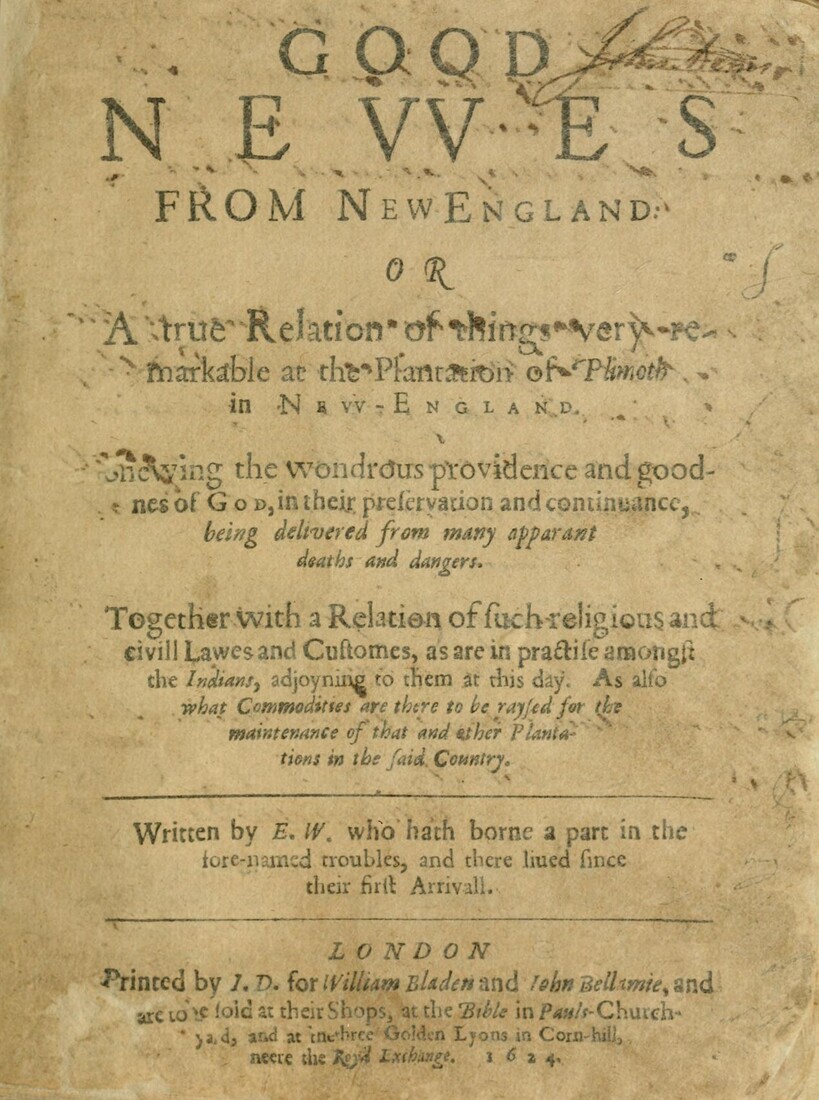
In 1624 Winslow published his own book about the colony, Good Newes from New England, and added some pages on the religion and customs of the Native people, whom he calls Indians. He opened these pages with a correction: he and others had written in earlier letters that the Indians had no religion, and those letters had gone to print without his knowledge. “Therein I erred”, Winslow now confessed, “though we could then gather no better”.
What he had learned since then filled the next pages. The people around Plymouth, he wrote, conceived of many divine powers. One of them, “whom they call Kiehtan”, was “the principal and maker of all the rest, and to be made by none.” Kiehtan created the heavens, the earth, the sea and all creatures. He also made one man and one woman, “of whom they and we and all mankind came”. How people came to be scattered so far apart, Winslow’s informants said, they did not know.
Kiehtan lived “far westward in the heavens”. Good men went there when they died, to see their friends and have their fill of all things. Bad men went there too and knocked at his door. Kiehtan told them “Quatchet”, which Winslow translates as “walk abroad”, because there was no place for them, and so they wandered in want and poverty. Nobody had ever seen Kiehtan, but old men told the young about him and charged them to teach their own children the same.
When the people wanted something great, such as plenty or victory, they gathered and cried to Kiehtan. Afterwards they sang, danced, feasted, gave thanks and hung up garlands in memory of it. Yet Winslow also heard that they called on Kiehtan less than before, “saying, in their memory he was much more called upon.”
Winslow added a note in the margin about the name. He thought that in the people’s language Kiehtan “hath reference to antiquity; for Chise is an old man, and Kichchise a man that exceedeth in age.” In his reading, the maker of all was named something like the Very Old One.
What did Edward Winslow write about Hobbamock?
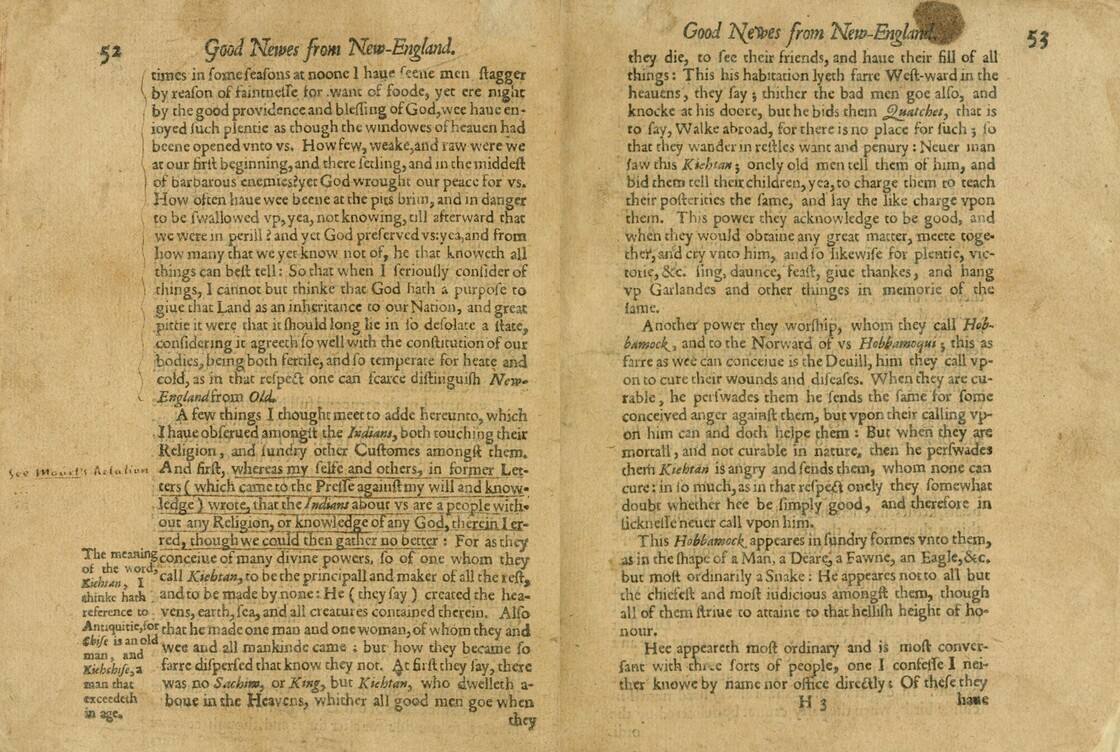
The second power took more room in Winslow’s pages. “Another power they worship, whom they call Hobbamock, and to the northward of us, Hobbamoqui; this, as far as we can conceive, is the devil.” The devil is an English label here, and Winslow himself marks it as a guess with the words “as far as we can conceive”.
People called on Hobbamock “to cure their wounds and diseases”. Winslow then explains how the two powers met at a sickbed. If an illness could be cured, Hobbamock claimed he had sent it out of anger, and once the sick person called on him, he would help. If the illness was fatal, Hobbamock told them that Kiehtan was angry and had sent it, and then nobody could cure it. So Kiehtan, the maker whom the people called good, was the one they doubted in sickness, and they “never call upon him” when someone was ill.
Hobbamock showed himself “in sundry forms”, as a man, a deer, a fawn or an eagle, “but most ordinarily a snake”. He did not appear to everyone, only to “the chiefest and most judicious amongst them”, and Winslow adds that all of them strove “to attain to that hellish height of honor”. Here the word “hellish” is his own judgement placed on top of what he was told: being seen by Hobbamock was an honour that men worked for.
The power was closest to three kinds of people. Of the first kind Winslow admits that he knows neither their name nor their role: “I confess I neither know by name nor office directly”. He had heard only that there were few of them, that they were highly esteemed and that people thought no weapon could kill them. The second was the powah, a healer whose name the English later spelled powwow. The third was the pniese, a rank of warrior that the next section describes.
A powah healed by calling on Hobbamock over the patient. The healer used fierce looks and strange movements, while the onlookers answered with an Amen or a short musical note. With a wounded patient he would sometimes seem to suck the wound. But if the wound could be healed, the people said, he did not touch it: the snake or the eagle sat on his shoulder and licked it. Only the powah could see the animal. He also promised Hobbamock skins, kettles, hatchets, beads and knives if he came to help, though Winslow writes, “whether they perform it, I know not.”
Winslow stood at such sickbeds himself. “They have told me I should see the devil at those times come to the party”, he wrote, meaning to the sick person. He assured them of the contrary, and the people themselves admitted that they never saw Hobbamock when any of the English were present. Winslow took this as proof that he was right, though his sentence records only what both sides agreed on: while the English stood in the room, nobody saw Hobbamock come.
Who were the pniese, and why did the Pilgrims tie them to Hobbamock?
Winslow describes the pniese as “men of great courage and wisdom”. Hobbamock appeared to them “more familiarly than to others”, and the English believed he made a covenant with them to keep them from death by arrows, knives and hatchets. Winslow then adds a careful phrase: “or at least both themselves and especially the people think themselves to be freed from the same.” In other words, perhaps the pniese and their people only believed that weapons could not kill them.
In his account the pniese stood next to the sachem, the leader. They sat on his council, and no war or “weighty business” began without them. Once a year they asked the people to bring corn for the sachem, stacked the baskets near his house and thanked the givers in his name. Winslow, who called their helper the devil, still praised them as “more discreet, courteous and humane” than anyone else and as men who scorned theft and lying.
Boys were prepared for this rank from childhood. The likeliest were raised “in great hardness” and kept from rich food. They drank the juice of bitter herbs until they vomited, and drank again until what came up seemed to be all blood. Then they had to go out into the cold, where their shins were beaten with sticks and they ran through bushes, stumps and brambles, all so that Hobbamock “in time may appear unto them.”
Winslow also heard of a “great spacious house” among the Narragansett, a neighbouring people, where priests cast kettles, skins, hatchets, beads and knives into a great fire as offerings. He wrote that the peoples around them credited this custom for the fact that the deadly sickness he calls “the plague” had not struck the Narragansett as it had struck the places around them.
The English had a pniese of their own close at hand. In 1621 a Wampanoag man named Hobbamock came to live at Plymouth. William Bradford, the colony’s governor, remembered him as “a proper lustie man”, which in plain words means a strong, fine man, and as someone respected among the Indians for his courage and abilities. Bradford added that he remained faithful to the English until he died.
In August 1621 a rival sachem named Corbitant seized Squanto, the colony’s interpreter, and held a knife at Hobbamock’s breast. Hobbamock broke away and fled to Plymouth, fearing that Squanto had already been killed. In 1622, when a rumour spread that Massasoit was turning against the colony, Hobbamock told the English it was false. Massasoit would never act without his pnieses, Hobbamock insisted. He was one of them himself, “that is, one of his chiefest champions or men of valor.” The governor had Hobbamock send his wife secretly to Massasoit’s town to look around, and she found everything quiet.
So the ally whom Bradford called faithful carried the name of the power Winslow called the devil, and he held the rank to which that power was believed to appear. Winslow wrote about both and never commented on the shared name, and neither he nor Bradford says how Hobbamock came by it. According to Pilgrim Hall Museum, Hobbamock lived with his family on the hill above the settlement and served as a translator, and colonial records suggest he died before 1643.
What did William Wood add in New England’s Prospect?
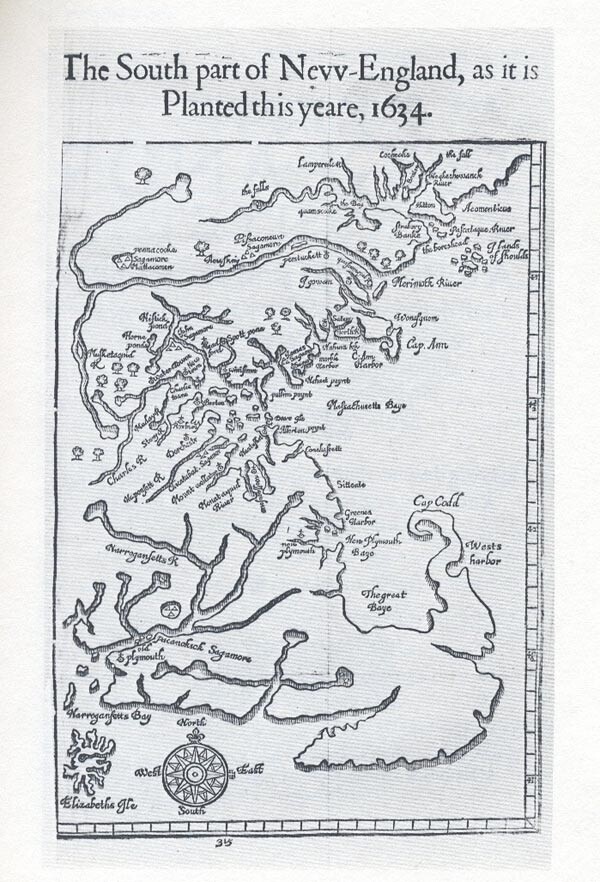
Ten years after Winslow, an Englishman named William Wood published New Englands Prospect in London (1634), a description of the country written for future settlers. He named the same pair, spelled his own way: Winslow’s Kiehtan is Wood’s Ketan, and Winslow’s Hobbamock is Wood’s Abamacho. The people acknowledged two chief powers, Wood wrote. Ketan was their good God, thanked after a good harvest and petitioned for rain, fair weather or health. If Ketan did not listen, the healers, whom Wood calls pow-wows, turned to their charms.
The other was “Abamacho (the Devill) whom they much feare”. According to Wood, people would rather sleep by an English fire than walk a quarter of a mile home in the dark, because of him. When good people died, their souls went to a paradise in the southwest. Enemies and “loose livers”, people who lived badly, went instead “to the infernall dwellings of Abamocho, to be tortured”.
Wood was open about how much of this he had from others. Of one healer’s marvels, such as making water burn, he wrote, “this I write but upon the report of the Indians”. Nine years later, in 1643, Roger Williams, an English minister who had learned the language of the Narragansett, published thirty-seven divine names that they had given him, and he noted that they called on all of them in their worship. Among them was Kautantowwit, the great god of the southwest, “to whose House all souls go, and from whom came their corn”. Like Winslow’s Kiehtan, he lived where the souls of the dead were going.
How reliable are Winslow and Wood as sources on Wampanoag religion?
The anthropologist Kathleen Bragdon gathered these English reports in Native People of Southern New England, 1500–1650 (1996). She calls the Native peoples of the region the Ninnimissinuok. She also treats the many spellings as two beings: Williams’s Kautantowwit and Winslow’s Kiehtan are one maker for her, and Wood’s Abamacho and Winslow’s Hobbamock are one power. In her reading, these two were associated with sacred directions, colours and elements such as fire, water and minerals. She adds that some of these peoples may have called Hobbamock Chepi, or that Chepi may have been a separate powerful being.
Bragdon’s central point concerns the frame the English brought along. The likeness between these powers and the Christian God and devil, she writes, was only partial: “the opposition of good and evil expressed in the Christian concept had no exact equivalent in the beliefs of the Ninnimissinuok.” She also writes that the maker’s “distant benignity”, his far-off goodness, “was less significant than the more local and powerful, if more ambivalent” power beside him.
The English had this frame ready early. Francis Higginson, an English minister who reached Salem in 1629, wrote within three months of his arrival that the Indians “do worship two Gods, a good God and an evil God”. On the pniese, Bragdon adds that Winslow writes at length about them, but they are not mentioned elsewhere, so the origin of the title is unclear.
In the books quoted here, what the two powers meant to the people who called on them reaches us only through English pens, and even Winslow conceded that he knew neither the name nor the office of one whole group of their holy people. The Wampanoag are a living people: the Aquinnah Wampanoag gained federal recognition in 1987 and the Mashpee Wampanoag in 2007.
According to William Wood, a great dog lay at the gate of the paradise in the southwest and snarled at the unworthy. So the dead were buried with bows and arrows to frighten the dog away, and with wampum, the shell beads used as money, to buy themselves a better place inside.
How did the name Hobbamock reach an English court?
Almost thirty years after Winslow’s book, the name turned up in an English court record in New Haven, a colony on the coast of today’s Connecticut. On 4 August 1653 the colony’s court of magistrates heard Elizabeth Godman, a woman who had summoned a whole row of neighbours. She complained that they “had given out speeches that made folkes thinke she was a witch.”
She blamed one neighbour above all, Mrs Atwater. Godman said that Mrs Atwater had said “she thought she was a witch and that Hobbamocke was her husband”. She could prove none of it. When the historian Samuel Drake printed the record in 1869, he explained the name for his readers as “the Divil of the Indians”. The court ruled that she had called her neighbours to court without cause, and that her own behaviour made her “suspitious of witchcraft”. It warned her that “if further proofe come, these passages will not be forgotten”, and told her to stop going to other people’s houses “in a rayling manner”.
Further proof, as the neighbours saw it, did come. In August 1655 Godman was jailed on fresh witchcraft suspicions, including spoiled beer at the home of Mr Hooke. She was released in September because of her health and stood before the magistrates again in October. The court found the evidence insufficient to take her life, but noted that suspicions were “cleere and many”. She had to pledge fifty pounds of her estate for her good behaviour. In New England witchcraft could carry the death penalty, and the region’s first recorded execution for it took place at Hartford in 1647, a story told in the history behind The Witch (2015).
In 1624 Winslow had written the name down from Wampanoag sickbeds, as a power that healed the sick and that nobody saw come while the English were in the room. In the New Haven record of 1653, Hobbamocke stands as the husband a neighbour was said to have given to an Englishwoman.