Myths and Folklore.

Huan Jing and the Dead Chickens

The Legend Behind the Double Ninth Festival

The Huan Jing legend of the Double Ninth Festival: a family flees up a hill, their animals die at home. Where the story comes from, and what zhuyu really was.

Huan Jing and the Dead Chickens: The Legend Behind the Double Ninth Festival
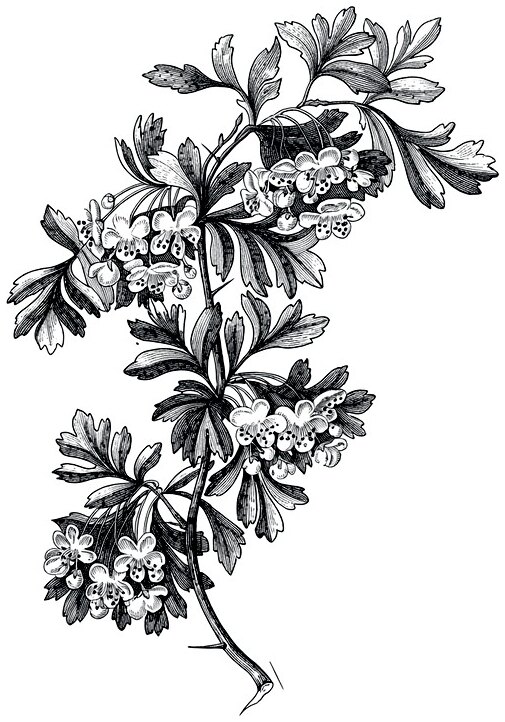
House engraving after the woodcut of wu zhuyu in Wu Qijun, Zhiwu mingshi tukao (1848), via Wikimedia Commons (public domain).

The Double Ninth Festival falls on the ninth day of the ninth month of the Chinese moon calendar. In 2026 that day is 18 October. Its best-known origin story is short and grim: a teacher warned his student Huan Jing that disaster would strike his home on that day, so the family fled up a mountain and stayed there until evening. When they came home, every farm animal on the place was dead.

What is the Huan Jing legend of the Double Ninth Festival?

In the legend a family escapes a disaster by climbing high, and their animals die in their place. The tale comes from a book of strange stories written in southern China around 500 CE. The teacher’s orders include bags of zhuyu, a strong-smelling plant, and wine made from chrysanthemums. The whole tale fits in a few lines:

“Huan Jing travelled and studied with Fei Changfang for many years. Fei said to him: ‘On the ninth day of the ninth month, disaster will come to your household. Leave quickly. Have each person make a crimson bag, fill it with zhuyu and tie it to the arm. Climb high and drink chrysanthemum wine, and the calamity can be removed.’

“Huan Jing did as he was told and took the whole family up a mountain. Coming back in the evening, they saw that the chickens, dogs, cattle and sheep had all died suddenly at once.”

Fei’s answer was brief: “These could stand in for you.”

The tale closes with the customs it explains, and a guess at their start. People still climb high and drink wine on the ninth day, and women wear zhuyu bags: “This is probably where it began.”

The book itself had a rough history. Editors of a later imperial library suspected that it was lost early and pieced back together from anthologies. Commentators were already quoting the Huan Jing tale around 600 CE, so the story is at least that old.

Who was Fei Changfang, the teacher who gave the warning?

Fei Changfang was a famous wizard long before anyone told the festival tale. The official history of the Later Han dynasty, compiled in the fifth century, gives him a full chapter among its magicians and healers.
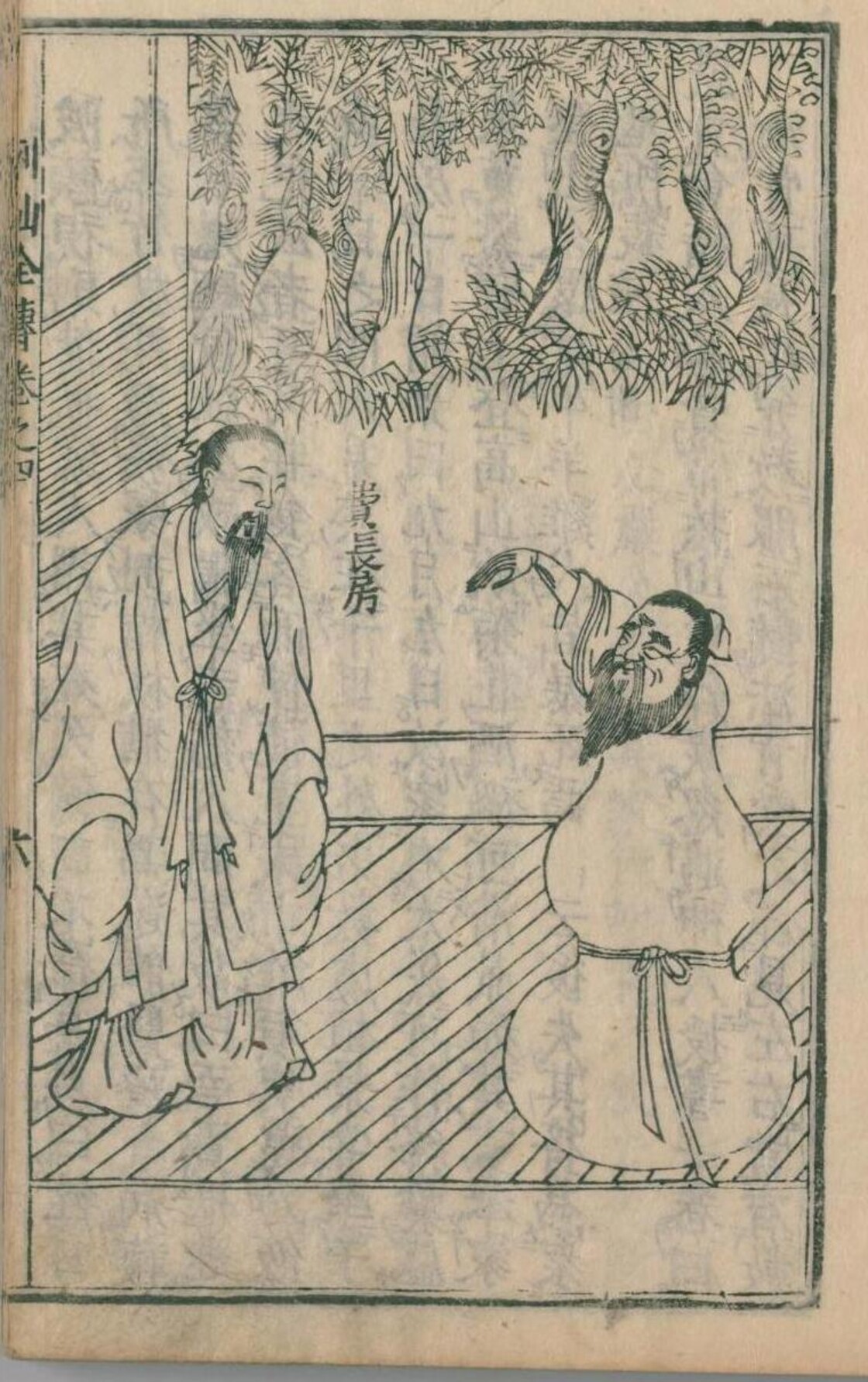
Woodblock print of a standing robed man facing an old bearded man who rises out of a large gourd, trees above, Chinese characters for Fei Changfang between them
The old medicine seller climbs out of his gourd in front of Fei Changfang. The characters between the two figures read ‘Fei Changfang’. From the Youxiang liexian quanzhuan, an illustrated book of the lives of immortals, Japanese printing of 1650. National Diet Library, Tokyo, via Wikimedia Commons. Public domain.

In his chapter Fei follows an old medicine seller who slips into a hanging gourd when the market closes. He learns to heal the sick and gets a talisman for commanding ghosts, and when he later loses it, the ghosts kill him.

Huan Jing, the dead animals, the plant and the ninth day all belong to the later story book. The likeliest reading is that the festival tale borrowed a famous wizard to give its mountain escape weight.

Was the Double Ninth custom older than the story?

The customs are older than the story, and the old texts admit as much. The earliest account sits in a collection of court anecdotes set around 200 BCE, under the first emperor of the Han dynasty. The collection itself was put together centuries later, in the third or fourth century CE.

In it, a former palace maid remembers the ninth day of the ninth month. The court wore zhuyu and drank chrysanthemum wine because “it makes people live long.” In her account the ninth day is a feast for long life.

She even gives the recipe. When the chrysanthemums open, flowers, stems and leaves are picked and brewed with millet, and the wine is ready a year later, on the next ninth day of the ninth month.

In the early third century the ruler Cao Pi, first emperor of the Wei state, sent a friend a letter on that day. “Years go and months come, and suddenly it is again the ninth day of the ninth month,” it begins. “Nine is the yang number, and the day and the month both answer to it.”

Yang is the bright, active force in Chinese thought, and odd numbers belong to it. The letter goes on to say that people liked the day’s name because it suggests lasting long. In Chinese, “nine” and “long-lasting” are both pronounced jiu, and that pun is the usual reading of the line.

Around 600 CE a commentator on a book of seasonal customs owned up to the gap: “The banquets of the ninth day: we do not know in which age they began.” In the very next lines he told Huan Jing’s escape up the mountain.

What is zhuyu: Tetradium, Cornus officinalis or dogwood?

In the legend, the bags of zhuyu on the family’s arms are part of what saved them, but what was inside them is far from obvious. Two different plants carry the name, and the old Chinese books and today’s English guides pick different ones.

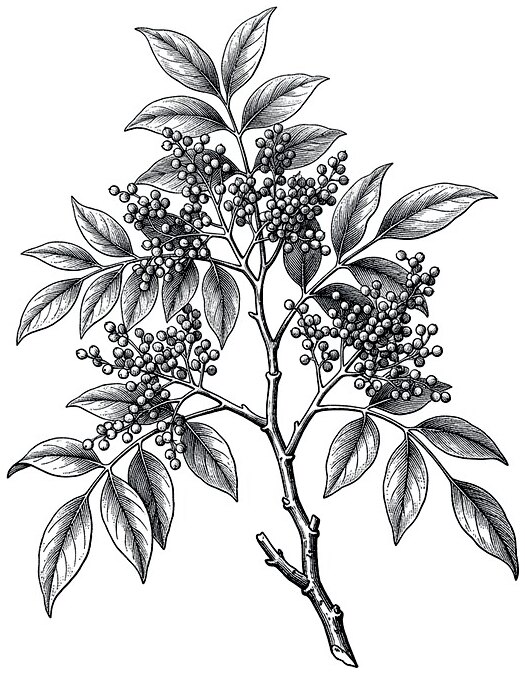
The first plant is a small tree of the citrus family. Chinese medicine calls it wu zhuyu. Its dark fruit tastes bitter and has a strong smell.
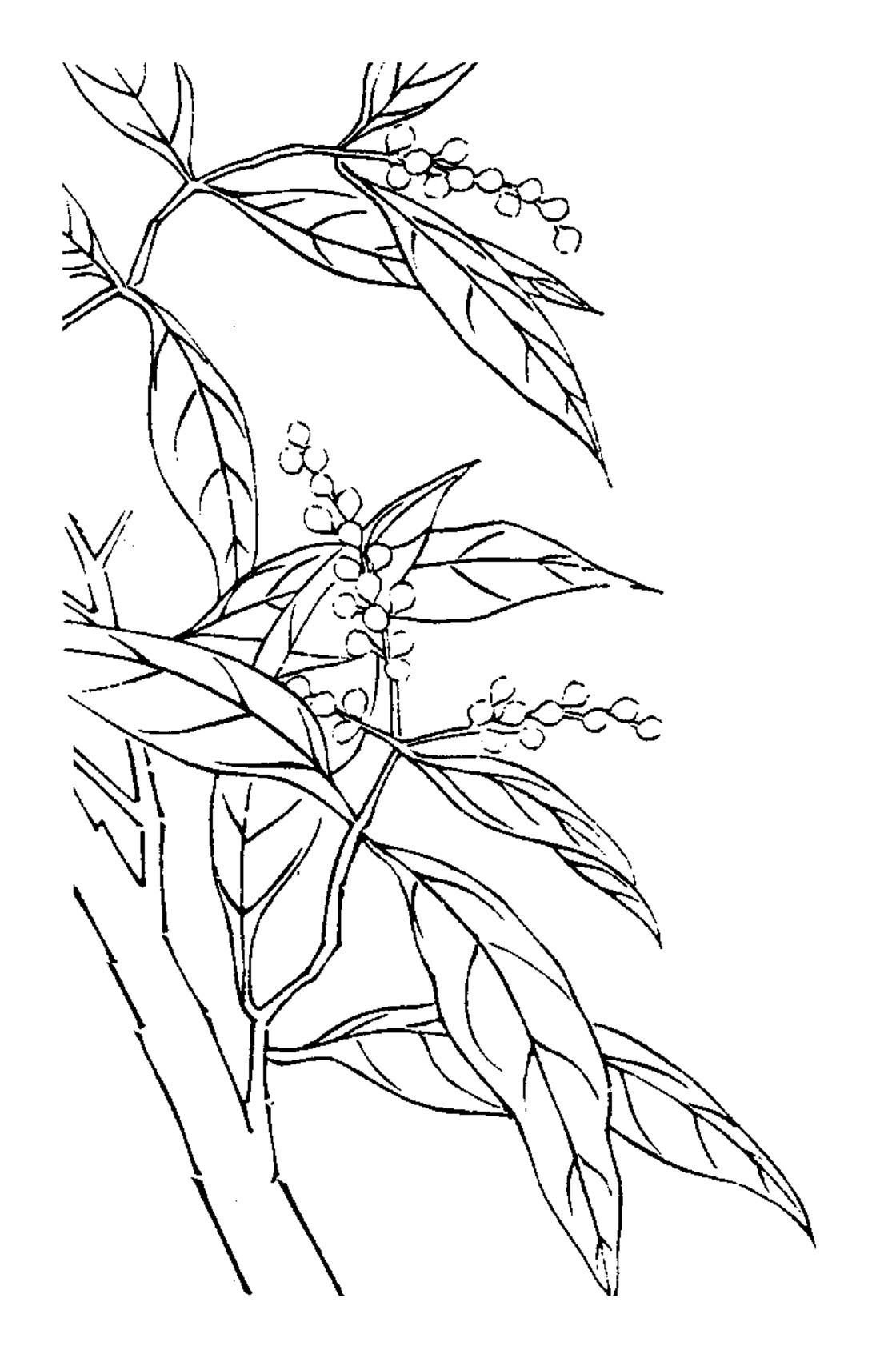
Black-and-white woodcut of a leafy branch with long pointed leaves and several clusters of small round fruits
Wu zhuyu, the strong-smelling tree that the old herbals tie to the ninth day. Woodcut by Wu Qijun in his Zhiwu mingshi tukao (Illustrated Study of the Names and Realities of Plants), 1848. Via Wikimedia Commons. Public domain.

The second is an Asian dogwood called shan zhuyu. Its fruit is bright red and sour, with little smell. Many English sources today name this dogwood as the festival plant and call it “medical dogwood”.
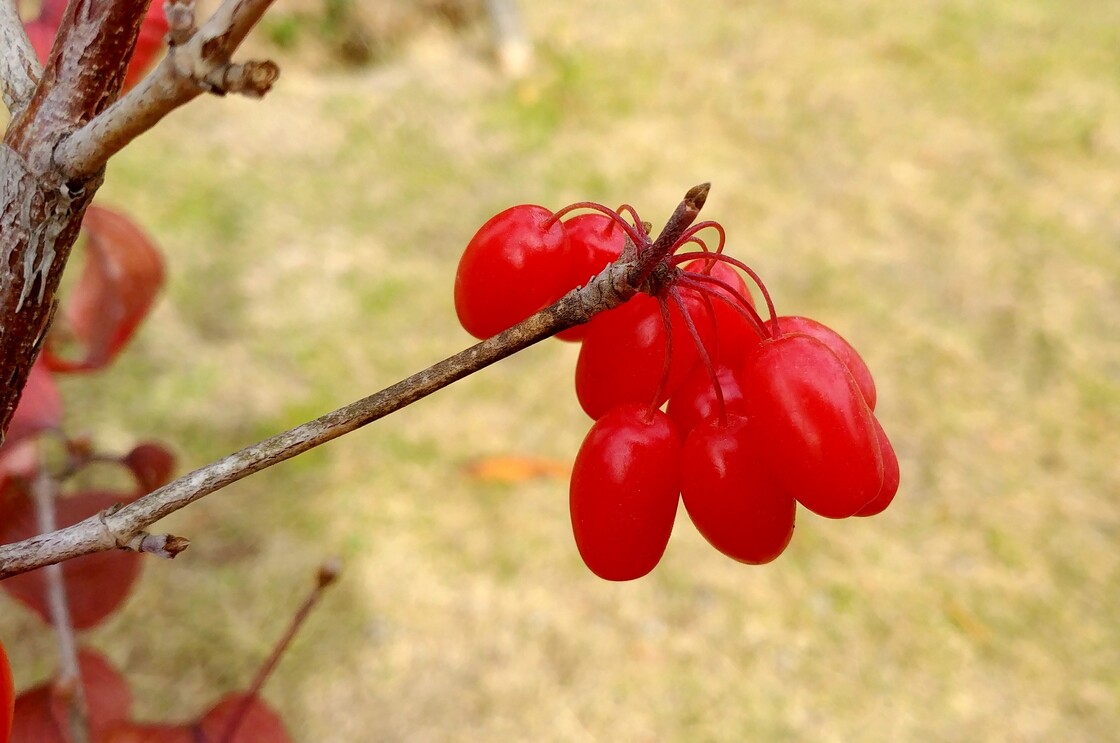
Cluster of shiny oval red berries hanging from a bare twig in autumn
Ripe fruit of Cornus officinalis, the Asian dogwood called shan zhuyu, in October. Many English sources name this as the festival plant. Photo by Choe YongWoo, 2018, via Wikimedia Commons. CC0.

The old Chinese herbals point to the strong-smelling tree and file the festival custom under it. Yet a general writing in the third century already seems to mix the two. His zhuyu on the ninth day “has a fierce smell, and is ripe and red”, and people stuck the fruit clusters in their hair “to ward off evil air and keep out the winter”.

The strong smell fits the citrus tree and the bright red fruit fits the dogwood. An eleventh-century herbal even printed a picture of the dogwood under the heading for the citrus tree.

Does zhuyu really repel insects or germs?

The old herbals set it against pests and spirits alike. In the classic herbal, wu zhuyu “kills the three worms”, parasites that Chinese medicine placed inside the body. The same entry has it treating sickness caused by demons.

Another old text says to plant zhuyu over a well. Its leaves fall into the water, “and people who drink the water get no pestilence.”

Lab tests give that reputation some support: oil distilled from the tree kills or repels grain beetles and booklice. Chemicals taken from the fruit stop a drug-resistant strain of Staphylococcus bacteria in the dish.

These tests used distilled oils and purified chemicals, a long way from a cloth bag of fruit on the arm. The fruit is also mildly poisonous: the old herbal already rates it “slightly toxic”, and a 2023 review counts “increasing reports” of liver damage in people who take it.

Did You Know?

The ninth day of the ninth month was a harvest date before it was a legend. An early Chinese medical text sets that very day for picking wu zhuyu, which was then dried in the shade. Old, long-stored fruit counted as better than fresh.

Why chrysanthemum wine and climbing a mountain on the ninth day?

The chrysanthemum belongs to the season, since it flowers late, after most plants are done. Cao Pi’s letter praises it for “blooming alone” in the ninth month. With the letter he sent a bundle of the flowers “to help the art of Pengzu”, a legendary sage who lived for centuries.

The wine carried the same wish. The palace maid gave the simplest reason for drinking it: “it makes people live long.”

Climbing high has no early explanation of its own. In the Huan Jing tale it is the escape route: the disaster comes to the house, so the family goes up and away. Today the day is also kept for honouring the elderly.
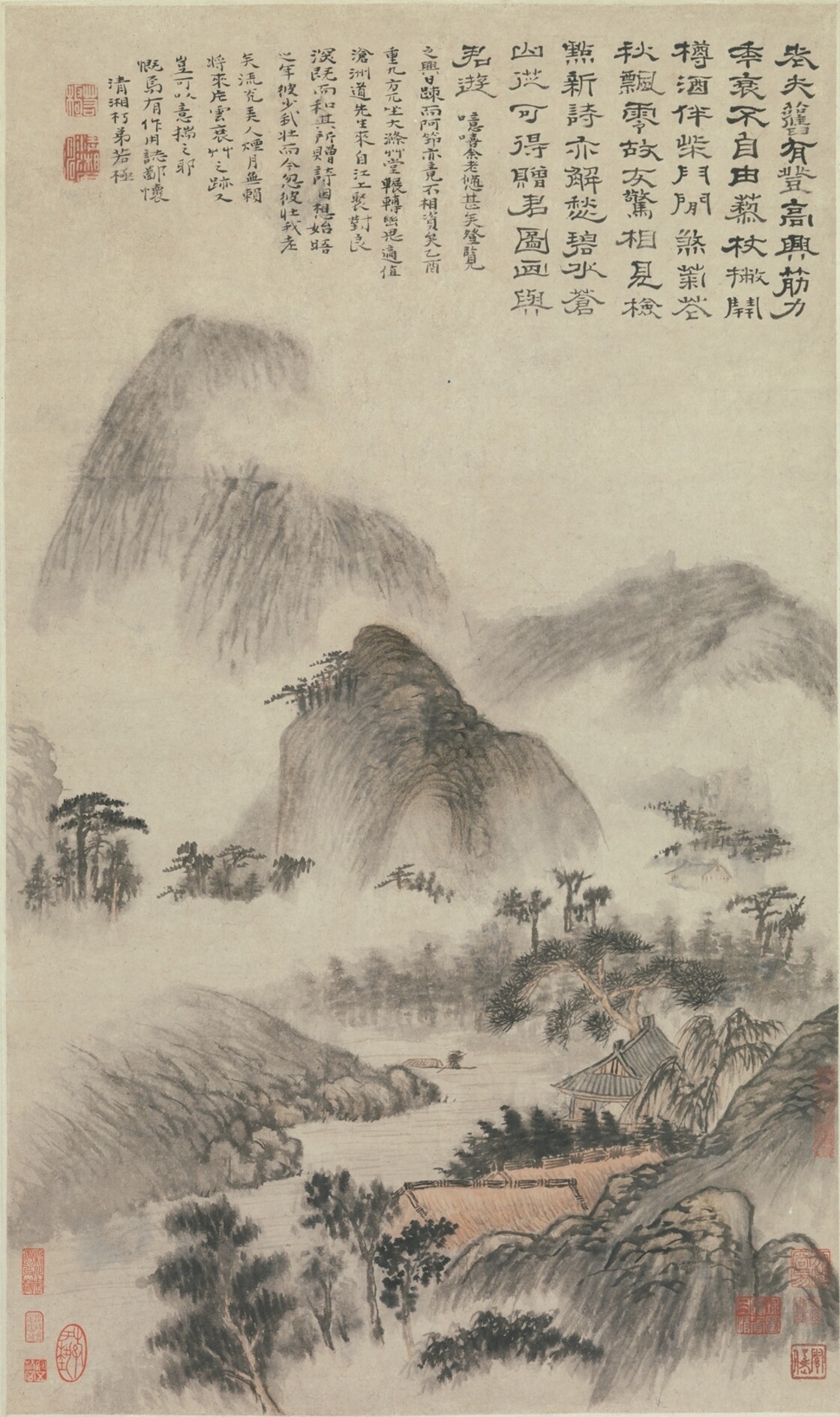
Chinese ink landscape with misty peaks, pine trees, a river and a thatched house, with columns of calligraphy at the top
Shitao, Landscape Painted on the Double Ninth Festival, dated 1705. Hanging scroll, ink and colour on paper, 71.6 x 42.2 cm. The Metropolitan Museum of Art, New York, 1981.285.13. Public domain (Open Access).

The festival’s most famous poem dates from the eighth century. By an old note on the poem, Wang Wei was seventeen and far from home when he wrote it. He pictures his brothers climbing the hill without him:

“Alone in a strange land, a stranger, at every festival I miss my family twice as much. Far away, I know: where my brothers climb high, all wearing zhuyu, there is one man missing.”

The Sources

Every statement in this report rests on these.

  • Wu Jun (469-520), Xu Qi Xie Ji (Sequel to the Records of Qi Xie), entries ‘Climbing high on the ninth day’ and ‘The winding water of the third day of the third month’, with the Siku editors’ note on the text. Chinese Wikisource.
  • Fan Ye (398-445), Hou Hanshu (Book of the Later Han), juan 82B, Biographies of Masters of Techniques, section on Fei Changfang. Chinese Wikisource.
  • Xijing Zaji (Miscellaneous Records of the Western Capital), attributed to Liu Xin and Ge Hong, juan 3, the account of Jia Peilan. Chinese Wikisource.
  • Zong Lin, Jingchu Suishiji (Seasonal Customs of Jing and Chu), with the commentary of Du Gongzhan (Sui dynasty), entry for the ninth day of the ninth month. Chinese Wikisource.
  • Cao Pi (Emperor Wen of Wei), letter to Zhong Yao on the ninth day, quoted in Taiping Yulan, juan 32 (Siku edition), and in Quanfang Beizu, first series, juan 12. Chinese Wikisource.
  • Li Shizhen, Bencao Gangmu (draft 1578, printed Nanjing 1596), Fruits part 4, entries wu zhuyu and shi zhuyu, quoting the Mingyi Bielu, Su Song, Zhou Chu’s Fengtu ji and the Huainan Wanbishu. Chinese Wikisource.
  • Wang Wei, ‘On the Ninth Day of the Ninth Month, Remembering My Brothers East of the Mountains’, Quan Tang Shi juan 128. Chinese Wikisource.
  • Flora of China, vol. 11 (Rutaceae), Tetradium ruticarpum, and vol. 14 (Cornaceae), Cornus officinalis. eFloras.org.
  • Chinese Medicine Regulatory Office, Department of Health, Hong Kong, ‘Fructus Evodiae versus Fructus Corni’, Identification of Easily Confused Species of Chinese Materia Medica in Hong Kong.
  • Z. L. Liu and S. H. Ho, ‘Bioactivity of the essential oil extracted from Evodia rutaecarpa Hook f. et Thomas against the grain storage insects, Sitophilus zeamais Motsch. and Tribolium castaneum (Herbst)’, Journal of Stored Products Research 35, no. 4 (1999): 317-328.
  • Ju-Qin Cao, Shan-Shan Guo, Yang Wang, Xue Pang, Zhu-Feng Geng and Shu-Shan Du, ‘Contact Toxicity and Repellency of the Essential Oils of Evodia lenticellata Huang and Evodia rutaecarpa (Juss.) Benth. Leaves against Three Stored Product Insects’, Journal of Oleo Science 67, no. 8 (2018): 1027-1034.
  • Xiaobei Pan, S. W. Annie Bligh and Eileen Smith, ‘Quinolone Alkaloids from Fructus Euodiae Show Activity Against Methicillin-Resistant Staphylococcus aureus’, Phytotherapy Research 28, no. 2 (2014): 305-307.
  • Chunyan Yan, Ting Peng, Tianyi Zhang et al., ‘Molecular mechanisms of hepatotoxicity induced by compounds occurring in Evodiae Fructus’, Drug Metabolism Reviews (2023).
  • Wikipedia, ‘Double Ninth Festival’ (English), and CGTN, ‘Why do people wear dogwood on the Double Ninth Festival?’ (7 October 2019), for the common English identification of zhuyu as Cornus officinalis.

Filed under Double Ninth Festival · Chongyang · Huan Jing · Fei Changfang · zhuyu · Tetradium ruticarpum · Cornus officinalis · chrysanthemum wine · Chinese festivals · Bencao Gangmu · Chinese folklore.

Pass this report on: Pinterest · Facebook · by Letter · Copy the Address


Questions from Readers

I. Who was Huan Jing, and what did Fei Changfang warn him about?

Huan Jing is the hero of a short tale in the Xu Qi Xie Ji, a collection of strange stories by the writer Wu Jun (469-520). He had studied for years with Fei Changfang, a master of magic arts. Fei told him that disaster would strike his household on the ninth day of the ninth month. Each family member was to tie a crimson bag of zhuyu to the arm. Then they were to climb high and drink chrysanthemum wine. The family spent the day on a mountain. In the evening they found their chickens, dogs, cattle and sheep dead, and Fei said the animals had taken their place.

II. Is the Huan Jing story in the official history of the Han dynasty?

No. Fei Changfang has a full biography in the Book of the Later Han, compiled by Fan Ye in the fifth century. It tells of an old medicine seller who lived inside a gourd and of a talisman for commanding ghosts. Neither Huan Jing nor the ninth day appears anywhere in that chapter. The festival tale comes from the later story collection.

III. What is zhuyu: Tetradium, Cornus officinalis or dogwood?

The word covers more than one plant. Wu zhuyu is Tetradium ruticarpum, a small tree of the citrus family with strong-smelling fruit. Shan zhuyu is Cornus officinalis, a dogwood with sour red fruit. Li Shizhen’s Bencao Gangmu also lists a spicy shi zhuyu used in cooking, and says the meaning of the word itself is unknown. The old herbals file the festival custom under wu zhuyu, while many English sources, including Wikipedia, name Cornus officinalis. A Song-dynasty herbal even printed a Cornus picture under the wu zhuyu entry.

IV. Does zhuyu really repel insects or germs?

Lab studies give it some support. Essential oil from Tetradium has killed or repelled grain beetles and booklice in tests, and alkaloids taken from the fruit stopped drug-resistant Staphylococcus bacteria in the dish. These tests use distilled oils and purified compounds, not a cloth bag on the arm. The fruit is also mildly toxic: the old herbals say so, and modern papers report liver damage from taking it.

V. Why do people drink chrysanthemum wine and climb mountains on the Double Ninth?

Both customs are older than the Huan Jing story. A collection of court anecdotes set in the early Han describes wearing zhuyu and drinking chrysanthemum wine on that day ’to make people live long’. In the early third century the ruler Cao Pi wrote that nine is the yang number, doubled in the date, and that people liked the name because it suggests lasting long. He praised the chrysanthemum for flowering when other plants have finished. In the legend, climbing high is the escape from the disaster.

The Weekly, by Post

Every Tuesday the week’s reports in a few lines, and one book from our press. Free, and you may leave at any time.


More from Myths and Folklore

Kiehtan and HobbamockWhat the Pilgrims Wrote About Wampanoag Religion BlåkullaHow Swedish Witches Flew to the Devil on Maundy Thursday Mile VampirovićA Vampire's Son in Serbian Folklore Why Was the Corner Behind the Stove Called "Hell"?

All 84 reports in Myths and Folklore ☞


From Our Own Press