Myths and Folklore.

Black Llamas in Cuzco

Why the Inca Kept a Llama Hungry Until It Rained

The black llama rain ritual of Cuzco: when the October rains failed, the Inca tied an all-black llama on open ground and fed it nothing until rain came.

Black Llamas in Cuzco: Why the Inca Kept a Llama Hungry Until It Rained
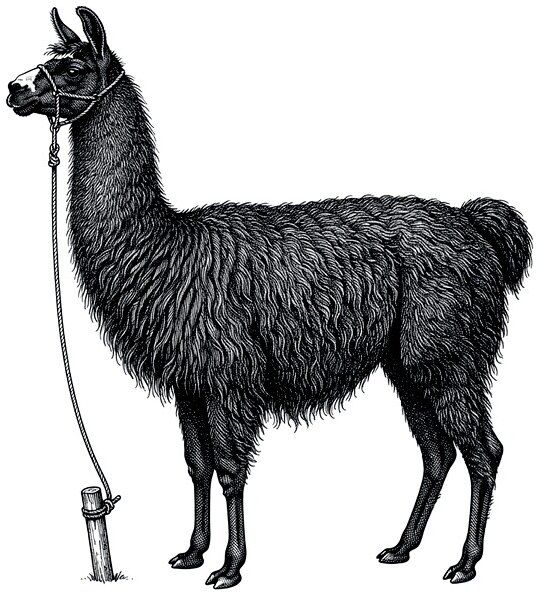
House engraving after a photograph of a black llama by Sanjay Acharya, Wikimedia Commons 'Black Llama Side.jpg' (CC BY-SA 4.0); the rope tether and stake follow Guaman Poma's drawing of the October rain rite (Nueva corónica, 1615, p. 254 [256], Det Kgl. Bibliotek, public domain).

When the October rains were late, the people of Cuzco took an all-black llama and tied it on open ground. They poured maize beer on the earth around it and gave it nothing to eat until rain fell.

The animal’s hunger was part of the prayer, since its suffering was meant to move the sky. An account printed in 1585 says people were still doing it in many places at that time of year.

This is the black llama rain ritual of the Inca. The animal tied on the ground may have had a twin in the night sky: a black llama in the Milky Way that drinks the sea at midnight.

What was the black llama rain ritual in Cuzco?

The oldest printed account explains the rite in a single paragraph. A Spanish magistrate in Cuzco, Polo de Ondegardo, recorded it after questioning local elders in the 1550s.

His notes were printed in Lima in 1585, in a handbook meant to help parish priests recognise traditional feasts. The black llama belongs to the month around October.
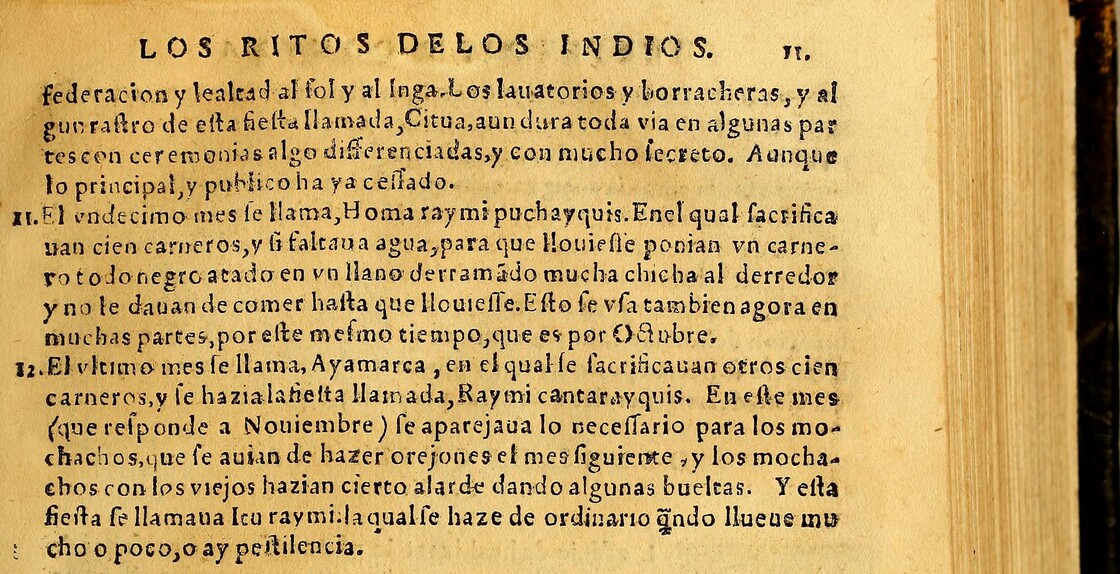
A page of an old Spanish book in sixteenth-century type, with paragraphs numbered 11 and 12 and the running head Los ritos de los indios
The oldest printed account of the rite. Paragraph 11 names the month Homa Raymi Puchayquis and describes the all-black llama tied on a plain until it rained. It ends: ‘This is also done now in many places, at this same time, which is October.’ Confessionario para los curas de indios, Lima: Antonio Ricardo, 1585, leaf B3r. John Carter Brown Library, via Internet Archive, public domain.

In that month, Polo wrote, they sacrificed a hundred llamas. If water was lacking, they tied an all-black llama on a plain, poured a lot of chicha (maize beer) around it, and gave it nothing to eat until it rained. Spanish writers of the time called the llama carnero, a ram, and every source here uses that word.

Why were the llamas denied food during the Inca rain ritual?

The writers give two reasons. One says the hunger was meant to move the Sun. The other says it helped the people weep.

The Jesuit historian Bernabé Cobo added further detail in 1653. The llama was picked from the herds dedicated to the Sun, and it had to be completely black. “Out of pity at seeing it suffer, the Sun would make it rain,” the people said.

If the rain still held off, the men who served at the sacrifices gathered by the animal. Each held two cups of chicha. He drank one and poured the other on the ground as an offering.

Did You Know?

Colour mattered in every Inca sacrifice. Llamas the brown colour of the wild guanaco went to the creator god Viracocha, white ones to the Sun. The rain rite called for one that was black all over.

What does the Andean drawing of the rite show?

Felipe Guaman Poma de Ayala was an Andean author who addressed a book of nearly 1,200 pages to the king of Spain. He finished it around 1615 and filled it with his own drawings. The manuscript is now in the Royal Library in Copenhagen.

His page for October shows a llama tied by a rope to a short stake. Next to it walks a line of people, faces wet with tears. Written along the animal’s neck is a line in his Spanish: “The black llama helps to weep and to ask God for water with the hunger it has.”
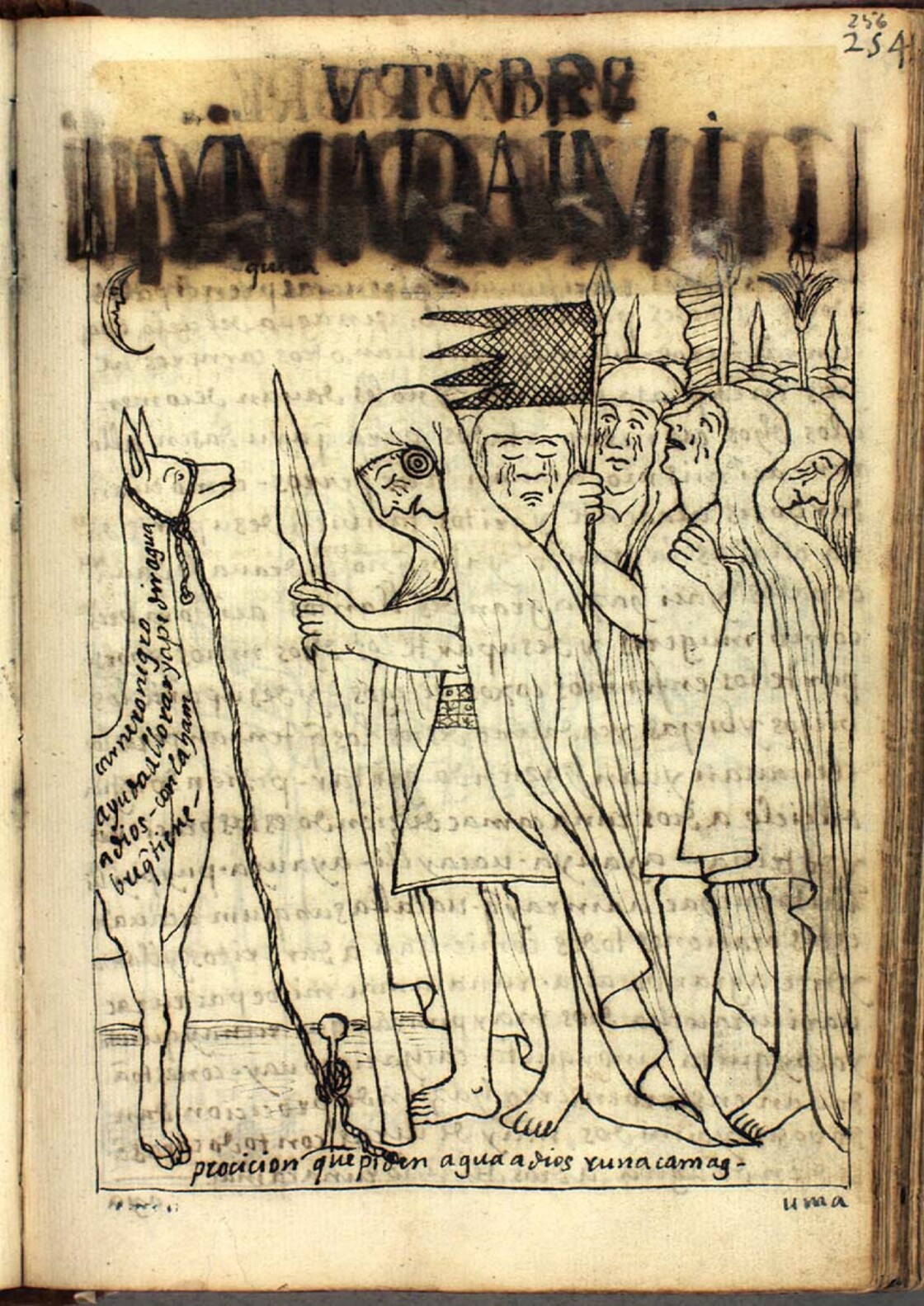
Pen drawing of a tall llama tied by a rope to a small stake, beside a procession of weeping men and women with tears on their faces, one holding a spear
October, Uma Raimi Quilla. The llama on the left is tied to a stake, and the writing on its neck says it helps the people weep and ask for water with its hunger. Below runs the line ‘procession in which they ask God the creator for water’. The heavy title at the top shows through from the facing page. Felipe Guaman Poma de Ayala, Nueva corónica y buen gobierno, 1615, p. 254 [256]. Det Kongelige Bibliotek, Copenhagen, GKS 2232 4°, public domain.

The text on the facing page fills in the scene. A hundred white llamas went to the huacas, the local holy places and their gods, so that they would send water from the sky. The black llamas stood tied in the public square, unfed, so that they would help with the weeping.

Dogs were tied up as well. When they saw people shouting, they howled along, and a dog that would not bark was beaten. The whole town wept, children and old people, the sick and the blind among them.

The people walked in procession from hill to hill, crying out to the creator: “Where are you? Send your water and your rain to your people!”

What did Cristóbal de Molina actually write in 1575?

One major Cuzco source leaves out the black llama entirely. Cristóbal de Molina, a Quechua-speaking priest writing in the 1570s, recorded boy initiations and beer brewing for October instead.

Molina still has a story about hungry llamas. In it, one month before the great flood, the llamas of a herder grew sad. They ate nothing by day and stared at the stars at night. When the herder asked why, they told him the stars were agreeing that the world would end in water. He took his six children up a high mountain, and the mountain grew as the water rose.

How does Uma Raymi connect to the October rains in the Andes?

Uma Raymi, the water festival, is the Inca month around October, when the rite was used if the rain was late.

The month also points to the sky. In a Quechua book of myths from Huarochirí, written down around 1600, a llama called the Yacana walks along the Milky Way. People see her “coming very black”, with two eyes and a long neck.
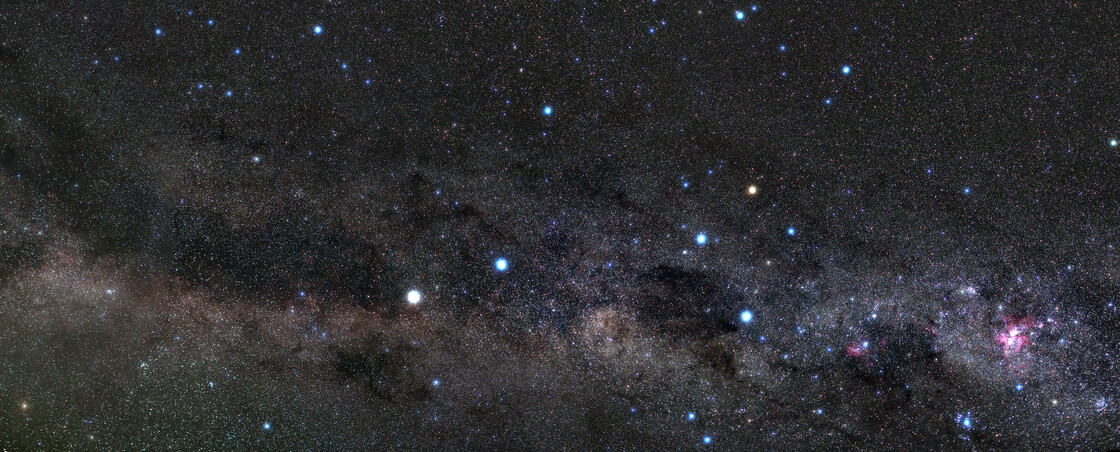
Night sky photograph of the southern Milky Way with dark dust lanes, two bright white stars on the left and the four stars of the Southern Cross on the right
The two bright stars left of centre are Alpha and Beta Centauri, which Quechua speakers around Cuzco still call the llama’s eyes. The dark lanes of the Milky Way around them form the black llama of the sky. The Southern Cross stands to their right. Photo taken in Chile in February 2020 by Uwe Reichert / IAU OAE, Wikimedia Commons, CC BY 4.0.

At midnight the Yacana drinks all the water of the sea, when no one sees her; if she did not, the sea would flood the world. Her two eyes are the bright pointer stars Alpha and Beta Centauri, and from about 23 October both stars sink below the southern horizon at midnight, so the sky llama does drink unseen. In 1976 the anthropologists R. Tom Zuidema and Gary Urton suggested a symbolic link between this black llama in the sky and the black llama tied in the square below.

Molina’s sad flood llamas fit their reading: their sadness, the two suggested, was perhaps the same sadness Cuzco expected of its black llama.

Did You Know?

In the same Huarochirí book, the sky llama sometimes fell on a lucky man at night. Others sheared her wool, which was blue, white, black and brown all mixed. The man bought one pair of llamas and soon owned two or three thousand. The tale shares its landscape with the mythical trickster Coniraya.

Polo has a sky llama too. Herders honoured a star called Urcuchillay, “a llama of many colours”, which looked after the herds. Every animal on earth, he adds, was thought to have its double in the sky.

Do llama skeletons on ritual sites confirm the practice?

Archaeology shows part of the story. In 2020 a team led by the archaeologist Lidio Valdez published five sacrificed llamas from Tambo Viejo, an Inca centre on the south coast of Peru. The dry air had mummified them.

All five were young. Three white llamas and one brown lay under the clay floor of one building, and another brown one under a second. They wore necklaces and coloured tassels in their ears. Their legs had been tied, and there were no cut marks. The team thinks they may have been buried alive.

The finds confirm that sacrificial animals were chosen by coat colour, but they mark a political founding feast rather than a plea for rain. None of the buried animals was black.

The rain rite itself leaves little for spades to uncover, because in no source is the animal killed: it stood tethered until the rain came. For rain at other times, Molina records that in July the priests asked the thunder god Illapa to send his waters and hold back the hail.

What did the Spanish make of it?

Polo’s list was printed so that priests could spot the old feasts and stop them. His next chapter turns to a feast called Itu, held in times of great need, when it rained too much or too little or when plague came. People fasted for two days, then walked in slow procession with drums, their heads covered, without a word.

The 1585 print adds that people still held the Itu in disguise, inside the Corpus Christi dances called llamallama, and that priests should watch them closely.
The Sources

Every statement in this report rests on these.

  • Polo de Ondegardo, ‘Los errores y supersticiones de los indios, sacadas del tratado y averiguación que hizo el Licenciado Polo’, chapter 8, no. 11, in Confessionario para los curas de indios, Lima: Antonio Ricardo, 1585, leaf B3r (fol. 11). John Carter Brown Library copy, Internet Archive confessionariopa00cath.
  • The same text reprinted as ‘Instrucción contra las ceremonias y ritos que usan los indios conforme al tiempo de su infidelidad’, Revista Histórica (Lima), vol. 1, 1906, pp. 207 and 216-217 (chapter 1 on the star Urcuchillay; chapter 8 on the months).
  • Felipe Guaman Poma de Ayala, El primer nueva corónica y buen gobierno (1615), Copenhagen, Det Kongelige Bibliotek, GKS 2232 4°, drawing 99, p. 254 [256], and text p. 255 [257], ‘Uma Raymi Quilla’. Digital edition and transcription: poma.kb.dk.
  • Bernabé Cobo, Historia del Nuevo Mundo (completed 1653), ed. Marcos Jiménez de la Espada, vol. 4, Seville: Sociedad de Bibliófilos Andaluces, 1895, book 13, chapter 21 (pp. 80-81, colours of sacrificial llamas) and chapter 30 (pp. 118-119, the eleventh month).
  • Cristóbal de Molina, Relación de las fábulas y ritos de los incas (c. 1575), critical edition by Paloma Jiménez del Campo, Madrid and Frankfurt: Iberoamericana and Vervuert, 2010 (the Ancasmarca flood story, the months of July, September and October, and the editor’s introduction on dating).
  • Cristóbal de Molina, Account of the Fables and Rites of the Incas, translated and edited by Brian S. Bauer, Vania Smith-Oka and Gabriel E. Cantarutti, Austin: University of Texas Press, 2011.
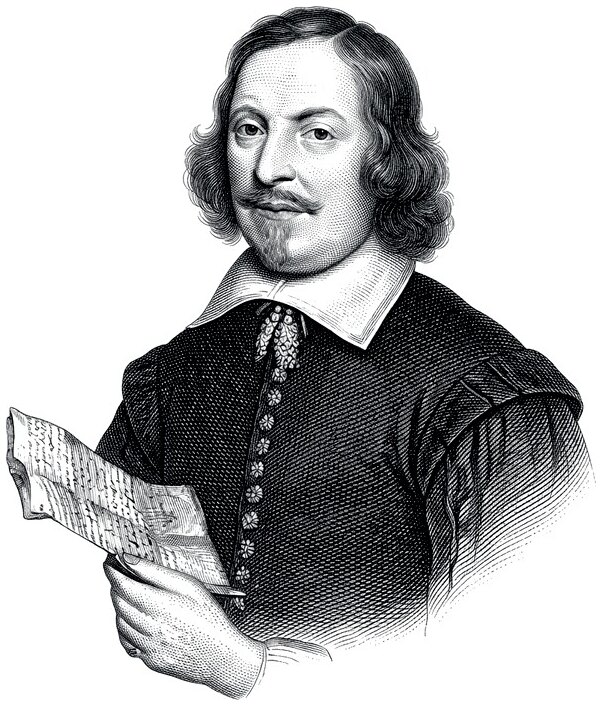
  • R. Tom Zuidema and Gary Urton, ‘La constelación de la Llama en los Andes peruanos’, Allpanchis 9 (1976), pp. 59-119 (including chapter 29 of the Huarochirí manuscript in J. M. Arguedas’s Spanish translation, and Juan de Betanzos on the month Omaraimiquis).
  • Lidio M. Valdez, Katrina J. Bettcher and Marcelino N. Huamaní, ‘Inka llama offerings from Tambo Viejo, Acari Valley, Peru’, Antiquity 94, no. 378 (2020), pp. 1557-1574, doi:10.15184/aqy.2020.183.
  • ‘Mummified Remains of Sacrificed Llamas Found in Peru’, Archaeology Magazine, 23 October 2020; ‘Sacrificial llamas found buried in Peru shed light on Incan rituals’, The Guardian, 22 October 2020.
  • ‘Polo de Ondegardo’, English Wikipedia (citing Teodoro Hampe Martínez 2016), accessed 13 October 2026.
  • Uwe Reichert / IAU OAE, ‘Cen-Lup-Cru-Panorama: Centaurus Carrying the Beast and Riding Along the Milky Way’ (ann22042p), Wikimedia Commons, CC BY 4.0.
  • Sanjay Acharya, ‘Black Llama Side.jpg’, Wikimedia Commons, CC BY-SA 4.0 (reference for the cover engraving).

Filed under Inca · Quechua · Cuzco · llamas · rain ritual · Uma Raymi · Guaman Poma · Polo de Ondegardo · Bernabé Cobo · Cristóbal de Molina · Yacana · Andean astronomy · huaca · Viracocha.

Pass this report on: Pinterest · Facebook · by Letter · Copy the Address


Questions from Readers

I. What did Cristóbal de Molina actually write about black llamas in Cuzco around 1575?

Nothing about a rain rite. Molina was a Quechua-speaking priest in Cuzco who wrote a month-by-month account of Inca ceremonies for the bishop, some time after 1573. His October is about boys preparing for their initiation and about brewing maize beer for the great feast of Capac Raymi. The black llama tied up for rain comes from other writers: an account by the Cuzco magistrate Polo de Ondegardo, printed in Lima in 1585, the Andean author Guaman Poma around 1615, and the Jesuit Bernabé Cobo in 1653. Molina does tell a flood story in which llamas stopped eating by day and stared at the stars by night, a month before the waters came.

II. Why were the llamas denied food during the Inca rain ritual?

The sources give two reasons. Bernabé Cobo wrote in 1653 that the people said the Sun would take pity on the suffering animal and make it rain. Guaman Poma, an Andean author writing around 1615, says the black llamas were left unfed so that they would help the people weep and ask for water. None of the three main accounts says the llama was denied water, and none says it was killed. It was fed again only when the rain came.

III. How does Uma Raymi connect to the October rains in the Andes?

Uma Raymi is the name the colonial writers gave to the Inca month that fell around October. The 1585 account says the black llama rite was used in that month if the water was lacking, and that people still did it in many places at the same time of year. The modern Copenhagen edition of Guaman Poma glosses the month as the month of the water festival. Older Cuzco sources explain the name differently, after a village called Oma near Cuzco whose people held their festival in this month.

IV. Do llama skeletons found by archaeologists confirm the practice described by the chroniclers?

Not directly. The best-studied Inca llama offerings, found at Tambo Viejo on the south coast of Peru and published in 2020, are five young llamas buried under floors, three white and two brown, with their legs tied and their bodies decorated. They show that the Inca chose sacrificial llamas by colour, as the chroniclers say, but they belong to a founding feast, not to a rain rite, and none of them is black. The rain rite as written down does not kill the llama, so it would leave no skeleton to find.

The Weekly, by Post

Every Tuesday the week’s reports in a few lines, and one book from our press. Free, and you may leave at any time.


More from Myths and Folklore

Kiehtan and HobbamockWhat the Pilgrims Wrote About Wampanoag Religion BlåkullaHow Swedish Witches Flew to the Devil on Maundy Thursday Mile VampirovićA Vampire's Son in Serbian Folklore Why Was the Corner Behind the Stove Called "Hell"?

All 84 reports in Myths and Folklore ☞


From Our Own Press