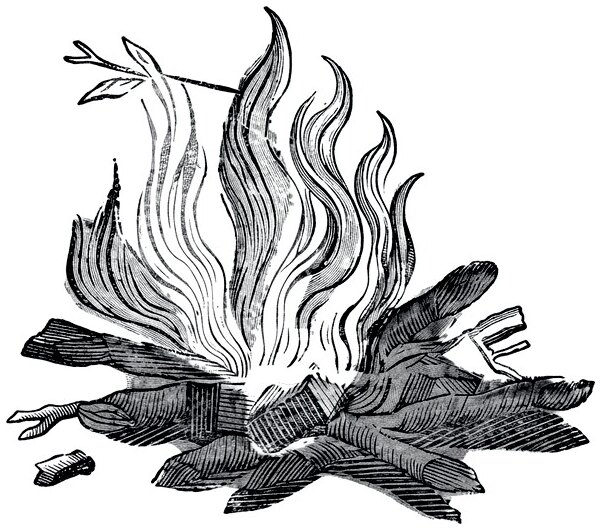
Between 1828 and 1840, people in the Vale of Glamorgan on the south coast of Wales lit what a local writer later called their last Beltane bonfires. Beltane is the old May Day festival of fire. In Glamorgan, nine men emptied their pockets of every coin and every piece of metal, gathered sticks from nine kinds of trees and rubbed two pieces of oak together until they had a flame. Then everyone drew a piece of cake from a bag. Whoever picked a slice of the darker brown-meal cake had to leap three times over the flames.
Where were the last Beltane fires in Glamorgan lit?
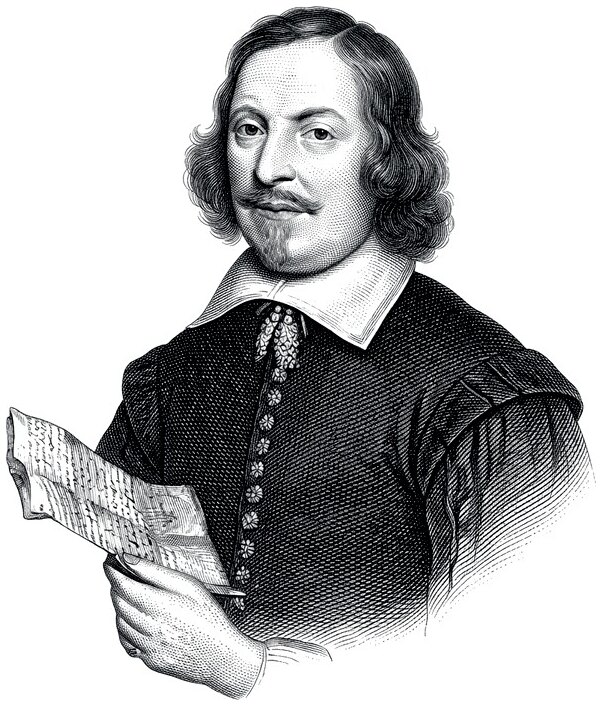
The account comes from one book, Folk-Lore and Folk-Stories of Wales, printed in London in 1909. Its author wrote as Marie Trevelyan. Her real name was Emma Mary Thomas, and she was born in 1853 at Llantwit Major, a small town on the Glamorgan coast. Her chapter on fire festivals names four places where “the latest Beltane fires were kindled” in South Glamorgan, each with a date.
The first was “the common land beside the Well of St. John, Newton Nottage, Porthcawl, in 1828-1830”. The next was Cowbridge, a market town, “about 1833”. Then came a fire “near Nash Manor in 1835”, by a sixteenth-century country house near Cowbridge. The last burned at Llantwit Major “between 1837 and 1840”, in the town where she was born in 1853, so every fire on her list went out before her lifetime began.
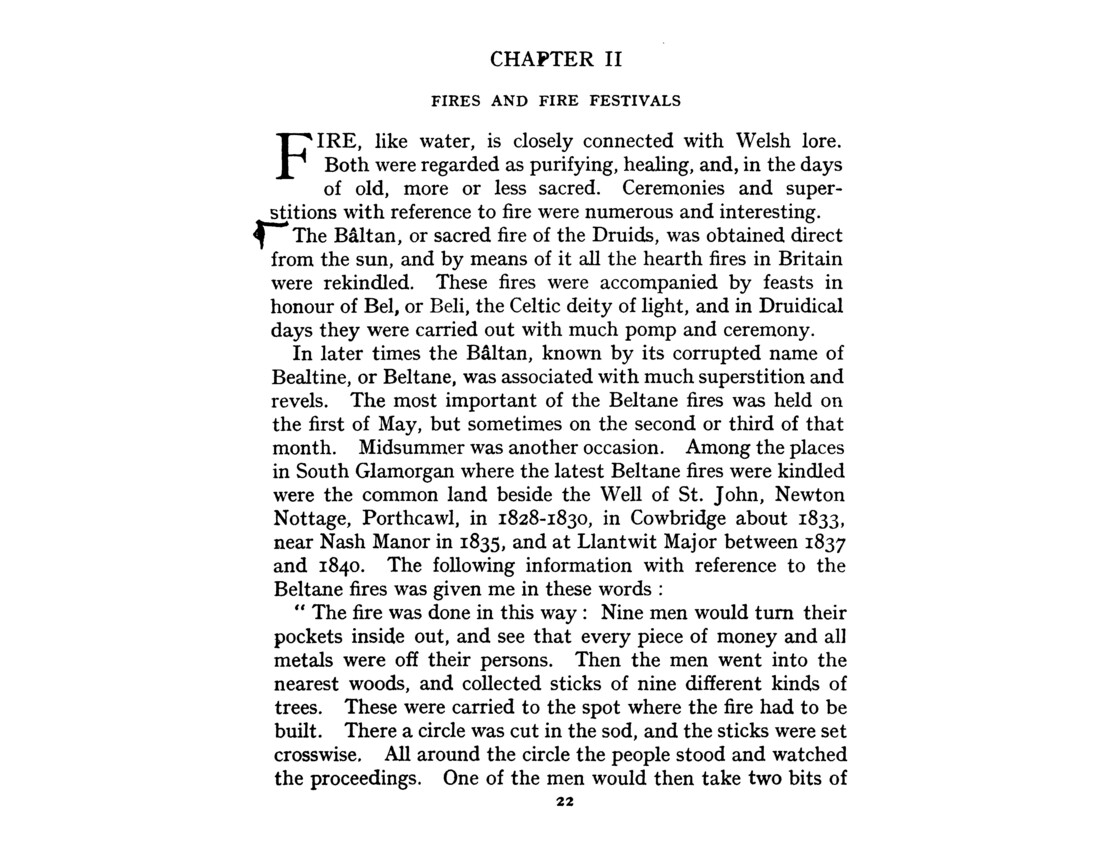
So Trevelyan had not seen the fires herself. She writes that the information “was given me in these words”, and then she quotes a witness for more than a page without naming this person; elsewhere in the book she often marks her sources with initials, but this passage has none. The witness speaks of what “my grandfather and father” told, and of things “I can remember myself seeing”, which takes the account back through three generations of one unnamed family. It tells what people did at the fire step by step, and it almost never says why.
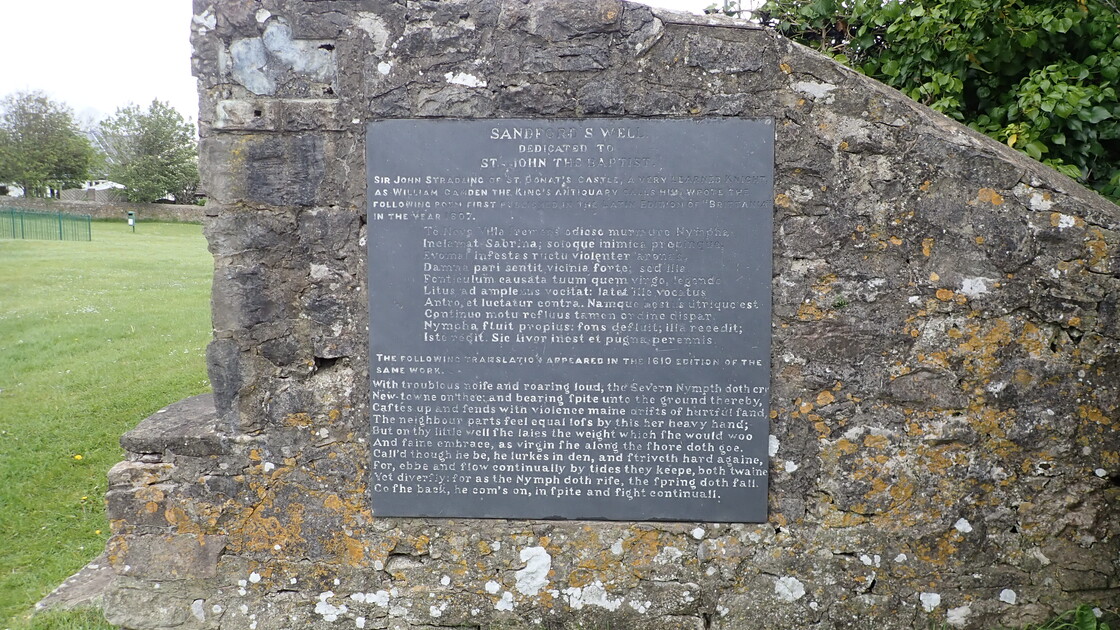
The water in the well beside the first fire site moves the opposite way to the sea. The poet Sir John Stradling described it in Latin verses printed in 1607: it seemed empty when the tide was in and full when the tide was out. The well still stands on the edge of Newton’s village green near Porthcawl, with steps leading down to the water.
How was the fire lit, and why nine men and nine woods?
The witness begins: “The fire was done in this way”. Nine men “would turn their pockets inside out, and see that every piece of money and all metals were off their persons.” Then they went into the nearest woods and “collected sticks of nine different kinds of trees”. They carried the sticks to the place chosen for the fire. There they cut a circle in the sod, the top layer of turf, and laid the sticks crosswise inside it. The people stood all around the circle and watched.
“One of the men would then take two bits of oak, and rub them together until a flame was kindled. This was applied to the sticks, and soon a large fire was made.” Sometimes the men built two fires side by side. Either way the fire was called coelcerth, the Welsh word for a bonfire. The witness adds that the flame was sometimes made “by stone instead of wood friction”.
Nothing in the account says why there had to be nine men, why nine kinds of wood, or why no metal could touch the work. Trevelyan does not explain them either. She opens the chapter with her own belief that the Beltane was once “the sacred fire of the Druids”, the priests of the pre-Christian Celts, taken “direct from the sun”, and held in honour of Bel or Beli, “the Celtic deity of light”. The witness she quotes talks only about what people did and what they hoped it would bring.
How did the cake lot decide who had to leap over the flames?
Once the fire was burning, the lot was drawn. “Round cakes of oatmeal and brown meal were split in four, and placed in a small flour-bag, and everybody present had to pick out a portion.” So there were two kinds of piece in the bag, oatmeal and brown meal. “The last bit in the bag fell to the lot of the bag-holder.”
“Each person who chanced to pick up a piece of brown-meal cake was compelled to leap three times over the flames, or to run thrice between the two fires, by which means the people thought they were sure of a plentiful harvest.” The witness also remembers the noise: the “shouts and screams of those who had to face the ordeal could be heard ever so far”, while those with oatmeal pieces “sang and danced and clapped their hands in approval”.
Then the witness adds a word on the danger: “As a rule, no danger attended these curious celebrations, but occasionally somebody’s clothes caught fire, which was quickly put out.”
The greatest fire of the year, the witness says, was on the eve of May, the evening before the first of May, or on the first, second or third of May. Midsummer Eve had a fire too, which “was more for the harvest”, and “very often” there was one on the eve of November. At Llantwit Major the place was “the high ground near the Castle Ditches”, used “for the Beltane on May 3 and on Midsummer Eve”. Castle Ditches is an earthwork fort from the Iron Age, built before the Romans came to Britain. It has three banks and ditches and stands on sea cliffs above the Col-huw river.
What did the fire have to do with sick cattle?
The witness’s account then turns from harvest to disease. “I have also heard my grandfather and father say that in times gone by the people would throw a calf in the fire when there was any disease among the herds. The same would be done with a sheep if there was anything the matter with a flock.” What the witness saw in person was this: “I can remember myself seeing cattle being driven between two fires to ‘stop the disease spreading.’” Later, when this “was not considered humane”, the herdsmen drove the animals over the wood ashes instead.
The fire was kept from year to year. Charred logs from the May fire were saved, and the next May fire was lit from them, while the midsummer fire was lit from the last summer’s wood. Building a midsummer fire from May wood was unlucky. People carried the ashes home, where “a charred brand was not only effectual against pestilence, but magical in its use.”
Four years after Trevelyan’s book appeared, the Scottish anthropologist James Frazer quoted the account at length in The Golden Bough, his huge study of magic and religion. In the 1913 volume on the fire festivals of Europe it sits under the heading “Beltane fires and cakes in Wales”. But Frazer’s quotation stops after the sentence about Castle Ditches, marks a gap with four dots and starts again where the witness says the fire was sometimes lit from stone, so the calf, the sheep and the cattle driven between two fires are missing from his version.
Burning a beast to save a herd is recorded elsewhere too. In the same volume Frazer prints an account from the Scottish island of Mull in 1767. Cattle disease led the people to carry “a wheel and nine spindles of oakwood” to a hilltop and make fire by friction. “They then sacrificed a heifer, cutting in pieces and burning, while yet alive, the diseased part.” On the Isle of Man the Welsh scholar John Rhys recorded in 1901 a man’s report of a live calf burned on a farm. The farmer’s reason, as Rhys gives it, was “to secure luck for the rest of the herd, some of which were threatening to die”.
Is the Glamorgan fire a need-fire?
A need-fire is a fire made by rubbing wood together, lit as protection against murrain (cattle disease), plague and witchcraft. Wikipedia’s article on Calan Mai, the Welsh May Day, calls the Glamorgan fire a need-fire, but Trevelyan never uses the word; her names for it are Beltane and coelcerth.
For the Scottish Highlands, Frazer quotes John Ramsay, a landowner at Ochtertyre in Perthshire. In papers from the late eighteenth century, Ramsay wrote that the fire had once been lit with tein-eigin, “forced-fire or need-fire”. The night before, “all the fires in the country were carefully extinguished”. In the islands the flame was drilled from a plank of oak, and in some places nine people, “three times three persons”, took turns at the work. If any of them had been guilty of murder, adultery or theft, it was thought “the fire would not kindle”. People held the new fire to be “a sovereign remedy against malignant diseases, both in the human species and in cattle”.
The cake lot has a Scottish twin as well. In 1794 the Reverend James Robertson, minister of Callander, a Highland parish in Perthshire, described the May Day of the boys of his parish. They cut a round table in the turf, made a fire and toasted an oatmeal cake. They broke it into equal pieces and blackened one with charcoal. “They put all the bits of the cake into a bonnet. Every one, blind fold, draws out a portion. He who holds the bonnet, is entitled to the last bit.” The one who drew the black piece had to “leap three times through the flames”.
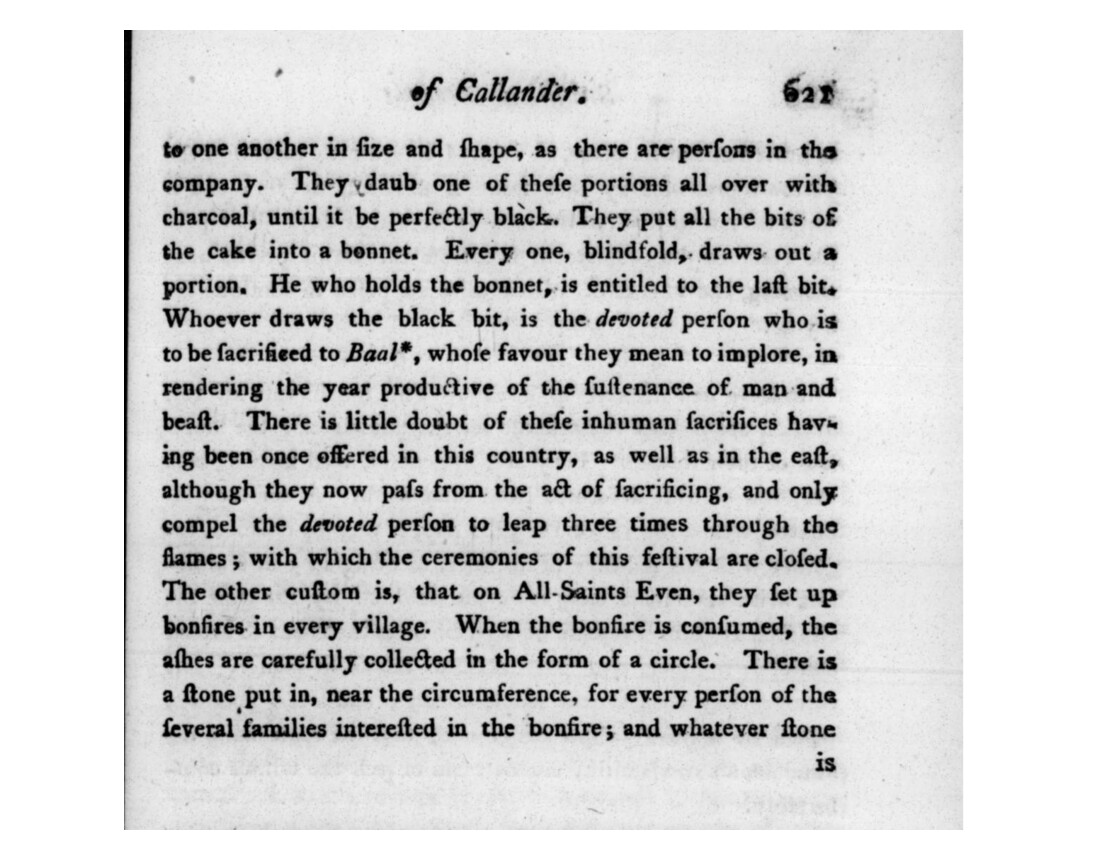
Robertson added his own reading. He called the one who drew the black piece “the devoted person who is to be sacrificed to Baal”, the god of the ancient Near East known from the Bible. In his view there was “little doubt” that people had once really been sacrificed there, and that the leap was what remained of it.
The Glamorgan account and the Callander account match in small details. Both have a circle cut in the turf, a cake divided by lot, a holder who keeps the last piece and a leap made three times. Robertson wrote that such customs were “fast wearing out, not only here, but all over the Highlands”, and none of the sources says how two places so far apart came to share them.
In North Uist in the Outer Hebrides, Frazer recorded that the need-fire was kindled from oak by “nine times nine men”, eighty-one in all. Every one of them had to be a first-born son.
When did the fires end?
By Trevelyan’s list the fires went out one place after another within about twelve years, from Newton Nottage in 1828 to Llantwit Major in 1840. Her book gives no reason for that. In her preface she writes about a time some ten years later, when during “the religious revival of the fifties of the nineteenth century”, the 1850s, “the lore and stories were regarded as gross superstitions, and were held in abeyance, but not wholly suppressed.”
For the same night of the year, the Welsh May Eve when the spirits were said to be abroad, see Nos Galan Mai (Welsh May Eve Spirit Night). The Welsh bonfire of the November eve, with its marked stones and the run home, is told in Hwch Ddu Gwta: Why Welsh Villagers Ran from the Tailless Black Sow.
The witness’s last words are about what people took home from the fire. “A few of the ashes placed in a person’s shoes protected the wearer from any great sorrow or woe.”