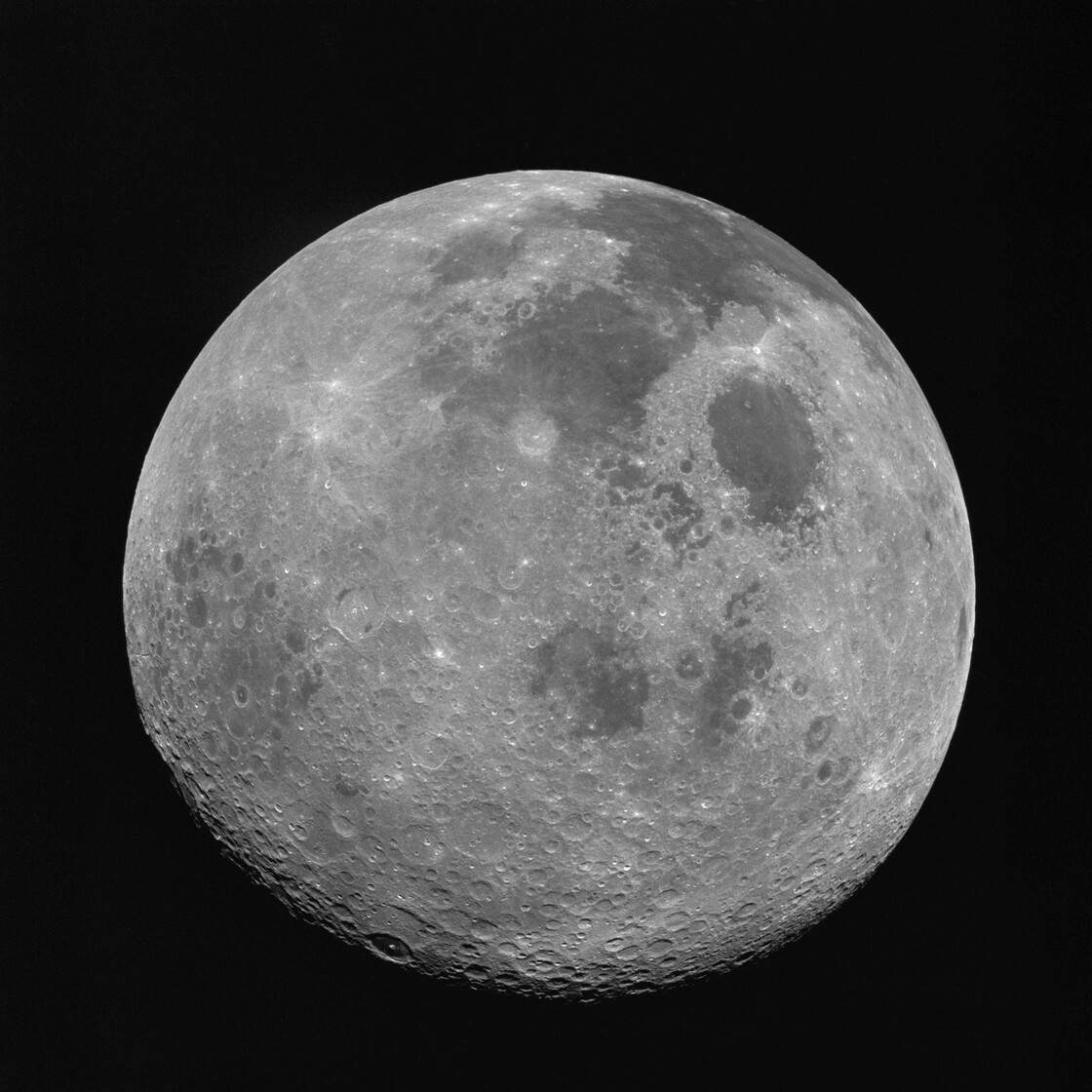
On a clear night a few days past the half moon, the dark plains on the western side of the lunar disc line up into an animal. Two ears and a body bent forward over something. Almost everyone who has looked at the moon has seen something up there, and what they see depends on where they are standing.
The rabbit that alchemists saw on the moon is a pattern in dark basalt, and the alchemists who saw a hare in it were working in a tradition where a hare with a mortar and pestle made sense. Chinese alchemy spent centuries grinding minerals and herbs into elixirs, and the hare it put on the moon does the same job for the immortals. European alchemists looked at the same disc and read a man carrying a thorn bush, and the animal they cooked in their vessels was a toad. Both animals are in the story, and they arrived from opposite directions.
The Sanskrit word for the moon is śaśin, which means “the one with the hare.” The grammatical fossil sits in the language whether or not anyone alive still looks up and sees the animal.
What Is the Rabbit on the Moon Made Of?
The near side of the moon is a mix of bright highland rock and darker plains called maria, from the Latin for seas. The maria are basalt, and they are the shapes the eye latches onto. Marc Thuillard’s 2021 paper in Folklore works from Yuri Berezkin’s motif database, 2,278 motifs recorded from more than 934 peoples, to map where in the world the moon motifs turn up. His starting point is the one thing everyone shares: the moon always shows the same side, so the same pattern of dark spots is visible at every full moon.
The Reverend Timothy Harley, writing in 1885, was more direct about the western patch. From about the eighth day of the moon to the full, he wrote, “it requires no very vivid imagination to descry on the westward side of the lunar disk a large patch very strikingly resembling a rabbit or hare.” What he was describing, shape by shape, is a hare with two ears and a head bent to its forepaws, mapped onto named ground. The ears are the Mare Crisium, the head the Mare Fecunditatis, the forepaws the Mare Nectaris. The animal’s belly rests on the Mare Tranquillitatis, where Apollo 11 landed, and its hindquarters and feet on the Mare Serenitatis and the Mare Vaporum. NASA’s own caption for a photograph taken from Apollo 17 on the way home names almost the same set of plains.
In 2024, Daigo Shoji at the Institute of Space and Astronautical Science in Japan ran the lunar pattern through seven machine-learning architectures to see what they would make of it. He gives the two standard reasons for the rabbit tradition: the colour pattern looks like a rabbit, and the moon and the rabbit are fertility symbols in the same cultures. The result worth holding on to came out of the first architecture he tried. Working with CLIP, Shoji found that the likelihood of the pattern being classified as a face rises with latitude, while low latitudes favour the rabbit. At fifty degrees north, the images came back as “face” with a probability above 0.6. The result lines up with the record from both ends of the map. The oldest writing about a moon rabbit is Indian, the oldest writing about a face in the moon is European, and the images at those latitudes come out the same way.
Shoji ran the binarised lunar pattern through a 1000-class image test as well. The rabbit never won, but it placed: CLIP gave it roughly a two percent probability in one image, second behind the top class, and ranked “tailed frog” in the same top ten.
Was the Rabbit There Before the Toad?
China’s oldest moon animal is the toad, and the toad has the better paperwork.
The Chu Ci, a collection of poems from the Warring States period, asks in its “Heavenly Questions” section what the moon has done to deserve the creature carried in its belly. The word used for that creature, gutu, has been argued over for two thousand years. The commentator Wang Yi, writing in the second century AD, read it as a hare and glossed the line as the moon nursing a rabbit. The poet and scholar Wen Yiduo read the same word as chanchu, the toad, and his reading still has supporters.
What settles the direction of travel is a text older than the argument. The Gui cang, a divination manual written on bamboo slips and buried in the third century BC, tells the story of Heng E stealing the medicine of immortality and fleeing to the moon, and it ends with a sentence that has no hare in it at all: “Heng E subsequently consigned her body to the Moon, and this became the frog.” Thuillard’s conclusion from the two texts is careful and worth repeating in his own words: comparing them suggests that the frog in the moon may have preceded the rabbit in China.
Then there is the fabric. The T-shaped silk banner buried with Lady Dai at Mawangdui, who died around 168 BC, carries a crescent moon in its heaven section with a toad and a smaller hare on it. Thuillard is explicit that this part of the banner is not in doubt, and that the arguments among art historians are about the banner’s other scenes. Whatever those scenes mean, by the second century BC both animals were already up there together.
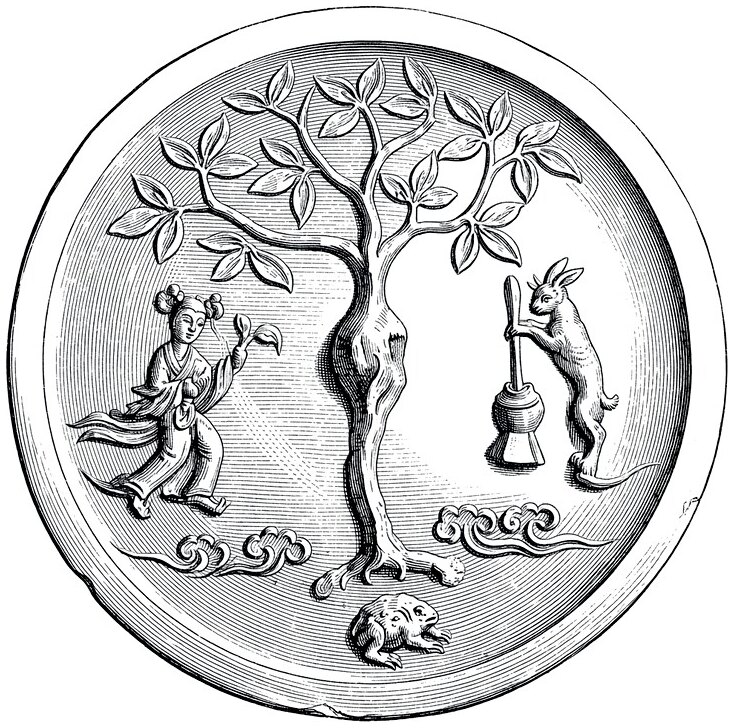
Han poets called the hare the jade hare, or the gold hare, and they gave it something the toad never had. The toad sat on the moon looking like a toad. The hare kneels at a mortar, and a creature at a mortar has a job: grinding the elixir.
Why Would a Hare Be Pounding an Elixir?
Because the people telling the story pounded things. The elixir tradition that runs from Han dynasty courts through medieval Taoist texts relied on mortars and compounding, and its moon animal is an assistant who never stops working.
One of the earliest descriptions of the hare at work is a Han dynasty yuefu song, “Dongtao xing,” preserved in the music chapter of the Song Shu. It shows the jade hare kneeling over its mortar and pounding medicine into a toad-shaped pill for the emperor’s immortality, a recipe that puts the moon’s older animal inside the medicine. Chang’e, the woman who stole the elixir and rose to the moon, is absent from that poem. She turns up in the moon stories later, and from the Wei-Jin period onward the two are found together. Li Bai, in the eighth century, wrote that the rabbit in the moon pounds the medicine in vain.
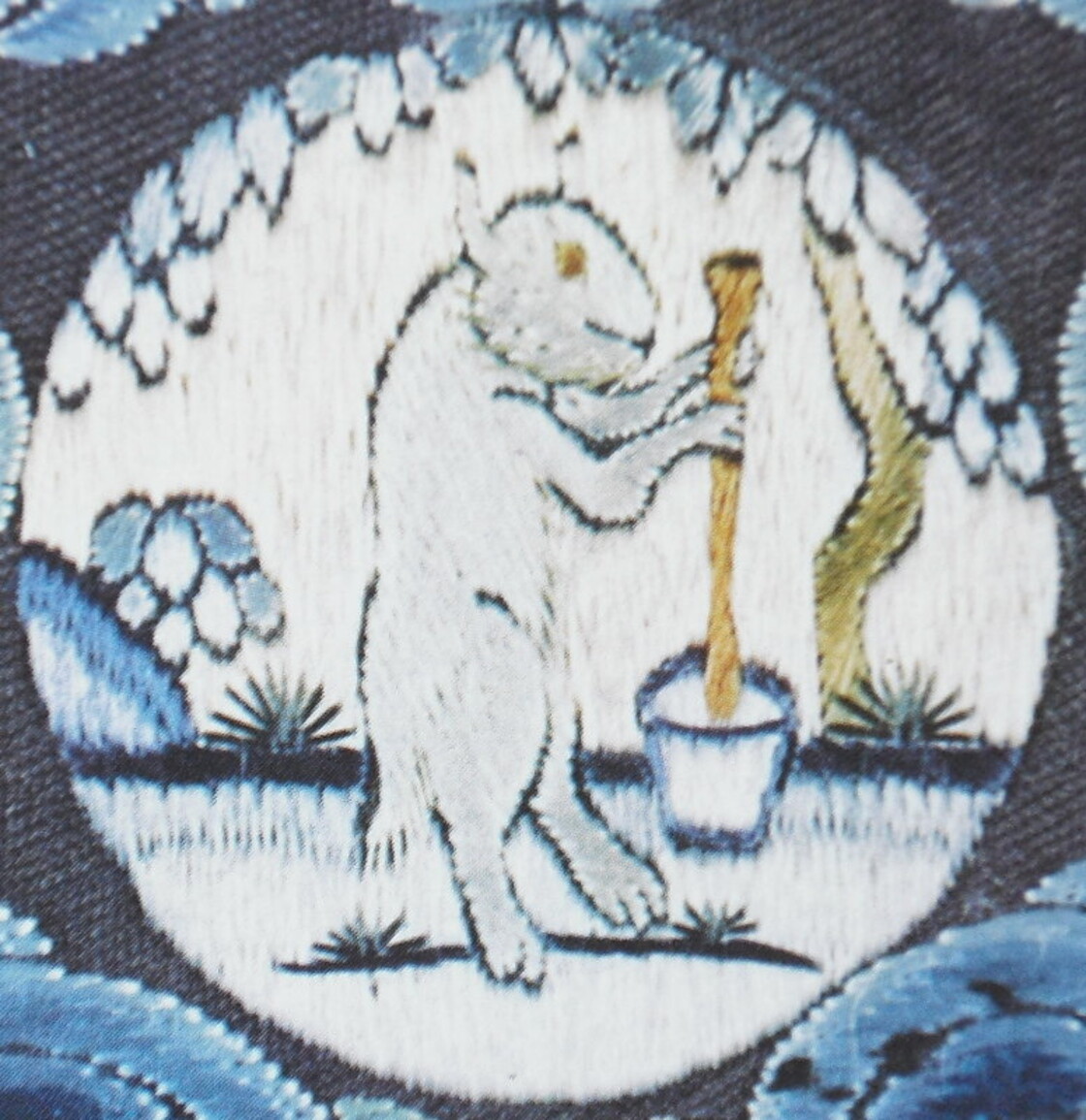
The festival that keeps the picture alive is the Mid-Autumn Festival, on the fifteenth day of the eighth lunar month, when the moon is at its brightest. Moon gazing that night is treated as a way of drawing down lunar qi, and the mooncakes carry an egg yolk in the centre, read as the golden elixir of Taoist alchemy. The hare on the packaging is the same hare Li Bai watched grinding away at nothing.
The story travelled. In the Buddhist version, retold as the Śaśa Jātaka in the Pali canon, a hare who can offer a beggar nothing but grass throws its own body into a fire. The fire refuses to burn it, the beggar turns out to be the god Sakka, and Sakka paints the hare’s likeness on the moon so that everyone can see it. That is the version Buddhism carried across East Asia, and it brings the animal without the mortar. Japan and Korea kept the animal and changed its product. The Japanese hare is pounding rice for mochi; the Korean hare prepares tteok. One explanation offered for the Japanese version is a pun: mochizuki means full moon, mochi tsuki means pounding rice cakes, and once the two phrases were close enough in sound, a mortar in the moon stopped needing a reason.
Did European Alchemists See the Same Rabbit?
Europe looked at the same disc and saw a man, most of the time.
Harley’s 1885 collection lists the sightings across the world, and the European entry is a man with a bundle of thorns, sometimes with a dog. Shakespeare puts him on stage in A Midsummer Night’s Dream and has him name his thornbush and his dog. The Prose Edda, written down around 1220, explains the spots as two children carrying a water bucket, Bil and Hjuke, taken up by the moon god from a well. No animal anywhere in it.
When European magic did assign animals to the moon, it went to the frog. Agrippa’s Three Books of Occult Philosophy has a chapter listing everything under the moon’s rule, from silver and crystal to hounds and cats, and among the fish it names frogs. The hare is not on the list. That is the useful fact in this chapter of Agrippa, because it puts a frog in the hands of any European occultist looking for a lunar animal, and leaves the hare in the moon sitting outside the system.
Agrippa’s lunar list runs past the animals. Among the plants under the moon he names the selenotropion, which turns to face the moon the way a heliotrope turns to face the sun. Whatever plant he meant by the word, the moon had a sunflower of its own.
European alchemy’s animal was a toad, and it lived in the flask rather than in the sky. The Ripley Scroll, a family of alchemical rolls named after a fifteenth-century canon of Bridlington and known in about twenty copies, draws the first matter of the work as a toad putrefying in a vessel. A hand holding a feather points down at the animal, and a line of verse runs across the sheet as the recipe: “you must make water of earth, and earth of Ayer, and ayer of the fyer, and fyer of the earth.” It is the black, unpromising stuff you start with, the thing in the flask that gets cooked, and up in the moon the hare is the one doing the cooking.
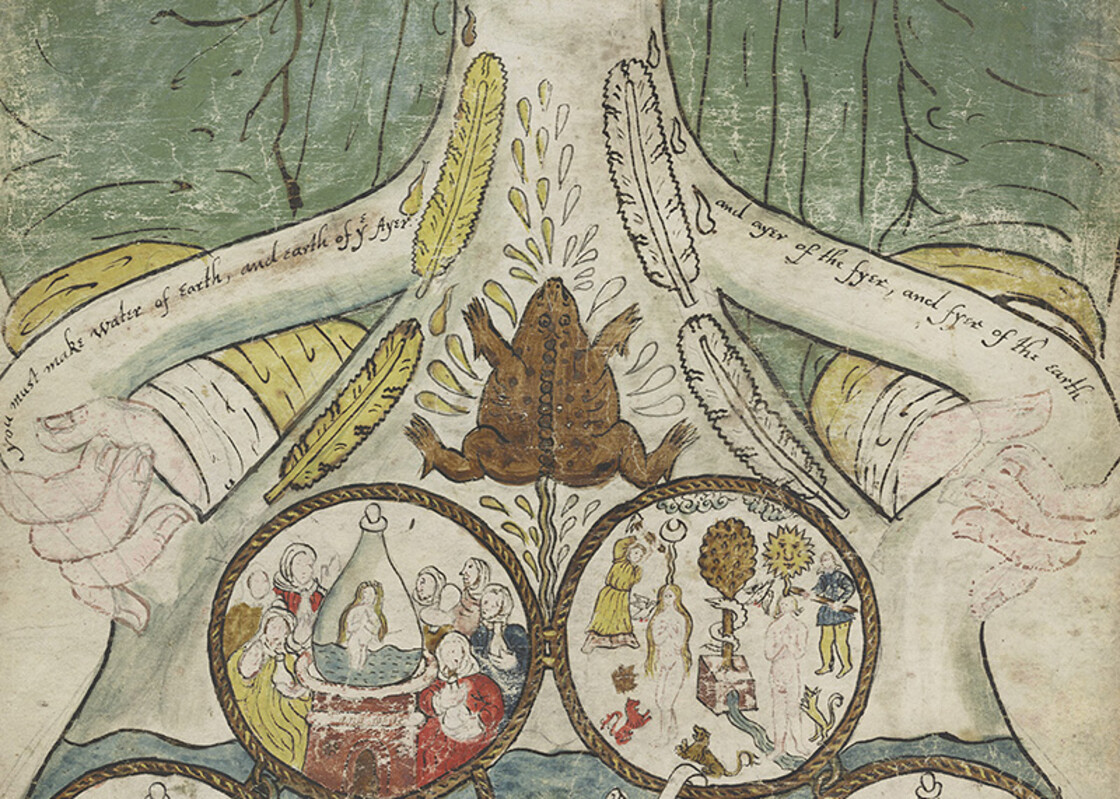
The hare at a mortar is Chinese, and so is the toad that preceded it. The toad in a vessel is European, and it is a laboratory animal rather than a lunar one. Europe knew the moon hare as folklore all the same, and Harley’s chapter carries two traces of it: a Swabian warning against throwing hare shadows on the wall for the sacred hare of the moon, and a plate of the hare in the moon taken from the French occult Dictionnaire infernal, where it sits under a Buddhist caption.
Where Did the Story Travel?
Thuillard’s paper is the place to go for an honest answer, and the honest answer is that nobody can prove a single origin. Seeing a rabbit in the moon and seeing a face in the moon come down to the same act of pattern recognition performed on the same visible object, and independent discovery is a normal outcome for that kind of perception. He puts the rule plainly: in the absence of convincing evidence to the contrary, a motif recorded in two separate regions should be assumed to have developed independently there.
The rabbit does turn up far from China. In Mesoamerica the moon and the sun rise equally bright out of a fire, and one of the gods throws a rabbit into the moon’s face to dim it, which is why the blotch is there. In the Aztec telling recorded by Bernardino de Sahagún in the 1570s, the moon god Tecciztecatl hesitates at the fire and the rabbit is his punishment. The motif appears in Asia and the Americas in distinct traditions, with no route by which one could have borrowed from the other in historical time.
The line that is genuinely traceable runs east, and it is a reading rather than a record. The Śaśa Jātaka is the text that carried the hare with Buddhism into China on the standard account, and the Indian animal arrived at a moon that was already occupied. Harley, quoting a Chinese scholar of the 1880s, called the Chinese moon hare “probably traceable to an Indian original,” which is as far as the evidence goes. What the two traditions did with the animal is easier to see than how it moved. The new arrival took over the moon, and the older animal kept its place beside it. The elixir work that Chinese alchemists had been doing for centuries handed the hare a job once it got there. It kneels at the mortar still, on the same dark patch of ground the Han poets looked at.
The Rabbit in the Moon Since
The hare was still up there when humans arrived. On the morning of 20 July 1969, before the landing, a capsule communicator in Houston read the Apollo 11 crew their news brief, and the brief included a headline asking the astronauts to watch for a hare. The transcript records what he told them: there is a Chinese girl called Chang-o who has been living on the moon for four thousand years, banished for stealing the pill of immortality from her husband, and she has a companion, “a large Chinese rabbit, who is easy to spot since he is always standing on his hind feet in the shade of a cinnamon tree.”
Buzz Aldrin, the lunar module pilot, came back in under a minute: “Okay. We’ll keep a close eye out for the bunny girl.”
China’s own lunar programme went back to the name. The rover that landed with Chang’e 3 on 14 December 2013 was called Yutu, the jade hare, and its successor on Chang’e 4, which touched down on the far side of the moon on 3 January 2019, was Yutu-2. Neither rover pounds anything. They drive and they photograph, and the name they carry is the name of the hare.