Mysteries.

Vèvè Symbols and Their Meaning

The Ground Drawings of Haitian Vodou

A vèvè is a drawing poured in cornmeal or ash on a Vodou temple floor to call one spirit. Here is what the veve symbols mean, which lwa each one belongs to, and how the drawing travelled from Dahomey to Haiti and New Orleans.

Vèvè Symbols and Their Meaning: The Ground Drawings of Haitian Vodou
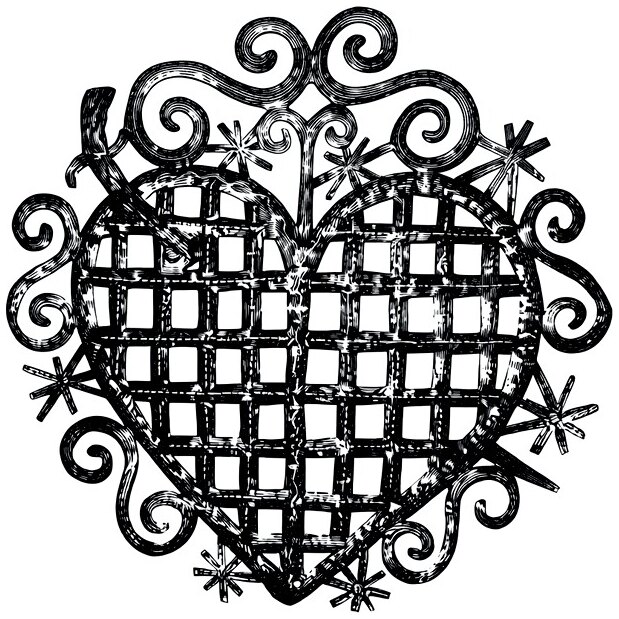
House engraving after a cut-iron vèvè of Ezili Dantor, Haiti, photographed by Oficinalis, via Wikimedia Commons (CC BY-SA 4.0).

A vèvè is a drawing on the floor of a Haitian Vodou temple. A priest or priestess pours it out by hand, usually in cornmeal mixed with ash. Each emblem in the drawing belongs to one spirit. Vodou calls these spirits lwa, and the drawing is how a temple calls them in.

The powder stays where it falls. Through the night people dance across the floor and set offerings down on the drawing. By morning the figure has been carried away underfoot.

Did You Know?

When a service feeds several lwa at once, their emblems are joined into one large floor drawing. Each spirit keeps its own sign inside it, and the whole figure can spread across a large part of the temple floor.

What Do Vèvè Symbols Mean in Haitian Vodou?

Each spirit has an emblem of its own, and the emblem marks the spot where that spirit is met.

The clearest example belongs to Papa Legba, the spirit who keeps the crossroads between the human world and the world of the spirits. His drawing is built on a cross. In most services he is greeted first and receives the first offering, because nothing else can come through until he opens the gate.

Temples in different regions draw the same spirit with slightly different lines. The central emblem is what they share.

The drawing is made near the central post of the temple, the potomitan. Vodou treats that post as the road the lwa travel down into the world of the living, so the drawing lies where they arrive.

Offerings go on top of it. Food and sacrificed animals for a spirit are laid right on that spirit’s drawing. For the length of the rite the drawing stands in for the spirit and marks the point where it can be reached.

Which Lwa Does Each Vèvè Belong To?

The best-known emblems are simple objects, and each one points to a single spirit.

Legba’s emblem is the cross. Danbala Wedo, the serpent spirit of creation, shares his drawing with his wife Ayida Wedo, so their emblem is a pair of snakes. On one sequinned Danbala flag, a rainbow runs beneath the two snakes. The rainbow is another of Danbala’s signs.

The other spirits each get one object. Ezili Freda, the spirit of love, is drawn as a heart, and Agwe, who rules the sea, as a boat. Ogou, the warrior, carries a cutlass. He came from West Africa, where the Yoruba people know him as Ogun, the spirit of iron.

Legba himself appears as an old man with a cane, and he has a feast day of his own, Fet Legba. Second in line come the Marasa, the divine twins, fed right after Legba and ahead of every other lwa.
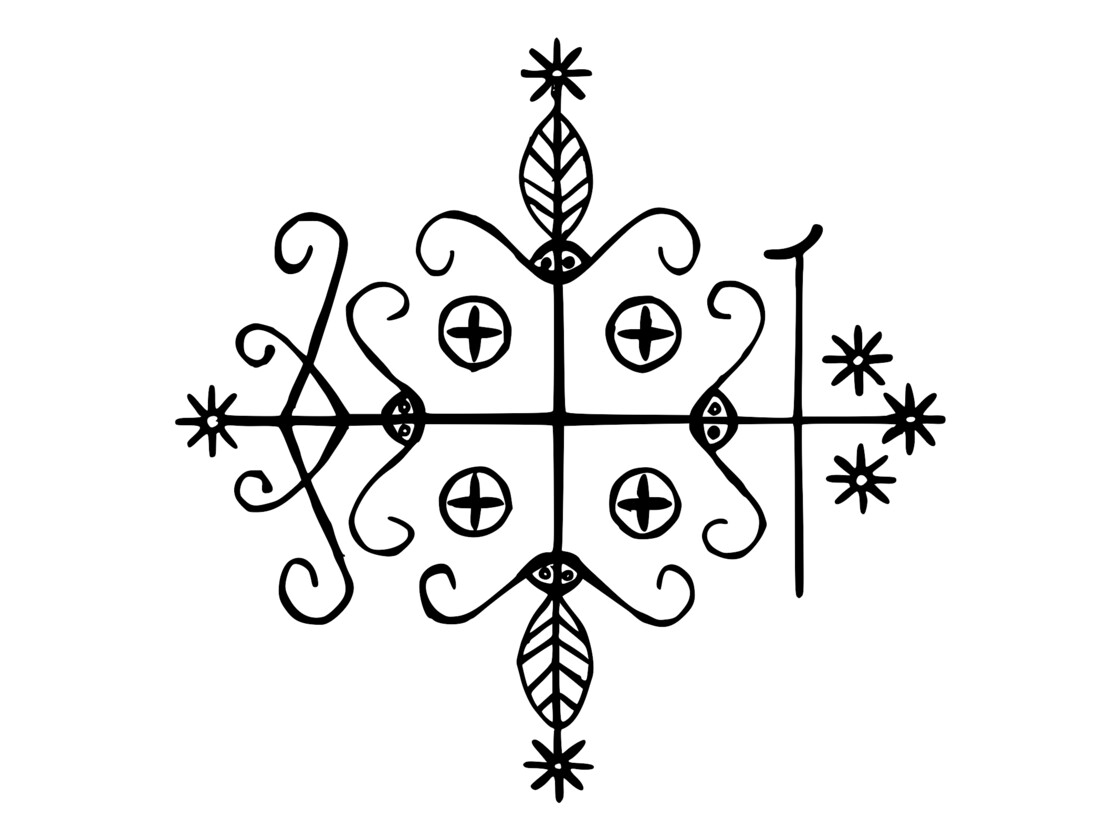
A black line drawing on white: a cross with curling scrollwork, stars and an upright staff
A vèvè of Papa Legba: a cross for the crossroads, small stars, and an upright walking staff at the right, which is the cane Legba carries. Legba is usually called first in a Vodou service because he keeps the gate. Hand-drawn reproduction, scanned and vectorised by a Wikimedia Commons contributor and released into the public domain.

What Are Vèvè Made Of, and How Are They Drawn?

A vèvè is poured by hand from a dry powder, made from whatever the temple has.

Cornmeal is the usual choice, often mixed with wood ash. Wheat flour or plain ash work as well.

The skill sits in the hand. The maker lets the powder run between finger and thumb, one scoop after another. Each scoop lays down part of a grid, and the figure grows on that grid. A vèvè can be a few lines or a figure covering half the floor. Making one takes real expertise, and the rhythm of the hand and a measure of improvisation count as much as the finished picture.

The drawing is finished before the ceremony begins, and then it is blessed. Dried food is sprinkled over the powder. Rum or water is poured out three times, and a white candle is lit.

After that, dancers and offerings slowly wear the drawing away. Nobody sweeps it up in a formal closing rite.

Where Does the Vèvè Come From?

The drawing has relatives in Africa, but no single parent.

In the old West African kingdom of Dahomey, in what is now Benin, people drew rectangles and squares on the ground in palm oil. Central Africa had ritual ground signs too, and the Haitian vèvè may have grown where the two traditions met.

The closest look-alike is a cross inside a circle from the Kongo region of Central Africa. Its horizontal line divides the living from the dead, and its vertical line is the path of the spirits. Many vèvè share that shape, but nobody has shown that one grew from the other.

Early written records do not help much. A French colonial description of a Vodou initiation from 1797 mentions only a circle drawn around the newcomer: the leader “traces a circle with some black substance and places the recruit in it.”

How Did the Vèvè Reach Louisiana and the Wider Diaspora?

The drawings came to New Orleans with Haitian refugees in the early nineteenth century.

Louisiana Voodoo, the New Orleans branch with its own spelling, still uses them, with local changes in style. The offerings changed too: in Louisiana a drawing can receive coffee and candies along with food.

The place most often named is Congo Square, a public square on the edge of the old city. Enslaved and free people of colour gathered there on Sundays to drum and dance. Local stories and eyewitness accounts tie the Voodoo priestess Marie Laveau to the square, though no official record shows that she led rituals there. Voodoo in the city still keeps a midsummer night of its own, Saint John’s Eve.

How Did a Floor Drawing Become a Flag and a Painting?

The drawing left the floor twice, first onto cloth and later onto canvas.

Vodou temples keep handmade flags called drapo, sewn with beads and sequins. A flag carries the vèvè of its spirit, so a sign that vanishes from the floor in one night stays on the cloth. Fet Dambala Wedo is the feast day kept for the serpent.

Sequins came to the flags from dance costumes, according to the story usually told. It credits a flagmaker named Joseph Fortine, who had seen Afro-Brazilian samba dancers in sequins, and dates the change to around 1940. In 1943, the story goes, he stretched a burlap coffee sack over a wooden frame and outlined Danbala in lines of sequins. The craft took root among flagmakers in an old quarter of the capital, Port-au-Prince.

Did You Know?

A single drapo can hold between two thousand and twenty thousand sequins and beads, sewn on by hand. The flags are hung in shrines and carried in processions, and the colours on them belong to the lwa the flag is made for.

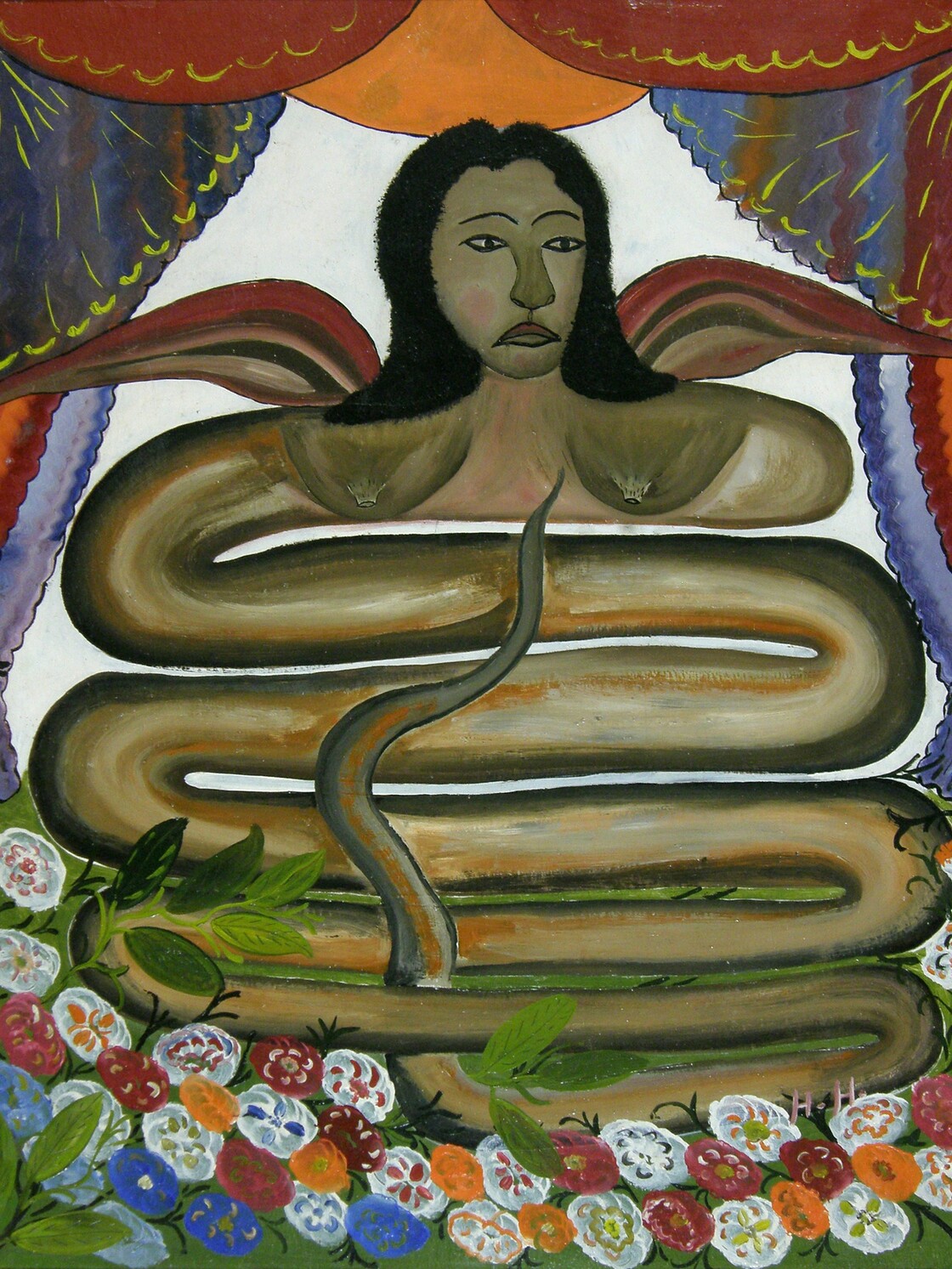
The move onto canvas came through Hector Hyppolite, a Vodou priest who had painted the doors of a roadside bar. In 1944 an art centre opened in Port-au-Prince with help from an American watercolourist, and it gave local painters free brushes and paint. Hyppolite worked there and put the spirits and their serpents onto boards and canvas.
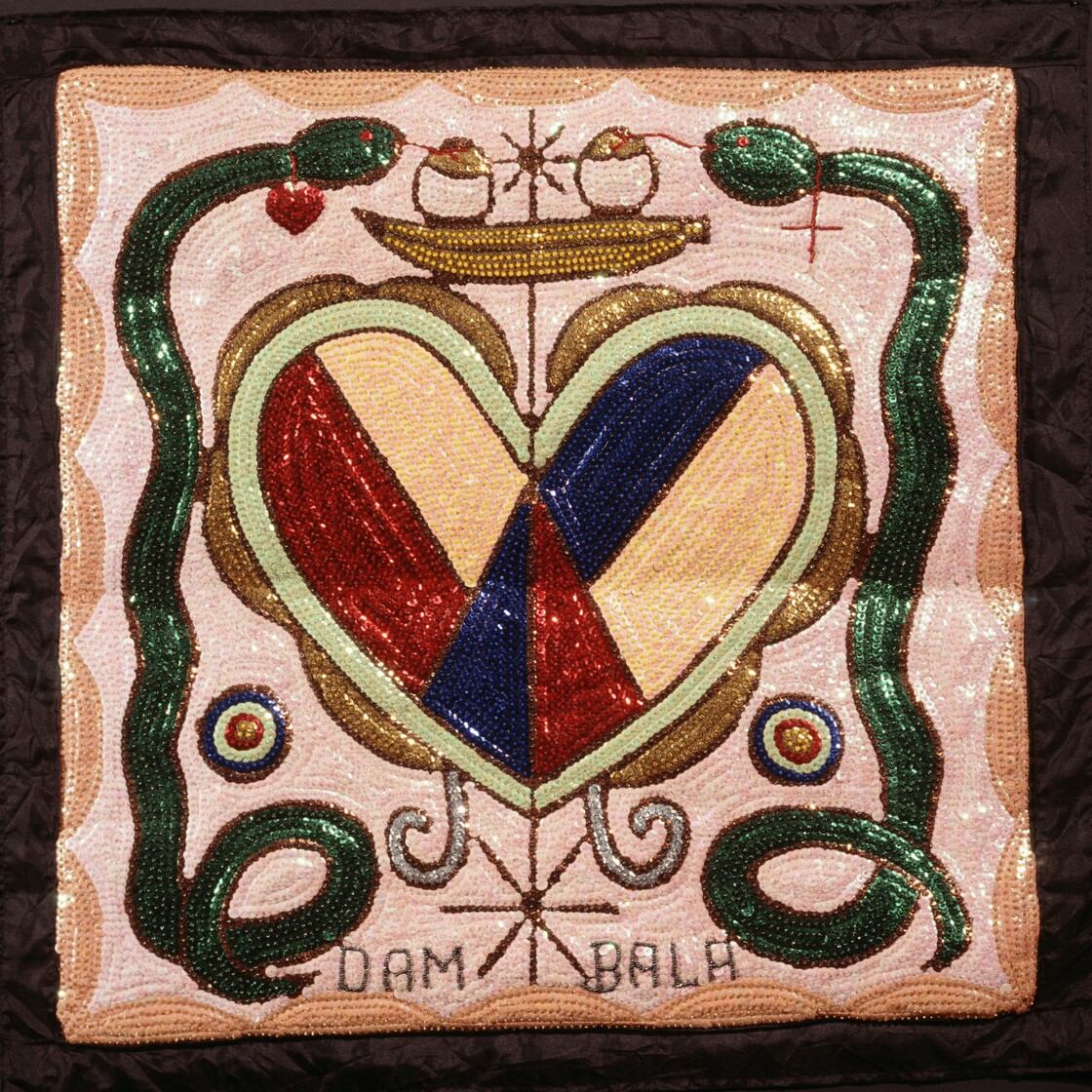
A beaded and sequinned ceremonial flag: two green serpents curving up both sides of a heart, with the word DAMBALA stitched at the bottom
A sequinned drapo for Dambala, Nationaal Museum van Wereldculturen, object AM-670-9. Drapo are hung in shrines and carried in processions, worked in sequins or beads, and the drawings and the colours on them belong to the lwa the flag is made for. The two green serpents are the reading usually given for this flag: Danbala Wedo and his wife Ayida Wedo. DAMBALA is stitched along the lower edge. Photograph via Wikimedia Commons, public domain.
A painting of a dark-haired woman behind a long coiling serpent, with flowers along the bottom
Damballah La Flambeau by Hector Hyppolite, who was a Vodou priest before he was a painter. Hyppolite set the cosmic serpent across the canvas in thick coils, with a woman’s head at the top and flowers along the base. He came to the Centre d’Art in the mid-1940s and died in 1948. Via Wikimedia Commons, public domain.

Why Did Haiti Try to Burn the Drums?

In the early 1940s the Catholic Church, backed by the state, tried to stamp out Vodou by destroying the objects its rites need. The vèvè, poured fresh for each ceremony, outlived the campaign.

The campaign ran from 1939 to 1942. Its target was a religion bound up with the birth of the country. In 1791 enslaved leaders met at a Vodou ceremony in the forest, Bois Caïman, and swore an oath that is remembered as the start of the Haitian Revolution.

Did You Know?

Drums were seized and burned, sacred trees were cut down, and practitioners were arrested. Others worked the other way. A new state office of ethnology, founded in late 1941, collected sacred objects, and a Haitian writer and a visiting anthropologist tried to save pieces from the church bonfires.

Full recognition came much later. In 2003 a government decree named Vodou a religion in its own right, so that recognised priests may hold baptisms and funerals.

What Happens When a Vèvè Leaves the Temple?

Outside the temple, a vèvè is often seen by people who do not know what it is for.

Museums show the quiet version of that gap. One American university holds a glass serving tray painted with Legba’s vèvè. The drawing is faithful, yet the catalogue files the tray as a tourist souvenir. Haitian metalworkers also cut vèvè in iron, and an art museum in Iowa keeps one from around 1965: Legba’s cross in straight lines and curves, a little under a metre across.
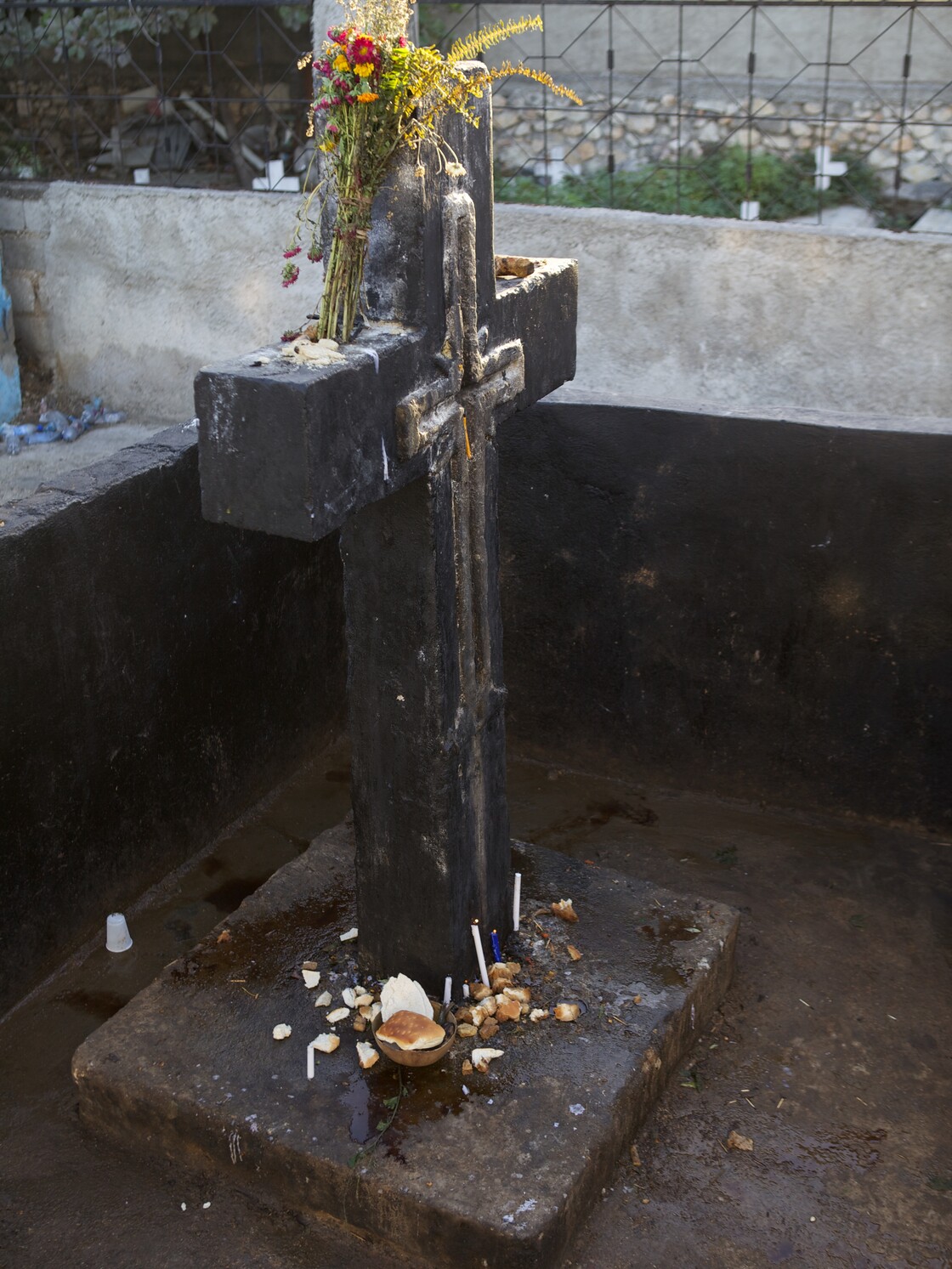
A black concrete cross in a cemetery, with flowers tied to the top and candles, a coconut and coins left on its base
A black cross in the Port-au-Prince cemetery, the cross of Baron Samedi, who leads the Gede family of lwa. Flowers are tied to the top, and candles, a coconut, a bottle top and coins have been left on the base. The photographer’s note records that this cross was destroyed in the January 2010 earthquake and rebuilt before the Gede holidays that year. Photograph by Andrew Welch, 2010, via Wikimedia Commons, CC BY-SA 3.0.

In 2013 the band Arcade Fire stencilled the logo of its album Reflektor on walls around the world. The band’s singer said the design took its cue from Haitian vèvè. The American magazine The Atlantic objected that the campaign stripped the imagery of its context. To audiences who had never seen a vèvè, it read only as mystery and exotic décor.

One detail did match the temple floor. The stencils were meant to be chalk or paint, so that the rain would wash them away.
The Sources

Every statement in this report rests on these.

  • Ama Mazama, ‘vèvè’, Encyclopaedia Britannica, 2 November 2016, https://www.britannica.com/topic/veve. Read in the Internet Archive snapshot of 8 December 2024. Source for the definition, the Dahomey palm-oil rectangles and squares, the Central African and Taíno/Arawak comparisons, cornmeal and ashes, the oungan or manbo, the potomitan, offerings placed on the veve, the emblems of Èzili Freda, Danbala Wèdo, Ayida Wèdo, Agwe, Ogou and Papa Legba, and the consecration with dried foodstuffs, a triple libation and a white candle.
  • Sacred Arts of the Black Atlantic, Duke University, catalogue entries A001 (Dambalah flag, Yves Telemak) and A060 (glass serving tray with an invocatory drawing for Legba, classified tourist/souvenir), https://sacredart.caaar.duke.edu. The A001 record identifies the two snakes as Dambalah and Ayida Wedo with the rainbow beneath them; the A060 record is the source for the tray.
  • Figge Art Museum, Davenport, Iowa, object 2003.0023, ‘Vèvè of Atibon Legba’, Haiti, c. 1965, iron, 37 1/4 x 33 1/4 inches, maker unidentified, https://figgeartmuseum.org/art/collections/item/veve-of-atibon-legba-20030023/1244. Source for the iron veve, the circle-and-cross combination, and for Legba as guardian of the crossroads, his link to Saint Peter, and his descent from the Yoruba Exu.
  • Médéric-Louis-Elie Moreau de Saint-Méry, Description topographique, physique, civile, politique et historique de la partie française de l’isle Saint-Domingue (1797), in A Civilization That Perished: The Last Years of White Colonial Rule in Haiti, translated, abridged and edited by Ivor D. Spencer (Lanham, MD: University Press of America, 1985), 1-7. Extract at World History Commons, https://worldhistorycommons.org/voodoo. The sentences quoted are ‘If there is an initiate-to-be, the King traces a circle with some black substance and places the recruit in it’ and ‘It is held in the dark of night and in a place closed and sheltered from all profane eyes.’
  • James R. Murphy, ‘Magic and Mesmerism in Saint Domingue’, Paroles gelées 24, no. 1 (2008), doi:10.5070/pg7241003182, on the reading of Moreau de Saint-Méry through the European vocabulary of animal magnetism.
  • Maya Deren, Divine Horsemen: The Living Gods of Haiti (London: Thames and Hudson, 1953), where the vevers are described as symbolic designs drawn on the ground to invoke the loa and made of wheat or maize flour or ashes; quoted in Deborah Stratman, ‘Vever’, Walker Art Center reader, https://www.walkerart.org/reader/deborah-stratman-vever/.
  • Haitian Studies Association / KOSANBA bibliography, University of California, Santa Barbara, listing ‘Rigaud, Milo. Ve-Ve Diagrammes Rituels du Voudou: Ritual Voodoo Diagrams. New York: French & European Publications, 1974’, https://haitianstudies.ucsb.edu. Source for the date of the standard published corpus of veve diagrams.
  • Tampa Museum of Art, ‘Sequin Arts: The Flagmakers of Haiti’, https://tampamuseum.org/sequin-arts-the-flagmakers-of-haiti/. Source for the first-generation flagmakers of the Bel-Air quarter, for Edgar Jean-Louis (1921-2010), his training under the houngan Silva Joseph, and the 2,000 to 20,000 sequins and beads on a single flag.
  • Kate Ramsey, ‘Vodou, Nationalism and La Police des Moeurs: State and Church repression in Haiti’, Gradhiva, doi:10.4000/gradhiva.352, and the Florida International University digital exhibit Island Luminous, part 9, slide 13, on the rejete movement of 1939-1940, its takeover by the concordat clergy in 1940-1942 under President Élie Lescot, raids on ritual sites, the burning of drums and sacred objects, the felling of sacred trees, the attempts by Alfred Métraux and Jacques Roumain to save objects, the founding of the Bureau d’Ethnologie in late 1941, and the end of the campaign in 1942 after the Delmas incidents and the removal of the nuncio Monsignor Silvani.
  • Smithsonian Folklife Festival 2004, ‘Haiti: Freedom and Creativity from the Mountains to the Sea’, programme book, folklife-media.si.edu. Source for possession as the lwa riding the devotee (chwal), for the 1987 constitution’s guarantee of religious freedom, and for the account of Vodou’s place in Haitian family and community life.
  • BBC News, ‘Haiti’s Aristide honours voodoo’, April 2003, news.bbc.co.uk/2/hi/americas/2985627.stm, with the text of the presidential arrêté of 4 April 2003, on the recognition of Vodou as a religion in its own right and the right of recognised Vodou leaders to celebrate baptisms, marriages and funerals.
  • Reports of the Arcade Fire Reflektor campaign of 2013 in The Atlantic (‘What’s Wrong With a “Mashup of Studio 54 and Haitian Voodoo Music”?’, 12 November 2013), NME and Consequence, and Win Butler’s statement that the stencils were inspired by Haitian veve drawings and were meant to use chalk or water-soluble paint that would wash off in rain.
  • Wikipedia, ‘Veve’ (accessed 21 September 2026), on the beacon function of the drawing, the invocation in the central cross, regional variation between veves for the same lwa, the distinction from the anaforuanas of Abakuá, the firmas of Palo and the pontos riscados of Umbanda, and the coffee and candies placed on a Louisiana drawing. Used only for claims that no stronger source contradicted; the article’s suggestion of an origin in the Nsibidi script is reported as a suggestion, not as a finding.

Filed under Vèvè · veve · Haitian Vodou · lwa · Papa Legba · Danbala Wedo · Ayida Wedo · Ezili Freda · Agwe · Ogou · ritual drawing · cornmeal · Dahomey · Kongo cosmogram · Louisiana Voodoo · New Orleans · drapo · Vodou flags · Hector Hyppolite · anti-superstition campaign · Arcade Fire.

Pass this report on: Pinterest · Facebook · by Letter · Copy the Address


Questions from Readers

I. What is a vèvè in Vodou?

A vèvè is a geometrical drawing on the floor of a Vodou temple that represents one lwa. It is sprinkled in cornmeal or ashes by an oungan (priest) or a manbo (priestess) and is always drawn near the potomitan, the central post of the peristyle. Britannica calls the finished drawing a material representation of the lwa and a magic point, which is why food offerings and sacrificed animals are put down on it.

II. What are vèvè symbols made of, and how are they drawn?

Cornmeal is the usual material, often mixed with wood ash, and wheat flour is used as well. Britannica records cornmeal and ashes; Maya Deren, writing in 1953, names wheat or maize flour; and one account from the kingdom of Dahomey describes palm oil, which is what was available there. The maker lets the powder run between finger and thumb in repeated scoops, each scoop laying down part of a grid, and the design is partly improvised. Britannica notes that the work demands a great deal of expertise. Nothing is fixed: the drawing is walked away during the ceremony and has no standard closing rite.

III. Which lwa are associated with which vèvè symbols?

The central emblems are few. A cross belongs to Papa Legba, the guardian of crossroads. Two snakes belong to the cosmic serpents Danbala Wedo and his wife Ayida Wedo. A heart belongs to Ezili Freda, the lwa of love. A boat belongs to Agwe, the lwa of the sea, and a cutlass belongs to Ogou, the lwa of war. When a service feeds several lwa at once, the floor drawing carries the emblems of all of them and can cover a large part of the peristyle.

IV. Where did the vèvè come from?

The African precedent is documented, the single ancestor is not. Britannica records that in Dahomey, in what is now southern Benin, palm oil was used to draw rectangles and squares on the ground, and that the same practice of drawing ritual emblems on the ground is attested in Central Africa. Britannica’s own wording is that the Haitian veve may owe its origin to a convergence of western and Central African practice, and that some scholars have pointed to a similar ground-marking custom among the Taíno and Arawak people. The Kongo cross-in-a-circle known as the dikenga is often compared with the veve, but no source establishes it as a direct ancestor.

V. How did vèvè travel from Haiti to Louisiana and the wider diaspora?

Haitian refugees arrived in New Orleans in the early nineteenth century and brought their Vodou traditions with them. Louisiana Voodoo uses the drawings too, with local variations. Congo Square was the square where enslaved and free people of colour gathered to drum and dance, and Marie Laveau is tied to it in eyewitness accounts and oral history, though no official document places her there. Louisiana practice has its own offerings, including coffee and candies for the spirit the drawing belongs to.

VI. What happens to a vèvè after the ceremony?

It disappears. People cross the floor, offerings are set down on the powder, and the figure is effaced as the service proceeds. Accounts of Vodou practice do not describe one standard closing step such as a formal sweeping, so the disappearance belongs to the ritual rather than to a clean-up. The sequence that is documented falls at the start: dried foodstuffs are sprinkled on the drawing, a libation of rum or water is poured three times, and a white candle is lit.

The Weekly, by Post

Every Tuesday the week’s reports in a few lines, and one book from our press. Free, and you may leave at any time.


More from Mysteries

The María Sabina Clock QuoteDid She Really See God as a Ticking Clock? Why Was the Magic of Armadel Title Page at the End of the Book? Magic Mirror Buried on a CorpseWhy a Dog Had to Look First Cornelius Agrippa's Black Dog MonsieurDemon Familiar or Household Pet?

All 106 reports in Mysteries ☞


From Our Own Press