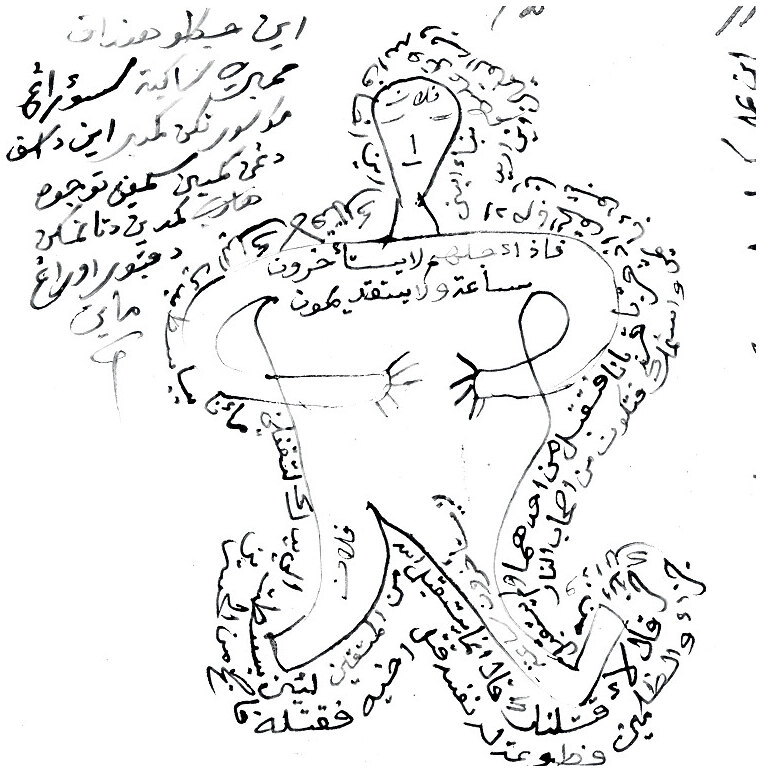
In a London library built to preserve the history of medicine, in a folder catalogued under the Hervey Collection of Malay manuscripts, there are two sheets of nineteenth-century paper, each showing a human figure drawn out of dense Arabic letters, as if a body had been written rather than sketched. At some point a curator examined them and added a startling line to the record, that the letters around the figure are “incantations and spells written in the language of Djinns and Syaitan,” the language of demons. The catalogue still carries that line today, next to a calm bibliographic detail, that the object is “intended to curse its recipient with a fatal illness.”
Whether those letters really are the language of Shaitan is the question the two sheets pose, and reading them closely gives an answer stranger and darker than the curator’s note.
A world of borrowed gods
The two sheets were made in the maritime world of the Malay Peninsula and the islands around it, one of the great crossroads of the Indian Ocean, where the monsoon winds carried in traders and, with them, new religions.
The Malays took on these faiths in layers that are still visible today. Underneath everything sits an old animism, a sense that the world is alive with spirits and that every person carries a semangat, a soul-substance or vital force. Centuries of Indian influence came on top of that, when Hinduism and Buddhism arrived with traders and priests and left behind Sanskrit words and written charms. Islam came later still, from roughly the thirteenth century, and Walter Skeat, who collected Malay folklore at the close of the nineteenth century, summed up what he found in 1900 as “Hindu, Buddhist, and Muhammadan ideas overlying a mass of apparently original Malay notions.”
Islam came to the archipelago by sea rather than by conquest, and it spread along the trade routes through Muslim merchants and Sufi teachers from across the Indian Ocean, and through local rulers who converted and found that a place in the Muslim trading network was good for business and for standing. The religion brought its alphabet with it, since reading the Quran meant reading Arabic letters, and once Malays had those letters they began writing their own language in the same script and added a handful of new characters for the sounds Arabic lacked. The result was Jawi, and its oldest dated example, a stone called the Batu Bersurat Terengganu and usually placed at 1303, already uses Malay in Arabic script to proclaim Islamic law, so the writing was doing religious work from its first appearance.
The Malay language has carried three different alphabets over its history. An Indic script came first, with Hinduism and Buddhism; Arabic-based Jawi took over once Islam arrived; and the Latin alphabet that European colonialism brought is the standard today. The very way Malay is written keeps a record of who arrived when.
Inside this layered world worked the ritual specialists the Malays called the bomoh and the pawang: the people you went to when a child sickened or an enemy needed dealing with. Their work ran from healing and divination through to its dark end, Ilmu Sihir, the knowledge of sorcery. Skeat records that it came in many branches, “ilmu-ilmu,” a whole library of secret learning, some of it for healing and much of it for harm.
The body on the page
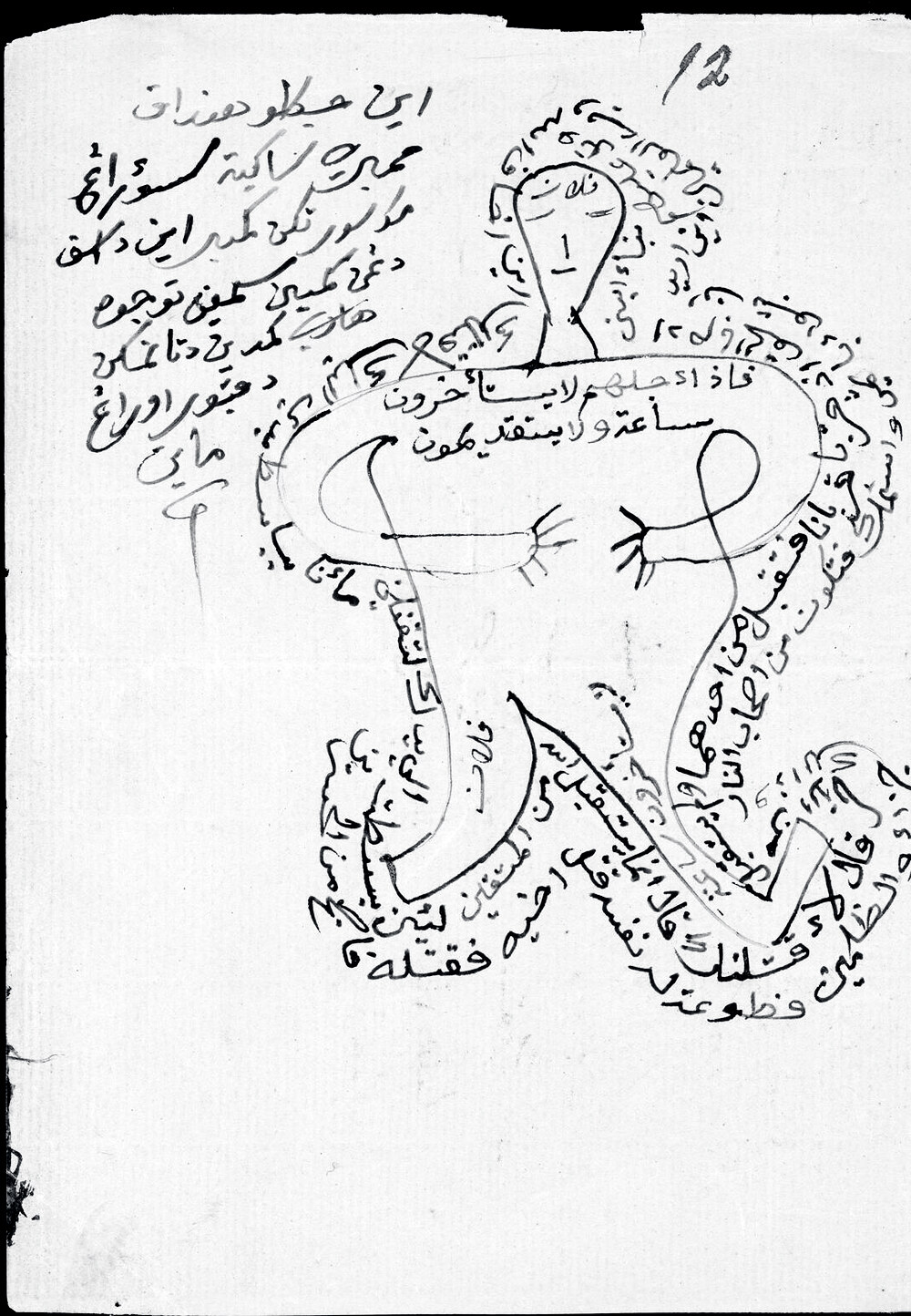
Each of the two sheets carries a single human figure, a head and torso with limbs splayed outward. The drawing represents the victim the way a wax doll does in other traditions: it stands in for the person without having to resemble him. This kind of magic treats the image as the body it depicts, and whatever the sorcerer does to the drawing he means for the living person.
The figure’s flesh is made out of the writing itself: where you would expect outlines for the arms and the legs, the letters bend and stretch into the limbs, so that cursing a person here came down to composing his body out of words.
The Malay instructions written in Jawi around the figure set out what to do with it, and as far as the script can be read they are specific. The sorcerer renders the figure onto a sheet of tin or lead and buries it in the grave of a dead person, so that the image then pulls the living victim down toward the dead. On that point the catalogue’s summary holds: by these instructions, the charm is meant to make its recipient sick and then to kill him.
Not the Devil’s tongue
The curator’s claim, the “language of Djinns and Syaitan,” is where the reading has to begin, and the strongest one available without a manuscript specialist in the room comes from putting the sheets to several current machine readers of Arabic and Jawi and treating the points where they agree as evidence rather than proof. Read that way, the demon language dissolves, because the letters are Arabic, the language is partly Jawi Malay and partly the Quran’s own tongue, and the most legible writing on the sheets is the holiest text its makers knew.
Inside the chest of the figure, in a clean and confident hand, sits a verse of the Quran, the verse of the appointed term, the one that says that when a person’s time has come, “they cannot delay it by a single hour, nor bring it forward.” Two separate machine readings of the image, run independently, picked out that same verse, which means the maker had set the verse of unavoidable death inside the body of the man he meant to kill.
At the head, the readers find the name of God ringed by the names of angels, so what surrounds the figure is the scripture and the angels of mainstream Islam, arranged for a purpose that same tradition condemns without reservation. The curator promised a demon tongue, and what the sheets hold is worse: the most sacred words in the maker’s world, turned to the killing of a neighbour.
What the legs may say
We put the charms to five of the strongest machine readers of script available, from four different makers, and on the basics all five agreed: the writing is real Arabic and Jawi, with the name of God at the head and the chest read by most of them as the Quranic verse of the appointed hour. Over the arms and the legs they parted company, and the way they split tells its own story. Three of them, models that handle printed and modern text with ease, saw mostly distorted and disconnected letters, the talismanic mark-making that fills the edges of charms like these, while Google’s models read something far more specific: a continuous passage running down the body, the Quran’s account of the first murder, the story of the two sons of Adam, one of whom kills the other over a rejected sacrifice.
Because a reading only one family of models can produce invites suspicion, we ran the harder test: we handed Google’s reader the bare images with no hint of what they were and no mention of magic or the Quran, and asked only that it translate what it could. It returned the same verses, in the correct scriptural wording, and did so on every repeat without drifting, and unprompted it also read the Malay instructions around the figure, the recipe for sending sickness and burying the charm in the grave of the dead. A model that fabricates tends to do it differently on each try, whereas this one came back to the same place, cold, every time.
None of that makes the reading certain, since it remains one maker’s model, and the readers who missed the verses most likely did so because this cramped nineteenth-century hand defeats them, which says more about the limits of the readers than about what the sheet contains. A scholar of Jawi and Arabic would settle the question in an afternoon, and until one does it stays the strongest reading available rather than a closed case. If it holds, the picture is hard to shake: a body drawn from the verse that says no one can delay their death by a single hour, with the story of the first murder running down its legs.
The page it lives on
Turn to the facing page and the register changes, as the curse gives way to a leaf from a working handbook. Most of it, by the same reading, sets out a table of the seven days, each one matched to a planet and to that planet’s angel and then to a material to use, so that Saturday runs to Saturn to the angel Kasfiyail to a measure of cardamom, on down through the week to Sunday, the Sun, and the angel Ruqyail. Those seven angels belong to the planetary-angel vocabulary of Islamic talismanic magic, itself shaped by older astrology, and on this page they wear Arabic names over a column of Malay herbs. The layering Skeat described is legible in a single grid, a sky first mapped by Babylon, its planets handed to Muslim angels and matched to the stock of a village apothecary.
Down the side of the same page runs a second charm, and this one protects. It is an ilmu kebal, a spell of invulnerability of the kind Malay men carried into a fight, a call on the spirit of iron so that no blade can enter the flesh. “No weapon can pierce me,” it reads, “nor any weapon in the world.” The same manuscript that shows a man how to bury a verse of death in a grave teaches him, a page away, how to make his own skin proof against a knife. Curse and protection sit inches apart on the leaf, in one script and, it seems, one hand.
Not all of them kill
The sheet we have been reading, the standing figure whose body carries the verse of death and the story of the first murder, is only one of the two, and the other is a different machine altogether: a small triangular figure, its head ringed by the four archangels of Islam, with Azrael, the taker of souls, drawn directly above it and the magic-square fifteen, that recurring sum of Islamic letter-magic, set inside its heart.
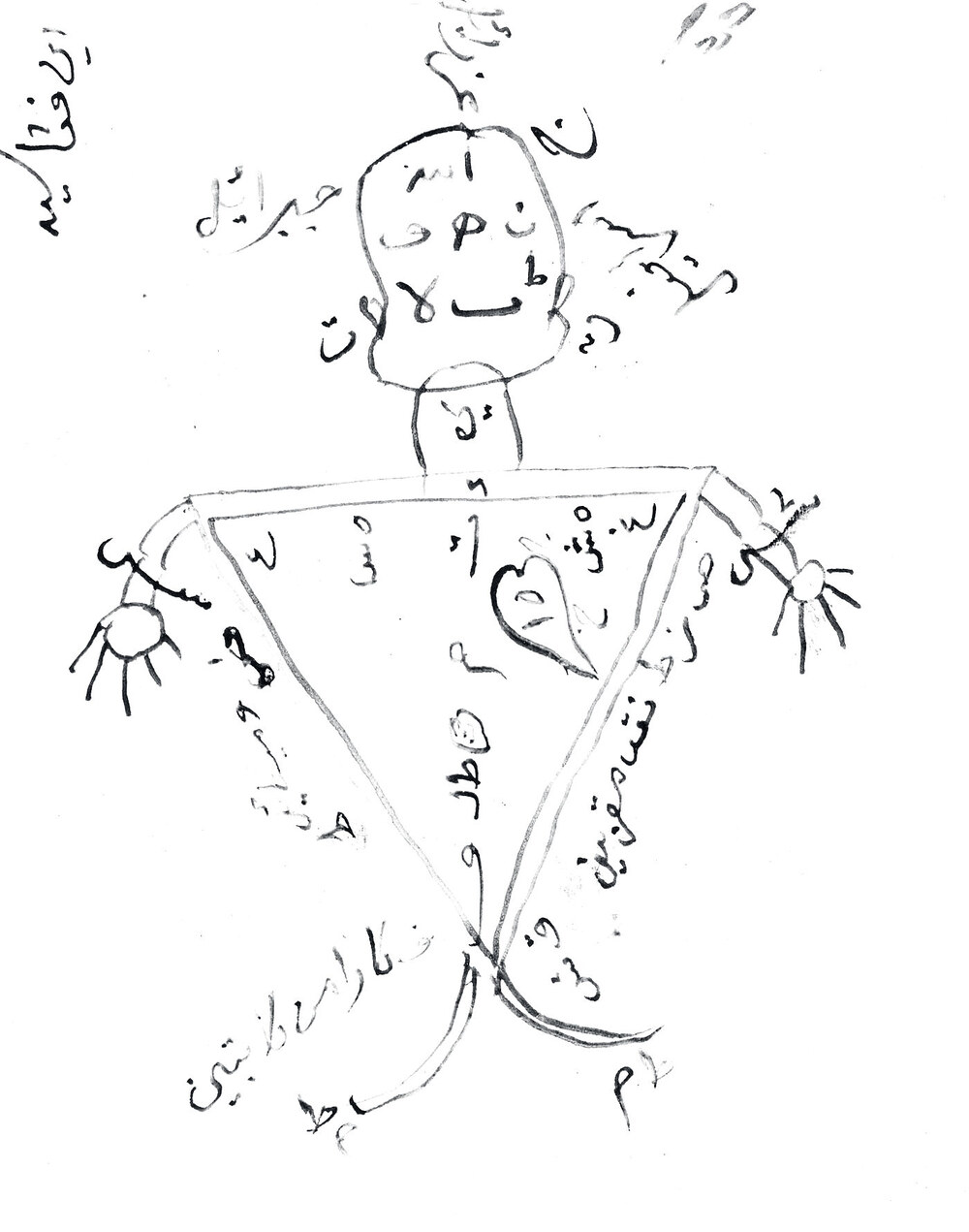
Put the same reader to the words on it and the purpose shifts, because across the torso runs a phrase that reads as “my love and my affection,” and the heading names it a ghasyiah, a covering or veiling spell, with the intent of binding a person’s affection or shielding whoever carries the sheet. The Wellcome files both sheets under one line, “intended to curse its recipient with a fatal illness,” yet this one reads as something nearer a love-charm, drawn by a kindred literate hand out of the same scripture that arms the curse. The love reading is less tested than the death verses, so it is best treated as the strongest one available rather than the last word.
The wish to bind another person’s desire runs as old and as wide as the wish to be rid of an enemy, and it reaches for the same instrument, an image of a person, named and charged with the holiest words within reach.
The cure wears the same face
These sheets matter past their own strangeness, because the single object opens onto something much larger, starting with the fact that mainstream Islam forbids the very magic it supplied the materials for. Sorcery, sihr, is among the gravest sins, and cursing a person to death with it is condemned outright, yet the same tradition that forbids the curse also supplies its mirror image, a sanctioned cure made of identical materials. It is called ruqya, the reciting of the Quran over an afflicted person, and writing the verses onto an amulet, often the two short protective surahs that close the book, is more contested, welcomed in some Muslim communities and refused in others, though it rests on the same conviction that sacred words can shield the body. The licit healer and the illicit sorcerer draw from one well: they use the same verses and divine names, and very often they are the same kind of literate religious man, the one who can read the sacred text at all.
All of this is why the curse and the cure are so hard to pull apart, since running your eye over one of these death-charms and then over a protective Quranic amulet means looking at one technology pointed in opposite directions. The charm in the Wellcome is the shadow of a healing amulet, drawn by the same kind of hand out of one scripture toward the contrary end.
Islam did not so much create this magic as give older practices new language and new limits. Islamic tradition treats the danger as real, since the Quran speaks of sihr, and the hadith record that a man worked magic on the Prophet himself until he imagined doing things he had not done, and that recitation of the Quran was what cured him. If sorcery could reach the Prophet then it is real, and a genuine affliction calls for a remedy, so the religion makes both the threat and its remedy official, and the curse lives in the gap between them, built from the same holy stuff.
Older than the book
The economy of curse and cure runs older than Islam by thousands of years. Long before the Quran, in the cities of ancient Mesopotamia, there was a man called the āšipu, an exorcist-healer who diagnosed witchcraft and performed the counter-rites against it, and the great Babylonian anti-witchcraft ritual, Maqlû, “Burning,” ran across a single night and chained together nearly a hundred incantations, much of it spent destroying images of the witch. The pattern on the Malay sheet, where you make a figure of your enemy and do violence to it, was already ancient when Babylon performed it, and Tzvi Abusch, who edited the Maqlû texts, has worked for decades on this fear and its deep roots.
The same logic surfaces everywhere humans have written, and it served the lover as faithfully as the enemy. Egyptian priests of the Middle Kingdom inscribed the names of enemies onto clay figurines and smashed them. From Roman Egypt there survives a small clay figure of a kneeling woman, pierced through with needles and folded into a lead tablet, a binding meant to fix her desire on the man who paid for the spell; it sits in the Louvre today. The Greeks left thousands of such tablets in their graves and wells, curses against rivals beside spells to compel a lover, scratched on lead in the same impatient hand. Shape a person into an image, name it, and the living body is suddenly within reach: this is one of the oldest ideas our species has, and it has always run in both directions, toward harm and toward desire.
So these Malay charms belong to a very old family, the figure-magic that works on a person through a drawing of them, as two of its youngest and most literate members. They take on the language and the authorities of whatever religion is in the room.
The same machine, everywhere
The same pattern repeats across cultures that never met. In the Christian Balkans, when a household was haunted by a Kozlak, the Dalmatian revenant, the defence was a Franciscan friar carrying zapisi, written prayer amulets, scraps of sacred text worn for protection, while in Muslim parts of the same peninsula the job fell to the hodja, whose written charm, the hamajlija, did the same work with Quranic verses in place of Christian ones. The scripture is the only thing that changes from one to the next, since the literate holy man writes the affliction away, and somewhere in that same village, with those very letters, someone writes it onto a neighbour.
A religion hosts the curse-and-cure economy without authoring it. It certifies the affliction as cosmologically real and licenses a cure, then supplies the one person literate enough to work both ends. The trade itself is human and ancient, and the faith supplies the house it works in.
Does it reach him?
One question is left that the charms cannot answer. A curse you shout in someone’s face can land, because the victim hears it, and the documented cases where a curse appears to harm or even kill, the ones Walter Cannon gathered in 1942 under the unfortunate name “voodoo death,” all share that feature: the victim knew. The harm runs through their own mind and body, the effect researchers now call nocebo, the dark twin of the placebo, which Fabrizio Benedetti and others have traced to measurable changes in the body. Belief can make a person ill, and there is little doubt about that.
These Malay charms, though, were never meant to be seen. They were drawn in secret, then rendered on lead and buried in a stranger’s grave, where the victim was never supposed to find them, so a charm hidden in the ground, working on a person who never learns it exists, has no path to the body that modern cause and effect can follow. The maker did not need the victim to know, because the charm was meant to work through an older account of how one person reaches another, by an image named and a verse sunk into a grave.
And still they were made, and made carefully, for generations, by literate men who poured the holiest words they knew into them. That is the puzzle the sheets leave you with, and we are not going to pretend to solve it here. A curse that cannot reach its victim and a cure that heals someone who was never harmed belong to the same large subject, the economy of affliction and relief that runs on belief and almost nothing else.
For now, sit with the object itself, a human body drawn out of the words of God’s own scripture, with a verse about the hour no one can delay written into the chest of someone an unknown man wanted dead. Buried once with the dead, then dug up and carried across the world, it now lies flat in a drawer in London, in a library devoted to healing, available to anyone with an internet connection under a Creative Commons licence. The curator called it the language of demons, but it was the language of God all along, in the wrong hands.