In the summer of 1947 a Soviet archaeologist named Sergei Rudenko began cutting through the floor of a frozen tomb in the Altai Mountains, on the border of what is now Russia, China, Kazakhstan, and Mongolia. The tomb, known to archaeology as Pazyryk Barrow 2, had been robbed in antiquity. Water seeped in through the looters’ shaft, froze, and turned the chamber into permafrost. The cold preserved everything the robbers had left behind: felt rugs, a wooden chariot, a man and a woman tattooed in animal-style ink. In one corner of the chamber, set on the floor, sat a small bronze cauldron with feet. Above it stood six wooden poles that once held a tent of mats over the cauldron. Burnt stones lay around the base, charred seeds scattered on the floor, and a leather pouch nearby held more seeds bundled with coriander and yellow sweet clover.
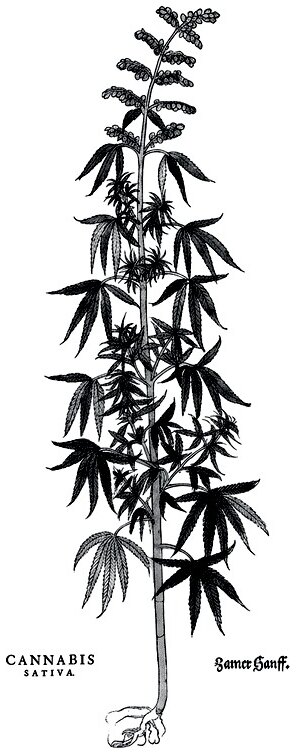
The seeds were Cannabis sativa.
Two thousand four hundred years earlier, the Greek historian Herodotus had described that exact apparatus.
What Herodotus Said
Herodotus wrote in the 440s to 420s BCE, perhaps from interviews with Greek traders working out of Olbia on the Black Sea coast, perhaps from his own travels. Either way, he had access to people who knew the Scythians up close. In Book 4 of the Histories he gives one of the most detailed accounts of any nomadic culture in the ancient record: their gods, their court, their war customs, their burial of kings, their mourning rituals.
The cannabis passage sits at chapters 73 to 75. After a burial, Herodotus writes, the Scythians cleanse themselves. The women do this with a paste of cypress, cedar, and frankincense ground on a stone with water. The men do it differently. They set up three poles leaning together to a point, cover the poles with felt or wool mats, dig a pit beneath the mats, and drop red-hot stones into the pit. Then, in the historian’s own words from a standard English rendering, they take “the seed of this hemp and, creeping under the mats, throw it on the red-hot stones, where it smoulders and sends forth so much steam that no Greek vapour-bath could surpass it.”
What happens next is the line everything turns on:
The Scythians, delighted by the vapor-bath, howl.
The verb Herodotus chose for “howl” is ὠρύονται (ōrýontai), present middle of ōrýomai. In Greek, dogs and wolves ōrýontai. People ōrýontai when they wail or bellow without restraint. It is not the verb a Greek would use for the contented sigh of a citizen leaving a public bath. The verb leaves the door open to something more than steam.
Herodotus uses the same word kannabis (κάνναβις) that we still use today. The Greeks borrowed it directly from a Scythian or Thracian source. The English word “cannabis” comes through Latin from this same Iron-Age root.
The Scythians
A short orientation, because the name Scythian covers more ground than is sometimes obvious. The Scythians were Eastern Iranian-speaking nomads. They moved out of Central Asia onto the Pontic-Caspian steppe in the ninth and eighth centuries BCE, displacing the earlier Cimmerians and becoming the dominant pastoralist confederation between the Black Sea and the Altai. Their cultural reach was vast. Greek colonists on the Black Sea coast traded with them and wrote about them. Persian armies fought them and lost. Chinese chroniclers in the east called their relatives the Saka.
What unifies the archaeological record is the kurgan, the great burial mound, with a wooden chamber inside, a chieftain or queen at the center, sacrificed horses around the edges, and gold worked in the famous animal style: stags with stylized antlers, snow leopards mid-leap, fighting griffins. The Pazyryk burials in the Altai are the eastern frontier of this world. The Sengileyevskoye-2 burial near Stavropol, where two gold cups were found in 2013, is on the western edge. They are the same culture.
The vapor-tent rite Herodotus saw on the Pontic steppe was practiced for centuries across thousands of miles.
The Dig That Confirmed the Text
Rudenko worked the Pazyryk barrows in three field seasons between 1947 and 1949, with Barrow 2 itself excavated in the 1947 season. The conditions were difficult. Each kurgan had to be excavated through layers of stone cairn and frozen earth, with thaw water removed bucket by bucket. The chambers, however, gave him almost ethnographic preservation. Wooden coffins kept their carved details. Saddles kept their leather. Cloth kept its dye.
In Barrow 2 he found two complete cannabis-inhalation sets. Each set consisted of a small bronze cauldron, footed like a tripod, on top of stones with obvious traces of burning. Above each cauldron were the remains of a hexapod, a six-pole frame designed to support a tent of felt or leather over the censer. A small leather flask was tied to one of the poles. Inside the flask were more cannabis seeds, this time uncharred, mixed with coriander and yellow sweet clover.
The seeds were identified by Soviet botanists as Cannabis sativa, morphologically wild type. The complete kit, censers and tent frames and pouch, is now in the State Hermitage Museum in St. Petersburg. Rudenko published the find in a 1953 monograph in Russian, Культура населения Горного Алтая в скифское время (The Culture of the Population of the Mountain Altai in Scythian Times). The English translation by M.W. Thompson, Frozen Tombs of Siberia, came out from the University of California Press in 1970. Plate 35B in the English edition shows the bronze censer. The hexapod fragments are in the same plate sequence.
What Rudenko had recovered was the apparatus from Herodotus 4.73 to 75 in three dimensions. The dig answered, as cleanly as ancient archaeology ever does, the question of whether the historian had been making things up. He had not.
The dating has since been refined. The Russian dendrochronologist Igor Slyusarenko built a floating larch tree-ring chronology from Altai kurgan timbers and wiggle-matched it to radiocarbon dates. Pazyryk Barrow 2 sits at about 300 BCE. The latest of the great elite tombs, Pazyryk Barrow 5, sits at about 240 BCE. The conventional bracket of “fifth to third century BCE” tightens to roughly the late fourth and the third century for the apparatus that Rudenko found.

The Pamir Chemistry, 2019
For decades the Pazyryk find was the strongest piece of confirmation we had. The seeds were Cannabis sativa. The apparatus matched Herodotus. But the Soviet identification rested on morphology. There was no chemistry. The question of whether the Pazyryk Scythians were inhaling something with significant THC, or just heating low-potency hemp because that was the local plant, stayed open.
In June 2019 a team led by Meng Ren of the Chinese Academy of Sciences published in Science Advances a paper called “The origins of cannabis smoking: chemical residue evidence from the first millennium BCE in the Pamirs.” The site was Jirzankal Cemetery, high in the eastern Pamir Mountains in what is now Xinjiang. The dating was about 500 BCE, contemporary with Herodotus and earlier than the great Pazyryk barrows.
The team analyzed ten wooden braziers from eight Jirzankal tombs. The braziers held burnt stones inside, in some cases discoloured almost black. Gas chromatography mass spectrometry on the charred internal surfaces detected cannabinol, abbreviated CBN. CBN is what THC turns into when it sits around for two and a half thousand years. The presence of CBN at those concentrations means THC was originally present at meaningful levels.
Wild cannabis carries low THC. The Jirzankal cannabis did not. Either someone had selected for higher-THC plants, or the high-altitude stress of the Pamir environment had pushed the local cannabis to produce more cannabinoids than usual, or both. Whichever the explanation, the chemistry shows that high-potency cannabis was being used in funerary contexts on the Eurasian steppe by 500 BCE.
The Pazyryk Scythians and the Jirzankal people were not the same population, but they belonged to the same Iron-Age Eurasian world, with the same kinds of kurgans, the same kinds of horse-riding pastoralism, and apparently the same kind of funerary smoke. The Pamirs were a cultural channel between Central Asia and what would later become the Silk Road. The 2019 finding pushes the documented history of psychoactive cannabis back to a date when, until then, the assumption had been that hemp was mostly fibre and the high-resin forms were a much later development.
Cannabis seeds, the part Herodotus actually names, contain almost no THC. The cannabinoids live in the resinous trichomes on the bracts and flowers. Either Herodotus used “seed” loosely (Greek spérma can cover whole inflorescences with the achenes still attached), or the Scythians were burning flowering material along with the seeds. The Pazyryk leather pouch contained whole seeds, charred. The Jirzankal braziers held no plant remains at all, just the cannabinoid residue on stones. The seed-versus-flower question is not yet formally resolved.
The Howl
Whatever the chemistry, what was the rite for?
The text gives one answer. Herodotus introduces the cannabis tent in the context of cleansing after a burial. He frames the Scythian women’s cypress-cedar-frankincense paste and the men’s hemp tent as parallel solutions to the same problem: how to purify yourself after handling the dead. The cannabis tent, Herodotus says, served the men “instead of bathing,” because the Scythian men did not wash with water. On the surface, this is a hygiene story. A vapor bath, in a culture where water was not the cleansing medium of choice.
But the verb keeps interfering. Ōrýontai is the wrong word for a quiet sauna. Karl Meuli, the Swiss classicist, was the first to push hard on this. In a 1935 paper in the journal Hermes called Scythica, Meuli argued that the Scythian hemp rite, the Scythian transvestite seers (the enarees of Herodotus 4.67), and a cluster of figures in early Greek religion (the wandering wonder-worker Aristeas of Proconnesus, the Hyperborean Abaris, the Thracian Zalmoxis), all preserved a recognizably shamanic complex carried west by Iranian-speaking nomads from Inner Asia. Mircea Eliade picked the reading up in Shamanism: Archaic Techniques of Ecstasy (French 1951, English 1964) and put it into the standard Western library. For Meuli and Eliade, the howl in the tent was a shaman’s cry.
Other scholars never bought it. E.D. Phillips’s The Royal Hordes: Nomad Peoples of the Steppes (1965) reads chapter 75 as a literal vapor bath in an arid environment where water washing was not practical. Renate Rolle’s Die Welt der Skythen (1980, English as The World of the Scythians, 1989) treats the rite as purification and pleasant intoxication, mainly the former. Andrew Sherratt’s chapter “Sacred and profane substances” in the 1991 Oxford volume Sacred and Profane puts the Pazyryk apparatus in a wider Eurasian map of ritual psychoactives, with the bath context intact. Jan Bremmer’s 2002 chapter “Travelling Souls? Greek Shamanism Reconsidered” pulls Meuli’s house apart from the inside and argues that no Scythian “shaman,” and no Scythian shamanic poetry, is actually attested in the sources Meuli used.
Two readings, both alive in the literature. Both have to wrestle with the same Greek verb. The text says cleansing. The verb says wolf-cry. The pharmacology, now that we know it, says the active compound was present at concentrations that produce intoxication.
The honest position is to hold all three. A vapor bath that also cleansed the soul. A purification that also produced visions. A funeral rite where the men inside the tent were both washing themselves of corpse-contact and, when the seeds hit the stones, going somewhere the dead might still be reachable.
The Wider Eurasian Belt
Herodotus did not write only about the Scythians. In Book 1, chapter 202, he describes the Massagetae, an Iranian nomadic people across the Caspian, who gathered in groups, threw certain fruits onto a fire, and became drunk on the smoke “as the Greeks become drunk on wine.” Many modern commentators identify the fruits as cannabis. The same plant, the same hot-stones-in-a-pit logic, slightly varied.
Strabo, writing in the first century BCE and first CE, mentions ascetics he calls the Mysian (sometimes confounded with Thracian) kapnobatai, the “smoke-walkers,” who lived on milk and honey. Strabo himself does not name the smoke; the link to hemp is a modern interpretation built on the etymology of the name and the analogy to the Scythian rite. The same plant again. The Thracians sat at the western edge of the same Indo-European-speaking complex that produced the Scythians, and the smoke-walking practice runs in parallel to the steppe rite. (Our Voiceless Civilization article on Thracian religion sits in the same family of evidence.)
Further east, in the Turpan Basin of Xinjiang, the Yanghai cemetery yielded a roughly 700 BCE shaman’s grave with a 789-gram cache of cannabis flowering tops set down beside the body. At the nearby Jiayi cemetery, dated to around 500 BCE, whole cannabis plants had been laid over a corpse like a funerary shroud. The plant itself goes into the grave. Different ritual, same web.
A chain of cannabis-using funerary and ecstatic practices stretched across the Eurasian steppe in the Iron Age, from the Black Sea to the Yellow River. The Scythian vapor tent is the first one named in a written source. The others came to light through archaeology after Herodotus’s text had survived 2,300 years on its own.

What the Gold Cups Could and Could Not Show
In the summer of 2013, a different kind of find made the news. The Russian archaeologist Andrei Belinski, working ahead of a power-line clearance near Stavropol in southern Russia, excavated a Scythian kurgan at a site called Sengileyevskoye-2. Two solid gold vessels were found in a stone chamber. Both were exquisite. One was bucket-shaped, the other a low bowl. Both showed Scythian battle scenes in repoussé.
Inside the cups was a black sticky residue. A Stavropol forensic laboratory, the same kind of lab that processes drug samples for police investigations, tested the residue and reported the presence of cannabis and opium. National Geographic ran the story in May 2015 under the headline “Gold Artifacts Tell Tale of Drug-Fueled Rituals,” and Archaeology magazine followed in 2016 with a longer piece, “Rites of the Scythians.”
The story spread fast. The implication was that the Scythian elite had been mixing cannabis and opium and drinking the brew from gold cups. It was a satisfying image: the warrior aristocracy of the steppe having a chemical experience their own historian had only described for the men in the tent.
The honest reading is more cautious. There is no peer-reviewed archaeobotanical paper confirming the residue analysis. The forensic-lab attribution is the entire evidentiary base. The cups themselves show no charring, which means whatever produced the residue was probably a brewed liquid rather than burned plant material. Belinski has not published a follow-up. The cups remain a strong suggestion of psychoactive use among the western Scythians, not a confirmation of the same vapor-tent ritual Herodotus described.
Position three on Sengileyevskoye: an interesting find that points in the right direction, with the chemistry not yet locked down. The Pazyryk apparatus is the firm evidence. The Pamir chemistry is the firm evidence. The gold cups are press-reported residue waiting for a peer-reviewed paper.
What the Apparatus Was Doing in a Tomb
The Pazyryk braziers were not found in a temple or a household. They were found in a grave. So was the apparatus at Jirzankal: the wooden braziers came from inside the tombs, set down with the body. The Yanghai cannabis was used as a shroud over the dead. The Scythian kurgan was a tomb.
Herodotus places the rite in the same context: it follows a burial. The men who go into the tent have just buried someone. They emerge cleansed in some sense, perhaps physically, perhaps spiritually, perhaps both.
Cannabis at the threshold of death is older than any of the names we usually attach to it. By the time the Greek philosophers were arguing about the soul, the Scythians had already been doing this for centuries. By the time the Buddhists were composing the Tibetan Book of the Dead as a manual for the bardo, the Scythian smoke-tent was a fading memory on the Pontic steppe. The plant had been on the threshold first.
What the rite did, mechanically, is not a mystery. Hot stones, hemp on the stones, men in a small enclosed tent, smoke building up, the cannabinoids volatilizing and condensing on the lungs and the brain, the men starting to feel it. The howling, whatever its religious freight, was the human animal reacting to a strong dose of something that went straight into the nervous system. The same body chemistry that turns ritual dance into an altered state was at work inside the tent: a strong sensory environment, repetition, communal experience, and now a chemical helping hand.
The harder question is what the men inside the tent thought they were doing. Herodotus says cleansing, the verb says howling, and the Pamir chemistry says the dose was meaningful. The philological case for an ecstatic and possibly visionary rite (Meuli, Eliade), and the case for a purificatory bath that also happened to be intoxicating (Phillips, Rolle, Sherratt), are standing in the literature with citations and arguments behind them.
A reader can decide which reading is more persuasive. The Crazy Alchemist position is to keep the question open and present the evidence on which the question rests.
Things Not To Claim
A few popular claims about the Scythian rite circulate that the sources do not support. They are worth flagging.
First, the enarees are a separate Scythian institution from the cannabis tent. Herodotus describes them in Book 1 chapter 105 (cursed with effeminacy by Aphrodite Ourania for the sack of her temple at Ascalon) and Book 4 chapter 67 (divining with strips of lime-tree bark). They were a hereditary class of androgynous diviners. The conflation of the enarees with the men in the cannabis tent is a modern simplification that does not appear in Herodotus or in the specialist scholarship (Bruce Lincoln, Yulia Ustinova, Adrienne Mayor). The two institutions sit in different chapters and serve different purposes. Anyone who tells you the enarees “performed” the cannabis rite is going beyond what Herodotus actually wrote.
Second, the Pazyryk hemp residue has not, as of this writing, been re-tested with modern gas chromatography of the kind Ren et al. used at Jirzankal in 2019. The 1953 botanical identification by Soviet botanists is still the basis for the cannabis attribution. A 2022 Russian re-study of the Fifth Pazyryk Barrow focused on conservation, not on cannabinoid chemistry. The opportunity to apply modern methods to the Hermitage material is open. Until then, what we have for Pazyryk is morphology and context: the right kind of seed, the right kind of apparatus, the right kind of ash.
Third, the Ukok Princess, the tattooed mummy excavated by Natalia Polosmak in 1993 from Ak-Alakha-3 on the Ukok Plateau, is sometimes described as having used cannabis to manage pain from breast cancer. Polosmak’s team did publish the cancer diagnosis in Science First Hand in 2014 and proposed cannabis as analgesia. That is the team’s interpretation, not a chemical residue identification. The Ukok burial included a censer with coriander seeds for sure; the cannabis attribution is reasonable but is not a hard chemistry result.
Position three holds even where the temptation to overclaim is strong. The case for Scythian cannabis use in funerary contexts is solid without the overclaims. The censer is real, the seeds are real, the Pamir chemistry is real. The other items are interesting and may eventually be confirmed; for now they are not.
The Document and the Dirt
What the Scythian cannabis tent actually shows is something rare in ancient history. A text written in Greek in the 440s BCE describes a ritual in detail. Twenty-four centuries later, in the permafrost of the Altai, the apparatus is still there with its seeds and its hot stones. A historian describes a thing; an archaeologist finds the thing. The two confirm each other across the gap.
Herodotus has often been treated as a teller of tales, an honest reporter when he had a good source and a credulous one when he did not. The Pazyryk find is one of the moments when he turns out to have been an excellent reporter. Whatever else the Scythians were doing inside that tent, Herodotus had the mechanics correct: the three poles, the mats, the pit, the hot stones, the hemp, the smoke, the reaction. The rite happened. It happened across a wide territory and over a long stretch of time. It happened, on the chemistry we now have, with cannabis strong enough to do real work on the people inhaling it. And it happened at the point in human life where, then as now, people most need a structured thing to do: at the edge of a fresh grave.
Whether the howling inside the tent was the relief of a hot bath, or the sound of someone’s mind opening, or both at once, is the question that keeps the literature alive. The censer, in the Hermitage in St. Petersburg, has been quiet about it for two thousand four hundred years.