Once a year, on a full moon in autumn, crowds sit on a riverbank in the northeast of Thailand and watch the water. Now and then a red or pink light, about the size of an egg, rises from the surface and climbs into the dark until it goes out. Local people say a great river serpent sends the lights up. Government scientists blamed gas from the river mud. A TV crew once filmed soldiers on the far bank firing guns into the air. More than twenty years of arguing has not settled which of them is right.
What are the Mekong fireballs of Ok Phansa?
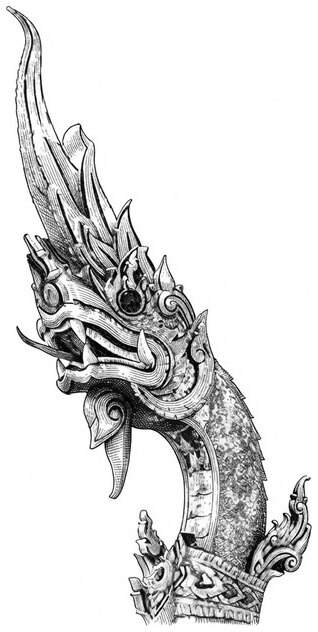
They are lights that people see rising out of the Mekong where it forms the border between Thailand and Laos. In Thai they are called bang fai phaya nak, the fireballs of the naga king. A naga is a giant water serpent of Buddhist and older Southeast Asian belief, and one is said to live in this stretch of river.
The lights appear on Ok Phansa, the full moon that ends the three-month Buddhist rains retreat. During the wet season, monks remain inside their monasteries. The festival usually falls in October; in 2026 the full moon is on 26 October.
The centre of it all is Phon Phisai, a district of Nong Khai province about 50 km from the provincial town. A Thai account of the lights from 2003 calls them “smoke-less, smell-less, and sound-less”. It says they range from the size of a thumb to the size of an egg and rise 20 to 30 metres straight up. Most come between six and nine in the evening.
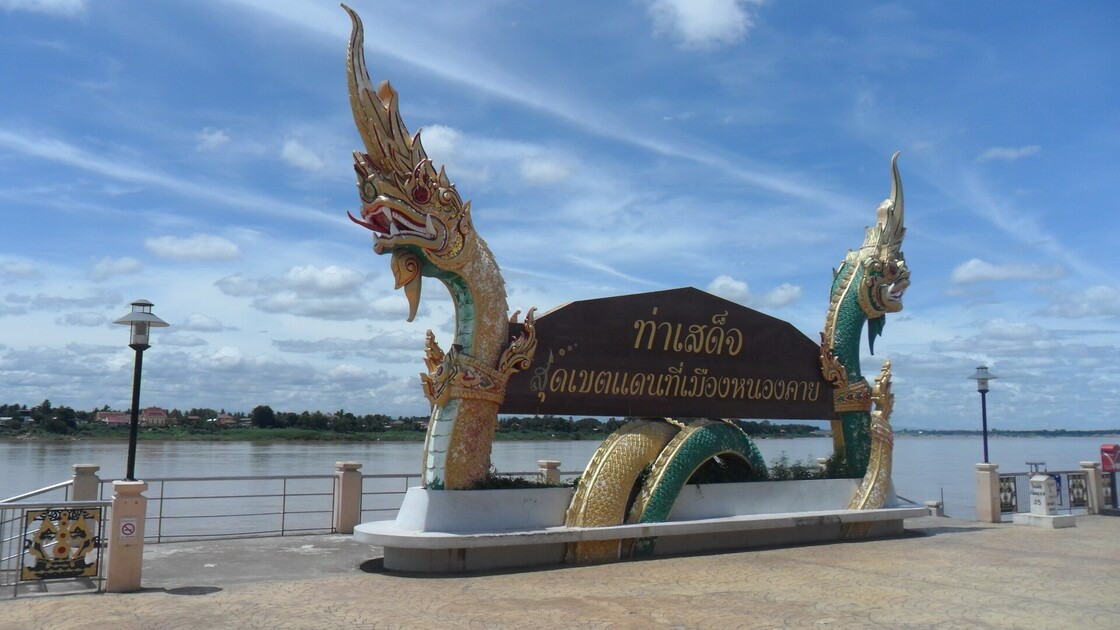
The crowds are large: a tourism official expected at least 200,000 people in 2002. By 2011 Nong Khai drew more than 300,000 visitors for the nights and held a six-day festival around them. In 2003 the roads backed up for 50 km and the hotels were full.
Why do the lights only come on that one full moon?
Believers give a Buddhist answer. During one rainy season, the story goes, the Buddha ascended to heaven to teach his mother and stayed three months. On the full moon that closed the retreat, he returned to earth on a ladder of jewels. The nagas beneath the Mekong were overjoyed and sent fire into the night sky to welcome him.
That is why the day is fixed. Thai temples hold their own festivals for the same homecoming: some float lit boats on the river, and others hang garlands made of baked rice, because angels are said to have welcomed him back with flowers and rice.
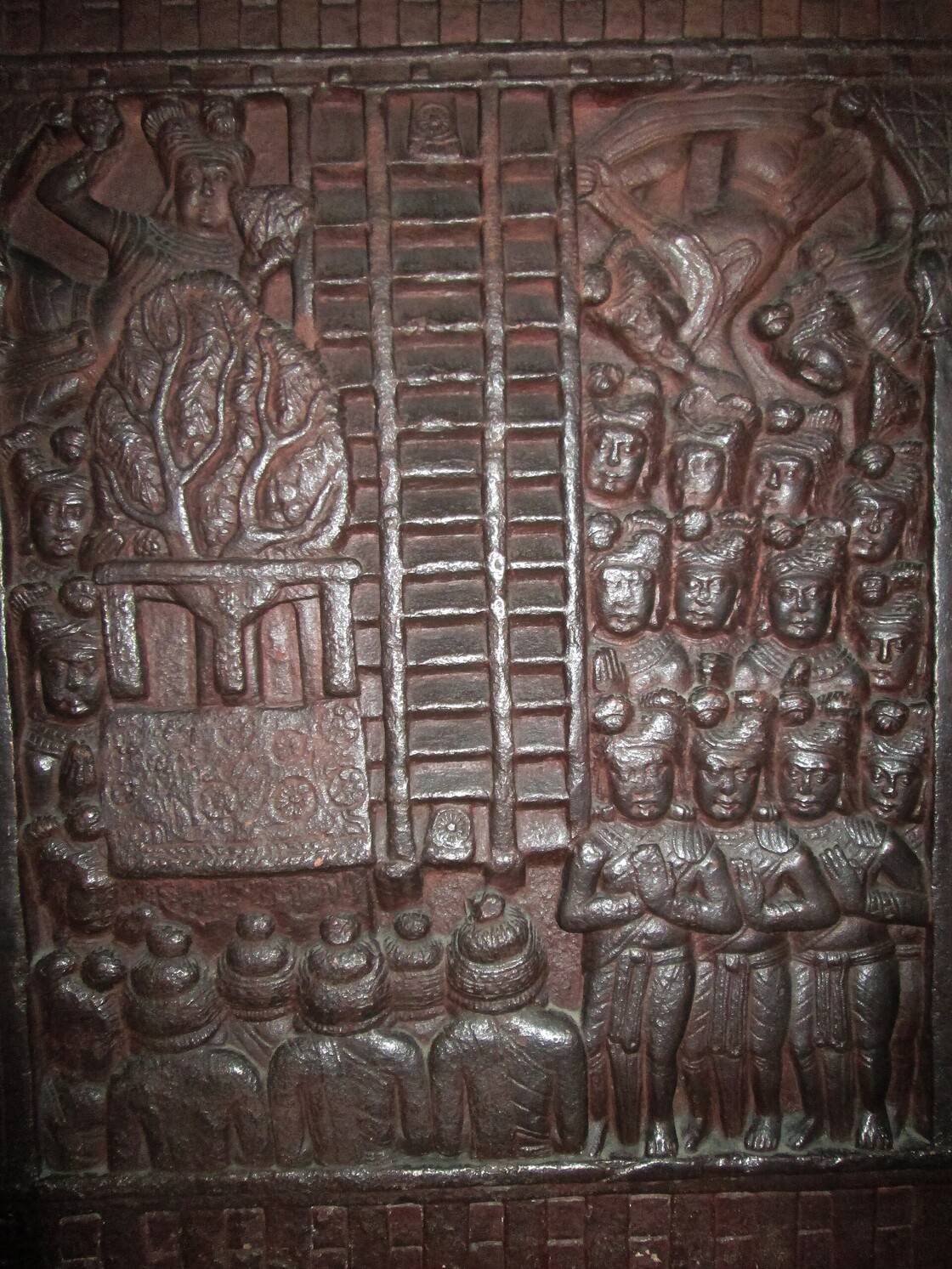
The serpents are older than this Buddhist frame. Local legend holds that nagas made Nong Khai and the other river towns in the first place. A Thai travel writer put it plainly: “Only later was the saga imbued with Buddhist fancy.” The naga of Southeast Asia guards water and rain across Thailand, Laos and Cambodia, and in Buddhist stories it shelters the Buddha too.
In 2003 a 93-year-old man from a village near the river told Al Jazeera: “I call it the Naga’s fireball in accordance with what my elders said. It happens naturally and no one stages the event.”
Did Thai scientists find methane and phosphine in the river?
Long before state laboratories sent teams to the river, a local doctor offered a natural explanation. Manas Kanoksin, a pediatrician at the Nong Khai hospital, spent years observing the river. He argued that decaying plants and animal matter in the riverbed produce methane. As bubbles of this flammable gas rise to the surface and meet the air, they spontaneously ignite.
He had a reason for the date as well. In his view the Lent full moon falls when the Earth is closest to the sun. More ultraviolet light, he argued, makes the air ready to light the gas. That part does not hold, since the Earth comes closest to the sun every year in early January.
He also had a reply to the sceptics. “If the fireballs are fake,” he told TIME in 2002, “the hoaxers would have to be more than 100 years old for a start.”
His main opponent was a geology lecturer at a university in the region. “It’s impossible that bubbles of methane could form in the river’s rocky bed or survive its turbulent flow,” he said. He did not name a culprit, only that the lights were “definitely not natural”. The two argued in public, and most of Nong Khai enjoyed the show and kept its faith in the naga.
What did the science ministry report?
Thailand’s Ministry of Science and Technology sent a team after the fireballs became national news in 2002. Led by a deputy head of the ministry, the team took soil and water samples along the river.
In October 2003, researchers reported traces of methane and phosphine in waterways near the river. Phosphine ignites spontaneously on contact with air. The team proposed that rotting riverbed debris released methane, while phosphorus from farm runoff helped create phosphine. In their view, monsoon floods set off “a complex geological process”.
They also listed what they could not explain. A glowing ball would need energy and microbes that they could not account for. One researcher still did not know why the lights came only on the full moon of the eleventh month.
A later ministry team went further. It put a heat camera on the bank and five groups of specialists along the river. Its leader then told a Bangkok paper: “The phenomenon is caused by flammable phosphine gas.” According to the team, the camera picked up gas rising off the water before anyone saw the orange glow. The gas builds up in the riverbed and peaks in October, and smaller sightings happen at other times of the year too.
The same burning-gas idea is the usual explanation for marsh lights in Europe and Brazil. In Brazil the lights are linked to the Boitatá, a serpent made of fire.
An American sceptics’ podcast, Skeptoid, pointed to a problem in 2009. In laboratory tests, a mix of methane, oxygen and phosphorus compounds burns bright bluish green with a sudden pop and black smoke. The Mekong lights are red, make no sound and rise straight up.
Could the fireballs be tracer rounds fired from Laos?
The rival answer says people make the lights with guns, and that answer made them famous. In 2002 the Thai channel iTV sent a crew of investigative reporters to the festival for a programme called Code Cracking. They took a boat up the Lao side, across from Phon Phisai, and filmed Lao soldiers firing tracer rounds into the sky. A tracer is a bullet with a burning tip that leaves a visible line. Each time the soldiers fired, the crowd on the Thai bank cheered.
Nong Khai took it as an insult. Thousands of local people held an angry protest that November. “The report suggests we are either a bunch of deceivers or gullible people fooled by Laotian soldiers,” a protest leader told the press. The tourist office worried that visitors would stay away. The Lao ambassador in Bangkok asked the press not to set the two countries against each other. “Lao people have lived with it for generations,” was his reply, “but we have no budget to prove what is behind the event.”
After the broadcast the crowds grew. A hit comedy about the dispute, Mekhong Full Moon Party, won top honours at Thailand’s national film awards that same year. By the following festival, hundreds of thousands of spectators lined the riverbank.
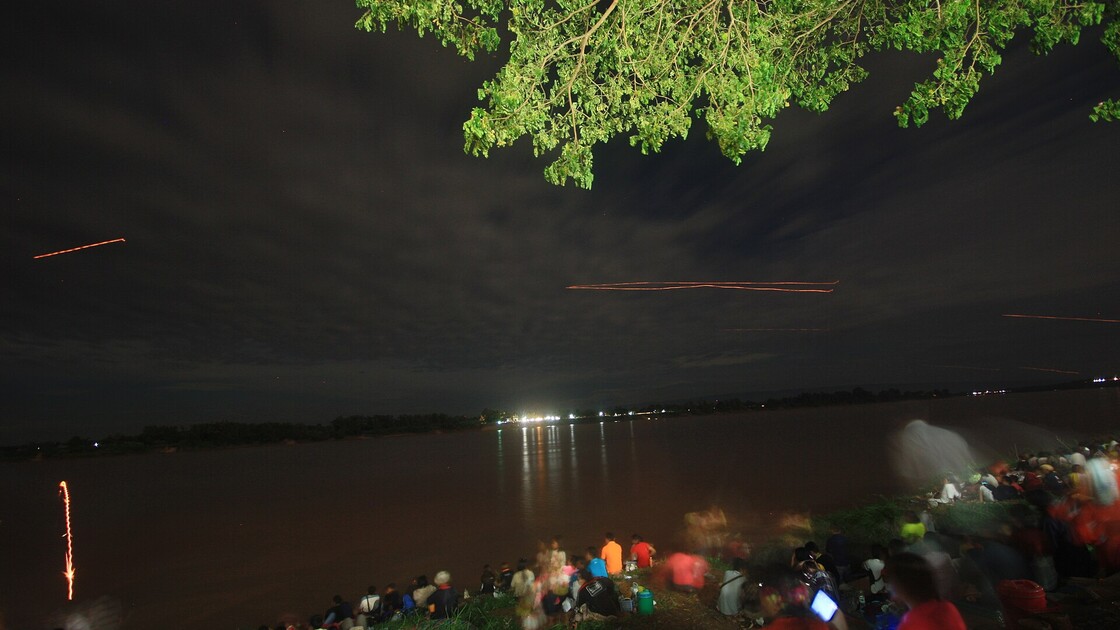
The loudest sceptic today is Jessada Denduangboripant, a biology professor in Bangkok. In 2016 he studied film of the lights and concluded they were flares fired from the far bank. In 2023 he called them “merely tracer bullets fired into the air by mischievous Lao villagers”. His evidence is photography. “Normal photos show the phenomenon as a fireball, but photos taken with a slow shutter reveal the truth of red streaks caused by projectile bullets.”
Laos denies it. In 2021 a Thai man sent documents to the Lao embassy claiming the lights were flares or tracers from the Lao side. The district across from Phon Phisai looked into it. The festival night that year fell under a Covid curfew, and police were out on the Lao bank all night. A senior police officer there called it “extremely unlikely that anyone could have fired weapons or flare ammunition without our knowledge on that night”.
What does the fixed date prove?
Each side reads the calendar its own way: a believer sees a greeting on the Buddha’s day, and the doctor wrongly blamed the sun’s position. In 2003 the ministry’s researchers called the date the one part they could not explain. Jessada argues that nature does not follow a religious calendar. If fireballs appear strictly when temples mark the festival, humans must be triggering them. In 2023, for example, astronomical full moon fell on one night, but the lights appeared the following evening, exactly when the local community celebrated the holiday.
The river is about 700 metres wide at Phon Phisai. None of the published reports describes a cartridge, a flare case or a gas sample caught from a fireball on the night.
On the curfew night of 2021, with Lao police watching their own bank, people in Narkoung, a village on that side of the river, said the lights were bigger than usual.