In the Paris manuscript of the Magic of Armadel, the page that names the book stands at the very end. The English occultist MacGregor Mathers, who translated this magic handbook in Paris in the late 1890s, moved that page to the front and said so in a footnote. His notes mention no other change to the order of the book.
About a century later a man who signed himself Frater Alastor put Mathers’s translation on the internet and went much further. He reversed every chapter, so that the last one came first, because he believed, in his own words, that the whole book “was written backward”.
Where was the Magic of Armadel title page in the original manuscript?
A grimoire is a handbook of magic, with prayers, the names of spirits and angels, and seals, the drawn signs a magician copies in order to call on them. The Armadel is a short one. Its title, in Mathers’s English, promises “The Most Perfect, Short and Infallible Science” of the whole Qabalah, the Jewish mystical tradition as Christian magicians read it. The manuscript names its author as Armadel. The sources say nothing more about him.
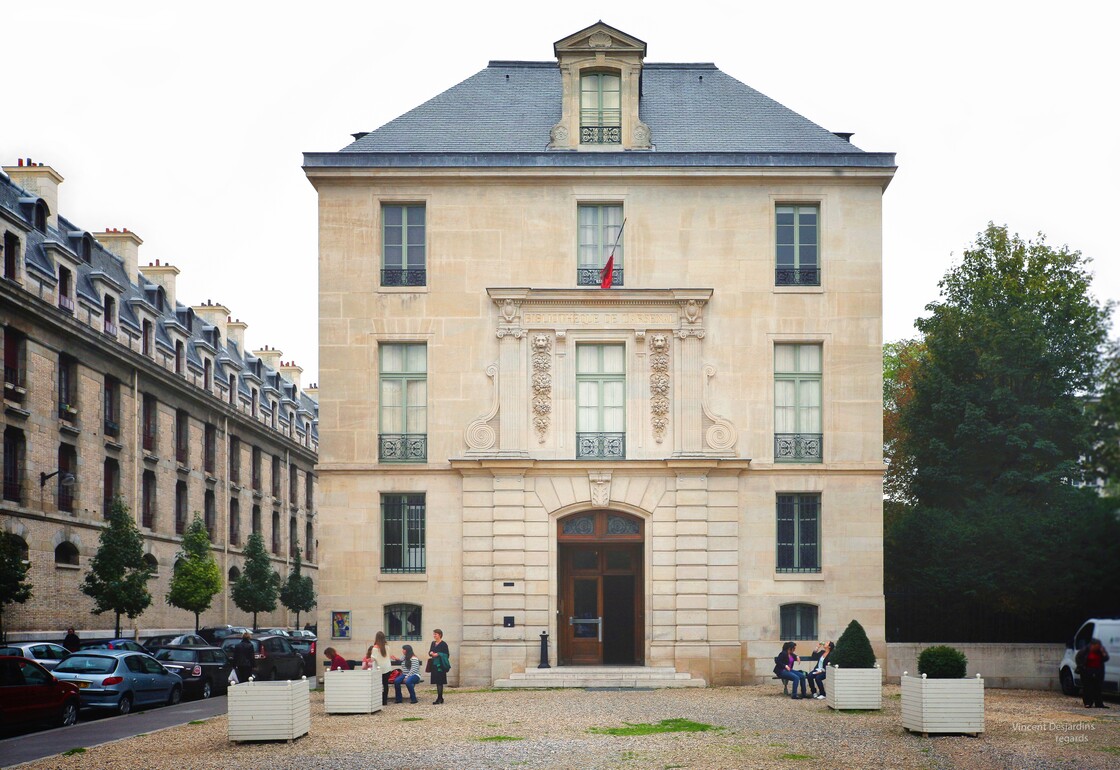
The manuscript Mathers used is kept in the Bibliothèque de l’Arsenal in Paris. The library grew out of the private collection of the Marquis de Paulmy, which was set up in the old Arsenal building in 1757 and has belonged to the French national library since 1934. Francis King, who edited the first printed edition of Mathers’s translation in 1980, gives the manuscript’s old number as 88. The library’s catalogue lists a volume under that old number, today Ms-2494, so this is very likely the book Mathers read.
Ms-2494 is a collection of texts on the occult sciences, written by hand in French in the 18th century and bound in marbled leather. It opens with the Grimoire ou la cabale, par Armadel, and five more magical texts follow in the same binding, the first of them a conjuring book attributed to Pope Honorius.
Mathers is the only source for the title page standing at the end. On the first page of his English text he added this footnote: “This species of title-page occurs in the original MS. at the extreme end of the book, instead of at the beginning, but I have placed it here as more suitable, while giving the Latin of it at the end.” He meant the page with the book’s Latin name. He put an English version of it at the front of his translation and kept its Latin wording for the last page.
What did Mathers change when he translated the Armadel?
Samuel Liddell MacGregor Mathers was born in London in 1854. He was one of the heads of the Hermetic Order of the Golden Dawn, a society that practised ceremonial magic. For its members he translated old grimoires, among them the Ars Goetia, a catalogue of seventy-two spirits. In 1892 he and his wife moved to Paris, where he soon found the large collections of magical manuscripts in the city’s libraries.
Because Mathers moved only that one page, his English text starts in the middle of a magical operation. Its first sentence refers to a protective magic circle and says the instructions for it were given “elsewhere”. After that come a conjuration in Latin and the licence to depart, the formula that sends a summoned spirit away again.
His footnotes record a few more details. A second title page in the manuscript was blank, so Mathers wrote a title for it himself, and he read the drawing on that page as a door, “the Portal of Wisdom, as it were”. At one point near the end he warned that from there on the whole manuscript is in “execrable and obscure Latin”.
Mathers never published this translation, and Francis King guessed that he made it between 1897 and 1899. Handwritten copies passed among the members of the Alpha et Omega, the magical order that stayed loyal to Mathers after members of the Golden Dawn rebelled against him. One of those copies became the printed book of 1980, long after Mathers died in Paris in 1918 (see Death of MacGregor Mathers).
Francis King placed the Armadel in a family of German magic books of the 1600s that were sold on the fame of Doctor Faust, the magician of the legend. Another member of that family is the Höllenzwang traced in Hell Had Seven Electors.
The 1980 book keeps Mathers’s order. After the circle and the conjuration, the first section is headed “The Sanhedrin”, after the Jewish high council that tried Jesus in the Gospels. Its first seal belongs to the angel Zadkiel, who will teach “all the Sciences Active and Passive”. From there the chapters walk backward through the Bible, from Jesus and John the Baptist through Elijah, Solomon, Moses and Abraham to Adam and Eden. Then the book turns to the spirits, the devils first and later the angels before their fall, and after them to God and “the paths of wisdom”. It closes with prayers and the seals of the angel Michael. On its last page, page 79, stands the Latin title page, “Liber Armadel”, with a note: “This is a reproduction of the original title-page.”
Who is Frater Alastor, and why did he reverse the chapters?
“Frater” is Latin for brother, a title members of magical orders often use among themselves. Frater Alastor is the name signed under the prologue of a web edition of Mathers’s text that was online by 2003, and the sources do not say who stands behind it.
His prologue begins with Mathers’s footnote, retold in his own words and spelling: “When Mathers made his translation he notice that the title page was the last page of the grimoire, so he moved to the front but keep the rest of the chapters in the same order.” Then he adds what struck him about the opening: the grimoire “began speaking about the magick circle like if it where something that the reader should already know.”
From there he drew his conclusion: “Now it is my believe that the whole grimoire was written backward, this is to say that you should read the last page first (the title page) then the last chapter and so on.” He gave two reasons. A book should not open with the licence to depart, because that “is the last think that a magician read”. And the chapter titles in Mathers’s version run from the Sanhedrin and Jesus back to Adam and then to the demons and the angels, which is “completely the opposite” of the Bible, where God comes first, then the angels, the demons, Adam and Jesus.
So he “inverted the orders of the chapters in Mathers version under the believing that this is the way that was intended to be read.” His edition opens with the Latin title page, a prayer and the seals of Michael, and it ends with the Sanhedrin, the conjuration and the licence to depart.
“Armadel” also appears on a different book. A manuscript in the British Library, Lansdowne 1202, is titled The True Keys of King Solomon by Armadel. Francis King describes it as a version of the Key of Solomon with seals of evil spirits added at the end, a separate text from the Paris grimoire.
Was the Armadel really written backward?
Part of what Frater Alastor noticed is in the text. Mathers’s text begins with a circle it never explains, and in Mathers’s order the chapters run from Jesus back to Adam and then on to the angels and God, like the Bible read from its last page.
His conclusion, though, rests on what he calls his belief. He describes only Mathers’s version, and nothing in his prologue suggests that he saw the Paris manuscript. Mathers, who did work from the manuscript, moved one page, called the move “more suitable” and said nothing about a book written backward.
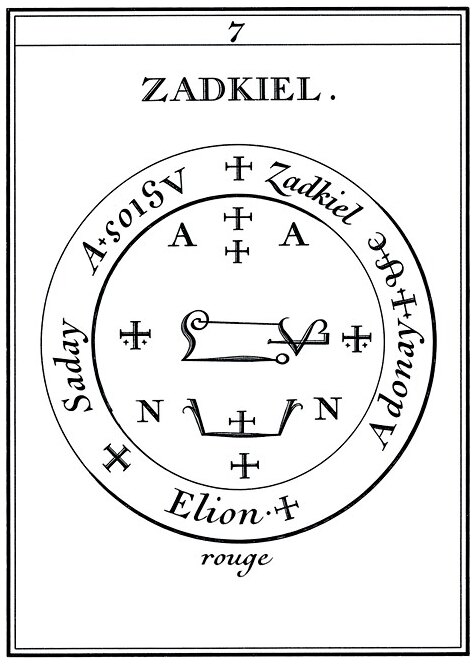
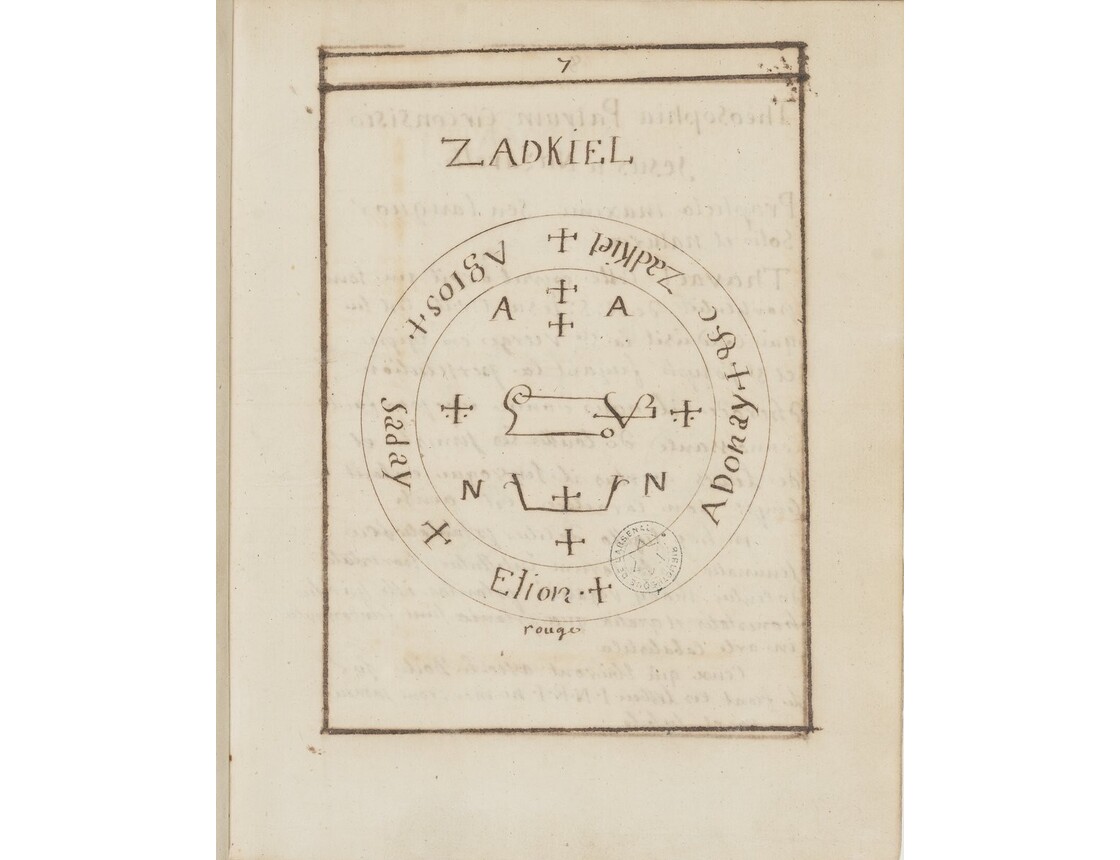
The copyist numbered the pages of the Paris manuscript, and those numbers can be checked. If Frater Alastor were right, the seal of Zadkiel, which opens the first section in Mathers’s English, would stand near the end of the manuscript. It stands on page 7, near the front (the page is shown above). So at least the start of Mathers’s order matches the copyist’s, and the one page Mathers calls out of place is the title page.
The sources do not explain why the copyist put that page at the end. Frater Alastor’s edition also leaves out Mathers’s footnotes, including the one about the title page, so a reader of the web version learns about both moves only from Alastor’s own prologue.
What does Pelech mean in the Armadel?
One name in the Armadel comes without any explanation. About halfway through the book, at the chapter “Concerning the Science of the Regeneration of Adam and his Children by Pelech”, Mathers noted that three signs in the manuscript “are evidently intended for the Hebrew letters P L Ch, Pelech”. He added that “later in the Work ‘Pelech’ is used as the Name of Jesus.”
The text itself makes that link several times. The seal of this chapter teaches the regeneration of Adam’s children “through Pelech now shown forth visibly as Jesus”, and the magician is told: “Thou shalt have fasted with the Lord God Pelech, now (called) Jesus, for Seven Days”. In the Latin part near the end, a passage built on the prophet Ezekiel’s vision of dry bones coming back to life has the spirit come so that the bones “may revive in the Name PELECH, now JESUS.” In one place Frater Alastor’s version spells the name “PELEG”.
Mathers does not say where the name comes from. In biblical Hebrew the word spelled with those three letters, pelekh, means the whorl of a spindle (the small weight that keeps it turning), a stick or a district, according to the standard dictionaries. None of the sources connects that word to Jesus, and the Armadel does not explain it.
In the 1980 edition the Latin page still comes last, as in the manuscript. “Liber Armadel,” it begins, and under the closing lines stands the word FIN, the French for “end”. In Frater Alastor’s version the same Latin words open the book.