An old German book of magic explains how to make a mirror that shows buried treasure. The glass lies for weeks on the face of a dead man, then in the middle of a crossroads, then on a church altar. The last instruction says that a dog or a cat must look into the finished mirror before its owner does. The book gives no reason, and a second magic book with the same rule gives none either, so the answer has to be pieced together from elsewhere. The best clue comes from German folk belief of the 1800s, where a new house or a new bridge was thought to claim the first living creature that entered it, so people sent an animal across first.
The book claims to come from Faust, the scholar of legend who made a pact with the devil and whose story was retold on stage and screen (more in Is Faust Based on a True Story?). In it, Faust asks the devil Mephistopheles, who has to serve him, how things are done, and Mephistopheles answers with recipes.
How was the magic mirror buried on a corpse made?
The book is called Doctor Johannes Faust’s Magia naturalis et innaturalis, and it is better known as a Höllenzwang, a “coercion of Hell”, meaning a manual for forcing spirits to obey. The Stuttgart publisher Johann Scheible printed it in 1849 from a handwritten copy in the library of the dukes of Coburg. Its title page claims “Passau 1505”, but Scheible himself judged the manuscript to be from the 1700s. The historical Faust, who lived from about 1480 to about 1540, had nothing to do with it (see The Real Dr. Faustus).
Chapter LXVII is headed “How to make an earth-mirror to see therein all goods hidden in the earth”. Faust asks whether one could prepare something of steel, metal or glass to see treasures in the ground, and also to see where a person’s illness came from. Mephistopheles says yes and starts with the purchase. The buyer must get a new mirror on a Friday and pay the price that is asked without haggling, “so that no spirit can find fault with you in it”.
Then comes the grave. The buyer takes the mirror to a churchyard in the hour of Mars. In the astrology of the time, each hour of the day was ruled by one of the seven planets, and this hour belonged to Mars. He buries it “in a man’s grave in your name, directly upon the face of the deceased, and leave it lying there for 9 Fridays”, which comes to about nine weeks. The words “in your name” return at every step, so the maker always acts in his own name.
Why the face, and why a man, the book leaves unexplained. A later chapter on magic crystals adds one detail: a woman who makes a crystal must bury it in a woman’s grave. So the dead person seems meant to match the maker, a man’s grave for a man and a woman’s for a woman.
What happens to the mirror at the crossroads?
On the ninth Friday the maker digs the mirror out and carries it to a crossroads. He lays it “exactly in the middle of the crossroads in the name of three spirits”, and which three depends on what the maker wants to see. For treasure, Mephistopheles names spirits whom the book later calls great princes. Two of them, Ariel and Marbuel, “will open up all the foundations of the earth to you through their great agility”. The third, Aciel, shows the treasure, says whether it is gold, silver or precious stones and how much it is worth, and drives away the “ancestral spirits” from it. In this book those are the spirits of the dead who keep watch over a buried hoard, as told in Baptizing Buried Treasure Coins.
The mirror stays at the crossroads for nine more Fridays. On the last of them the maker takes it out and speaks a ban, a formula that binds a spirit to a place so that it must serve. The ban calls Ariel, Aciel and Marbuel by name, followed by names of God such as Adonay, Agla and Elohim. It orders “that you three princes remain in this mirror and show me all hidden goods, be it silver, gold, or precious stones.”
Just before the ban stands a warning: “But do not look into it, neither before nor after the ban.” Once the words are spoken, Mephistopheles says, the three spirits “will instantly enter into the mirror and appear to you therein.”
In 1868 a magic mirror of this kind was sold at an auction in Paris for 25,500 francs. Adolf Wuttke’s survey of German folk belief noted the price in its section on magic mirrors, next to the instructions for making one in a grave.
Why does the mirror go on a church altar?
Even with three spirits inside, the mirror is “not yet fully right”. The maker must bring it onto an altar, “so that the spirits may be consecrated by an ordained person, so that they show you the truth.” It stays there for three Sundays. Read closely, the blessing is meant for the spirits in the glass, so that they answer truthfully.
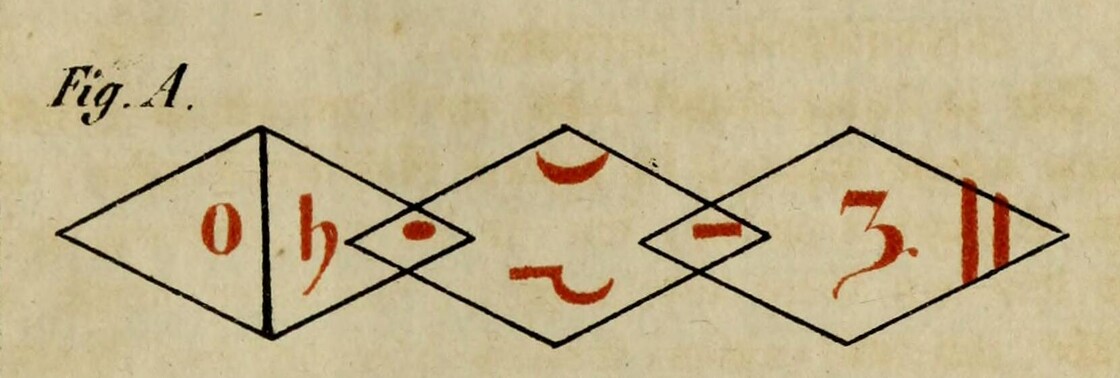
The maker must also “take great care, dear Faust, that no consecration of a corpse is spoken over it, otherwise all effort is in vain and lost.” A consecration of a corpse is the blessing a priest speaks over the dead at a burial, and the book says it would undo the work. Under the finished mirror the maker lays a sign drawn on plate 73, one of the full-page pictures printed with the book: three linked diamond shapes filled with red and black marks.
Then, as its very last line on the mirror, the chapter gives the rule about the animal: “Now when this mirror is thus ready for use, you must first let a dog or a cat look into it before you look into it.”
Why must a dog or cat look into the magic mirror first?
In the German of the 1849 print the same sentence reads must du zuerst einen Hund oder Katze hinein sehen laßen, ehe du hinein siehest, and the chapter closes on it without a reason. The next chapter moves on to another mirror, made from electrum, a mix of metals.
The text around the rule still shows what the first look would meet. The owner has been told not to look before the ban and not after it, and the book has just said that three spirits sit in the glass and appear in it. Whoever looks first would therefore meet them, and the book wants that to be an animal.
The same book has a holy mirror that works the other way. In a chapter on a polished steel mirror, a priest reads masses over the glass, and afterwards the owner “shall see to it that no one else looks into it, for it would become unclean.” In that holy mirror the danger lies in a stranger’s look, whereas every warning about the treasure mirror concerns the owner’s own look.
Faust’s book also makes magic crystals the same way. The glass is ordered from a glassmaker on a Tuesday, in the hour of Mars, paid for at the asking price and buried “as the discourses on the mirror teach you”. A crystal can do less than the mirror, the book says, and it needs other spirits: Mephistopheles himself, with Azeruel and Adadiel.
Does any other book give the same rule?
A small book of charms and cures, sold in English as Egyptian Secrets and put under the name of Albertus Magnus, has it too. Albertus was a Dominican scholar who died in 1280, centuries before this little book was printed under his name (more in Albertus Magnus on Mirrors and Silver). The title page of the English edition says it was “translated from the German”, and the scanned copy from the Boston Public Library is catalogued as printed around 1900. On page 89 of its second volume it gives this recipe:
“Procure a looking glass, such as are commonly sold. Inscribe the characters noted below upon it. Inter it on the crossing of two pathways, during an uneven hour. On the third day thereafter, hie to the place at same hour, and take it out: but you must not be the first person to look into the glass. It is best to let a dog or a cat take the first look into the mirror.”
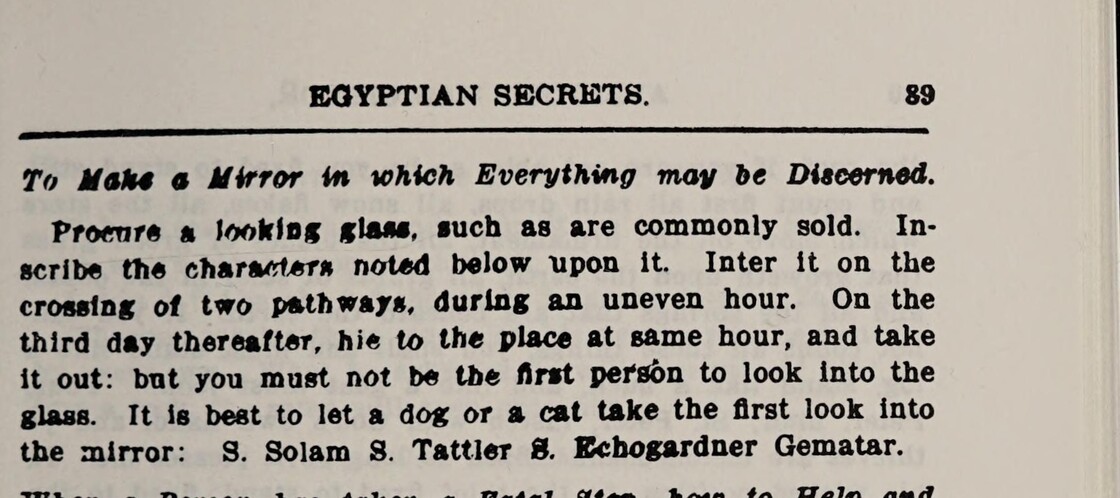
Here “inter” means bury, “hie” means hurry, and an uneven hour is an odd-numbered one. The “characters” are a short line of strange words printed at the end of the recipe. This version leaves out the grave, the named spirits and the altar, and the mirror stays in the ground for only three days. The crossroads, the ban on the owner looking first and the dog or cat are all there, and again no reason is given.
What did German folk belief say about going first?
In the 1800s, collectors wrote down what country people in the German lands believed. One such collection is Adolf Wuttke’s Der deutsche Volksaberglaube der Gegenwart, “German folk superstition of the present day”, revised by Elard Hugo Meyer in 1900. It says several times that the first creature to use something new is in danger, and that an animal should go first.
In German folklore the devil often built castles, walls, bridges and even churches in exchange for a human soul. “If he demands the soul of the one who first enters the new building,” Wuttke wrote, “then one lets an animal enter it first.” Elsewhere the survey says that every new building demands its victim, so an animal had to step across the threshold first. In Bavaria, a new comb was first run through an animal’s coat, and only then through its owner’s hair.
The Brothers Grimm printed a legend built on this trick. A Swiss herdsman had to wade through the river Reuss with great effort whenever he went to see his girl, and he wished that the devil would build him a bridge. The devil agreed on one condition: “the first living thing that goes over it” would be his. The herdsman promised, and the bridge stood ready in a few moments. Then he drove a chamois, a wild mountain goat, ahead of him and walked over behind it, and the cheated devil let the pieces of the torn animal fall from the heights.
Wuttke also records what a mirror could show. After eleven at night, people said, nobody should look into a mirror, because the one who did might see an ugly face next to his own, or the devil, or a witch. In Bohemia it was said that he might even die.
Put together, these beliefs suggest one possible reading of Faust’s rule. The mirror is new, spirits have just been bound into it, and the first look is its first use, the kind of moment when folk belief sent an animal ahead. This is a reading built from folk belief, and both magic books leave the rule without a reason.
Did anyone else make mirrors in graves?
Folk belief records the grave rite outside Faust’s book as well. The 1900 edition of Wuttke’s survey says that people called such a tool an earth mirror or mountain mirror. It was a plain glass mirror, usually square with a sliding wooden cover, used to find thieves or buried hoard. “There is a strong suspicion,” the survey says, that these mirrors gain their power when held before the face of a corpse at midnight, and for this people even broke open graves.
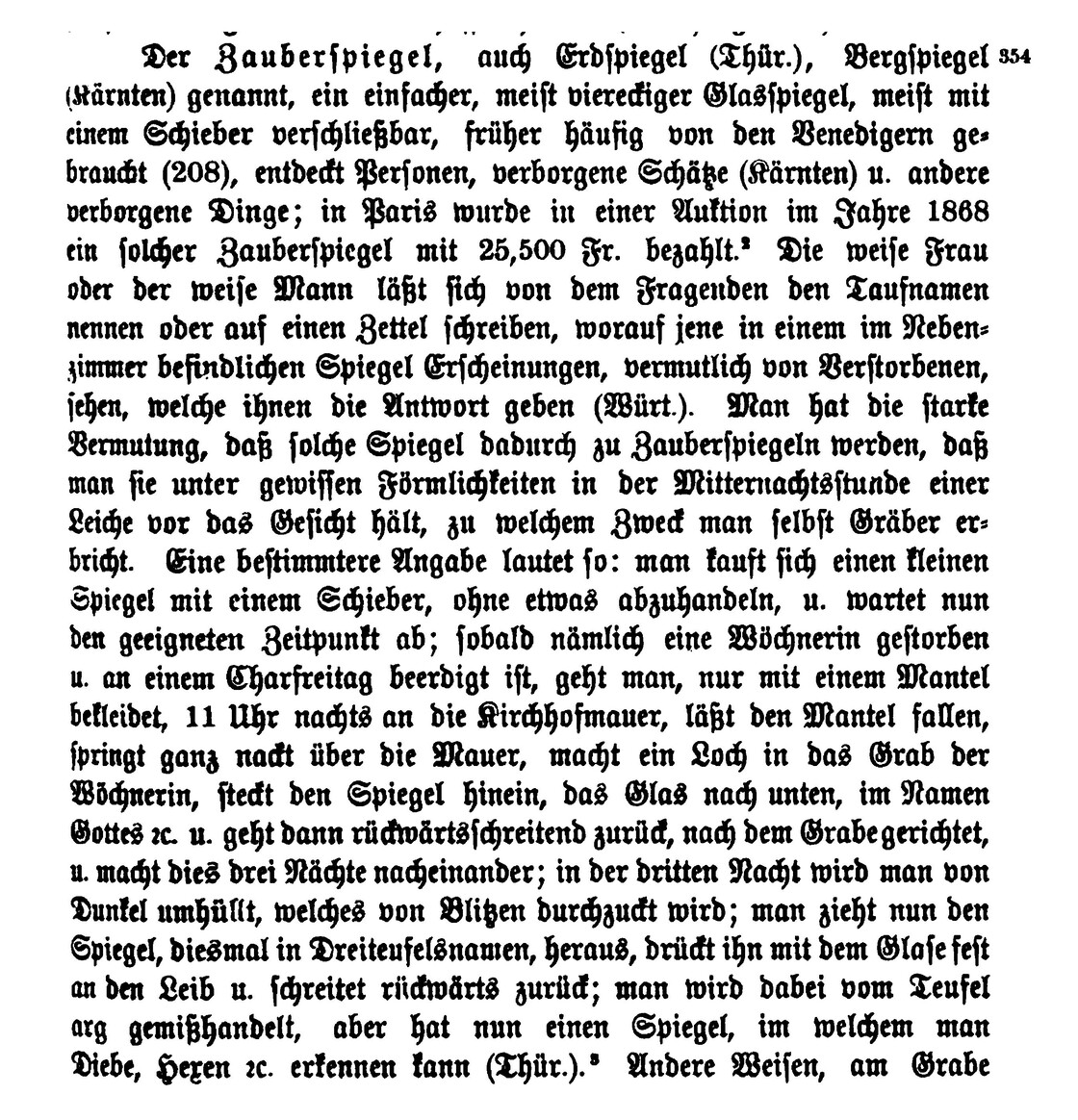
A Thuringian recipe in the same section goes further. The maker buys a small mirror with a sliding cover “without haggling” and waits until a woman who has died in childbirth is buried on Good Friday, the Friday before Easter. At eleven at night he goes to the churchyard wall wearing only a cloak. He drops the cloak, climbs over the wall naked, makes a hole in her grave and pushes the mirror in with the glass facing down, in God’s name. Then he walks back the way he came, backwards, with his face to the grave.
He does this on three nights in a row. On the third night darkness closes around him, broken by flashes of lightning. He pulls the mirror out, this time in the names of three devils, presses the glass against his body and walks away backwards again. “One is badly beaten by the devil while doing so,” the recipe says, “but one now has a mirror in which one can recognise thieves, witches and the like.”
In Thuringia the maker paid with the devil’s blows on his own body. Faust’s recipe ends differently, with a dog or a cat looking into the glass, where the three spirits have just been bound, before its owner does.
Animals and mirrors also met in gentler folk charms. In several German regions, people bound a pet to a new home by letting it look into a mirror three times and leading it around a table leg. To make a cat settle in, owners put it in a sack, swung it around themselves three times, then made it look into the chimney and into the glass.