The central prayer of today’s witches is a goddess speaking to her circle as “I”. It is called the Charge of the Goddess. In 1953 a new witch, Doreen Valiente, heard it read aloud at her initiation by a man who presented it as ancient, and she heard whole sentences by Aleister Crowley in it, an occultist the papers tied to black magic.
A few years later she rewrote the Charge, and her version is the one witches recite today. She cut Crowley’s love talk, the lines where his goddess longs for her worshippers, but other lines of his stayed. By one careful count, about a quarter of the words are still his.
What is the Charge of the Goddess?
The Charge is a short speech for use in ritual in Wicca, the modern witchcraft religion that went public in the 1950s. In the early years it was read out before an initiation, and it opens with “Listen to the words of the Great Mother”.
The word “charge” comes from rites like those of the Freemasons, where a new member is formally addressed. Valiente herself saw the Charge as part of that Masonic side of the rituals.
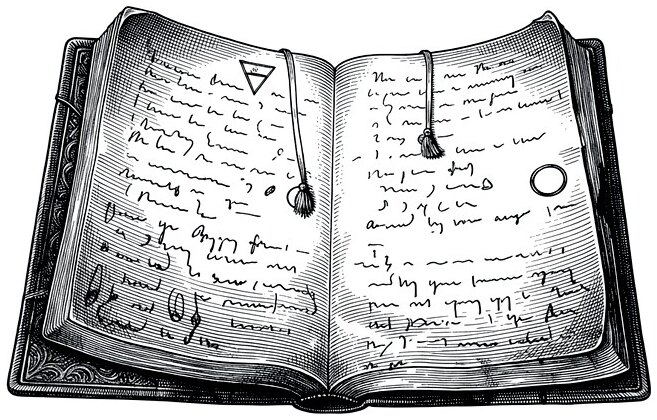
The man who read it to her was Gerald Gardner. In his account, he had found an old coven of witches in the New Forest in southern England. He presented their rites as old and kept them in a handwritten book, the Book of Shadows.
How did Doreen Valiente spot Crowley in the Charge of the Goddess?
She recognised the words the first time she heard them, at her initiation in the summer of 1953 in the house of a fellow witch.
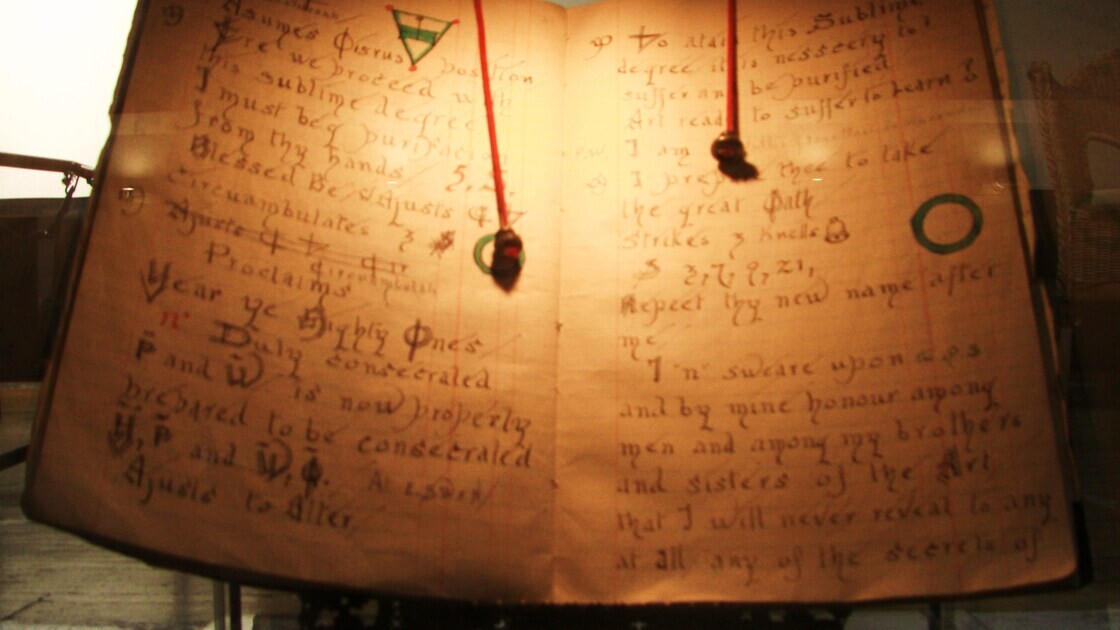
Her memoir of 1989 keeps the scene. Candles lit the room, and the altar was improvised. Gardner stood naked, with wild white hair, tattooed arms and a heavy bronze bracelet. In one hand he held a sword, in the other the Book of Shadows.
From the book he read a section called “The Charge”, and Valiente caught sentences from a book by Crowley as well as passages from an 1899 book on Italian witchcraft. After the rite she pointed this out to Gardner. “I think he was none too pleased at my recognition of its sources.”
Later she was given the book to copy by hand, and she saw more. To her it was obvious that the book “owed a good deal to the works of Aleister Crowley”. One of its chants turned out to be an adaptation of a poem by Rudyard Kipling.
The Kipling poem was “A Tree Song” from Puck of Pook’s Hill, a childhood favourite of Valiente’s. Two of its lines run: “Oh, do not tell the priest our plight, / Or he would call it a sin”.
Did Gerald Gardner copy Aleister Crowley in the Book of Shadows?
Gardner did copy him, in part. The oldest known Charge sits in one of Gardner’s handwritten notebooks from the 1940s. Most of it joins passages from the Italian witchcraft book to long stretches of Crowley.
Most of the Crowley comes from one essay of his, “The Law of Liberty”, printed in 1919. Gardner copied the lines in the essay’s own order, probably with the book open in front of him.
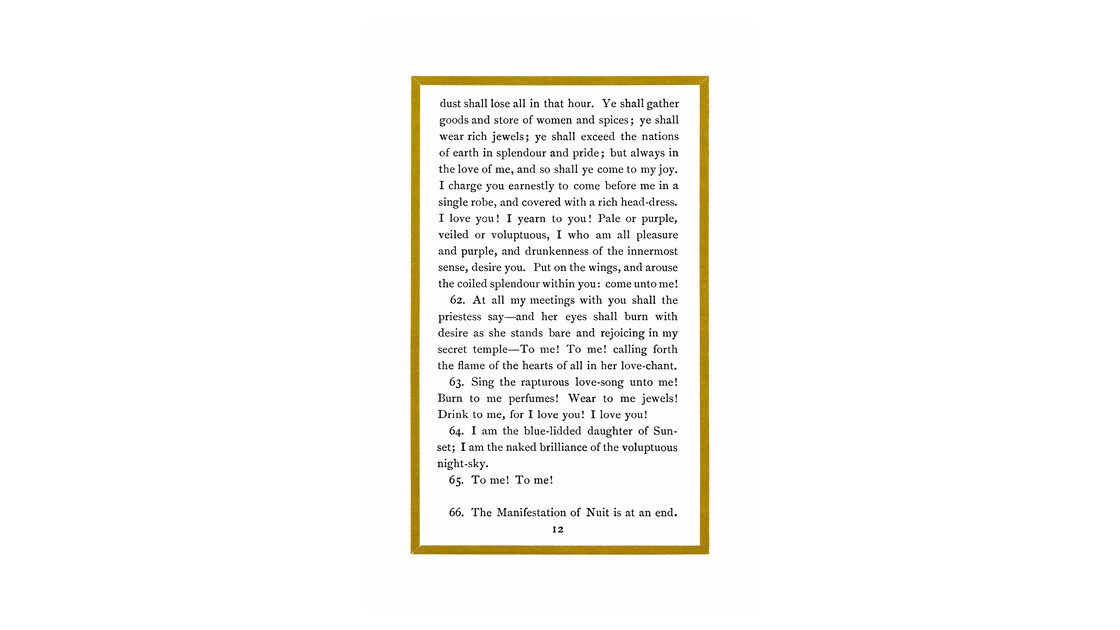
Put the texts side by side and the borrowing is plain. In 1904 Crowley wrote down a short book that, in his account, a spirit dictated to him. Its title is The Book of the Law, and it became the holy text of his own religion. In it an Egyptian sky goddess speaks to her followers: “I love you! I yearn to you! Pale or purple, veiled or voluptuous, I who am all pleasure and purple, and drunkenness of the innermost sense, desire you.”
Gardner’s Goddess says almost the same words: “I love you: I yearn for you: pale or purple, veiled or voluptuous.” She also repeats the sky goddess’s promise of joy that asks for no sacrifice.
Gardner had two reasons for using Crowley. First, Crowley headed a secret society for magic, and Gardner held a signed charter from him to run a local branch of it. In Gardner’s view, that paper gave him the right to use the material.
Second, the rituals of the old coven had reached him only in fragments, so he had to fill the gaps. Crowley’s writings, in his words, “breathed the very spirit of paganism and were expressed in splendid poetry”.
The two men met only near the end of Crowley’s life. An old friend of Gardner’s, a stage magician, later said he had introduced the two men in 1946. Crowley was then living in a guest house at Hastings, and he died on 1 December 1947. According to a friend of Crowley’s, Gardner paid Crowley about £300 for the charter.
The stage magician, Arnold Crowther, first went looking for Crowley because a woman at a party mistook him for “that dreadful man”. He found an old gentleman living in a guest house who was glad of someone to talk to.
Valiente wondered whether that payment started the rumour, repeated by some writers, that Crowley was paid to write the witch rituals. She knew of no evidence for it. She never saw a Book of Shadows in Crowley’s handwriting, and she met nobody who had. The notebook with the oldest Charge is in Gardner’s own hand.
Why did Valiente remove Crowley’s words from Gardner’s rituals?
Valiente cut Crowley because of his reputation. After Gardner’s book Witchcraft Today came out in 1954, more and more people wanted to join. Gardner hoped the old religion could win public acceptance.
In Valiente’s view it never would while Crowley’s influence was “so prevalent and obvious”. In her words, “Crowley’s name stank”: the papers tied him to black magic, and for years he had lived “upon involuntary contributions from his friends”.
She judged the writing and the man apart. Crowley “may have been a brilliant writer and a splendid poet but as a person he was simply a nasty piece of work”.
Gardner’s answer was short: “Well, if you think you can do any better, go ahead.” She took him at his word and set out to rewrite the Book of Shadows, “cutting out the Crowleyanity as much as I could”.
What did Doreen Valiente change in the Charge of the Goddess?
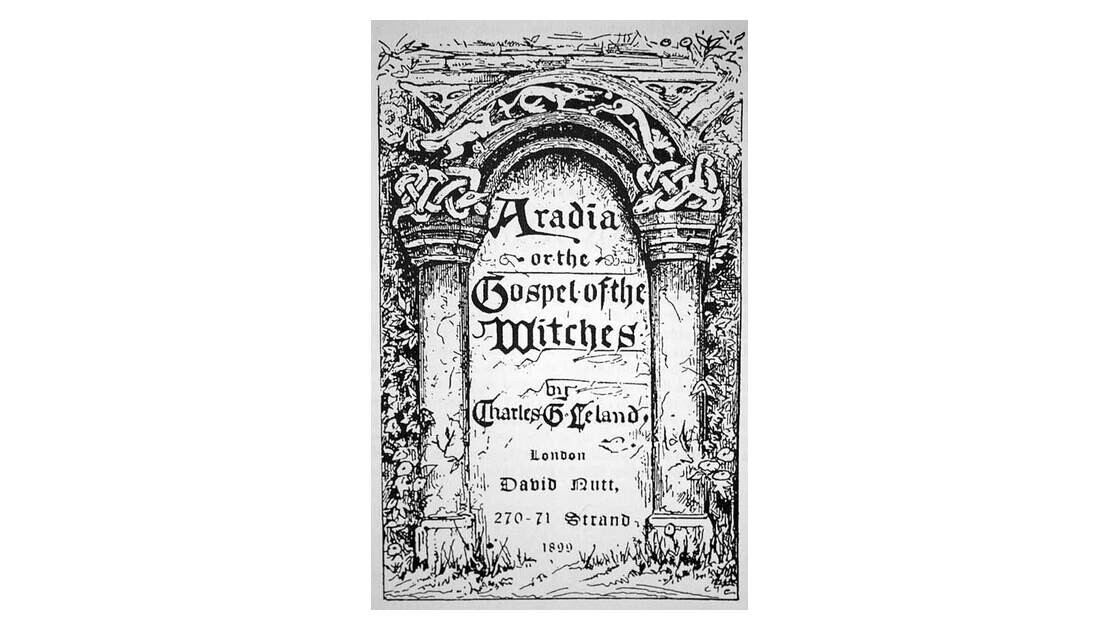
Valiente kept the Italian witchcraft book as the base of her new Charge. It is called Aradia, and it came out in 1899. Its author, Charles Godfrey Leland, presented it as the secret gospel of Italian witches.
In it, Aradia tells her followers to meet “once in the month, and when the moon is full” to adore “my mother, great Diana”. Diana, the Roman moon goddess, is the queen they worship. Aradia adds: “And as the sign that ye are truly free, / Ye shall be naked in your rites”. Those lines survive in both of Valiente’s versions.
Her first version was a poem in eight rhyming verses. It opens “Mother darksome and divine” and calls the Goddess the lover of the Horned God. Its last verse begins “No other law but love I know”.
The poem did not work well in the circle, where people found its long list of old goddess names hard to pronounce and tripped over some of its old-fashioned words.
So she wrote a prose version: she kept Gardner’s opening and the lines from Aradia and added lines of her own. In them the Goddess is “the beauty of the green earth; and the White Moon amongst the Stars”, and her love “is poured out upon earth”.
An American book on witchcraft later printed lines based on Valiente’s rhyming Charge and credited them to the witch Sybil Leek. Valiente was “very amused”.
How much Crowley is still in the Charge?
Valiente did not get all of Crowley out. One pagan writer counted the words of her prose text, line by line: about a third are her own, and about a quarter, roughly 120 words, still come from Crowley, most of them word for word.
Several of his lines stayed. “Keep pure your highest ideal; strive ever towards it” comes from his 1919 essay, and so does “all acts of love and pleasure are my rituals”. The only change is the word “my”: Crowley wrote “all acts of love and pleasure are rituals”. Valiente’s Goddess also still says “nor do I demand aught in sacrifice”, the sky goddess’s words of 1904.
The counter found it “interesting that she left so much of his work in the Charge”. What went was mostly the sky goddess’s love talk. The “pale or purple” lines are gone from her prose.
Which version of the Charge of the Goddess do Wiccans use today?
Most Wiccans today use Valiente’s prose, in many small variations. It was printed in the witchcraft books of Janet and Stewart Farrar, and others reworked it. A 1979 version by the writer Starhawk takes out every phrase using the word “man”.
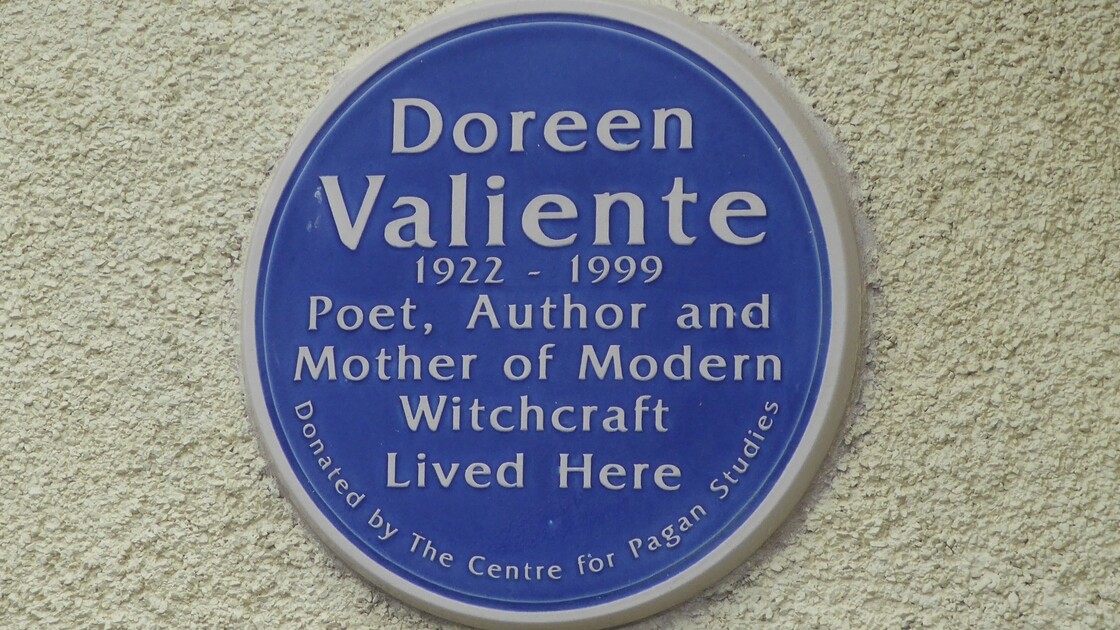
Valiente died in Brighton in 1999. On 21 June 2013, sixty years after her initiation, the Mayor of Brighton unveiled a blue plaque on her former home in Tyson Place. It was the first blue plaque for a modern pagan.
Valiente kept her faith after tracing the sources. Under Leland, Kipling, Crowley and the Freemasons, she found “a basic structure which was not from Crowley” or any of the others. In 1957 she left Gardner’s coven with a few others. Of that group she remembered: “we still believed that the real traditional witchcraft lived.”