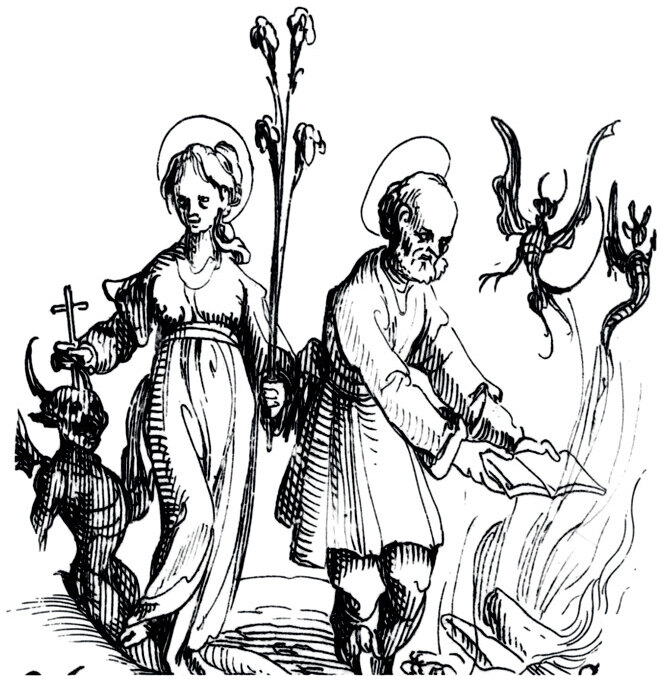
Cyprian of Antioch is the magician of an early Christian story. He sends demons after a young woman to win her for a client, and the demons fail. He burns his magic books, becomes a bishop and dies a martyr beside her. Much later, readers saw in him an older Faust, a learned man who deals with the Devil.
The story was written in Greek in the 4th century, and nothing outside it shows that he lived. Yet for centuries people prayed to him against sorcery, and magicians put his name on their spell books.
Who was Cyprian of Antioch?
Cyprian’s story survives in three short Greek texts. One tells how he became a Christian, another how he died. The oldest, called his Confession, lets him tell his own life as a sorcerer and was written around the middle of the 4th century.
The conversion story begins with Justina, a young woman in Antioch, then a great city in Syria. She hears a Christian deacon preach from her window and becomes a Christian with her parents. A young man wants to marry her, and she refuses. When he tries to carry her off in the street, she fights him off with the sign of the cross.
The rejected suitor then hires Cyprian, the city’s magician. Cyprian sends three demons against her one after the other, and she drives each one away with prayer and the sign of the cross. The third demon admits that the cross beat him, and Cyprian decides to become a Christian.
He carries his magic books to the church, and the bishop burns them. Cyprian is baptised and rises through the clergy until he becomes a bishop himself. He makes Justina a deaconess and puts her in charge of a house of women living as nuns.
The story of their death comes next. A Roman official arrests the pair and puts them in a pan of boiling fat, tar and wax, but they stay unharmed. A pagan priest tries to prove his own gods by stepping into the pan, and he burns to death.
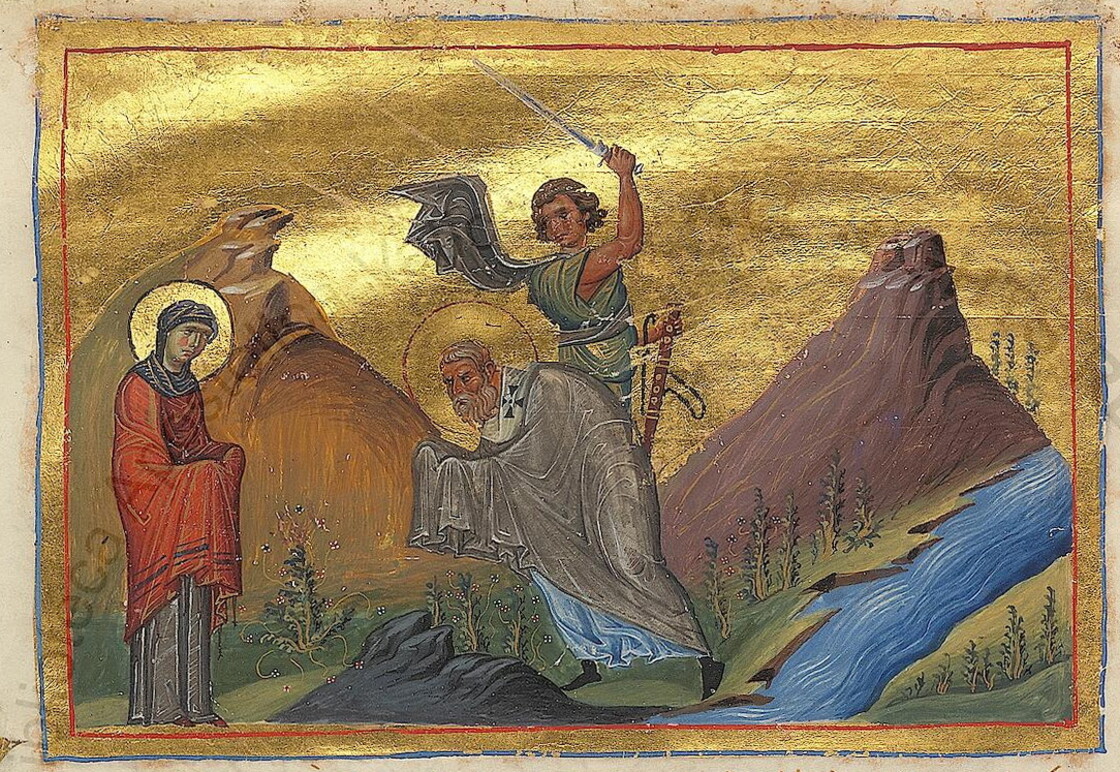
The two are beheaded beside a river near Nicomedia, the city where the emperor held court in the east. A bystander declares himself a Christian too and dies with them. Later, sailors take the bodies to Rome, and a Christian woman buries them there.
What does the Confession of Cyprian say?
The Confession tells his life from the inside, in Cyprian’s own voice. It was one of the most popular Christian stories outside the Bible. His parents give him to the god Apollo as a child, and as a boy he joins the old secret cults of Greece.
He spends forty days on Mount Olympus, the mountain of the Greek gods, and sees demons there. Then he travels to learn every kind of fortune-telling. At twenty he studies demons in Egypt, and the text lists them at length. At thirty he goes east to the star-readers of Babylon.
Then he meets the Devil in person. The Devil praises him as a good servant, gives him a troop of demons and promises to make him a ruler after death. All this splendour is a trick: the text gives the Devil no substance of his own, only the power to deceive.
Here the love story runs differently: Cyprian has no client and falls in love with Justina himself, and for seventy days he throws his magic at her. He turns himself into a woman and later into a bird, and each time the spell breaks at her door. He sends a plague on the city along with an oracle. Her prayers end the plague, and the crowd turns on him.
The Devil tells him that Christ will never forgive a man like him. A Christian of the city tells Cyprian that the Devil is lying. A priest then hears Cyprian’s long list of sins and accepts his change of heart.
In the 5th century the Byzantine empress Eudocia retold all three texts as Greek poetry. About 800 lines of her poem survive. The part on the martyrdom is lost.
Copies of the Confession spread in Latin, Coptic and Slavonic. An early church list of forbidden books condemned it as apocryphal, meaning a book the Church did not approve. Readers kept copying it anyway.
Was he a real person?
Most likely Cyprian of Antioch never lived. The name did belong to a real man, Cyprian of Carthage, a bishop in North Africa who died as a martyr. Early Christians mixed the two up.
A sermon shows how. Around 380 the famous Greek preacher Gregory of Nazianzus spoke in honour of the bishop of Carthage. He told the sorcerer story as that bishop’s own wild youth. In his telling the young woman has no name and prays to the Virgin Mary.
A Latin poet, Prudentius, made the same mistake around the year 400. His poem on the bishop of Carthage opens with a young man “most learned in the sinister arts”, who chants spells among the tombs to break up a marriage.
Historians of the early saints now read the tale as literature, a story so popular that a cult grew out of it.
Small details in the legend point the same way. The conversion story calls the bishop of Antioch Anthimos, but no bishop of that name is known there. The official who sentences the pair has the name of a real Roman governor. That man served in the early 370s, when Christians were no longer put to death for their faith.
Churchgoers still honoured Cyprian and Justina as saints for centuries. Their feast entered the Roman calendar in the 13th century. In 1969 the Vatican removed it in a calendar reform, with a blunt reason: both were “merely fictitious persons”.
Is Cyprian the first Faust?
Cyprian and Faust are both learned men who deal with the Devil to get what they want, and the comparison is old. A German study of 1882 puts it in its title: Cyprian of Antioch and the German Faust Legend. A modern editor of the Confession counts the conversion story among the earliest forerunners of Goethe’s Faust, perhaps the very first.
The Spanish playwright Pedro Calderón de la Barca put Cyprian on stage in El mágico prodigioso, “The Wonder-Working Magician”. He wrote it in 1637 for a church festival in a small town near Toledo. A shorter version for the public theatres was printed in 1663.
Calderón turns the deal into a written contract. His Cyprian is a pagan scholar in Antioch who falls for Justina. A demon offers to teach him how to bring her to him. Cyprian objects at first that no spell can touch a person’s free will, then gives in and signs in his own blood.
At the end Cyprian faces death as a Christian and says he will wipe out the blood contract with his own blood as a martyr. The demon closes the play by admitting it: Cyprian erased the paper “with the blood of his neck” and left the page blank.
The oldest printed Faust book appeared in Frankfurt in 1587. Calderón’s play came fifty years later. In the 19th century, critics writing in German called it “the Catholic Faust” or “the Spanish Faust”.
Unlike Cyprian, the magician behind the Faust legend was a real man, Johann Georg Faust. Later his name went onto books for calling up spirits, such as the Höllenzwang, the “compulsion of hell”.
How did a converted magician end up on spell books?
Long before Faust, Cyprian’s name had taken the same road. It went first onto prayers, and from the prayers it slid into magic. Protective prayers under his name survive in many languages of the Christian world, from Latin to Armenian. Most were meant to drive off demons or undo curses. One Latin manuscript with such prayers goes back to the 8th century.
A long love spell in Coptic, the language of Christian Egypt, also carries his name.
A medieval Latin handbook of black magic, falsely credited to the English scholar Roger Bacon, has an odd step for making a magic circle. It asks a priest to say a mass in honour of Saint Cyprian over the circle.
A cheap Spanish print shows how this worked in daily life. In the early 1630s a single printed sheet went on sale there, the “Most devout prayer of Saint Cyprian”.
It promised to free people from “spells, and evil eyes and evil tongues”. It would also help a woman in labour and keep off plague. Owners who could not read were covered too, as long as they “carried it or kept it in the house.”
In 1634 five Jesuit censors caught the sheet out. The prayer mentions the Moors, the Muslims of medieval Spain, who came centuries after Cyprian’s time, so it could not be his, and the censors judged that it smelled of superstition.
In north-western Spain and Portugal the prayer grew into a whole book. People believed in a “Book of Saint Cyprian”, nicknamed the “Little Cyprian”. Its pages supposedly listed the places where treasure lay hidden, about 150 of them for Galicia, the north-west corner of Spain, alone.
Local folklore gave these treasures a guard, the Moura Encantada, an enchanted spirit of the prehistoric tombs. Elsewhere in Europe treasure hunters also used church rites, and some even baptised the coins they dug up.
What is the Clavis Inferni?
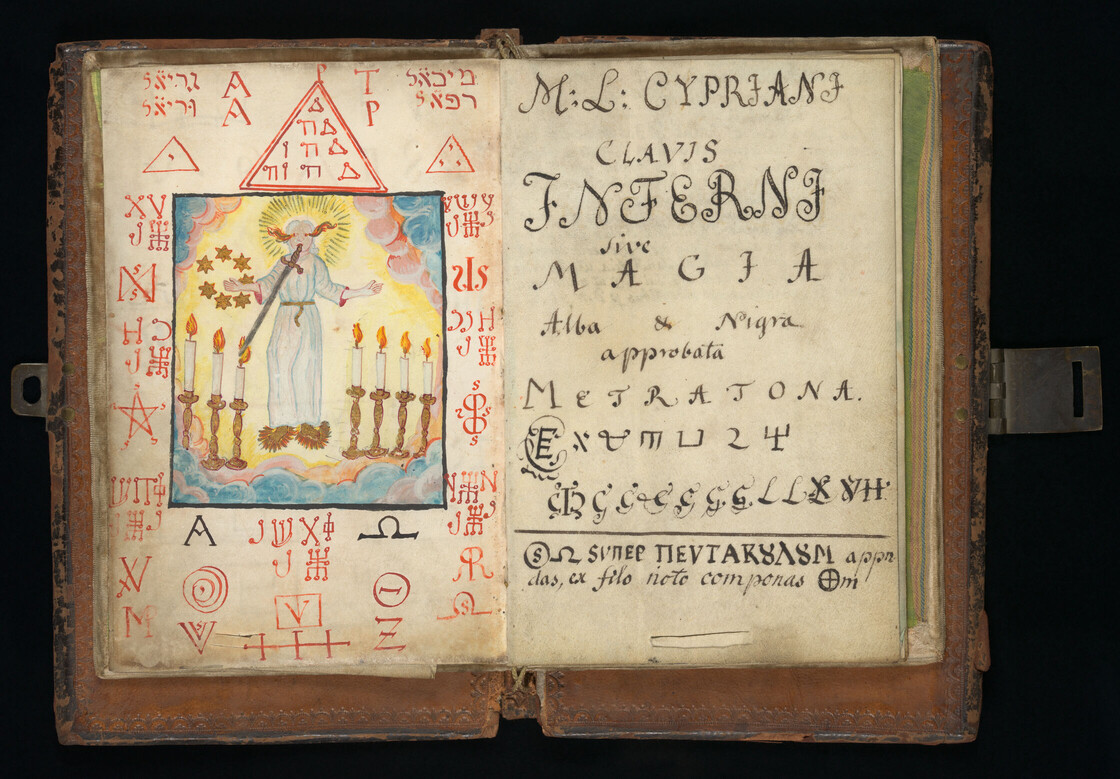
A small book of eleven vellum leaves in London makes Cyprian the author of a manual for calling up spirits. It is called the Clavis Inferni, or Key of Hell. Its title page gives the author as “M. L. Cyprianus” and promises white and black magic approved by an angel.
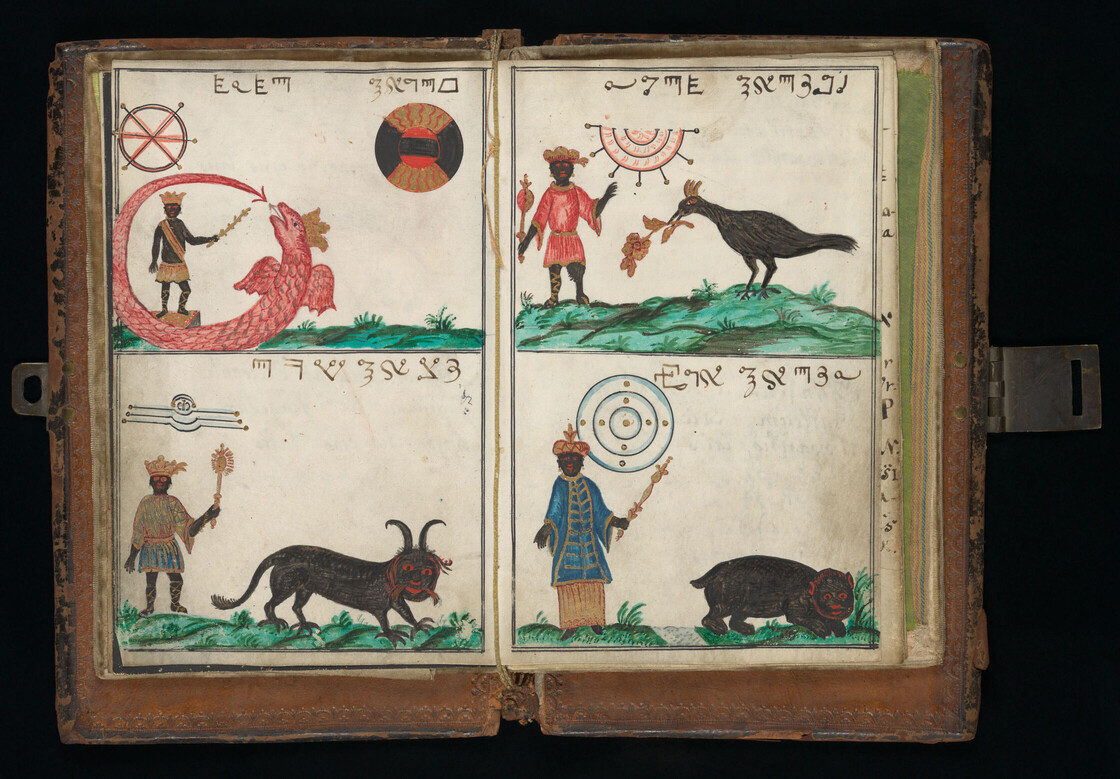
The book was written in the late 18th century, and inside it crowned demon kings stand beside beasts painted in gold and colours.
Books like this rarely quote the Greek story. They borrow Cyprian’s name as a mark of authority, the way other grimoires claimed King Solomon as their author. An early step on that path is the Testament of Solomon, the story of a king who put demons to work.
Why are Norwegian black books called Cyprianus?
In Norway a handwritten book of spells and cures is called a black book, or simply a Cyprianus. About 100 of them are registered, and the oldest known copy dates to the late 1400s.
The dates written inside are often wrong, because owners backdated them to make the books look older than they were.
Many of the Norwegian books tell how Cyprianus got his knowledge. To a folklorist at the University of Oslo he is “one of the most notorious mythical figures of the Middle Ages”. She thinks the name fits because the convert kept something of the dark sorcerer: “The book holds both good and perhaps also evil.”