In 1546, about ten years after the scholar Cornelius Agrippa died, the Italian bishop and historian Paolo Giovio printed a short life of him that ends with a death scene. Agrippa lies dying in a dark inn at Lyon. When he is urged to repent, he takes a leather collar marked with magic signs off his black dog and shouts: “Go, wretched beast, who have ruined me entirely.” The dog is never seen again, and those who claimed to have seen it believed it had leapt into the river Saône and never swum out.
Thirty-seven years later Agrippa’s former student Johann Weyer answered in print. He had often led that dog on a leash made of hair, he wrote, and it was a real male dog called Monsieur. Weyer, though, was living in Paris when Agrippa died, and Giovio never says who told him the story.
Why was Cornelius Agrippa’s black dog Monsieur suspected of being a demon?
Heinrich Cornelius Agrippa was born in Cologne on 14 September 1486. He worked as a scholar and physician, and from 1524 he served at Lyon as physician to Louise of Savoy, the mother of the French king. Two books made his name. The first, printed in 1530 and known in short as De vanitate, “On Vanity”, mocked every branch of learning. The second was a large handbook of magic, the Three Books of Occult Philosophy, printed complete at Cologne in 1533.
The magic book tied him to the dog, because a man who wrote openly about magic drew suspicion, and popular belief gave such scholars a familiar, a demon that served its master in the shape of an animal (traced in The Voice in the Belly). Giovio calls Agrippa’s dog the constant companion of all his journeys, and he reports that many people cursed Agrippa because they believed he led a demon around in that shape.
In June 1532 the Archbishop of Cologne took Agrippa into his household, and Agrippa lived at Bonn until 1535. His young student Weyer lived with him there, so Bonn is where Weyer’s memories of the dog are set.
What exactly did Paolo Giovio write?
Giovio was an Italian historian and the bishop of Nocera, and he collected portraits of famous men at his villa near Lake Como. He wrote short Latin lives to go with them and published them in 1546 under the title Elogia, meaning “words of praise”. A later edition, printed at Basel in 1577, added woodcut portraits.
His entry on Agrippa starts with praise. Agrippa had a vast memory and had grasped the hidden core of every science, Giovio writes, and then he used that gift to mock all scholarship. Next comes the book on occult philosophy, which Giovio calls “very pestilent for the curious” and says had been forbidden by the Christian censors.
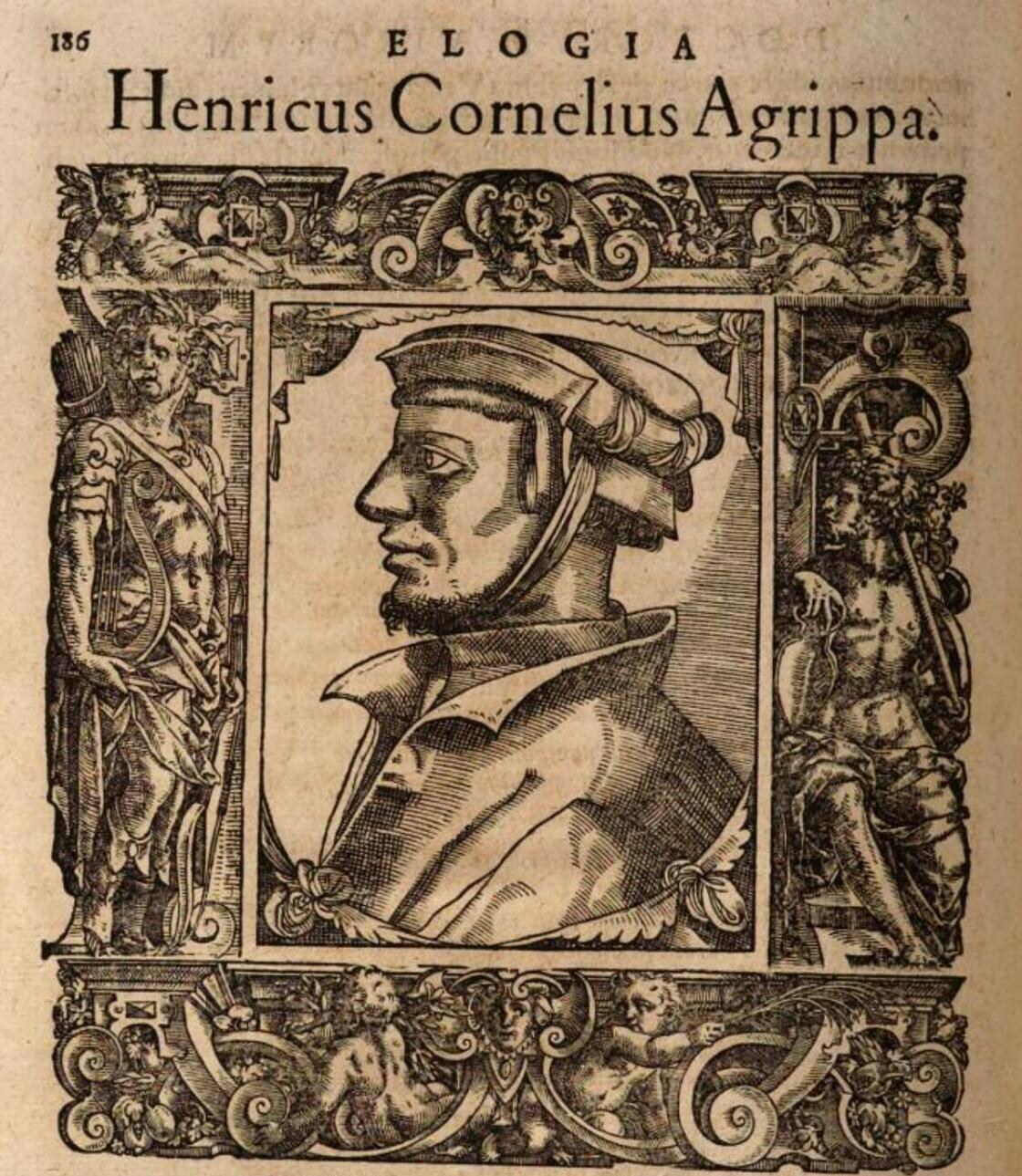
The dog appears only in the last lines of the entry. Agrippa died “not yet old”, Giovio writes, in a mean and dark inn at Lyon, and many people cursed him as a man suspected of necromancy, magic worked through the spirits of the dead, because he led around an evil demon in the shape of a black dog. Then he tells of the collar with its magic signs and the angry last words, and of the dog that deserted its dying master and was never seen again.
Giovio gives no source for any of this, and he does not say that he was there. The leap into the Saône rests, in his own words, on “those who claimed to have seen it.”
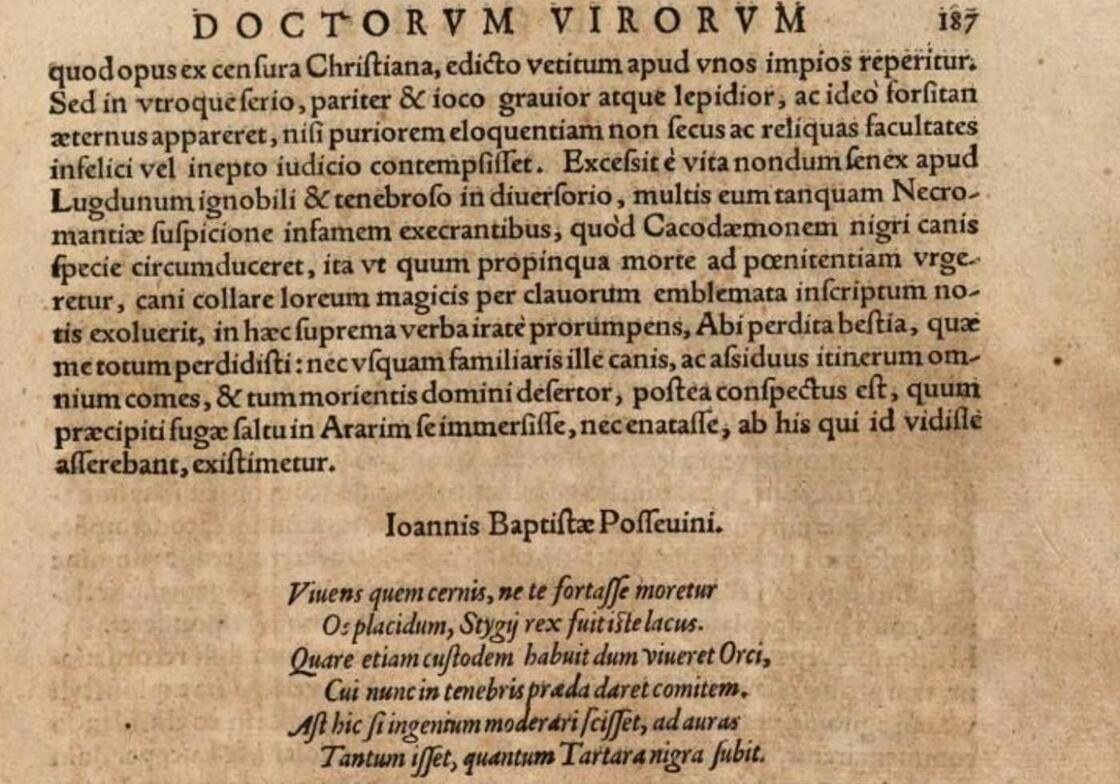
In the Basel edition two short Latin poems follow the entry, written as epitaphs, the kind of verse cut on a tomb. The first, by Giovanni Battista Possevino, says that Agrippa had the guard of the underworld with him while he lived. The second, signed Latomus, speaks of cakes given to the dog of the Styx, the river of the underworld, to devour.
What did Johann Weyer, who walked the dog, answer?
Johann Weyer was born in 1515 at Grave, a small town on the river Meuse in the Low Countries. At about fourteen he joined Agrippa’s household as a live-in student and followed him to Bonn. He later studied medicine in Paris and became court physician to the Duke of Jülich-Cleves. In 1563 he published De praestigiis daemonum, “On the Tricks of Demons”, in which he argued that many women accused of witchcraft were sick or deceived.
Weyer kept enlarging the book, and its last edition, printed at Basel in 1583, carries a passage about the dog that the editions of 1563 and 1568 lack. It sits in a chapter on magic books. There Weyer first condemns a book that an impious man had lately put out under Agrippa’s name as a fourth book to follow his three books of Occult Philosophy, and he calls Agrippa “my former host and honoured teacher”, dead by then for more than forty years. That forged book, he writes, gives him the occasion to stop keeping silent.
He had read in several writers that the devil, in the shape of a dog, kept Agrippa company to his last breath and then vanished somehow. Weyer could not wonder enough, he wrote, that men of such standing spoke and wrote so foolishly from the emptiest rumour of the crowd. In the margin he names Giovio’s Elogia and a German book of examples by Andreas Hondorff.
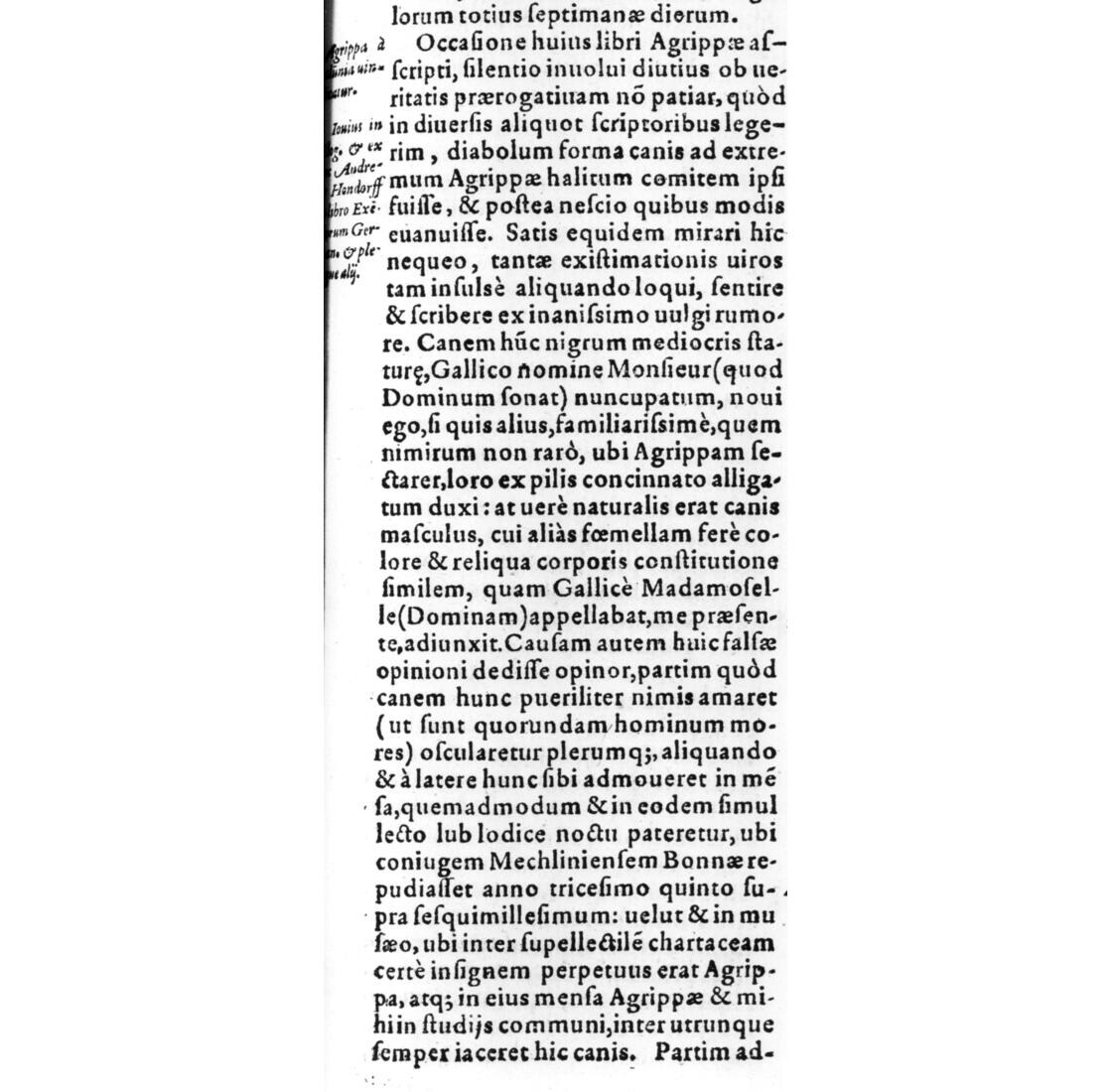
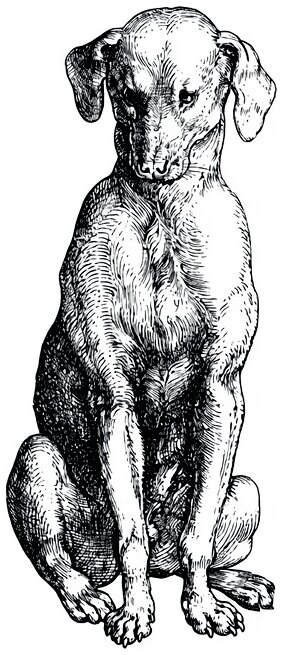
The black dog, Weyer writes, was of middling size and went by the French name Monsieur, “which means Lord”. Weyer knew him as closely as anyone, and when he followed Agrippa he often led the dog on a leash made of hair; in his words it was a real, natural male dog. In Weyer’s presence Agrippa gave Monsieur a female companion of almost the same colour and build and called her Madamoselle, “Lady”. Modern retellings often shorten her name to Mamselle, while Weyer’s printed text has Madamoselle.
Weyer then gives two causes for the rumour. Agrippa loved the dog too childishly, he writes: he often kissed him and sometimes kept him at his side at table. In 1535, Weyer writes, Agrippa divorced his wife, a woman from the town of Mechelen, at Bonn, and from then on he let the dog lie in his bed under the blanket at night. In the study, on the table that master and student shared, the dog always lay between the two of them among Agrippa’s great pile of papers.
The second cause was how much Agrippa knew of the world. He stayed hidden among his papers in a heated room and hardly came out once in eight days, and still he knew what was happening in distant regions. Less prudent people, Weyer writes, put that down to the dog as a demon while Weyer was in the house. His own explanation is the post: the most learned men wrote to Agrippa from everywhere, every day.
What can neither witness tell us?
Weyer then tells how Agrippa’s life ended. In 1535 Agrippa travelled from Bonn to Lyon and was arrested on the order of King Francis I, because he had once written too freely against the king’s mother, Louise of Savoy, whom he had served as physician. Friends spoke for him and he was freed, and a few months later he died at Grenoble. Then Weyer adds one short sentence: “At that time I was living in Paris.”
So Weyer could speak for the dog’s life at Bonn but not for Agrippa’s last hour, and Giovio never says how he knew about it either. The two men do not even agree on the place: Giovio puts the death in an inn at Lyon, Weyer at Grenoble in the Dauphiné. Neither text names anyone who watched the collar come off.
Giovio’s page passes on what people said about a man they suspected of necromancy, while Weyer’s comes from a man who held the leash and who calls Agrippa his honoured teacher.
The same Basel volume of 1583 that defends Monsieur also carries Weyer’s catalogue of demons, the Pseudomonarchia daemonum, printed as an appendix. That list of spirits and their ranks became the direct ancestor of the Ars Goetia, a later magic book that lists seventy-two demons with their ranks and seals.
Is Agrippa’s dog the origin of the poodle in Goethe’s Faust?
Faust was a real wandering magician in early sixteenth-century Germany, and his legend grew into Goethe’s play (the man behind it is traced in The Real Dr. Faustus). His dog appears early. In 1548 Johannes Gast, a pastor in Basel, wrote that he had dined with Faust there. Faust “led a dog and a horse with him,” Gast wrote, “which I believe were devils, ready to do anything.” Some people told him the dog sometimes took the form of a servant and brought the food.
Fifteen years later Faust’s dog and Agrippa’s dog appeared in a single sentence. In 1563 Johannes Manlius printed at Basel a collection of sayings by Philip Melanchthon, and in it Faust “had a dog with him that was the devil, just as that rascal who wrote On the Vanity of the Arts also had a dog running with him that was the devil.” Agrippa is not named, but the book is his De vanitate of 1530. In 1596 a German chronicle, the Epitome Historiarum, repeated the comparison in German.
A Faust book by Georg Rudolf Widman, printed at Hamburg in 1599, gave Faust a black, shaggy dog named Praestigiar, from the Latin word for illusions. In 1683 the Wittenberg scholar Johann Georg Neumann argued in a disputation on Faust that this black dog, the devil in flesh, had been carried over from the story of Agrippa.
In 1664 the English poet Samuel Butler put both sides of the quarrel into his comic poem Hudibras. One speaker claims that “Agrippa kept a Stygian pug, / I’ th’ garb and habit of a dog, / That was his tutor.” Sidrophel, the poem’s conjurer and astrologer, answers: “Nor was the dog a caco-dæmon, / But a true dog that would show tricks,” one that would “fetch and carry, was more civil / Than other dogs, but yet no devil.”
No surviving document shows Goethe naming Agrippa, so Neumann’s view remains an opinion, and the black dog may as well have reached Goethe through two centuries of Faust books. (How modern cinema reworked these legends is explored in Is Faust Based on a True Story?)
Goethe published the first part of his Faust in 1808. On an Easter walk outside the town gate, Faust points out a black dog roaming through the fields. It circles closer and closer in wide spirals, and Faust thinks he sees a whirl of fire trailing behind it. His assistant Wagner sees nothing of the kind: “I see nothing but a black poodle; it may be an illusion of your eyes.” Then: “You see! A dog, and no ghost is there. It growls and hesitates, lies on its belly, wags its tail.”
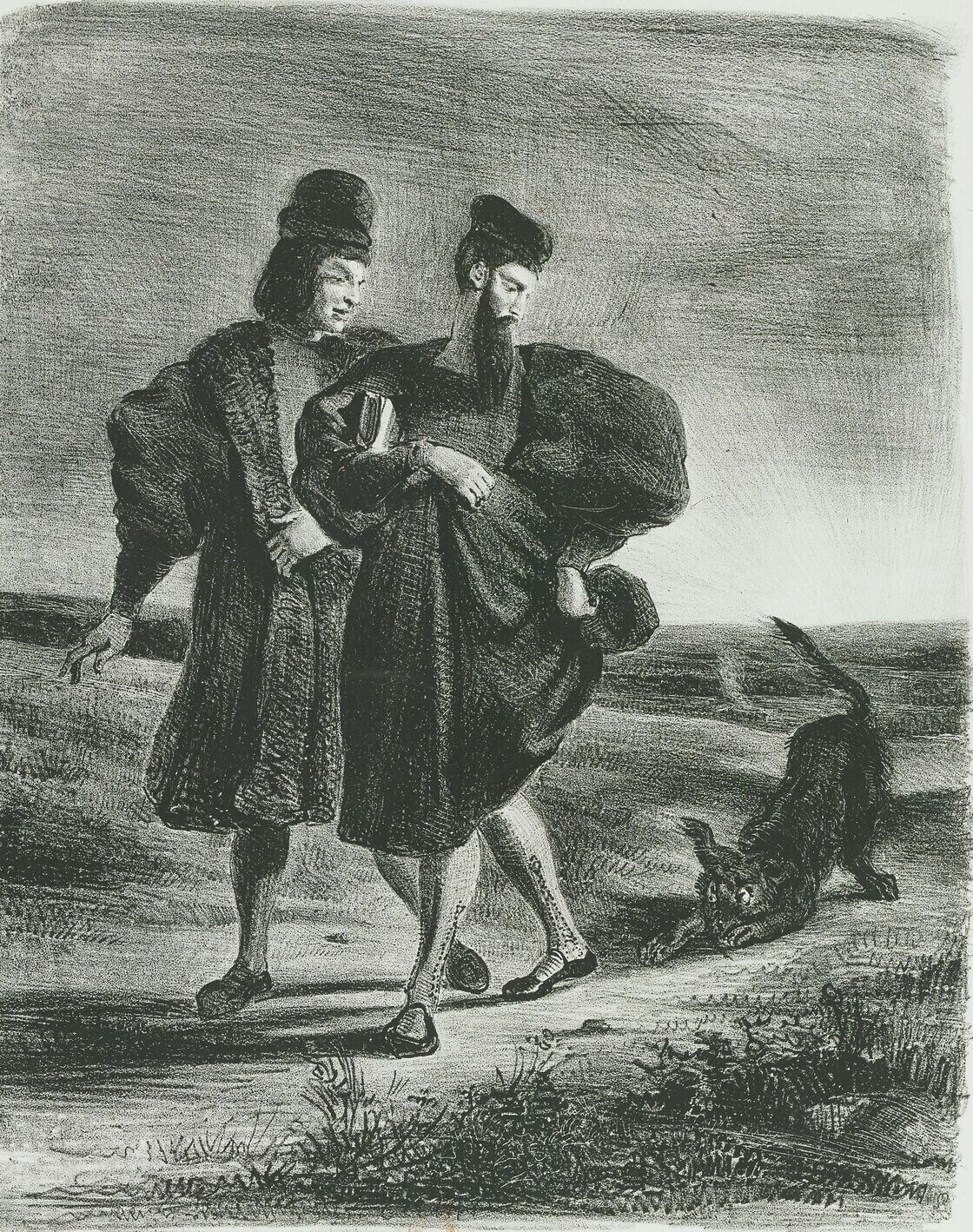
Faust takes the dog home to his study. There Mephistopheles steps out from behind the stove, where the poodle had been, dressed like a travelling scholar, and Faust says: “So that was the poodle’s core!”