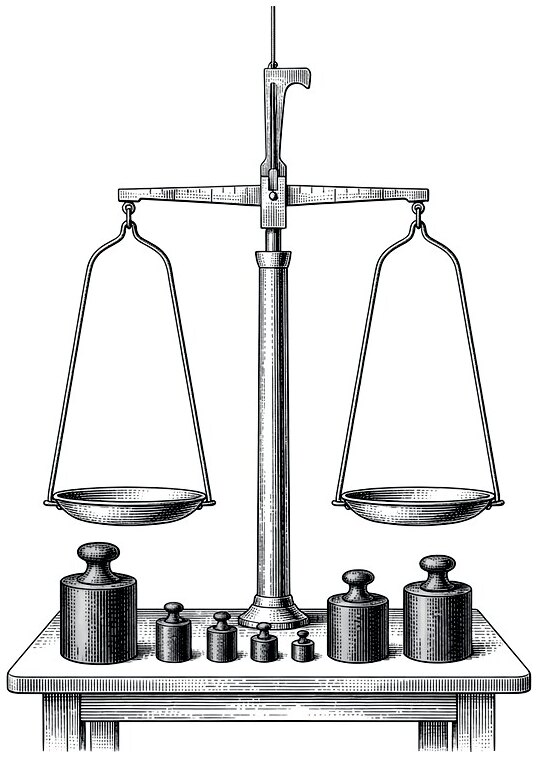
In a German story printed in 1616, every guest at a royal wedding has to stand on a golden scale. Seven weights wait on a table covered with red velvet, and whoever cannot hold them down is thrown out, branded or put to death. Most of the emperors fail, and the cheats who sold false books on gold-making are whipped off the pan. The man telling the story had spent the night tied up in the dark because he felt unworthy to be there, yet when his turn comes he outweighs all seven weights.
The book appeared at Strasbourg without an author’s name. It belongs to the first wave of Rosicrucian writings: in 1614 and 1615, two anonymous pamphlets had announced a secret brotherhood of learned men to the whole of Europe (how that movement began is told in The Invisible College).
What is the Chymical Wedding weighing scale test?
“Chymical” is an old spelling of chemical, and here it means alchemical, because in early modern Europe alchemy was the art of refining metals and perfecting matter. The story is told in the first person by its hero, Christian Rosenkreutz, and it covers seven days. It opens on the evening before Easter, when Rosenkreutz sits at prayer and a messenger brings him an invitation to a royal wedding. He sets out for the king’s castle, and on the third day a scale decides which of the guests may stay.
The English quotations below come from the first English translation, made by Ezechiel Foxcroft in 1690 and reprinted in 1887 by the English author Arthur Edward Waite.
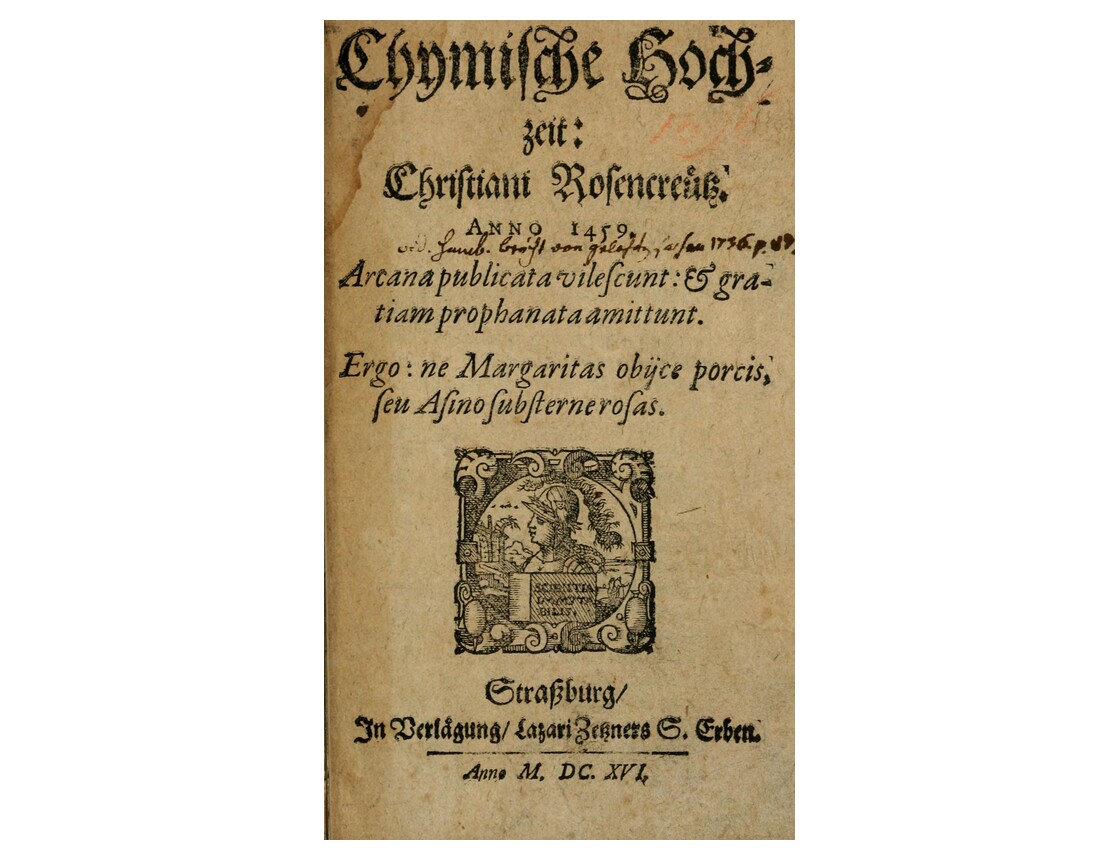
The title page dates the story to 1459, more than 150 years before the book was printed. Below the title, a Latin motto warns that secrets lose their value once they are made public, so do not cast pearls before swine. The printer was the firm of Lazarus Zetzner at Strasbourg. Two years earlier, the first Rosicrucian manifesto, the Fama Fraternitatis, had come out at Kassel.
Who chose to spend the night tied up?
The test is announced on the evening of the second day. The castle is run by young women in the king’s service, whom the old translation calls Virgins, and one of them, whom the story calls the Virgin, looks after the guests. She speaks to them in verse. No one, she says, was invited who had not received special gifts from God.
And yet some men are so bold “as still to thrust themselves in place / Whereto none of them called was.” So “the artists for to weigh, / Scales shall be fixt th’ ensuing day.” Anyone who doubts himself should leave now. Whoever stays in the hall overnight will be let go in the morning, on condition that he never comes back.
Most of the guests decide to wait for the scale and, if things go badly, to leave in peace. Rosenkreutz thinks it over, and because his conscience convicts him “of all ignorance and unworthiness”, he chooses to stay in the hall and be content with the meal he has already had rather than risk being thrown out later. Eight other men stay with him. A page ties each of the nine with cords, and they are left in the dark. In the morning the other guests come back and mock the nine bound men as cowards.
How did the golden scale and the seven weights work?
The Virgin returns dressed in red velvet, with a white scarf and a green laurel wreath, and behind her march two hundred armed men, also in red and white. She has the nine untied, coupled in pairs and placed where they can watch the scale, because “it may fare better with them than with the presumptuous who yet stand at liberty.”
The scale is made entirely of gold and hangs in the middle of the hall. Beside it, on the velvet table, stand the seven weights: first a fairly large one, then four small ones, and last two large ones. Every armed man carries a drawn sword and a strong rope. The men split into seven bands, one for each weight, and each band picks one of its members to lay its weight on the scale.
The test works like a market scale. The guest stands in one pan, and the weights are laid into the other pan one after another. As long as the guest is heavier, he stays down. Once the weights outweigh him, his pan shoots up, he has failed, and one of the bands takes him prisoner.
The German print of 1616 has a verse that the early English editions leave out. Before the weighing, the Virgin compares a pretender to a fool who walks into a painter’s workshop knowing nothing about painting and talks loudly about it until everyone laughs at him. Whoever goes up on the scale with a crash, she warns, will be laughed at in the same way.
What happened to the emperors on the scale?
The emperors go first. The first one bows to the Virgin and climbs into the pan in all his stately clothes. Weight after weight is laid in, and “to the wonder of all” he holds out until the last one, which is too heavy for him. He is tied up and handed to the sixth band, and the Virgin herself seems to pity him.
The second emperor steps up proudly. He has a thick book hidden under his gown and imagines he cannot fail, but he can barely bear the third weight and is flung up without mercy. In the fright the book slips out from under his gown, the soldiers burst out laughing, and he is handed over, bound, to the third band.
Beside him, the margin of the 1616 print carries the note “Dan. 5.” It points to the fifth chapter of the Book of Daniel, where writing appears on the wall at King Belshazzar’s feast and is read to him as: “Thou art weighed in the balances, and art found wanting.” In Christian art the archangel Michael holds a pair of scales like these to weigh souls at the Last Judgment.
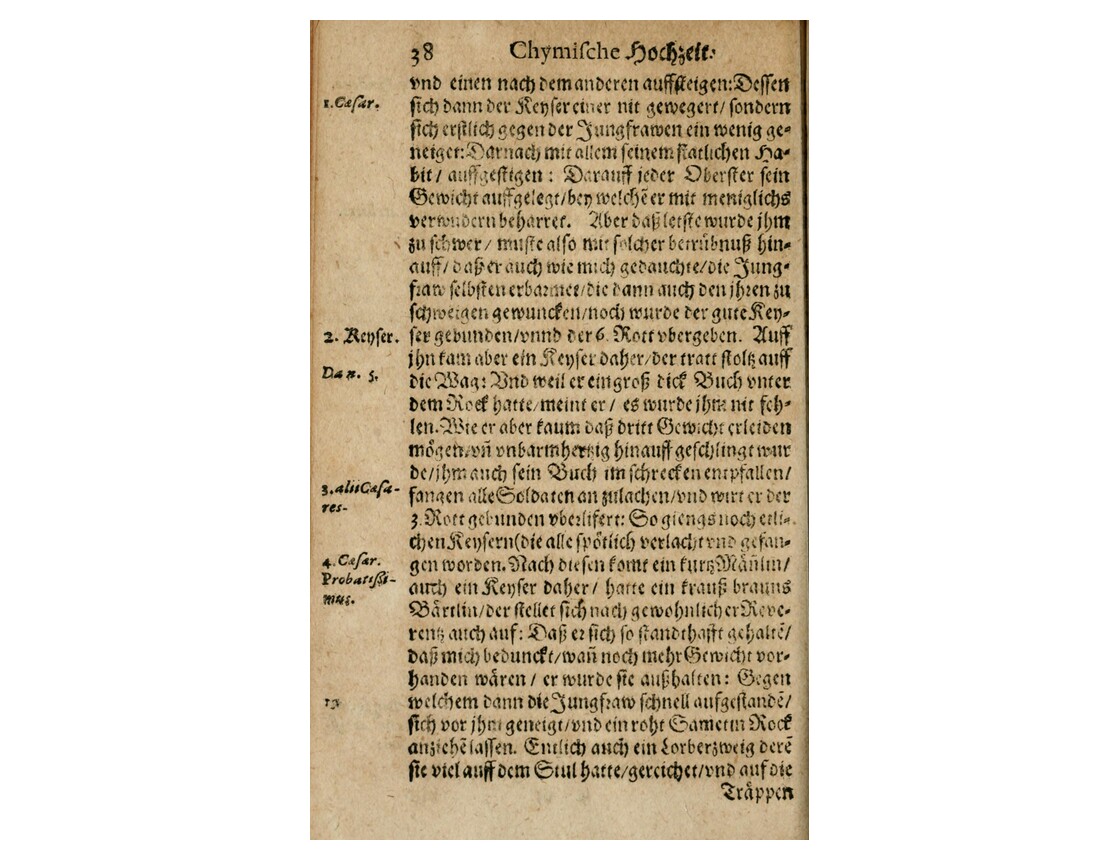
More emperors follow, and they too are laughed at and taken prisoner. Then comes “a little short man, with a curled brown beard”, also an emperor, who stands so firm that the narrator believes more weights would not have moved him. The Virgin rises, bows to him, has him dressed in a gown of red velvet, hands him a branch of laurel and seats him on the steps of her throne. After the emperors only a few kings and lords hold out, “though sundry eminent vertues were found in many.” Among the nobles, the learned and the unlearned that follow, one or perhaps two in each group are found perfect, and often none.
Who were the cheats whipped off the scale?
Last come those the 1616 print calls “Landtbetriegern”, vagabond cheats who roam the country, and makers of “Lapidem Spitalauficum”. The printed margin names the scene Proba falsariorum, the trial of the counterfeiters. They are set on the scale amid open scorn, the narrator can hardly keep from laughing, and most of them cannot stand the trial at all, so they are driven out of the pan with whips and scourges.
What these cheats were making is unclear. Lapidem is Latin for “stone”, and Spital is the German word for a hospital or poorhouse, but the meaning of the whole phrase is unknown, and the English translation leaves it in Latin.
How did the man who stayed tied up outweigh the seven weights?
When the weighing is over, only the nine men who had let themselves be tied up are left standing aside. One of the captains asks the Virgin to set these “poor men” on the scale as well, without any penalty, only for recreation’s sake. The narrator is frightened, because his one comfort so far had been that he would not stand in disgrace or be whipped off the scale. The Virgin agrees, and although most of the nine fail, no one laughs at them or beats them. The fifth to step up is the narrator’s companion, a fellow guest who had stayed bound with him, and he holds out bravely, so everyone applauds him.
The narrator is the eighth. He steps up trembling and outlasts all seven weights, so the Virgin orders her men to force his pan up. Three more men hang their weight on the other side of the beam, and still his pan does not move. A page cries out, “THAT is HE”, and another answers, “Then let him gain his liberty.”
As a reward he may set one prisoner free. He chooses the first emperor, the one who failed only at the last weight and whom he had long pitied. By then it is “about ten in the forenoon”.
The 1616 print counts the guests by how many weights they held: 7 held one, 21 held two, 35 held three, 35 held four, 21 held five and 7 held six. Among these 126 men, the narrator says, no two held the same weights. Of the 35 who held three, for example, one held the first, second and third, another the third, fourth and fifth. There are exactly 7 ways to choose one weight out of seven, 21 ways to choose two, 35 to choose three, and so on, so every possible result short of all seven turned up once.
Why were the impostors put on trial?
The prisoners are given one more meal before the sentence, and there the charges are read in two parts. The lords are told they had “too lightly given credit to false, fictitious books” and had come to the castle uninvited, perhaps to make a profit from it and live in greater pride. They admit it humbly. The cheats hear a harder charge: they had forged “false, fictitious books”, fooled and cheated others, and used “ungodly, deceitful figures … not even sparing the Divine Trinity.” They must confess themselves “convicted vagabond-cheats, and rascals.”
The cheats confess, but they push part of the blame onto the lords, who had been set on getting into the castle and had promised them large sums of money. False books also sold so well, they say, that anyone with no other way to make a living took up the trade. The court answers that what they say is partly true and that all of them will be punished, some more than others.
What was the punishment for each weight?
At noon the sentence is read out in the castle garden. The deceived lords keep their lives and may buy their release with a chain or whatever else they carry. The king promises to send them a catalogue of heretical books, a list of the titles they should no longer keep, and asks them to burn the misleading writings in their own libraries.
For everyone else the penalty follows the scale. Those who failed at the first, third or fourth weight are stripped naked and sent away. Those found too light at the second and fifth weight are stripped as well and marked with one or more brands. Those who were lifted only by the sixth or seventh weight are treated more gently, and the sentence says that every combination of failed weights has its own punishment. The cheats who could not hold down a single weight are punished “in body and life, with sword, halter, water, and rods”, that is, by beheading, hanging, drowning and flogging.
The lords pay more than was asked of them, in chains, jewels, gold and money, and leave in such a hurry that they never once look back. “At the door was given to each of them a draught of FORGETFULNESS, that he might have no further memory of misfortune.”
Then the punishments are carried out. Some of the condemned are sent away naked, some are driven out with small bells, and others are whipped out of the garden, while some are hanged, some beheaded and some forced to leap into the water. The narrator weeps as he watches, over the blindness of people who keep chasing “that which since the first fall hath been sealed to us”, meaning since Adam’s fall in the Garden of Eden.
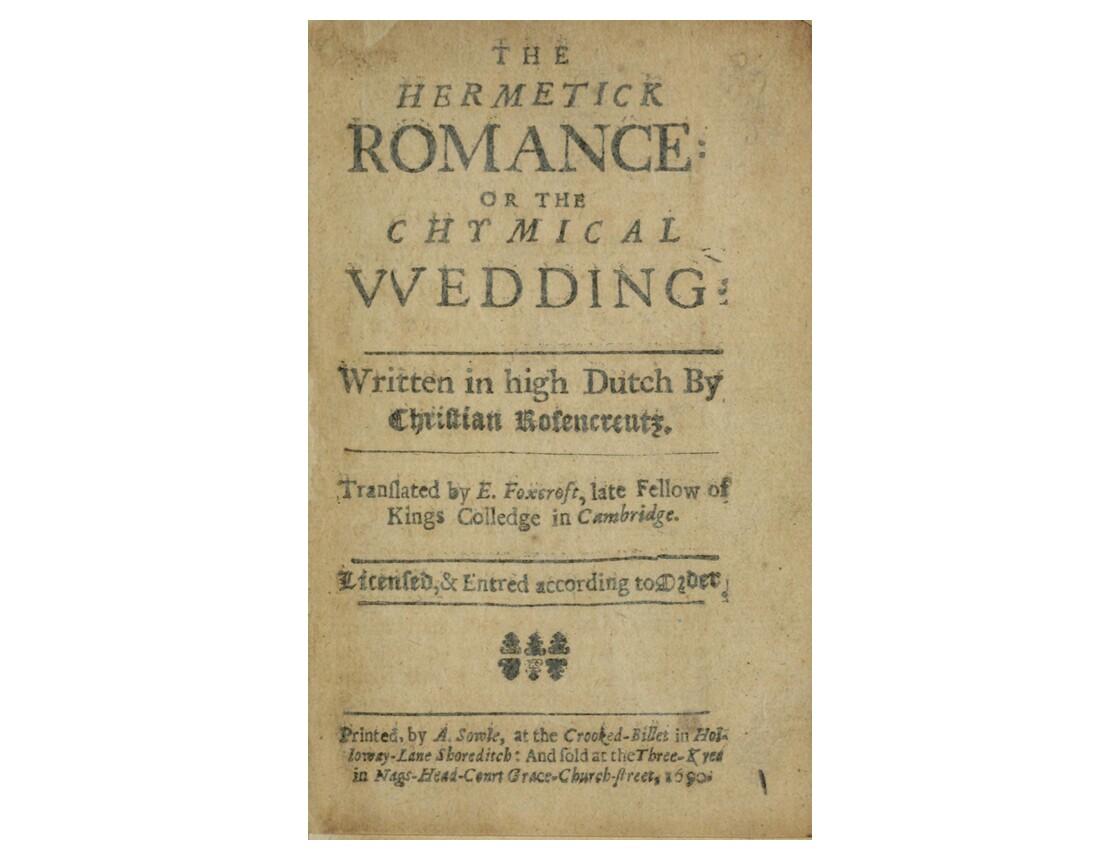
The first English translation appeared in London in 1690 as The Hermetick Romance: or The Chymical Wedding. Its title page says the book was “Written in High Dutch by Christian Rosencreutz”. High Dutch was the English name for German, and the line treats the hero of the story as its author. The translator, Ezechiel Foxcroft, signed as a former fellow, a member of the teaching body, of King’s College, Cambridge.
Was the Chymical Wedding a joke about alchemists?
German biographers name Johann Valentin Andreae (1586-1654) as the author, a Lutheran theologian from Württemberg in south-west Germany. The Allgemeine Deutsche Biographie, the national biographical dictionary, dates the writing to around 1602-1603, when Andreae was about sixteen, although the book was printed only in 1616. Its 1875 entry calls the story an adventurous fantasy, meant to tempt readers into hunting for a deep meaning and to mock them when they kept looking for one that was not there.
Waite saw it the other way and argued in 1887 that the romance has a serious purpose and hides a deeper meaning. He also noted that it attacks the same people as the earlier Rosicrucian pamphlets did: the vagabond cheats who turned alchemy into a swindle. In the garden trial the worst of these cheats lose their lives, while the lords who paid them get away with a fine.
Where did the seven weights go?
On the evening of the weighing, back in the castle, a woman wearing a coronet comes to the guests with six other maidens, and at first they all take her for the bride. Rosenkreutz calls her the Queen and admits, “I yet know not who she was.” She has each maiden take up one of the weights, gives the largest, her own, to the Virgin, and leads the guests through her apartments. In the first chamber the Virgin hangs up the Queen’s weight while a hymn is sung, and in the next chamber the first of the maidens hangs up hers.
The book does not explain the weights or the chambers; the narrator only leaves a riddle of his own, in a passage of the 1616 print that the English version omits. He says he wrote every guest’s result on his writing tablet and could name each man with his weights, “wann mir es nit noch der zeit verbotten were”, if it were not still forbidden to him for the time being. He hoped, he writes, without saying who had forbidden it, that the names would come to light later together with “the interpretation” of the story.