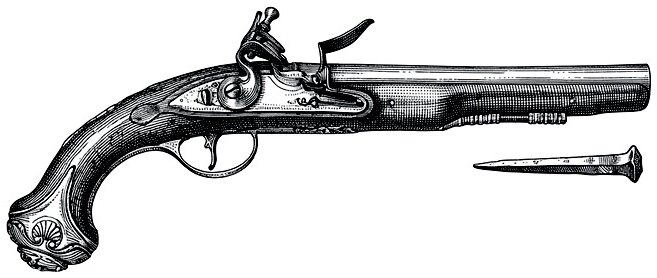
In the card nailed to the wall pistol trick, a spectator’s chosen card was burned to ash, and the ash went into a pistol loaded with a nail instead of a ball. The conjurer fired, and the card turned up nailed to the wall, whole again.
A Paris book printed the method in 1784. Before the shot, the nail dropped secretly out of the barrel into the performer’s hand, and an accomplice hidden behind the wall did the rest. The book was White Magic Unveiled, and its author, Henri Decremps, gave the trick four pages.
How did the card nailed to the wall pistol trick work?
A spectator drew a card and tore off a small corner, which he kept so that he could recognise his card later.
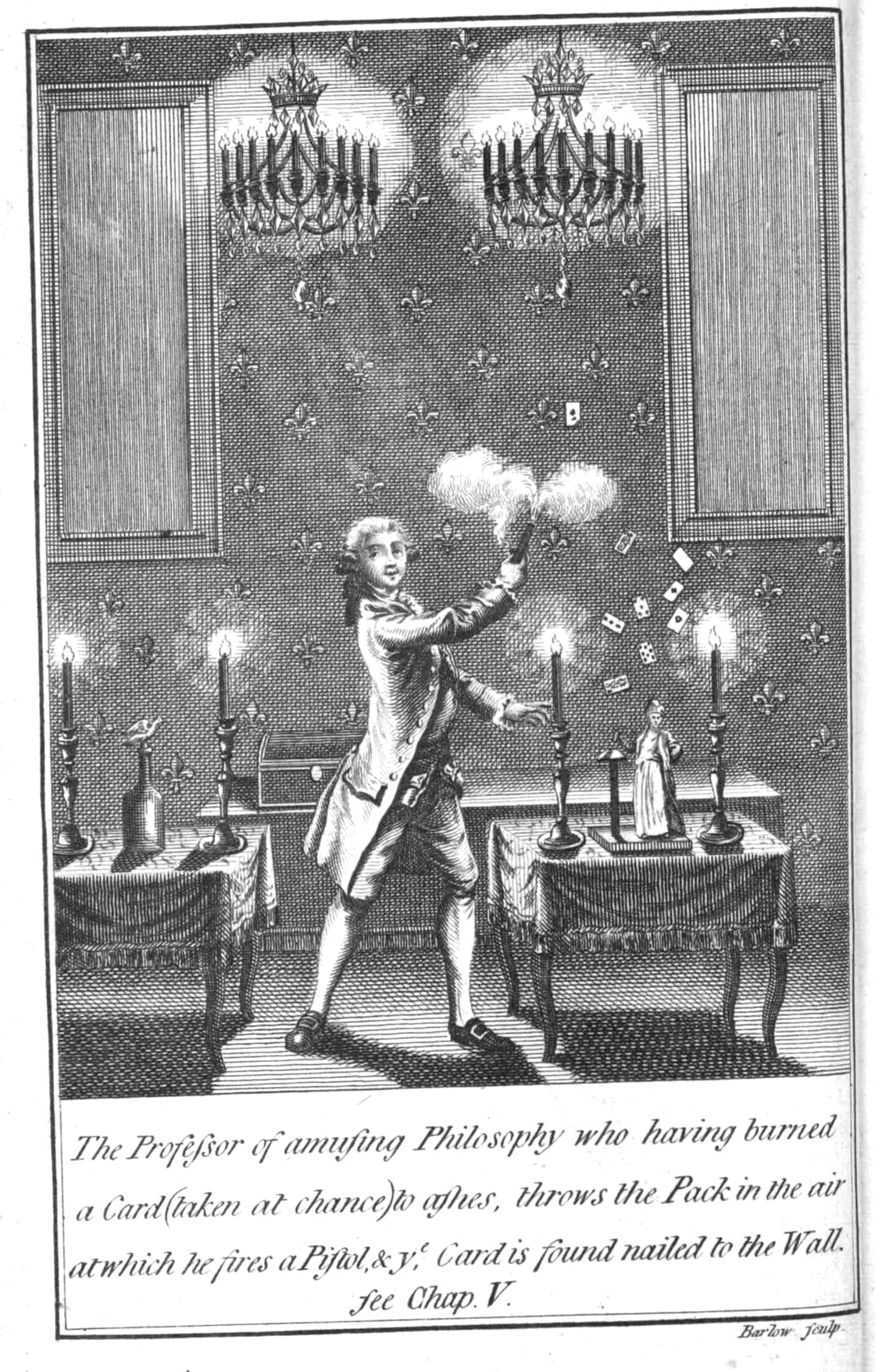
The conjurer took the card, tore it up and burned it. An assistant loaded a pistol with gunpowder and added the ashes to the charge, and instead of a lead ball a spectator pushed a marked nail down the barrel.
Then the conjurer threw the whole pack into the air and fired. People found the burned card on the wall, held there by a nail. The torn corner fitted it exactly, and the man who had marked the nail knew his mark.

Which card was really burned?
The card in the flames was a copy. As soon as the corner was torn off, the conjurer stepped into a side room, took an identical card and tore a matching corner off it.
Back on stage he asked for the chosen card, slipped it under the pack and quietly put the prepared copy in its place. That copy is what burned, so the real card, with its real tear, never went near the fire. Decremps sums up the effect: since the card on the wall is “the same one that was marked”, it is no wonder the trick won “the applause of the great number”.
Where did the nail go?
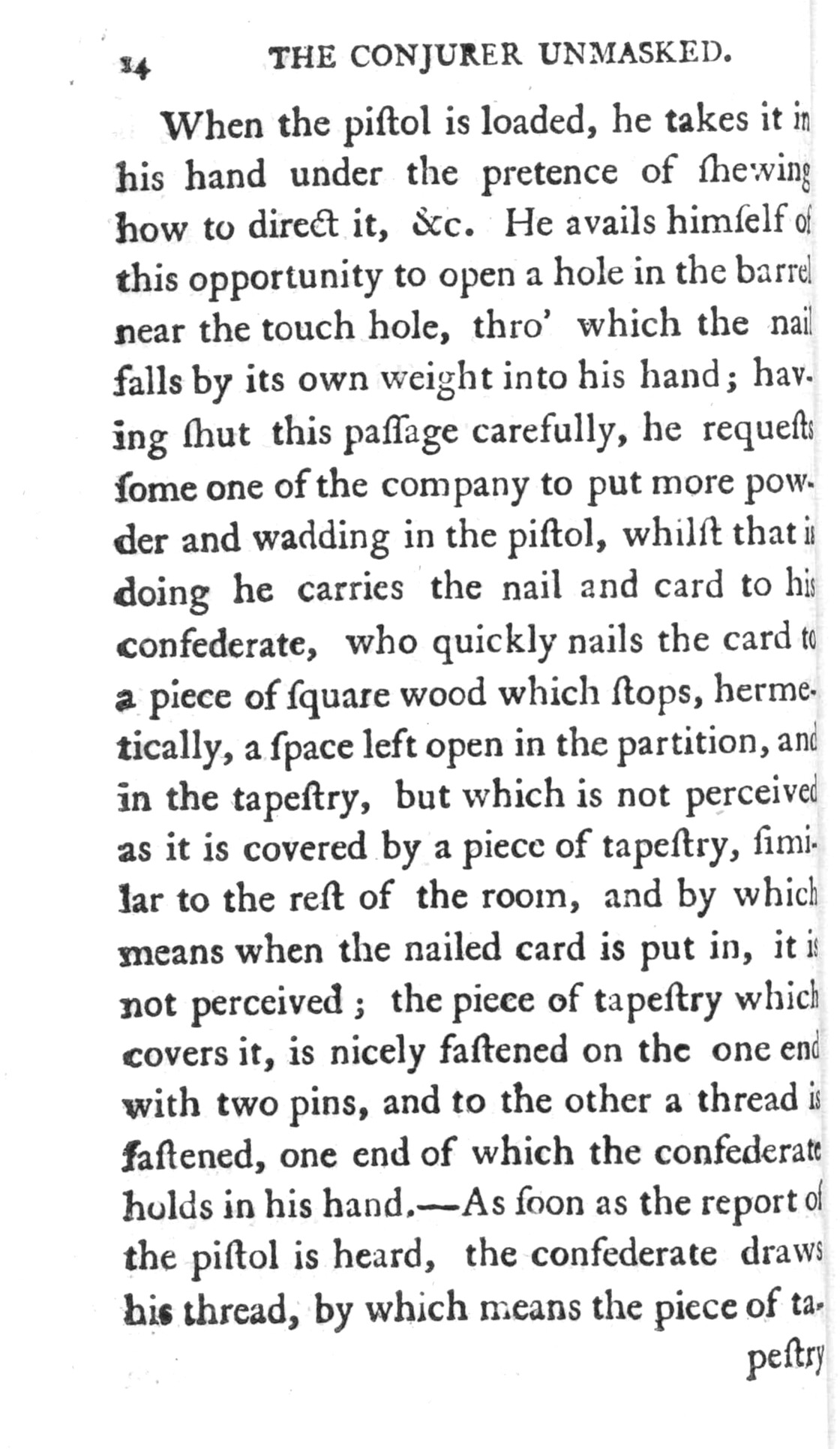
For this part the conjurer needed a rigged gun. He picked the pistol up for the first time only once it was fully loaded, with the excuse of showing everyone how to cock and handle it.
Under the barrel, near the touch-hole (the tiny vent where the spark lights the powder), there was a secret opening. He uncovered it, and the nail slid out into his palm by its own weight.
Next he slid “a kind of iron collar” over the opening and fixed it there, so that nobody would notice anything, and asked a spectator to add more powder and paper. All this time he held the deck with the genuine card hidden at the bottom. While everyone watched the loading, he slipped offstage and passed the real card and the nail to his accomplice behind the partition.
Decremps explains the exact same steal for a trick with a borrowed ring. The ring slips out through the trapdoor under the gun barrel into the conjurer’s palm, and an accomplice feeds it to a tame turtle dove.
What was behind the wallpaper?
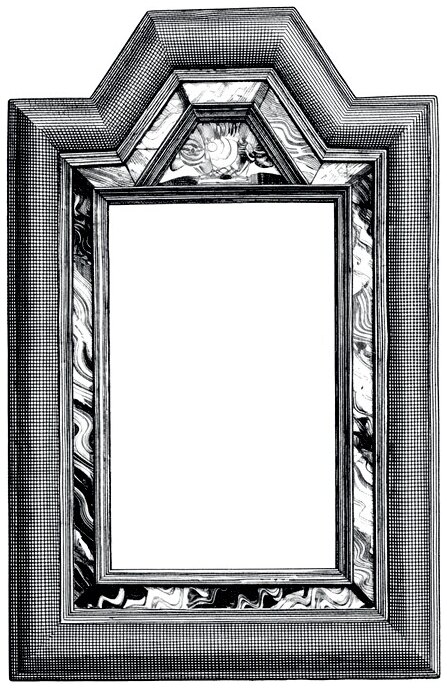
The wall belonged to the machinery. It was a thin partition hung with patterned fabric and set beside a large wall mirror, with a square hole cut through it and plugged from behind by a block of wood.
A flap of matching fabric covered the hole from the front. One side was pinned, and the other was tied to a thread whose end the accomplice held. Behind the wall he nailed the real card to the wooden plug with the marked nail, and as soon as the pistol fired he pulled the thread. The flap whipped out of sight behind the edge of the mirror, and there was the card.
What if someone in the audience got suspicious?
Decremps has a note for the moment someone doubts the gun. If a spectator suspected that the nail had been stolen out of the pistol, the conjurer was to protest and invite the doubter back the next day.
On the second night he brought an ordinary gun and took it apart to show there was no secret opening. For the nail he had two ways out: a helper planted in the seats could mark it, or he showed a nail to the room and acted as if he had forgotten the marking step.
Behind the wall, the helper drove a second, fresh nail through the card. The conjurer then told the room that several people had checked the nail and invited them forward to look.
Who was Henri Decremps, and whose trick was he exposing?
Decremps, trained in mathematics and law, had worked at the French embassy in London before he came back to Paris in 1783. He published the book the following year, and its title promises to explain tricks “that have lately been the admiration of the capital and the provinces”.
He never named the performer. His readers took the book as an attack on Giuseppe Pinetti, an Italian conjurer who was filling a Paris theatre at the time and had performed privately for Louis XVI.
Pinetti answered on stage. He hired an actor to play Decremps and fail to explain the tricks, and according to a dealer’s description of the first edition, the audience threw the actor out. Decremps went on exposing: under the pen name Jérôme Sharp he wrote several more volumes on sleight of hand and mechanical stage illusions.
Did Pinetti really shoot cards onto walls?
Nobody has shown that he did. The 1784 engraving names no performer, and no playbill or newspaper of the period links Pinetti to a nailed card. Decremps may have worked out a plausible method on his own and used Pinetti’s fame to sell it.
Pinetti did use firearms on stage. His own book of 1784 describes firing a pistol to put out candles, and shooting quicksilver at a swallow to stun the bird and bring it round again, but a card shot onto a wall is nowhere in his pages.
How did the trick travel to London?
Decremps soon came out in English as The Conjurer Unmasked, with an opening plate copied from the Paris engraving and an English caption that sends readers to chapter V.
The third edition of 1790 adds a second method that the French text lacks. Once the powder is in, a small tin tube goes down onto the charge, and the nail is rammed into it with the wadding. When the conjurer tilts the pistol to hand it to a spectator, tube and nail fall into his hand.
Is the nailed card related to the bullet catch?
The darker branch of firearm conjuring is the bullet catch. A gun loaded with a marked lead ball is fired at the performer, who seems to catch the ball in mid-air. It rests on the same deception as the 1784 trick: a marked object goes into the gun in plain sight and is already in the performer’s hand before anyone pulls the trigger. In the usual method the marked bullet reaches him by sleight of hand, or an assistant offstage marks a second bullet to match.
The bullet catch is much older than Decremps. An English book of 1597 tells of a performer in France who claimed to catch bullets in his bare hand when guns were fired at him, until an angry servant shot him with a real pistol and killed him.
Next to that, Decremps’s nail looks like a gentler cousin. In both tricks the gun has to look loaded without firing what it seems to hold, and in the bullet catch that is where the danger lies.
Why did the bullet catch kill Chung Ling Soo?
In March 1918 the trick killed one of the most famous magicians in the world. William Robinson was shot on stage in London during a number called “Defying the Bullets” and died the next morning. Robinson was an American who had appeared for years in yellowface as Chung Ling Soo.
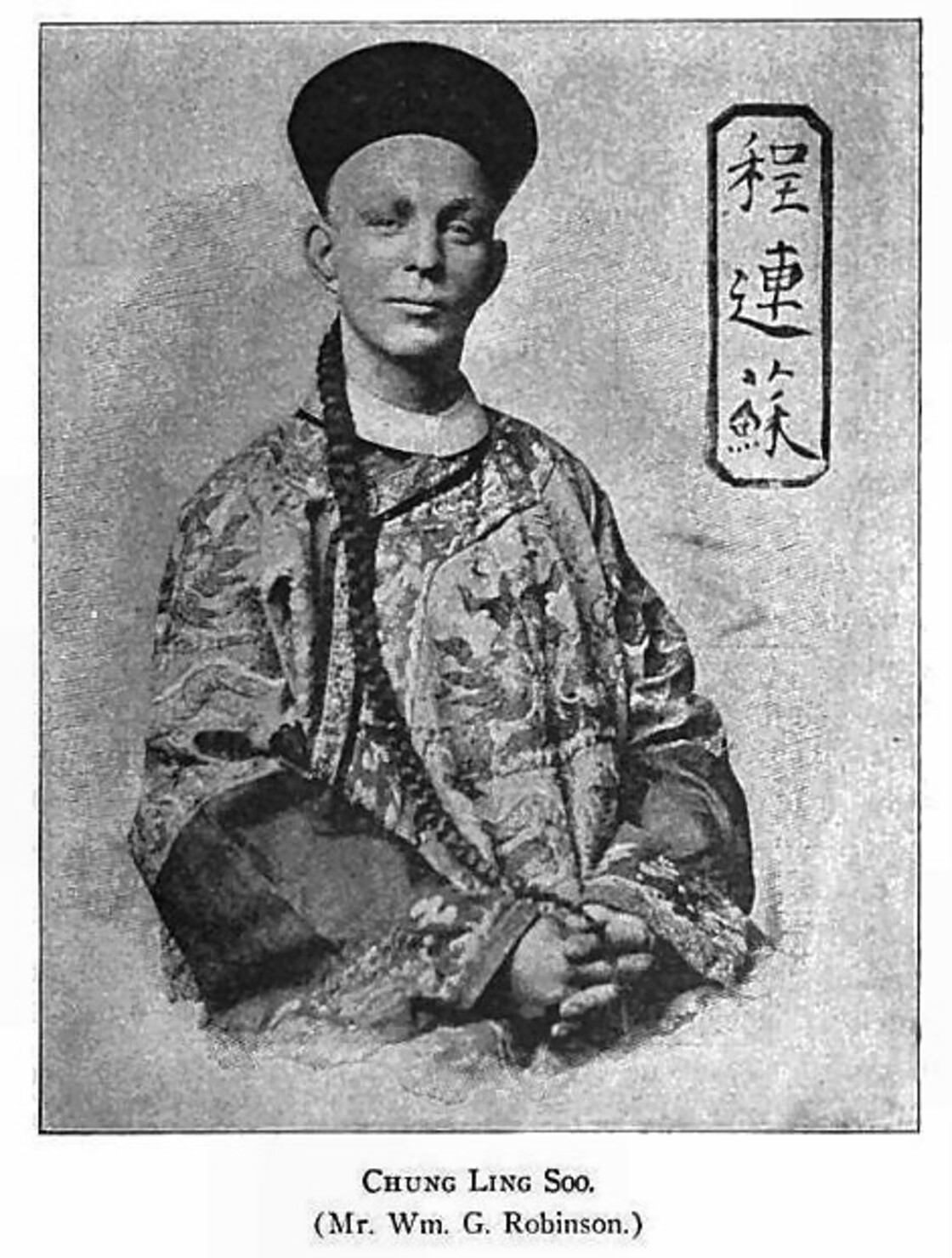
The extra tube in Chung Ling Soo’s gun did the same job as the hole near the touch-hole in 1784. Both gave the audience a loaded gun to look at, while the part that mattered sat somewhere else.
The coroner’s inquest laid the gun mechanism open. Each weapon had a second steel tube hidden where the ramrod usually sat, and it held a blank charge for the flash and bang. The live round in the main barrel was never meant to go off, and on stage an assistant switched the marked bullets with a cup that had a false bottom.
Years of firing had worn the metal. The gunsmith Robert Churchill told the inquest that powder had seeped through a worn seam to the space behind the real bullet in the main barrel. When the blank went off, that powder caught as well and drove the bullet into Robinson’s chest. The jury ruled the death an accident.