In June of AD 79 the Roman emperor Vespasian lay ill in the hill country of the Sabines, where he had been born and where he spent every summer. When the illness first took hold of him, he said: “Vae, puto deus fio.” In plain English that is “Alas, I think I am becoming a god.” He meant it as a joke, and the joke rested on a real Roman practice: when an emperor died, Rome could declare him a god, with priests and sacred rites of his own.
What did Vespasian mean by “I think I’m becoming a god”?
The line comes from Suetonius, who wrote the lives of the first Roman emperors. He tells it in a passage about Vespasian’s jokes, because the emperor, he says, did not stop joking “even when in apprehension of death and in extreme danger”.
Two strange signs came before the end, according to Suetonius. The Mausoleum of Augustus, the tomb of Rome’s first emperor, opened by itself, and a comet appeared in the sky. Vespasian had an answer for both. The tomb, he said, was about Junia Calvina, a woman of Augustus’ family, and the comet was about the king of the Parthians, Rome’s rival in the east, because that king wore his hair long.
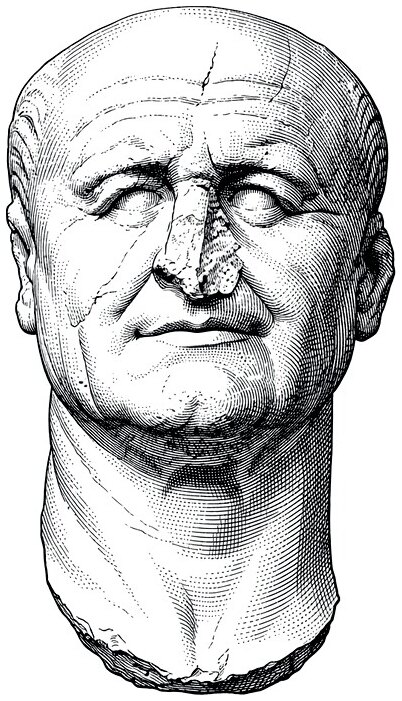
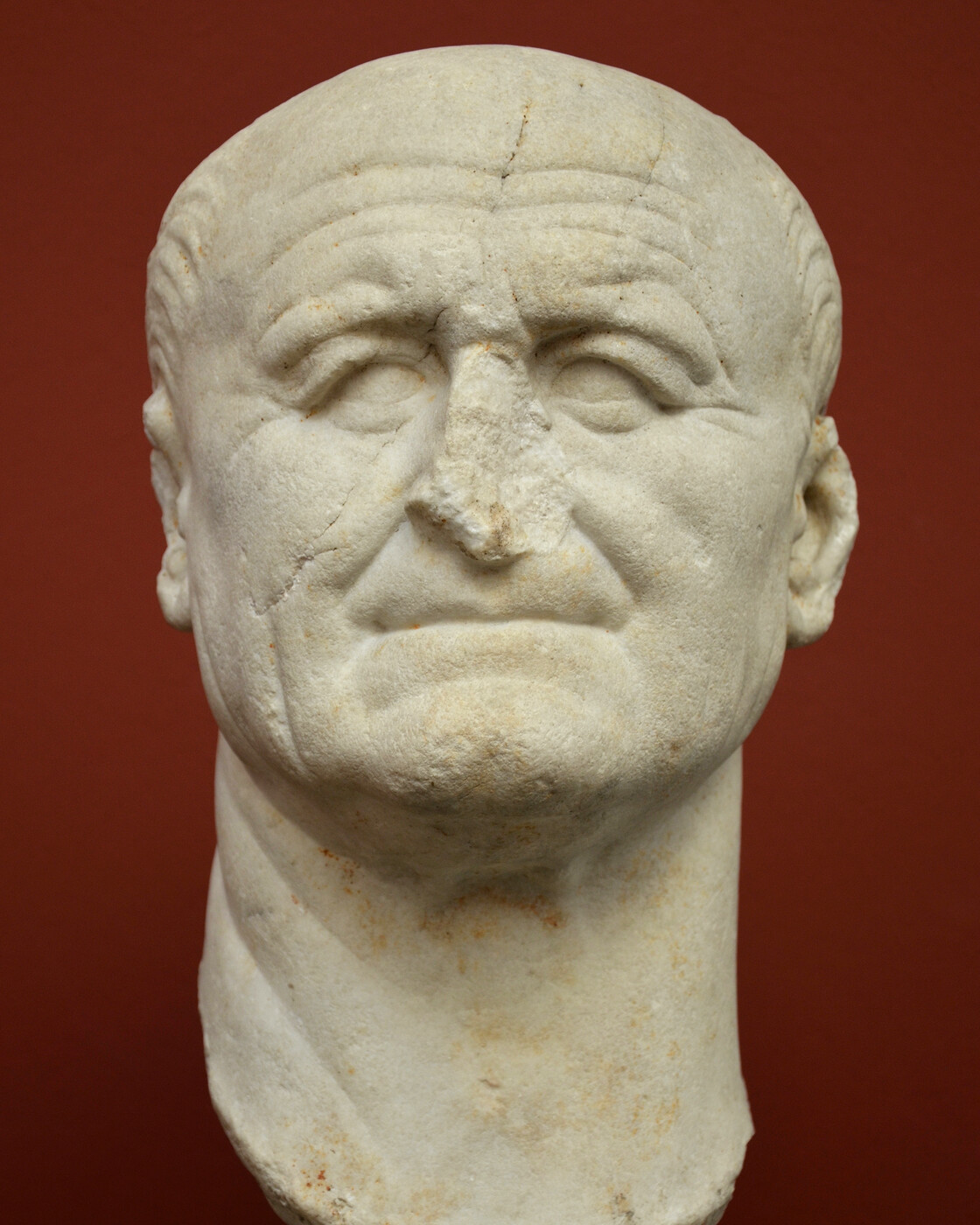
The comet joke turns on a word: the Romans called a comet stella crinita, a “long-haired star”, and the Greek word kometes also means “hairy”. The Greek historian Cassius Dio gives the rest of the joke as Vespasian told it: “This is an omen, not for me, but for the Parthian king; for he has long hair, whereas I am bald.” The marble head below shows how little hair Vespasian had left.
Dio also has the last words, in a shorter form: when Vespasian was at last convinced that he was going to die, he said, “I am already becoming a god.”
Who was Vespasian?
He was born on 17 November AD 9 in Falacrina, a village in the Sabine country, five years before Augustus died. He won the throne in AD 69 in a civil war, and Suetonius calls him “an unexpected and still new-made emperor”. Among the buildings he began in Rome was “an amphitheatre in the heart of the city”, the arena we now call the Colosseum.
Many of his jokes were about money. When his son Titus objected to a new tax on urine, Vespasian held some of the money from the first payment under his son’s nose and asked whether it smelled. Titus said it did not. “Yet it comes from urine,” his father answered. Another time envoys told him that a huge statue of him was to be set up at public cost. He held out his cupped hand and said the base was ready, as if the money could go straight into it.
Suetonius also admits that the new emperor at first “lacked prestige and a certain divinity, so to speak”, and he tells how these came to him in Alexandria, in Egypt. A blind man and a lame man approached Vespasian there and said that the god Serapis had promised them in a dream that the emperor could heal them. Vespasian had hardly any faith that it could work. Still, he spat on the blind man and touched the lame man with his heel, and Suetonius reports that both were cured.
How did a Roman emperor become a god after death?
The Romans called it consecratio. The dead ruler was “brought into the number of the gods”, and from then on people called him divus, “the deified”. William Smith’s Dictionary of Greek and Roman Antiquities of 1875 notes that the Roman Republic, the state Rome had before it had emperors, knew no such case. The only exception was the old legend that Romulus, the founder of Rome, had become the god Quirinus. Julius Caesar was the first Roman to be deified after his death, and the emperors who came after him followed his example.
What was Caesar’s Comet, and why did Romans see it as his soul?
Julius Caesar was murdered in 44 BC. In July of that year Caesar’s young heir, the man who later ruled as Augustus and whose tomb Vespasian joked about more than a hundred and twenty years later, held games in Caesar’s honour. During the games a comet shone for seven days in a row. In a book of 1997 John T. Ramsey and A. Lewis Licht calculated that it appeared around 20 to 23 July.
The Roman author Pliny the Elder, in his Natural History, quotes what Augustus himself said about it: “During the very time of these games of mine, a hairy star was seen during seven days… The common people supposed the star to indicate that the soul of Caesar was admitted among the immortal Gods.” Suetonius adds that this is why Caesar’s statues showed a star on the crown of his head.
That was what Augustus said in public. Pliny writes that in private Augustus rejoiced at the omen and took the comet as a sign that had appeared for his own sake. He also records that Rome was “the only place in the whole world where there is a temple dedicated to a comet”.
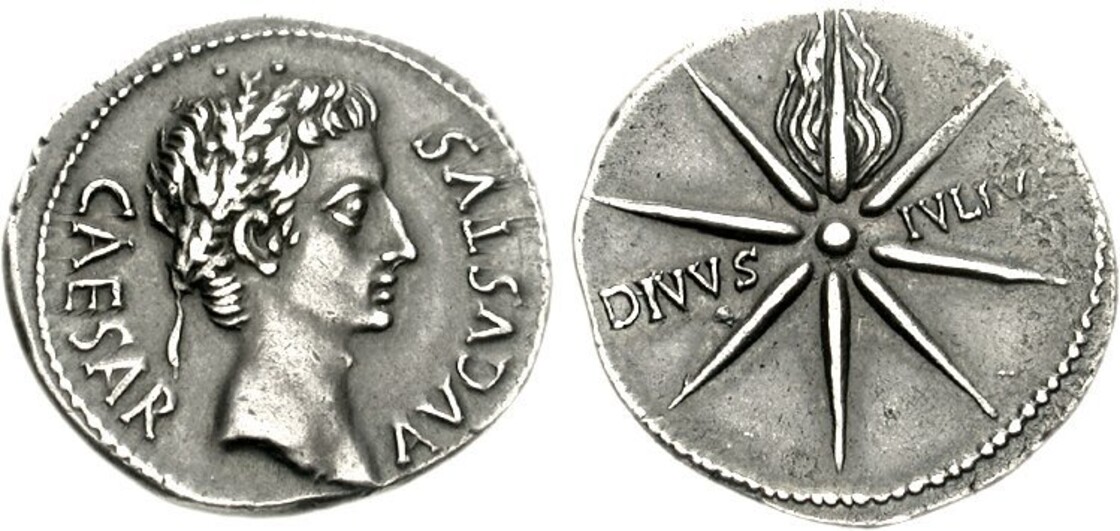
Suetonius tells the same story more briefly and draws a conclusion from it. Caesar, he writes, “was numbered among the gods, not only by a formal decree, but also in the conviction of the common people”, and the comet is the reason he gives for that conviction.
Comets usually frightened the Romans. Pliny the Elder calls the comet “a terrific star, and one not easily expiated”, and he lists the troubles that came with them, from civil wars to the time when the emperor Claudius was poisoned and power passed to Nero. About Caesar’s comet he writes the opposite: “to confess the truth, it really proved a salutary omen for the world at large.”
What happened at an emperor’s funeral?
Augustus died in AD 14, and Cassius Dio describes what Rome did for him. Centurions, officers of the army, lit his pyre by order of the Senate, and an eagle released from it flew up, “appearing to bear his spirit to heaven”. Afterwards the Romans declared Augustus immortal, gave him priests and sacred rites, and made his widow Livia his priestess. A former praetor, one of Rome’s senior magistrates, named Numerius Atticus swore that he had seen Augustus going up to heaven, and Livia gave him a million sesterces. Suetonius mentions the same oath, without naming the man.
In the third century the Greek historian Herodian described the ceremony as it was held in his own day for emperors who died leaving successors. A wax image of the dead emperor lay on an ivory bed in the forecourt of the palace for seven days, while doctors came and declared that the patient was getting worse, until at last they announced that he had died.
The image was then carried in procession to a pyre built in several storeys on the Campus Martius, the Field of Mars, and when the pyre burned an eagle was set free from its top. According to Herodian, the Romans believed that this eagle carried the emperor’s soul from earth to heaven, and from then on he was worshipped with the other gods.
Women received the honour too. Smith’s Dictionary lists Augustus’s wife Livia, Nero’s wife Poppaea and Faustina, the wife of the emperor Antoninus Pius, among the women who were declared goddesses after their deaths.
Did Vespasian become a god?
According to Suetonius, a sudden attack of diarrhoea left Vespasian close to fainting, and he said: “An emperor ought to die standing.” While he was struggling to get to his feet, he died in the arms of the men who were trying to help him. The date was the ninth day before the Kalends of July, which is 23 June AD 79. The historian Eutropius, writing in the fourth century, records the next step in one line: Vespasian “was received among the gods”.
His son Titus, now emperor, put the new god on his coins. On a bronze sestertius struck in Rome in AD 80 or 81, the dead Vespasian sits on a throne, wearing a crown of rays and holding a branch and a sceptre. The lettering reads DIVVS AVGVSTVS VESP, the deified Vespasian, and on the other side Titus calls himself the son of the deified Vespasian.
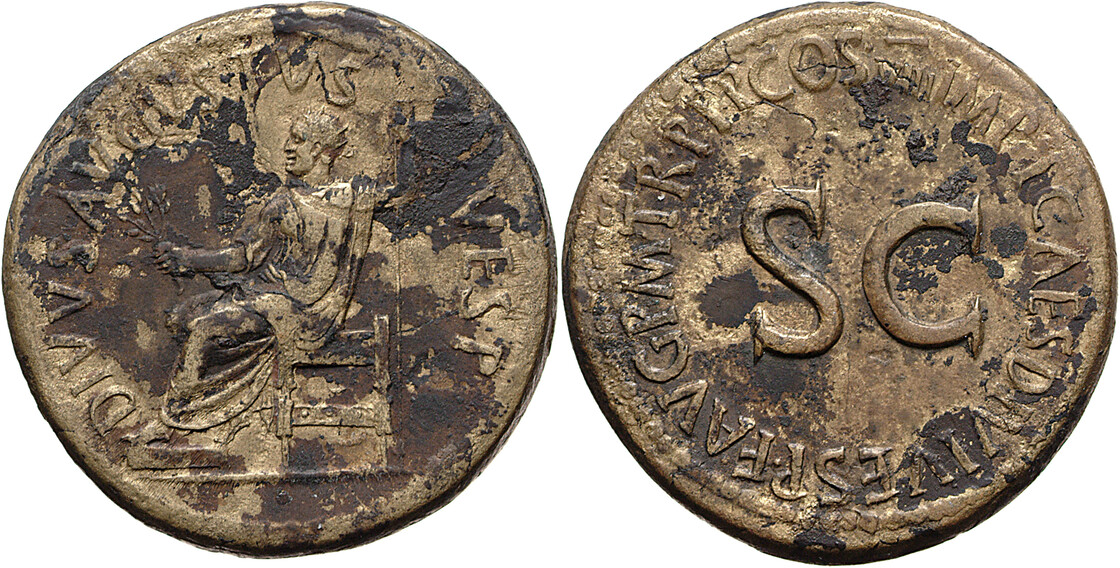
Titus also began a temple for his father on the Roman Forum, the old public centre of the city, and Vespasian’s younger son Domitian finished it. Later it was called the temple of Vespasian and Titus, but the original inscription named only the father: divo Vespasiano Augusto SPQR, “to the deified Vespasian Augustus, the Senate and People of Rome”.
Did Romans really believe their emperors were gods?
The Roman writers do not give one answer. For Caesar, Suetonius speaks of a decree and of the conviction of the common people side by side. Cassius Dio writes that when the comet of 44 BC appeared, some people said it foretold the usual misfortunes, while most of them took it as a sign that Caesar had become immortal.
Even Vespasian’s own son spoke of it with a condition. As emperor, Titus refused to hear charges of insulting the dead emperors, and Cassius Dio quotes his reason: “As for the emperors who are dead and gone, they will avenge themselves in case anyone does them a wrong, if in very truth they are demigods and possess any power.”
What Vespasian meant by his last words is still argued over. In 1965 the classicist Duncan Fishwick called it an open question. Most scholars before him, he noted, had read the words as a sarcastic sneer at deification, and Suetonius, who put them among the emperor’s jokes, certainly took them as a joke. Fishwick himself thought that Vespasian probably did not expect, in any literal sense, to become a god.
Almost three hundred years before Vespasian, China’s first emperor, Qin Shi Huang, took the opposite road. He tried not to die at all, sending expeditions to find the islands of the immortals and taking elixirs. Rome’s emperors were made gods only after their deaths, by the decision of the living. Read more in Qin Shi Huang: The Emperor Who Poisoned Himself Seeking Immortality.
Where can you still see the deified Vespasian?
Both deified men of this story had a shrine on the Roman Forum. At the place where Julius Caesar’s body was burned, the triumvirs, the three men who governed Rome together after his death, laid the foundation of a shrine to him. Vespasian’s temple stood between the Tabularium, the old record office of Rome, and the road that climbs to the Capitol.
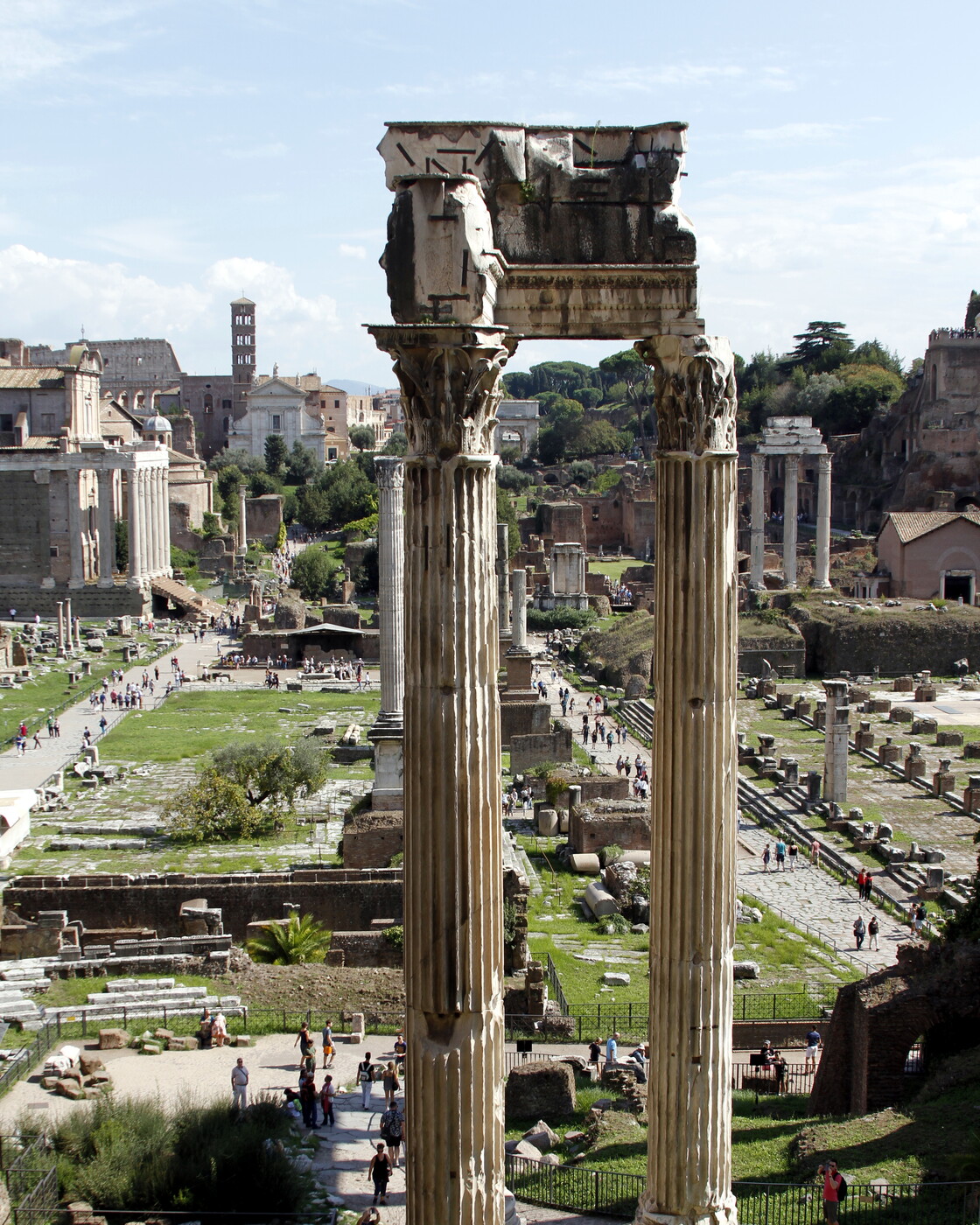
Three Corinthian columns of white marble, 15.20 metres high, survive from its southeast corner. They were set upright again in 1811, when the people of Rome still called the ruin the temple of Jupiter Tonans, Jupiter the Thunderer.