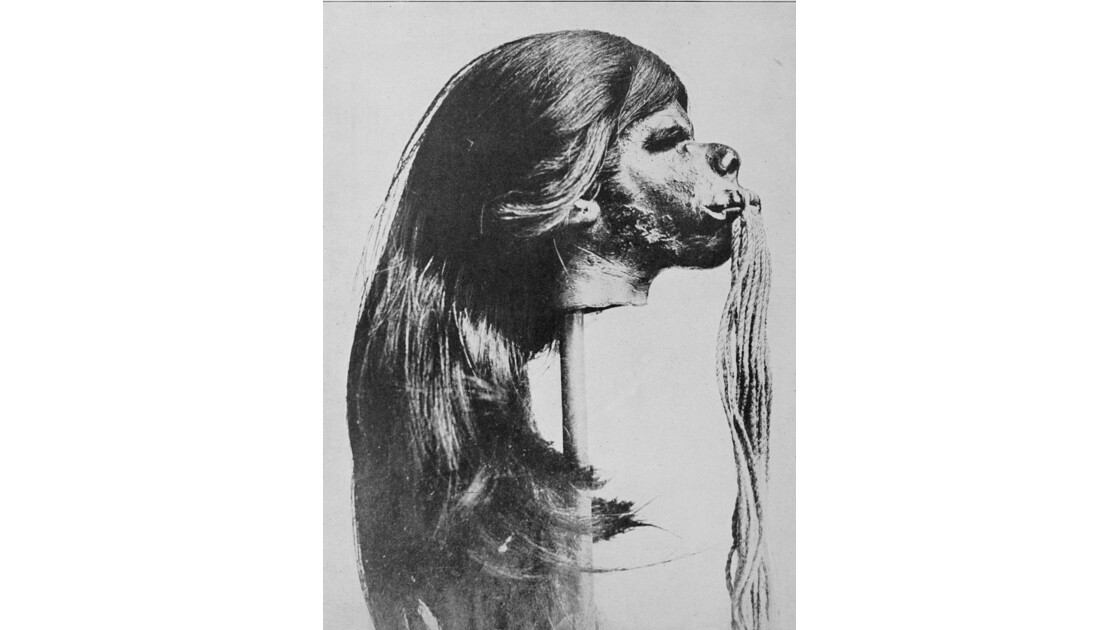
A book from 1975 about the spirits that Native Americans feared has a photograph of a small human head that fills a whole page. Long dark hair falls past the head and pale cords hang from its lips. The caption says only this: “Shrunken human head, four inches from chin to crown. Jivaro Indians, Ecuador.” The people who made such heads, the Shuar of Ecuador, called one a tsantsa. It was the skin of an enemy’s head with the skull taken out, shrunk with hot stones and sand into a trophy that was believed to hold the dead man’s spirit. Many heads in museums were made later for collectors, some of them from animal skins, and in the last few years CT scans have begun to sort the trophies from the trade.
The book is The Ghosts the Indians Feared by Sigmund A. Lavine. The photo sits beside a passage about cannibal sorcerers in North American legend, which has nothing to do with the head, and the word Jivaro appears nowhere else in the book. The picture credits name the Museum of the American Indian, Heye Foundation, in New York, whose collection became the Smithsonian’s National Museum of the American Indian under a law of 1989. So the caption makes three claims of its own: that the head was shrunk, that it was human and that it came from the “Jivaro”.
What is a shrunken head, or tsantsa?
“Jivaro” is the old outsiders’ name for a group of peoples who live in the forests and foothills of the Andes in eastern Ecuador and northern Peru. The best known of them are the Shuar and the Achuar. In April 2018, Shuar and Achuar scholars and leaders meeting in the village of Sevilla Don Bosco declared that “Jivaro is a pejorative exonym born out of colonial confrontations”, a name others gave them and which they never used for themselves. Their own word for the shrunken head is tsantsa.
The most detailed early description of how a tsantsa was made comes from Rafael Karsten, a Finnish scholar of religion who travelled among these peoples and wrote down what they told him. In 1923 the Bureau of American Ethnology in Washington, the US government’s office for research on Native peoples, printed his report on their wars and victory feasts. He spelled the old outsiders’ name “Jibaro”, and researchers who examine tsantsas today still cite his description of the method.
How was a shrunken head made?
According to Karsten, a tsantsa could only be made from an enemy of a foreign group. Taking the head of someone counted as a blood relative was forbidden, and a man who did it risked being killed by his own people. After a fight the warrior cut the head off as close to the body as he could. On the way home the war party often had to carry it for a couple of days before there was time to work on it.
The first step was a small ceremony. The head was laid on a leaf, and the warrior who had cut it off sat down on the head while the chief blew tobacco juice into the warrior’s nose. Then each of the other men who had taken part in the killing did the same. Karsten calls this the first of many rites to protect them “against the revengeful spirit of the killed enemy”.
Then the head was opened with a long cut down the back, from the crown to the neck. The scalp and the skin of the face were drawn off the skull “in much the same way as is done with the hides of animals for stuffing”. At the face the skin would not come away by pulling, so it had to be cut from the flesh with a sharp knife. The skull and everything still attached to it were thrown away, so the trophy was made from the skin alone.
The skin was tied to a vine and put into boiling water for a while. Karsten says the boiling killed the germs, made the skin contract a little and gave it more body. Once it had cooled on a stick, the cut at the back was sewn shut with a needle and a thread of chambira, a palm fibre. A ring of vine was fixed inside the neck opening, the same size as the finished neck would be.
Now the shrinking began, and it started with three small round stones from the river bank. They were heated in the fire, and the man who had cut off the head dropped one, with the chief or an old warrior holding his hand, through the neck and rolled it about inside. Then came the second stone, then the third. Karsten thought the stones did little that the sand did not do later, so he took them for a rite to weaken the dead enemy’s soul, which was thought to cling to the skin, and to keep it away.
The sand did the real work. Fine river sand was heated in a piece of a broken clay pot and poured into the head until it was more than half full. The men kept the head moving so the heat reached every part. When the sand cooled they poured it out, scraped the inside of the skin with a knife and filled it again with hot sand. As the skin dried and shrank, they shaped the face with their fingers so that it kept its human features.
This went on for days or even weeks, all the way home and sometimes after. The man who had taken the head carried the sand and the broken pot on the march. Karsten was told it had to be an old broken pot, because a whole one or a piece of a new one “would not do”.
At the end the head was “no larger than an orange, or about one-fourth of its normal size”, hard and completely dry. Three pins of chonta, the hard wood of a palm, about five centimetres long and painted red, were pushed through the lips and bound with a red cotton string. Finally the whole head, face included, was blackened with charcoal. The four inches in Lavine’s caption, about ten centimetres from chin to crown, fit this description.
The hair was the part the makers cared most about. Karsten writes that the hair was taken to be “the seat of the soul or the vital power”. The men usually wore their hair longer than the women did, so tsantsas with hair half a metre long or more were not unusual.
What did the tsantsa mean to the Shuar?
For Karsten the trophy was the centre of what he called “the great mystery feast”. In his account the spirit of the dead man stayed attached to the skin and wanted revenge on his killer. The rites around the head were meant to hold that spirit down and then make it serve the man who had killed him. The lip pins, the red string and the charcoal had, by Karsten’s own account, plain explanations among the people themselves: the pins kept the mouth closed, and the string was decoration.
Karsten thought otherwise and wrote that their real aim was to keep the soul of the dead “under a constant magical force”. A much later source, a scan study by researchers in Canada and Ecuador published in 2022, which comes up again below, adds that the charcoal was rubbed in “so the avenging spirit could not see out”.
The victory feasts stretched over about two years. The final great feast needed full-grown pigs, chickens and new fields of manioc, an edible root, for the guests. Karsten was told that the tsantsa itself made all this grow.
After one of the feasts, the spirit of the enemy became the killer’s “obedient slave”. It visited him in dreams and showed him how to feed the pigs and tend the crops. In his sleep he heard the grunting of future herds. Pigs and fields were normally women’s work, but during this time the killer went out to the gardens with the tsantsa round his neck and directed the work.
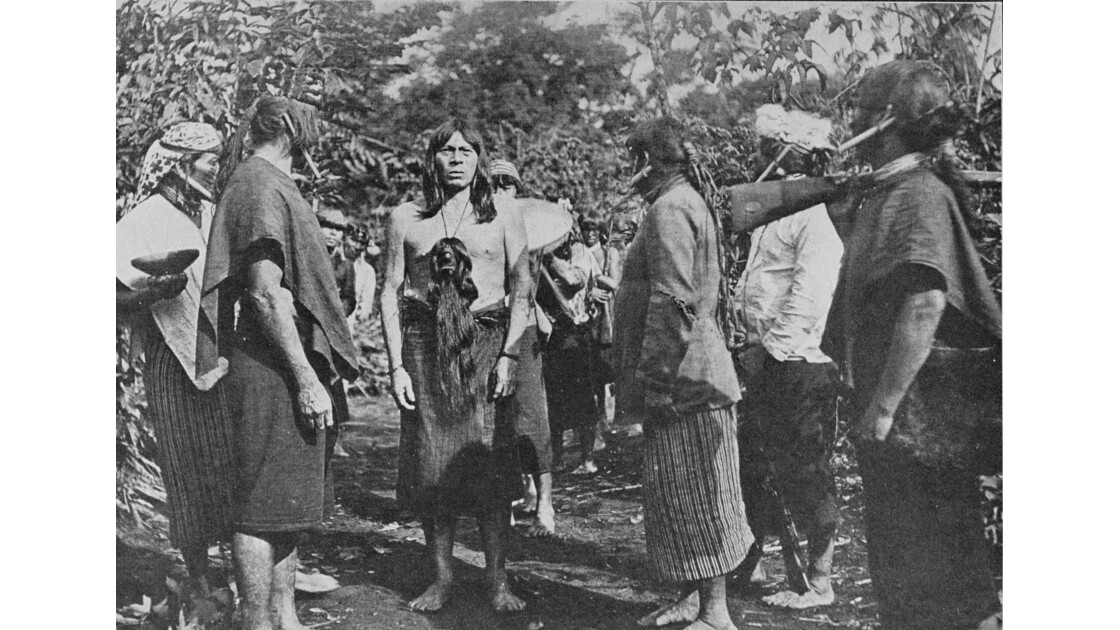
Between ceremonies, Karsten says, the trophy was tied to a lance of chonta wood driven into the ground just inside the door. The hard palm wood was thought to have a power of its own that kept the enemy’s spirit in check, so a lance with an iron point would not do.
That 2022 study does not agree with Karsten on every point. Its authors report that the Shuar and Achuar hung their tsantsas inside particular houses or on poles and did not wear them, as much of the older literature claims. They also record a living Shuar tradition: tsantsas may have been made from clan leaders who died naturally, so that their power stayed with the community. The older books describe tsantsas only as trophies taken from enemies killed in war, so this belief tells a different story from theirs.
One more detail from Karsten matters later, when museums try to sort their heads. Karsten’s hosts told him that in the earliest times all animals had been people, who waged war and took heads just as people still did. Because the sloth moves slowly and has partly grey hair, they still saw it as a very old man of a foreign tribe, and so as an enemy.
A hunter who killed a sloth therefore made a trophy of its head in the same way, only shrunk a little less, with the fur of the neck standing in for hair. He then went through the same cleansing rites as a man who had killed a human enemy and held the same great feast. Karsten adds that feasts with sloth heads were “equally common as feasts with human tsantsas”.
Why are so many shrunken heads fake?
Ceremonial tsantsas reached Europe through trade with settlers and missionaries in the nineteenth century. According to the 2022 study, scientists in North America and Europe began to publish on head shrinking after 1860, and demand from collectors and museums grew quickly. Tobias Houlton and Caroline Wilkinson, two researchers working in Britain whose study of 65 heads comes up below, date the first documented heads made by outsiders for sale to 1872.
What came onto the market was a mix. Some heads were made from skins of pigs, monkeys and sloths, softened in hot water and molded over a wooden form. Others were human, and the makers named by Houlton and Wilkinson included doctors, mortuary technicians and taxidermists, who worked with surgical needles, thread and gloves.
The 2022 study reports that human heads for the trade were said to come from unclaimed bodies in local hospitals, but it adds that the only evidence for this is sensational news reports. Europe had known a similar trade three centuries earlier, when dealers sold dried corpses as a medicine called mummy, a story told in The Curse of the Mummy.
How many of the heads in collections came from this trade, nobody has counted. Houlton and Wilkinson write that “accounts speculate” the share is 80 percent. The 2022 scan study cites the same figure as “up to 80%” and leaves out the word “speculate”, so in the newer paper the guess reads more like a count.
In 1942 a Mercer University professor serving with the US military in Ecuador traded coins, a pocket knife and a military badge for a tsantsa. The head was stuffed with Ecuadorian newspaper for the journey. When researchers examined it more than seventy years later, they took the newspaper out with tweezers and found sand and ash with it.
How can museums tell a real shrunken head from a fake?
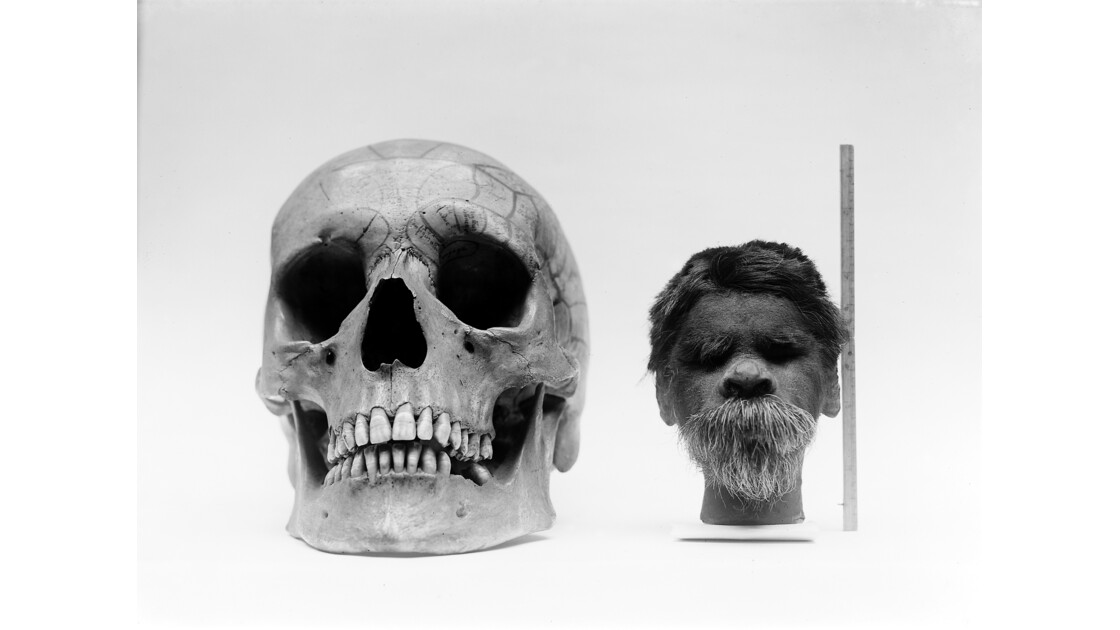
The first test is a checklist. From Karsten and the other old descriptions, researchers have built a list of signs that a ceremonial tsantsa should show and a trade head usually does not. A ceremonial head is about the size of a clenched fist. It has one cut down the back, closed with wide, uneven stitches of palm fibre, a ring of vine in the neck, eyelids drawn in and sewn shut, and three holes in the lips. Its skin is browned with charcoal and its face is free of fine hair. A commercial head more often has neat stitches made with a metal needle, grey or yellowish skin, and a beard or moustache left in place.
In 2016 researchers applied this list to 65 human heads in British and American museums. They examined stitches, took CT scans and checked hairs under the microscope. Six heads matched the ceremonial pattern, 36 looked commercial, and 23 could not be placed either way.
A CT scan in a hospital machine shows the skin layers, the cut and the stuffing, but it cannot show single stitches or hairs. In 2022 a team in Canada and Ecuador turned to micro-CT, a scanner that captures microscopic tissue details. With advice from Shuar and Achuar communities, they tested a head from the Chatham-Kent Museum in Ontario. The Sulman family had bought it on a trip to the Amazon and given it to the museum in the 1940s, and the museum record said only “Peruvian Indians”.
The question was whether the head was human or a sloth. At the finest setting, the scanner showed hair roots sitting in the remains of the skin, with the shafts growing out through the surface, just as in human skin. The hairs were round in cross-section and had a medulla, a core running down the middle. Hair of the two-toed sloth has grooves running along its length, and these hairs had none, so the head was human.
Whether it was ceremonial was harder to say. The rough cut at the back and the way the skin had split into two layers fit the ceremonial method. But the back, the eyes and the lips had been sewn with modern thread, which points to the trade. The team concluded that the Chatham head was likely made for sale, though the authors noted that the making of tsantsas probably sat on a spectrum rather than in two separate boxes: commercial makers copied genuine rites, and Indigenous hunters may sometimes have produced heads directly for collectors.
In workshops at the Universidad San Francisco de Quito, Shuar and Achuar leaders told the researchers that a ceremonial tsantsa only ever had a single cut. A painted face, they said, is a sign that a head was made for sale.
Why did the Pitt Rivers Museum take its shrunken heads off display?
The Pitt Rivers Museum in Oxford had shown its tsantsas for about eighty years in a case called “Treatment of Dead Enemies”. In the summer of 2020 its staff took 120 human remains off open display, the tsantsas among them, and the museum reopened on 22 September 2020. The director, Laura Van Broekhoven, said the displays “reinforced racist and stereotypical thinking that goes against the Museum’s core values”.
Since 2017 the museum had been talking with Shuar delegates through the Universidad San Francisco de Quito. Shuar leaders Miguel Puwáinchir and Felipe Tsenkush stated: “We don’t want to be thought of as dead people to be exhibited in a museum, described in a book, or recorded on film.”
The museum has 12 tsantsas, collected between 1884 and 1936. According to The Art Newspaper, seven are made from human heads and five from sloths and monkeys. After Karsten’s account of the sloth feasts, the animal heads are hard to judge, since a sloth head on a museum shelf might have been made for the trade or might once have been honoured with a feast like a human trophy.
Some heads have already gone back. The tsantsa from Mercer University in Macon, Georgia, for example, was checked against 33 signs of the ceremonial method, of which it showed 30, and was scanned in a CT machine. Ecuador accepted the result, and on 12 June 2019 the head was handed to the Consulate General of Ecuador in Atlanta.
In October 2025 a Shuar delegation of leaders, elders, students and professors came to Britain. Four institutions there, the Pitt Rivers Museum, the British Museum, the Wellcome Collection and the Science Museum Group, hold more than 80 tsantsas between them, and the delegates looked at 68 human and seven animal heads. According to Laura Van Broekhoven, they asked for the ceremonial tsantsas to be returned to their territory.
Mercer kept a copy of its tsantsa, printed in three dimensions from the scan. The original went home to Ecuador seventy-seven years after the professor had carried it away in 1942, stuffed with an Ecuadorian newspaper.