In the spring of 1662 a woman named Isobel Gowdie stood before the minister and landowners of Auldearn, a village in the north of Scotland, and confessed to being a witch. She did this four times between 13 April and 27 May, and each time a notary wrote down what she said. Among many other things she told them that the Devil had given her a new name, Janet, and that he had given nicknames to other women of her coven, the group of thirteen witches she said she belonged to. One of them was called Pickle-nearest-the-wind and another Over-the-dyke-with-it.
Robert Pitcairn, an antiquary in Edinburgh, printed her confessions in 1833 at the back of a large collection of Scottish court records, and they have been retold many times since. Some of the retellings carry three more names, Raise-the-wind, Batter-them-down-Maggy and Blow-Kate, which his printed text does not contain. Which names Gowdie gave can be checked line by line in her confessions. Why a witch needed a new name at all is harder to answer, because the Scottish records never give a reason. The records come closest in a trial held seventy years before hers, in which a gathering of accused witches turned angry because three of them were called by their real names.
What were the Isobel Gowdie witch names in the 1662 confessions?
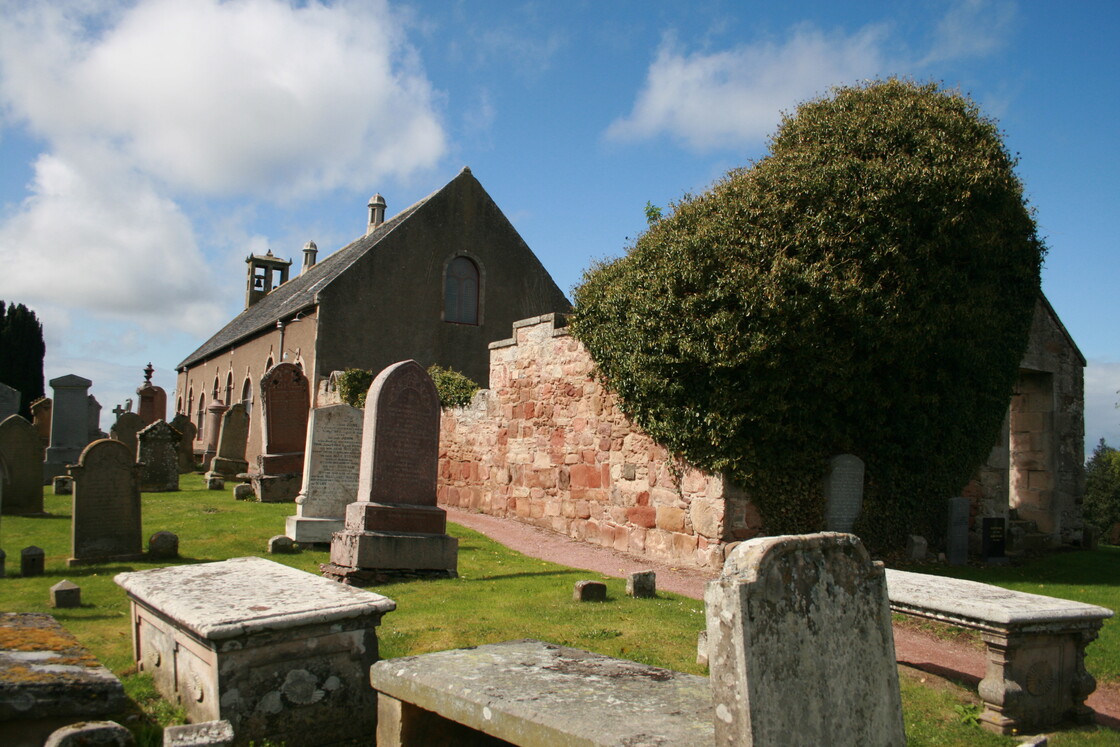
Gowdie lived at Lochloy, near Auldearn, which lies close to the town of Nairn on the Moray Firth. The record calls her the wife of John Gilbert of Lochloy. She gave her four confessions in Auldearn on 13 April, 3 May, 15 May and 27 May 1662. The parish minister, the sheriff’s deputy and several local landowners listened while the notary, John Innes, took down her words in the first person and in the Scottish spelling of the time, so the page reads as if she were speaking.
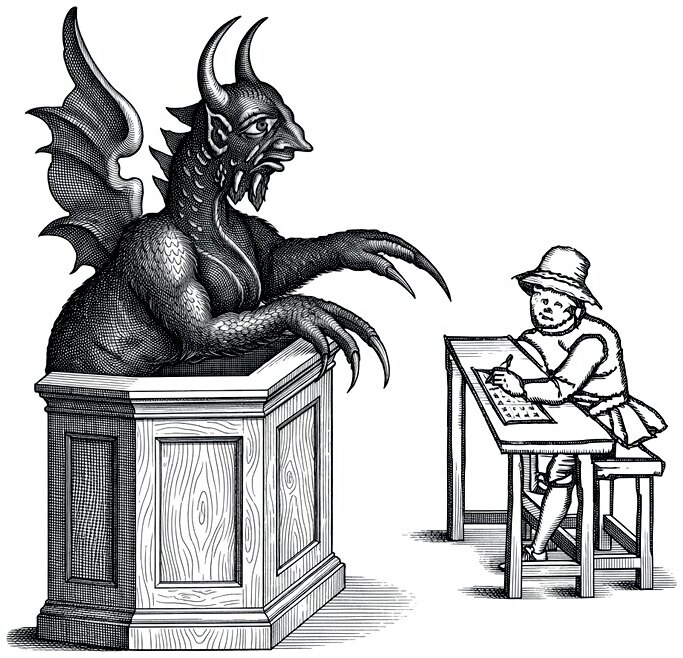
Her first confession begins with a meeting on the road. She was walking between two farms, she said, when she met the Devil and promised to meet him at night in the church of Auldearn. There she denied her Christian baptism. She put one hand on the crown of her head and the other on the sole of her foot, and gave everything between her two hands over to him. The Devil stood at the reader’s desk of the church with a black book in his hand, and another woman of the village, Margaret Brodie, held Gowdie up to him to be baptised. He marked her on the shoulder, sucked blood out of the mark, spat it into his hand and sprinkled it on her head. Then, in the notary’s spelling, he said: “I baptise the, Janet, in my awin name!”, which is to say: I baptise you, Janet, in my own name.
She told this scene again in her third and fourth confessions. On 15 May she said that the Devil had “re-baptised” her and that the blood fell on her head and face, and this time the notary wrote the words as “I baptise ye, Janet, to my selff, in my own nam!” Gowdie never says why the Devil chose the name Janet, only that he gave it to her with the baptism.
Who were Pickle-nearest-the-wind and Over-the-dyke-with-it?
In her second confession, on 3 May, Gowdie described the coven from the inside. She had already said that it had thirteen members. Now she said that each of them had a spirit to wait on her, and she admitted that she could not remember all the spirits’ names. Then she named ten spirits, said for many of them what colour they wore, and for six of them gave the nickname of the woman the spirit served.
A spirit called Swein, dressed in grass-green, waited on Margaret Wilson of Auldearn, whose nickname was “Pikle neirest the wind”, in modern spelling Pickle-nearest-the-wind. In Scots a pickle is a single grain, but Gowdie does not say what the name meant or why Margaret Wilson had it. A spirit in yellow waited on Bessie Wilson, whose nickname was “Throw the corne yaird”, Through-the-cornyard. An aged spirit in dun, a dull brown, served a woman nicknamed “Able and stowt”, Able-and-stout. Two nicknames in the list look like ordinary names: a spirit called the Roaring Lion, in sea-green, waited on Isobel Nicoll of Lochloy, who was nicknamed “Bessie Rule”, and a spirit called Laing served a woman nicknamed “Bessie Bauld”. Gowdie’s own spirit was called the Red Reiver, and he wore black.
Only one nickname comes with its reason. Jean Martein, the daughter of Margaret Wilson, was the Maiden of the coven, which meant that the Devil took her by the hand next to him when they danced. The dance was called Gillatrypes, and whenever he leapt, he and she called out: “Ower the dyk with it!” A dyke in Scots is a drystone field wall, so the shout means “over the wall with it”, and “Over the Dyke with it” was Jean Martein’s nickname.
The paper of this second confession is badly damaged at the ends of its lines. Pitcairn filled some of the gaps with words in brackets and left others blank, and one blank comes right after “Throw the corne yaird”. The list also stops early: after the tenth spirit, Thomas a Fearie, the notary wrote only “&c.”, and Pitcairn noted that her questioners appear to have stopped her short at this point.
On 27 May, in her fourth confession, Gowdie gave the nicknames again, this time as a list of their own that begins “The Nik-names that the Divell gaw wnto ws wer”, the nicknames that the Devil gave to us were. She named five women: Margaret Wilson was Pickle-nearest-the-wind, Bessie Wilson was Throw-the-corn-yard, Elspet Nishie was Bessie Bald, Jean Martein the Maiden was Over-the-dyke-with-it, and Bessie Hay was Able-and-stout. Bessie Rule, the nickname she had given for Isobel Nicoll on 3 May, is missing from this second list.
Gowdie was not the only woman in her coven to describe a baptism with blood. Janet Breadhead, wife of John Taylor of Belmakeith, confessed that the Devil sucked blood from her shoulder, sprinkled it on her head and “baptised me thairvith, in his awin nam, ‘Christian.’” She also said that when she first came to the meeting, the Devil “called tham all be thair names, on the book”, reading each name out of his book.
Why did a real name cause an uproar at North Berwick?
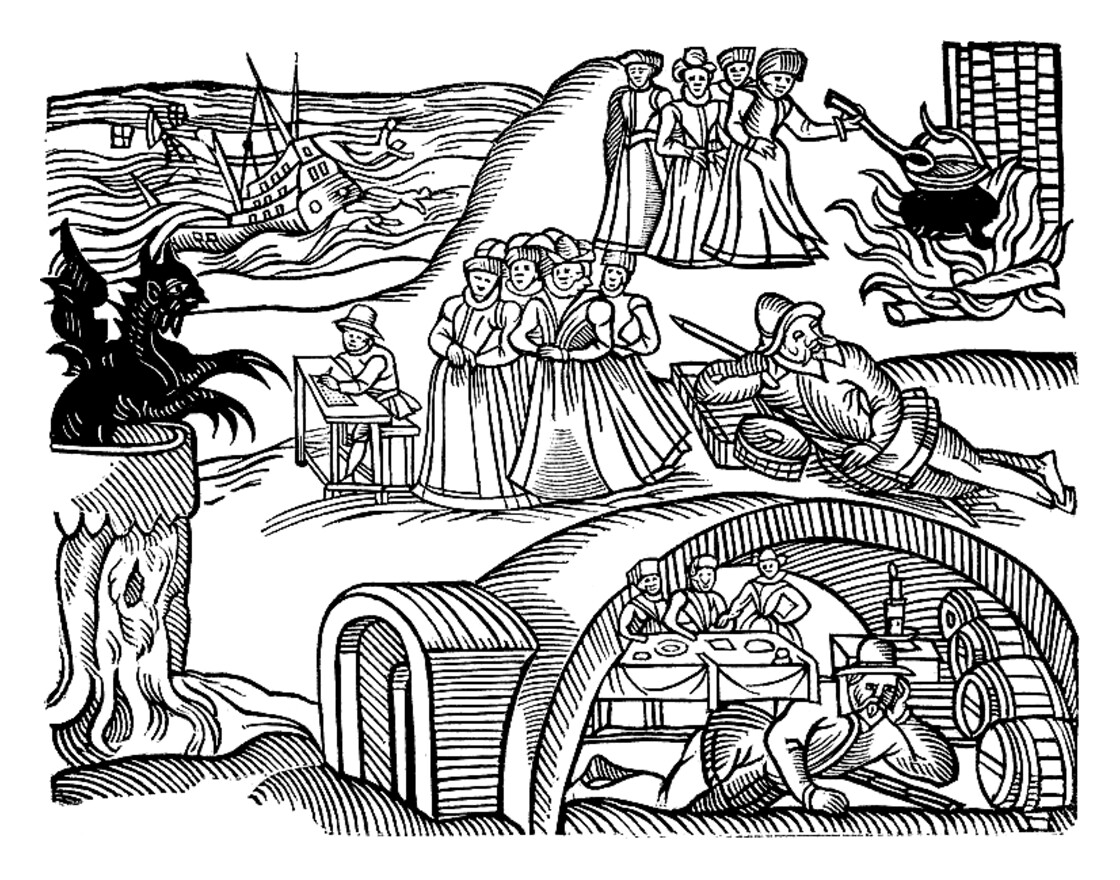
Gowdie gives no reason for the names, and the Scottish record that comes closest to one is seventy years older. It comes from North Berwick, a town on the coast east of Edinburgh. In 1590 and 1591 a group of people were tried for witchcraft there, and one of them was Agnes Sampson, a midwife and healer from Keith. The charges against her say she confessed before King James VI himself that the Devil had ordered her to come by night to the church of North Berwick. More than a hundred people were there, she said, six of them men, and they danced in the churchyard while a woman named Geillis Duncan played on a trump, a small mouth harp. A pamphlet of the time tells that night in its own way, and its version is in Where Halloween Really Comes From.
Inside the church the Devil rose up in the pulpit in the shape of a big dark man. He called everyone by name, and each one answered “Heir, Mr.”, Here, Master. But when he called Robert Grierson, the charge says, “thay ran all hirdie-girdie and wer angrie”, they all ran about in disorder and were angry, because Grierson had been promised that he would be called “Rob the Comptroller alias Rob the Rowar”.
The charge against a second accused, Barbara Napier, tells the same moment more plainly. Three people happened to be called by their own names at that meeting, Robert Grierson, Euphemia McCalyan and Barbara Napier herself, and this “offendit all the cumpany”, because they should not have been named with their own names. Grierson was to be called Rob the Rower, Euphemia was to be called Cane and Barbara was to be called Naip. The same charge says what the meeting was for, which was a wax image of the king that was to be roasted over a fire to destroy him. So the North Berwick charges show that a real name was not to be spoken at the meeting, but they too stop short of saying why.
Agnes Sampson was strangled and burned on Castlehill in Edinburgh on 28 January 1591. In 1921 the folklorist Margaret Murray went back to these names. She read Naip as a short form of Napier and Rob the Rowar as a title for the man who kept the rows, or rolls, of the meeting. She wrote that the giving of a new name was peculiar to Scotland, and that there was nothing in the sources “to throw any light on the reason for the change”.
What did Gaufridi’s 1611 confession say about baptism with water, sulphur and salt?
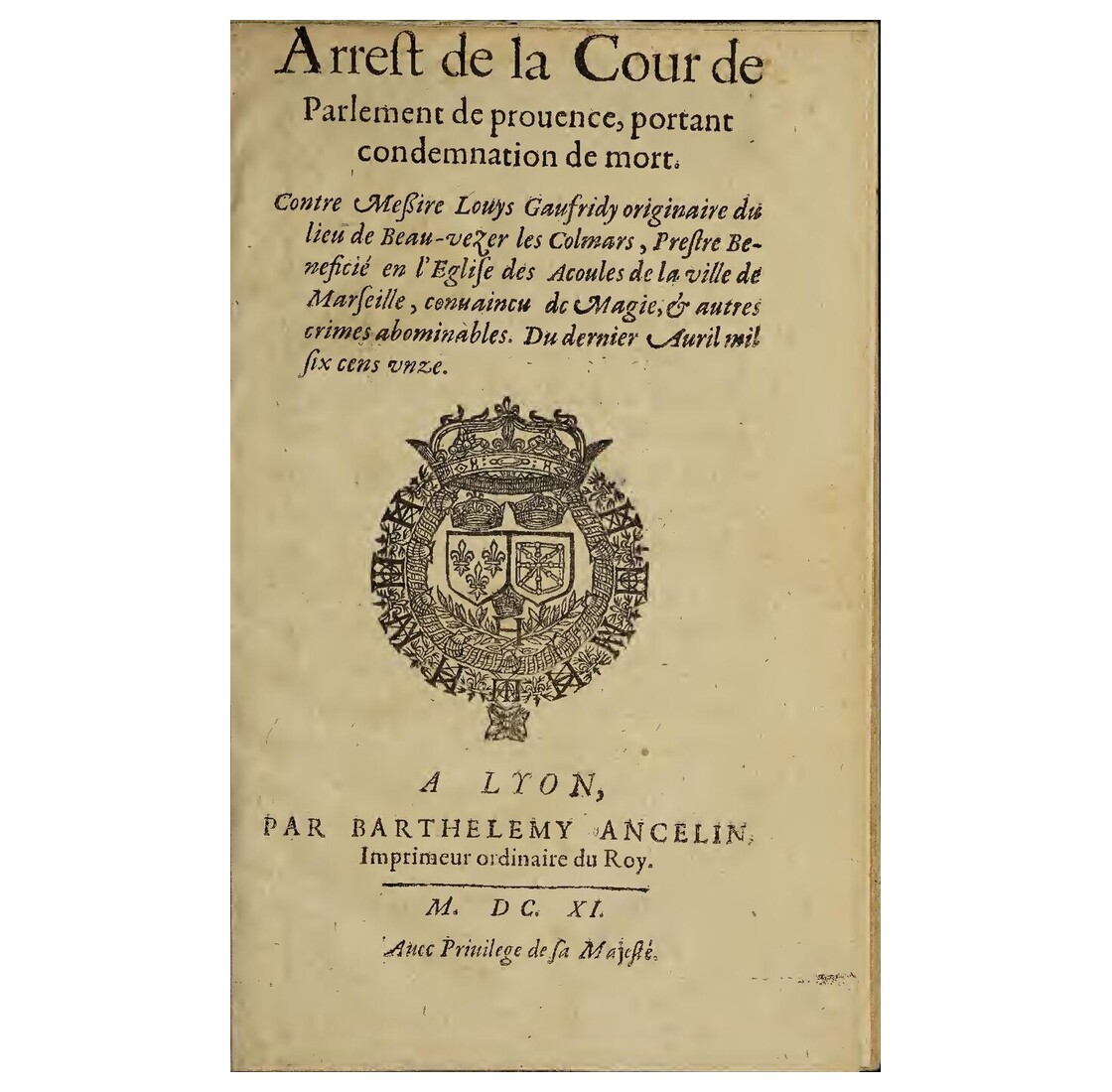
A new name is also given in a French confession printed in 1611, and a later English book would set this case directly beside Gowdie’s. Louis Gaufridi was a priest in Marseille who was accused of seducing a young nun whose confessor he had been, and of delivering her to the Devil. The Parlement of Provence, the high court of the region, condemned him for magic and other crimes, and he was burned at Aix-en-Provence on 30 April 1611. A fourteen-page booklet was printed in Aix with the verdict, and it gave what it called his confession to two Capuchin friars.
The confession runs in numbered articles, and four of them deal with the sabbath, the gathering of witches with the Devil. Article 28 calls the Devil “a true ape of the Church”, who does at the sabbath everything that is done in church. Article 29 says that there is a form of baptism at the sabbath, that every sorcerer vows to have his children baptised there if it can be done, and that everyone present is given a name different from their own. Article 30 says what is used, which is water, sulphur and salt: the sulphur makes the person a slave of the Devil, and the salt confirms the baptism in the Devil’s service. Article 31 adds that the baptism is given in the name of Lucifer, Beelzebub and other devils, and that the sign of the cross is made backwards, from the feet up to the head.
So Gaufridi’s baptism uses water, sulphur and salt, and Gowdie’s uses her own blood, but in both accounts the person leaves with a new name, and in neither is a reason given. More of Gaufridi’s story is told in The Aix-en-Provence Possessions.
Where do Raise-the-wind, Batter-them-down-Maggy and Blow-Kate come from?
In 1926 the English writer Montague Summers published The History of Witchcraft and Demonology. In its third chapter he put Gaufridi, North Berwick and Auldearn on one page. The giving of a new name, he wrote, “seems to have been very general”, and Isobel Gowdie had “stated that many witches known to her had been baptized in their own blood by such names as ‘Able-and-Stout,’ ‘Over-the-dike-with-it,’ ‘Raise-the-wind,’ ‘Pickle-nearest-the-wind,’ ‘Batter-them-down-Maggy,’ ‘Blow-Kate,’ and similar japeries.” He gave no source for this sentence.
Three of his six names stand in Gowdie’s confessions as Pitcairn printed them: Able-and-stout, Over-the-dyke-with-it and Pickle-nearest-the-wind. The other three, Raise-the-wind, Batter-them-down-Maggy and Blow-Kate, do not occur there. The second confession has gaps at the ends of its lines, so a lost word cannot be ruled out in that one, but the fourth confession lists the nicknames on purpose and names five. Summers’s sentence also goes further than the confessions on the baptism. In Gowdie’s own words the blood baptism is something done to her, and Janet Breadhead, whose confession is printed after hers, describes it for herself. Summers extends that baptism to “many witches known to her” and ties the nicknames to it.
The words “to raise the wind” do occur in the confessions, where they belong to a charm. When the coven wanted wind, Gowdie said, they wet a rag in water, beat it on a stone with a beetle, a wooden mallet, and said three times: “I knok this ragg wpon this stane, To raise the wind, in the Divellis name; It sall not lye vntill I please againe!” In modern words: I knock this rag upon this stone, to raise the wind in the Devil’s name; it shall not lie until I please again. To lay the wind they dried the rag. “We haw no power of rain,” she added, “bot ve will reise the wind quhan ve pleas”, we have no power over rain, but we will raise the wind when we please.
Later popular books on witches repeat names from Summers’s list, and one of them counts Batter-them-down-Maggy among the “recorded names” of the Scottish witches, beside Pickle-nearest-the-wind.
A year before Gowdie, in June 1661, a woman named Janet Watson confessed at Dalkeith near Edinburgh that the Devil had come to her in green clothes and a black hat at a meeting, where she denied Christ. Then he “gave her a new name, and called her ‘Weill-dancing Jenot’”, and promised her money at the next meeting.
What became of Isobel Gowdie?
After her second confession a deputy justice, A. Colville, wrote that a commission might “verie justlie pass, for hir last Tryall”, meaning that she could rightly be sent to a final trial. Scotland’s Privy Council then granted a commission to try her. What the court decided is not known: the Survey of Scottish Witchcraft, the University of Edinburgh’s record of the Scottish cases, lists no outcome for hers, and no record of her death survives.
The last of her four confessions is the notary’s page of 27 May 1662. Before the minister of Auldearn and five other witnesses, Gowdie said that she had denied the Father, the Son and the Holy Ghost in that church fifteen years before. Then she named the members of her coven, thirteen people including herself, and for five of the women the name the Devil had given them. Margaret Wilson was Pickle-nearest-the-wind, and her daughter Jean, the Maiden of the coven, was Over-the-dyke-with-it.