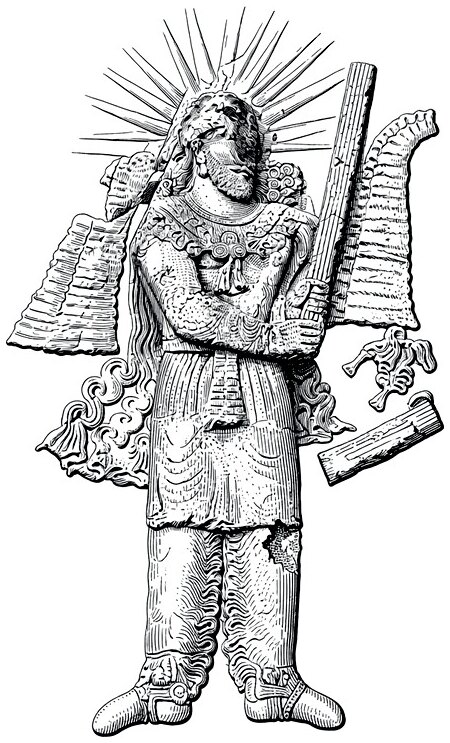
Mehregan is the old Iranian autumn feast of the god Mithra, and this year it falls on 2 October.
At dawn on that day, in the palaces of the old kings, a soldier stood alone in the courtyard. He shouted as loud as he could: “O ye angels, come down to the world.” Then he called on them to strike the demons and evil-doers and drive them out.
A scholar named al-Biruni wrote the custom down around the year 1000. By then it was already a memory of the old royal court.
The Naming
Mehr is the later Persian form of the name Mithra. Mehregan means the feast of Mehr, and it counts among the oldest festivals in Iran. Zoroastrians still keep it.
The old Iranian month had thirty days, and each day carried the name of a divine being. When a day and its month shared a name, the day became a feast. Mehregan is the day Mehr in the month Mehr, the 16th day of the 7th month.
Zoroastrians in Iran count it as 2 October. Iran’s civil calendar, with longer months, reaches it six days later.
The tyrant and the smith’s apron
The Persians told the feast’s origin as a story of liberation. It comes from the Shahnameh, the Persian epic of the kings by the poet Ferdowsi.
The tyrant Zahhak ruled the world for a thousand years. Two black snakes grew from his shoulders. The devil, dressed as a doctor, told him to feed them on human brains, so the palace cook killed two young men every night.
A blacksmith named Kaveh had eighteen sons, and only one was left. He took the leather apron that smiths wear at the forge, stuck it on a spear, and walked through the market calling people to rebel. They followed him to the young prince Faridun.
Faridun took the apron as a good omen. He decked it with brocade and jewels and set a full moon on the spearpoint. It became the royal banner of Iran. Each new king added more jewels to the smith’s old leather.
Faridun beat Zahhak and chained him inside Mount Damavand. In the epic he was crowned “on the first of Mihr, a blessed day.” Then “he bade men kindle bonfires and the people / Burned ambergris and saffron; thus he founded / Mihrgan.”
Parsi communities, Zoroastrians who had settled in India, let the feast fade in the 19th century. Today they mark only the day itself, the 16th of Mehr, in a calendar that has drifted months away from autumn.
The god of the contract
The feast carries the name of Mithra. In the Avesta hymn he appears as “the lord of wide pastures, who has a thousand ears, ten thousand eyes.”
His name is also an ordinary word: mithra means a contract. In the hymn the supreme god gives the rule to the prophet Zarathushtra: “Break not the contract.” It holds whether the other side shares your faith or not.
Whether the feast was first his is an open question. One historian points out that all the old information on the feast comes from writers who were not Iranian. Some historians think it was an older autumn festival that took Mithra’s name later, perhaps from a Babylonian feast of the sun god Shamash.
The customs
Most of the customs we know come from the royal court. The Sasanian kings crowned themselves on this day, the last Persian dynasty to do so before Islam arrived. The crown carried an image of the sun and of the wheel on which the sun turns. There was a fair.
Much earlier, in the Greek geography of Strabo, the Persian governor of Armenia used to send twenty thousand foals to the king every year at the feast.
The day once marked the start of winter. Around the year 1000 the rulers of Khorasan still handed out autumn and winter clothes to their soldiers on Mehregan. Over centuries the feast grew from one day to six, and then to thirty. Each class of society got its own five days.
Two customs were traced back to Faridun’s time. People ate in silence and prayed at dinner in a whisper, to give thanks that they could eat when they liked again. They greeted each other with “live a thousand years,” a wish linked to Zahhak’s long reign.
The common people had their own charm. al-Biruni’s translator spells the feast Mihrajan: “He who eats on the day of Mihrajan a piece of pomegranate and smells rose-water, will be free from much mishap.”
Legends and beliefs
The old beliefs make Mehregan a day of creation. On it, people said, God spread out the earth and made bodies as houses for souls. On it God dressed the moon in light, after making her “as a black ball without any light.”
Others said Mihr was a name of the sun, which first appeared to the world on this day. A priest at the caliph’s court in Baghdad gave a darker reading. On Mehregan the sun rises halfway between light and darkness, “then the souls die within the bodies.”
Persian theologians paired it with Nowruz, the spring New Year. Nowruz stood for the beginning of the world, and Mehregan for its end and the resurrection, because by autumn everything that grows has reached its full size. An old saying put it in jewels: God made an ornament of rubies on Nowruz and of emeralds on Mehregan.
Across traditions
The feast travelled far beyond Iran. Under Arab rule it was kept from Aden to Cairo. In Muslim Spain it fell at the end of June, close to the bonfires of St John’s Day. A Persian poet in Baghdad wrote sixty-nine odes for it in the early 11th century.
The Roman Empire knew a god Mithras too, worshipped in cave-like rooms (see Mithras and Mithraism, the Roman mystery cult). His Roman followers called the cult “the mysteries of the Persians” and believed Zoroaster, as the Greeks and Romans called Zarathushtra, had founded it.
Scholars spent most of the twentieth century arguing whether Iranian Mithra worship really travelled west, or Rome built a new cult in Persian costume. The question is still open.
The day today
Zoroastrians in Iran still hold Mehregan as a community feast with prayers of blessing. A Parsi religious handbook of 1869 called it “a time for love and gratitude for life.” In Kerman, a shrine to Mehr was an important centre, and Iranian Zoroastrians offered animals on the feast, among them the cock.
Tajikistan made the feast a national holiday in 2009, calling it Mehrgon locally, and celebrating it with harvest stalls and dancing. In 2024 UNESCO put the Ceremony of Mehregan on its heritage list for Iran and Tajikistan, kept from 2 October to 2 November.
Zoroastrians and Muslims set the same table for it: pomegranates, watermelons, pears, limes and lemons, grapes, apples, rice and wheat.