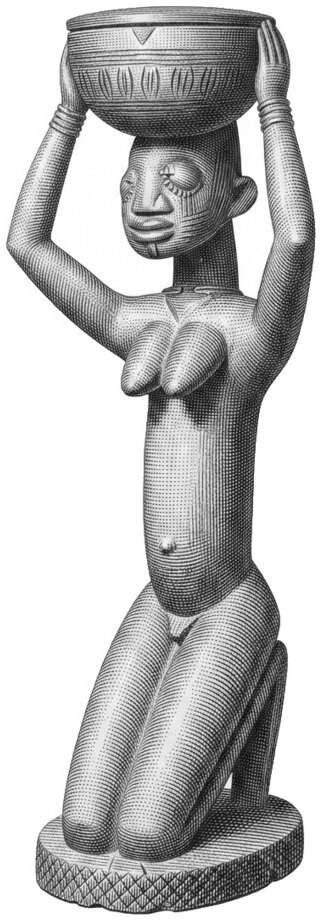
A girl from the king’s own family walks at the front of the crowd with a white calabash on her head. Inside the bowl sit the offerings of Osogbo, the sacrifices and petitions the town sends to its river goddess once a year. Men called Olose, the whip boys, clear the path in front of her, because if her foot catches a stone or a stump, the whole town reads it as a bad omen. For that walk she is the Arugba, the carrier of the calabash, and the crowd follows her to the river.
The last day of the festival
The grand finale is the closing day of the Osun-Osogbo festival, two weeks in August that Osogbo, a city in Osun State in southwest Nigeria, keeps for Osun, the goddess of the river that runs through the grove. She rules fresh water and fertility, and her river heals. The festival is the largest gathering for a traditional deity in Nigeria, and it draws Yoruba people from the Americas and Europe as well as from across the country. Devotees keep another river festival for her in March, the Oshun River Festival.
The sacred grove where it happens is a 75-hectare forest on the Osun River, ring-fenced against the town. It holds about forty shrines and nine river worship points, and in 2005 UNESCO inscribed it as a World Heritage Site. It is the last of the great Yoruba sacred groves to survive at full size.
The name Osogbo is said to come from oso igbo, “wizard of the forest,” the words the goddess used when a felled tree broke her dye pot.
The two weeks before
The festival opens with Iwopopo, the ritual cleansing of the town. A few days later comes the lighting of the old sixteen-point lamp, Olojumerindinlogun, which the town counts in centuries. Then comes Iboriade, when the crowns of every past Ataoja are carried out and blessed while the living king sits with the Arugba and the priestesses of Osun.
The last day is the procession. Devotees in white, with drummers and dancers at their head, walk from the palace to the grove. Many carry containers and will fill them at the river, because the water is said to heal. The Arugba leads the walk with the Igba Osun, the sacred calabash. Tradition says the goddess herself gave the calabash to the town’s founders, on the condition that a royal virgin carry it to the river every year.
She is chosen by Ifa divination, not by nomination, and she serves until she marries. Osuntomi Ewatomilola held the role for about twelve years before her wedding in 2024. Her successor, Princess Alimot Osunbunmi, was picked in March 2025, when she was still a child. At the 2025 festival she walked at the front but the calabash was carried by the chief priest, Baba Osun, because the load was too heavy for her; traditionalists said she would grow into the duty.
The covenant
The festival renews a promise that, by the town’s own reckoning, is more than six hundred years old. One account says migrants under the hunter Olutimehin settled on the riverbank, and Yeye Osun rose from the water and promised them protection and prosperity if they honoured her yearly. A fuller version names Larooye, the first Ataoja. In that telling a felled tree broke one of the goddess’s dye pots, she called him oso igbo, and he offered an apology she accepted. She gave him a fish, and the gesture with which he took it, open palms, became his title: Atewo-Gbeja, shortened to Ataoja, the name every king of Osogbo has carried since.
What Larooye promised in return was an annual sacrifice and respect for the forest and its creatures. The grove is the physical record of that promise, and the river is its altar. In Yoruba tradition the fish in the Osun are the goddess’s own messengers; they carry peace and blessings.
The goddess who crossed the Atlantic
Enslaved Yoruba people carried Osun to the Americas. There she kept her river and her honey under new names. In Cuba, where she is Ochún, she is honoured together with the Virgen de la Caridad del Cobre, the island’s patron saint, whose feast falls on 8 September. In Brazil she is Oxum, the Lady of Gold, the orixá of rivers and waterfalls, and her shrines sit at the water’s edge. Her marks travel intact: yellow and gold, mirrors and amber.
Scholars have mapped the route in the collection Osun across the Waters, edited by Joseph Murphy and Mei-Mei Sanford. The river goddess is one reason so many of the same orishas appear on both sides of the Atlantic. The messenger who opens the roads for all of them, Eshu, made the same crossing, and the grove in Osogbo still holds his shrines.
The grove today
The forest almost disappeared in the twentieth century. Shrines fell into neglect, and parts of the grove were being sold or cleared. In 1950 an Austrian artist, Susanne Wenger, arrived in Nigeria. She was initiated as a priestess, took the name Adunni Olorisa, and with local labourers founded the New Sacred Art movement, which raised the monumental sculptures and gates that now line the grove’s paths. Her work, backed by the Ataoja, helped stop the selling-off and the poaching, and it led eventually to the UNESCO inscription in 2005. The Adunni Olorisha Trust, named for her, has restored more than eighty shrines and sculptures since 2006.
The 2026 festival runs from 27 July to 7 August, under the theme “Preserving Heritage, Inspiring the Future.” The Arugba is Princess Alimot, now ten, and the organisers expect more than half a million people for the finale. On the last day the white-clad crowd follows her down to the river. The offering is presented at the water’s edge, and the covenant holds for another year.