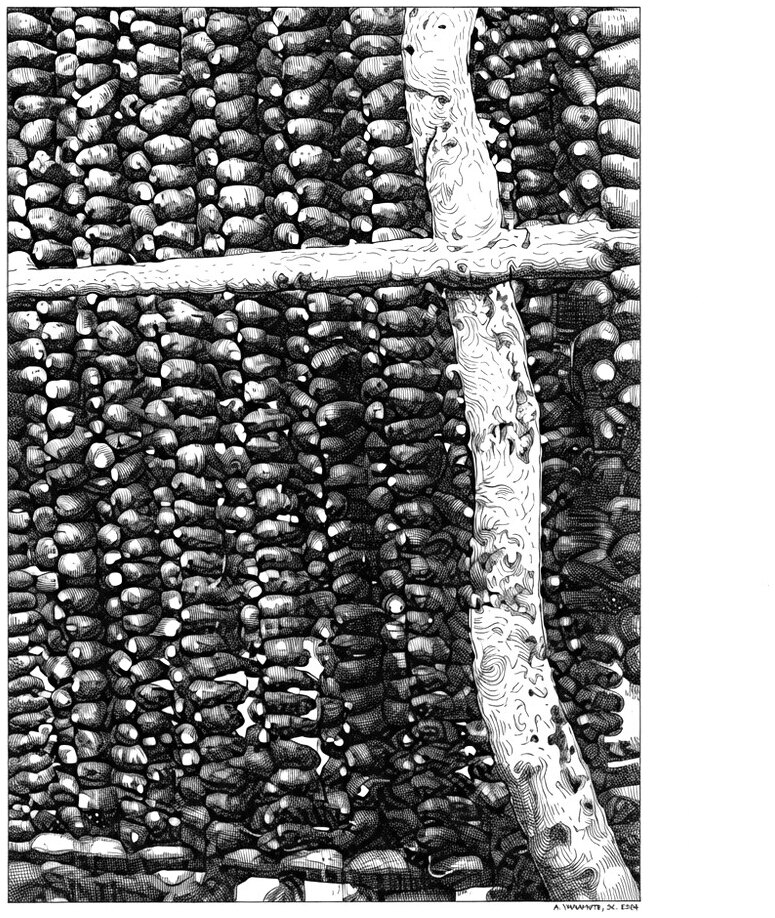
The oldest man in the village roasts the first new yam of the season. He sets it out with palm oil, says the prayer, offers it to the gods and the ancestors, and takes the first bite. Only then do the rest of the people eat. Until that moment the new yams have stayed in the ground, or in the barn if dug, because eating one before the festival is a breach that touches the whole community.
The day the yam taboo lifts
Iri Ji Ohuru means “eating the new yam” in Igbo. Other communities say Iwa Ji, the cutting of the yam, or Ike Ji. The feast is the first-fruits celebration of the Igbo, the majority people of southeastern Nigeria, and it closes the farming year: the rainy season ends, the first yams come out of the ground, and the community thanks the powers that carried it from one harvest to the next. The traditional cue is the new moon of August. The dates are not fixed; each community keeps its own festival from early August into October, and our calendar pin of August 22 sits inside that season. In 2026 the new moon of August fell on August 12.
What the eve and the day ask
The eve of the festival is a clearing out. Old yams from the previous year are eaten up or thrown away, and on festival day only dishes of yam are served. Nothing from the old harvest is meant to survive the night.
In the morning the yams go to the gods and ancestors before they go to anyone. The rite is called Iwa Ji, and it belongs to the oldest man in the community, the king, or an eminent titleholder. He acts as the go-between, gives thanks to Chukwu, the supreme being, and eats the first yam, usually roasted and dressed with palm oil. After him everyone else eats. Old accounts say that harvesting a new yam before its time brought misfortune on the eater and the village alike, and that stealing yam once carried the harshest penalties.
Around the feast move the masquerades. Mmanwu dancers in painted costumes pass through the squares and marketplaces, with ekwe slit drums and oja flutes playing behind them. Wrestling matches test the young men, girls dance in groups, and the occasion doubles as a courtship ground. In Nnewi the local form of the feast is called Afiaolu, and it runs across the four native market days, Eke, Orie, Afor and Nkwo, with the Igwe, the king, first to eat the roasted yam. In Issele-Uku, a community in the Anioma area of Delta State, the order runs the other way: the legend says the first new yam might be poisoned, so children eat first, then the untitled, then the titled men, and only last the king.
The god of the yam
Behind the feast stands Ahiajoku, the yam spirit, known in some places as Njoku Ji, the guardian of the crop. The name reads as a proverb: hard work brings wealth. The earth goddess Ala holds her place beside it, and the ancestors sit with them. Children dedicated to the deity were given the name Njoku and expected to grow into prosperous yam farmers, which is one root of the common Igbo surname.
The origin is told as legend, in more than one version. In one, Eze Nri, the divine king, is ordered by the oracle to cut up his son and bury the pieces during a famine, and yam tendrils climb from the burial mound. In another, a man named Igbo sacrifices his son Ahiajioku and his daughter Ada; yams grow from the son’s flesh and cocoyam from the daughter’s, and the famine ends. The versions differ on the names; both make the yam a gift paid for with a child’s body.
Yam was the measure of a man. A full barn, the ọba ji, showed industry, and the size of the harvest set a man’s standing. D. G. Coursey called the Igbo the most enthusiastic yam cultivators in the world, and G. T. Basden compared the yam’s place in Igbo life to the potato’s among the Irish.
The name Njoku still marks the old covenant with the yam. Children promised to the deity were called Njoku, and the title carried a duty: grow into a farmer whose barn is full, and the clan’s standing rises with yours.
The same fire, other names
West Africa keeps several first-fruits festivals built on the same order. In Ghana the Ashanti Yam Festival, the “Yam Custom” tied to the Odwira Festival, has the priest offer the first yam to the ancestral gods before the people may eat. The Ga of Accra keep Homowo, a harvest feast whose name means hooting at hunger. The Yoruba honor their own yam orisa, Oreluere, who tradition says planted the first yam; in Ikere the feast is called Odun Ijesu. Farther east the comparison is made in print: Ịwa jị resembles the Mid-Autumn Festival, another harvest feast that follows the moon’s cycle.
Where the festival lives now
The feast follows the Igbo wherever they settle. Dublin keeps a New Yam Festival, and the diaspora version has grown large enough that the scholar Austin Okigbo documented its Chicago form. The Chicago Igbo Fest runs a cultural forum called Ama Ndi Igbo, a main celebration at Warren Park where elders cut the yam as a blessing, and an interdenominational church service on Sunday. The Ohafia war dance is danced, women cook dishes from every Igbo region, and the yam itself has changed meaning: in the city it stands for education and business rather than farming. The order survives. The first yam is still offered before anyone eats.