At a Vietnamese pagoda on the full moon of the seventh lunar month, someone pins a paper flower to your chest as you come through the gate. If both your parents are living it is a red rose. If your mother has died it is a white one. People wear the flower for the rest of the day, so that a whole courtyard of strangers can read, at a glance, who still has a mother to go home to. This is the flower ceremony of Vu Lan.
What the day is
Vu Lan is the Vietnamese keeping of a festival held across Buddhist Asia on the fifteenth day of the seventh lunar month. Because the lunar and solar calendars drift against each other, the civil date moves: in 2026 it falls on Thursday, 27 August. The name is Vietnamese shorthand for Ullambana, the Sanskrit word behind the Chinese Yulanpen, and it usually comes paired with the words báo hiếu, repaying the debt owed to one’s parents.
Two things happen on the same day. One is the temple observance of gratitude to parents and ancestors. The other is older and stranger: the folk belief that during the seventh month, the “ghost month” (tháng cô hồn), the gates of the underworld stand open and the ownerless dead wander back into the world of the living to look for food. Vu Lan sits on top of that month. It honors a family’s own dead, and it feeds the ghosts that nobody claims.
The day has deep roots in Vietnam. The Đại Việt Sử Ký Toàn Thư, the old court annals, record that in 1118 the emperor Lý Nhân Tông held a Vu Lan ceremony for his late mother, the regent Ỷ Lan, who had died the year before. A stone stele carved at Đọi Pagoda in 1121 describes another such rite by the same emperor, done out of filial duty toward his parents. The festival was already imperial business nine centuries ago.
The word Ullambana is usually glossed from a Sanskrit root meaning “hanging upside down,” an image of the torment of the hungry ghosts the festival is meant to relieve. A competing reading connects it instead to the bowls and trays (Chinese pén) used to serve food to the assembled monks.
The monk who could not save his mother
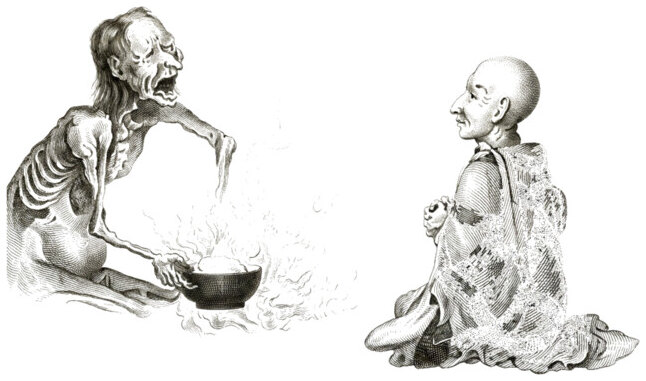
The story under the day comes from the Ullambana Sutra. Maudgalyayana, in Vietnamese Mục Kiền Liên, was the disciple of the Buddha most gifted in psychic sight. When his mother died he went looking for her with that sight and found her reborn as a preta, a hungry ghost: a starved figure with a swollen belly and a throat as thin as a needle, unable to eat. She had been, the tradition says, a greedy woman who mocked the monks and gave nothing away, and her rebirth followed from that.
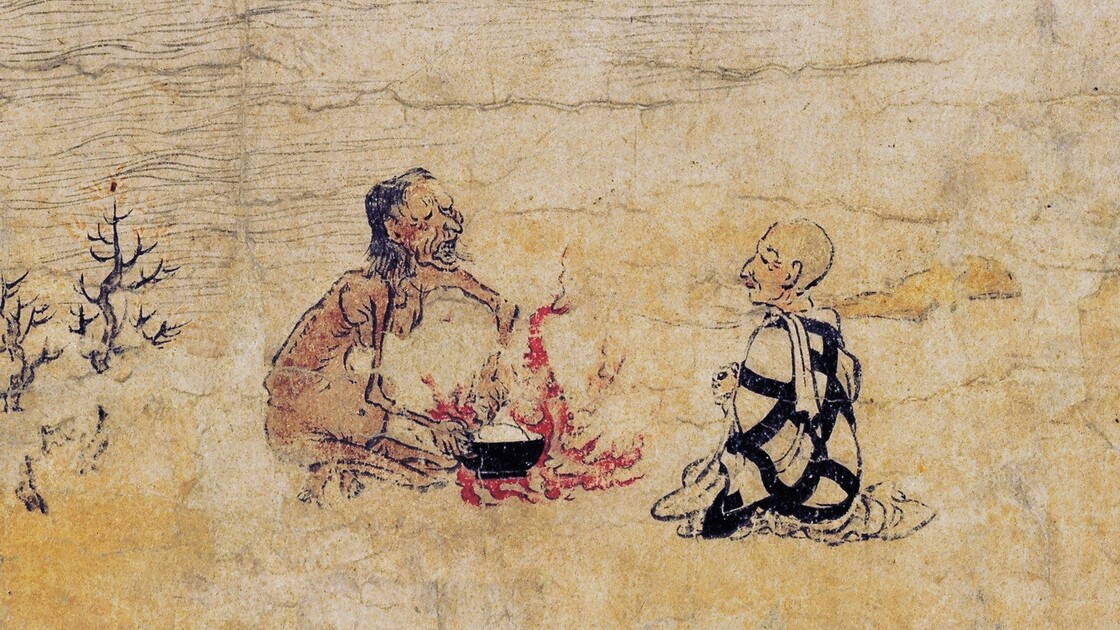
He brought her a bowl of rice. She snatched it and hid it from the other ghosts with one hand, and as she raised it to her mouth the food turned to burning coals. That scene, the gaunt mother reaching across the flames while the monk sits helpless before her, is the one Japanese painters set down in the twelfth-century Hungry Ghosts Scroll now in Kyoto.
Mục Kiền Liên went to the Buddha in grief. The Buddha told him that no single person’s power, not even his, could lift a karmic debt like hers. Only the pooled merit of the whole monastic community could reach her, offered on the fifteenth day of the seventh month, when the monks came out of their three-month rains retreat. He made the offering, and his mother was released. The Buddha added that anyone wishing to repay their own parents, living or dead going back seven generations, should do the same. That instruction is the festival.
The customs
The day is kept in two registers. Inside the pagoda and the home, families hold memorial rites for ancestors, many keep a vegetarian day (ăn chay), and the flower-pinning ceremony takes place. That ceremony, Bông hồng cài áo, is younger than the rest: the Zen teacher Thích Nhất Hạnh introduced it after writing an essay of that title in 1962, inspired by a flower custom he had seen in Japan. Red for a living parent, white for one who has died, with pink sometimes used for the loss of a single parent and yellow worn by monks and nuns, for whom the ties are meant to fall away.
Outside, the offering to the wandering souls (cúng cô hồn) is set on a tray in the open air, never indoors. It is deliberately humble: rice and salt, thin rice gruel (cháo loãng), puffed rice, fruit, sugar cane. The gruel is watered down on purpose, because a ghost with a needle-thin throat cannot manage solid food. Families burn votive paper (vàng mã), paper money, clothes and houses meant to reach the dead as goods, though whether that belongs in a Buddhist rite at all is argued over inside Vietnamese Buddhism itself.
Two acts of mercy round out the day. Phóng sinh, the release of captive animals, sends birds and fish back into the air and water to earn merit, and there are mass fish releases on the rivers. After dark comes thả hoa đăng, the floating of paper lotus lanterns, each with a candle and often a written wish, set adrift downstream for the dead.
The same fire under other names
Vu Lan is one branch of a much larger tree. The same Yulanpen Sutra and the same story of Maudgalyayana and his mother stand behind the Chinese Zhongyuan Festival — Hungry Ghost Day, where a Daoist layer of the “Middle Prime” grew over the Buddhist rite, and behind the Japanese Obon, where the dead are welcomed home for a few nights each summer. All three fall at the same point of the seventh lunar month, and all of them feed and remember the dead.
The date is not chosen at random. It is the end of Vassa, the monks’ rains retreat, marked in its own right as Pavarana, the day the community invites correction from one another. The retreat’s completion is what the sutra says makes the assembled monks’ merit strong enough to reach a ghost. Nearer to Vietnam, Cambodia keeps Pchum Ben in the same lunar season, feeding hungry ancestors at the pagoda with rice thrown into the pre-dawn dark. The motif of the starving dead who must be fed by the living runs under all of them.
The day now
Vu Lan is a working holiday in Vietnam now, kept by families who are Buddhist and by many who are not. The pagodas fill. After dark the rivers carry paper lanterns, and the outdoor trays of thin gruel go out for the ghosts nobody feeds the rest of the year. The flower-pinning, barely sixty years old, has become the part people photograph most. Nobody picks their own color, and by mid-morning the courtyard of every pagoda shows at a glance who in the crowd has already lost a mother.