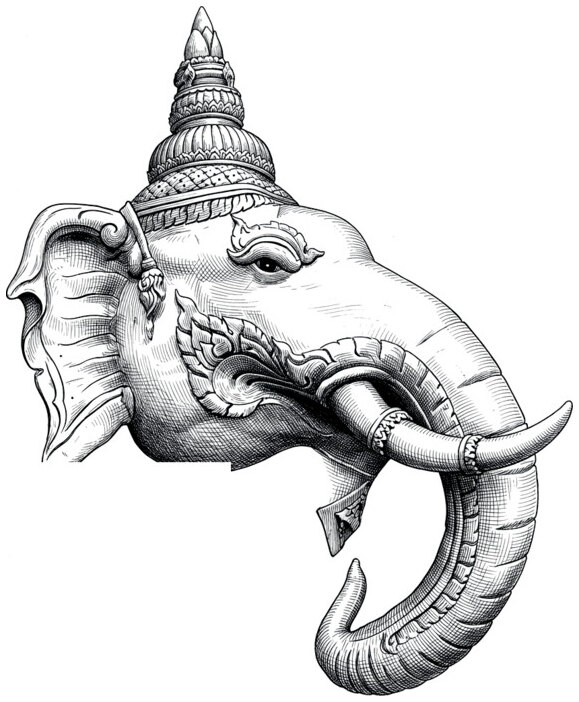
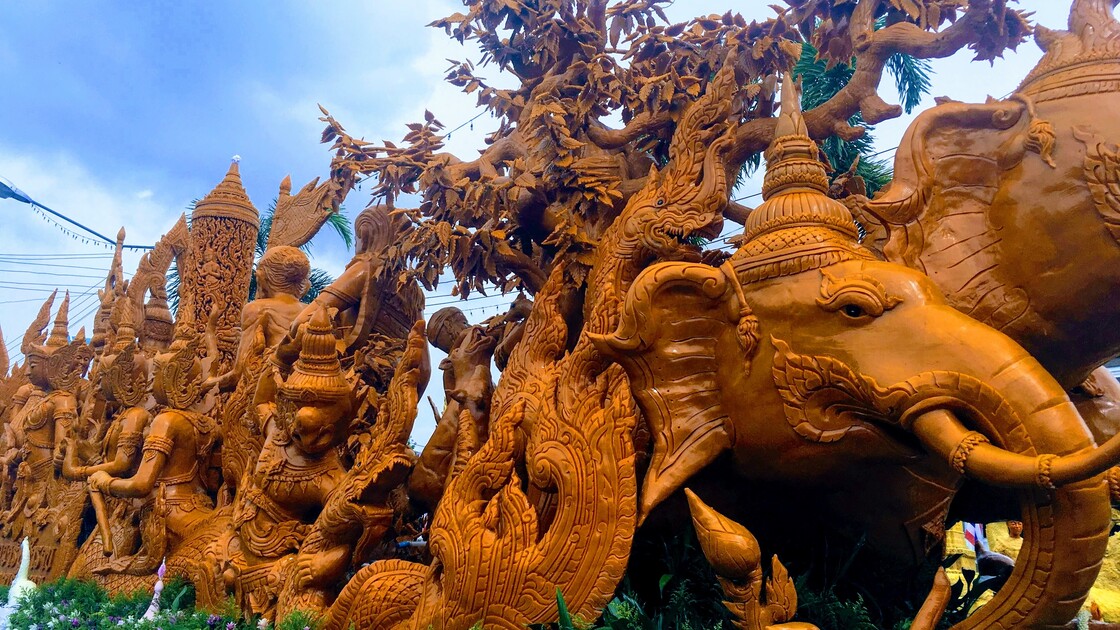
The candles that move through Ubon Ratchathani on the morning after the July full moon are the size of tree trunks, and the largest carry whole scenes sculpted in beeswax over cores of wood and plaster: a naga rearing at an elephant’s crowned forehead, figures out of Buddhist and Hindu mythology frozen mid-gesture. Each float represents a temple or an institution of the province, and teams of carvers work on them for weeks. They are called thian phansa, rains-retreat candles. The giant ones are never lit.
The full moon of the eighth month
Asalha Puja falls on the full moon of Asalha, the month the old Indian lunar calendar counts as the eighth, which usually lands in July. In Thailand the day is Asanha Bucha, in Sri Lanka Esala Poya; English-language Buddhist calendars often list it as Dhamma Day. Because the date follows the moon, it wanders through the civil calendar from year to year; in 2026 Thailand keeps it on July 29.
The day commemorates the Buddha’s first sermon. In the deer park at Isipatana outside Varanasi, at the site now called Sarnath, he taught the five ascetics who had once practiced austerities beside him. The discourse, the Dhammacakkappavattana Sutta, “Setting the Wheel of Dhamma in Motion,” names the two extremes of indulgence and self-torment, the middle way between them, and the Four Noble Truths. One of the five, Kondañña, understood it as it was spoken and asked to be received as a disciple. Theravada tradition counts that ordination as the birth of the monastic community, the moment the Triple Gem of teacher, teaching, and community stood complete.
The next morning the rains retreat begins. Thailand calls it Wan Khao Phansa, the day of entering the rains. For three lunar months, roughly July to October, monks stay inside one monastery. The Vinaya, the monastic law code, allows two entry dates: the day after the Asalha full moon, or exactly a month later for those who cannot arrive in time.
Candles, robes, and flowers
The candle came first out of plain need: a monastery holding still for three months of monsoon needed light in its halls and quarters, and in the centuries before electricity the laity supplied it at the retreat’s door. Thai tradition holds that the gift returns to the giver as clarity: donate light, and you are blessed with insight and a sharp mind. Out of that offering grew the carved giants of Ubon Ratchathani. A history published on the Thai government’s Thailand Now platform names the craftsmen who changed them: in 1939 the goldsmith Pho Songsri pressed wax through cement moulds of traditional patterns, Pradab Konkaew added cast wax figures recreating scenes from the Buddha’s life in 1954, and in 1959 Khamma Saeng-ngam became the first to cut figures directly into the candle itself. The bundled candles of the old processions turned into sculpture, and by the late twentieth century a judged competition had grown up around it.
Khao Phansa is also Thailand’s great ordination season. Men traditionally take robes for the length of the retreat, a temporary monkhood understood as moral training and as merit earned for their parents; the scholar-monk Phra Payutto describes it as the standard rite of passage before adult responsibility, though the Bangkok Post has tracked its decline in the cities. At Wat Phra Phutthabat in Saraburi province the day has a custom of its own, Tak Bat Dok Mai: devotees fill the monks’ bowls with dok khao phansa, a small flower that blooms just as the rains arrive.
A Theravada monk’s seniority is measured in rains rather than years: the number of vassa retreats he has kept since ordination. A monk of “five rains” has been five monsoons in the robe.
The same full moon opens the retreat across the Theravada world under different names. Myanmar keeps the full moon of Waso by offering robes to monks who are about to stop traveling. In Laos the day is Boun Khao Phansa, marked with candlelight processions, and Cambodians enter Chol Vossa by carrying enormous vossa candles to the temples, where the flame stands for the light of the teachings through the dark months.
The wheel that could not be stopped
The sutta itself gives the day its legend. When the Buddha finished speaking, the text says, the earth devas cried out that he had set in motion “the unexcelled Wheel of Dhamma that cannot be stopped,” and the cry passed upward, heaven by heaven, to the Brahma worlds, until the ten-thousand-fold cosmos shivered and quaked. The same passage records the human moment underneath the cosmic one: there arose to Kondañña “the dustless, stainless Dhamma eye: whatever is subject to origination is all subject to cessation.” “So you really know, Kondañña? So you really know?” the Buddha said, and the words became the man’s name: he was called Añña-Kondañña afterward, Kondañña-who-knows.
The retreat has its own origin story in the Mahavagga, the Vinaya’s narrative book, which records that householders complained about monks who kept walking tours going straight through the monsoon, “crushing crops and grasses, harming one-facultied life, and bringing many small creatures to destruction.” Even the wanderers of other sects settled down for the rains, the critics said. Even the little birds built nests in the treetops and stayed put. The Buddha heard the complaint and bound his monks to the rains-residence.
The older monsoon
The critics were pointing at something real: the monsoon pause is older than Buddhism. Wandering ascetics in ancient India already stopped traveling when the rains made the roads impassable and the ground thick with new life. Jain monks and nuns keep their own version to this day, a four-month stillness called Chaturmas, held in one place expressly so that the insects and shoots multiplying in the wet season are not trampled. Hindu tradition keeps a Chaturmasya of the same length, beginning when Vishnu is said to enter his cosmic sleep; weddings pause, and ascetics traditionally stay where they are until the god wakes. The Hindu observance has its own page in this calendar, Chaturmas (Four Sacred Months).
The day today
Asanha Bucha and Wan Khao Phansa are public holidays in Thailand, and both belong to the five Buddhist holy days on which the sale of alcohol is banned nationwide for the full 24 hours, a rule in force since 2009 under the Alcoholic Beverage Control Act. Falling back to back, they make an annual two-day dry stretch in July. Many Thai laypeople extend the spirit of it across the whole retreat and give up alcohol, meat, or cigarettes for the three months, which is why the period is casually called Buddhist Lent, a borrowed label some Buddhists point out fits badly.
Selling a drink in Thailand on Asanha Bucha or Khao Phansa carries a penalty of up to six months in prison, a 10,000-baht fine, or both. Recent amendments exempt only a narrow list of venues, such as international airport terminals.
The retreat that begins on this full moon has its own ending built in. Three months later the monks sit for Pavarana, the invitation day on which each monk asks the community to point out his faults, and the season closes with Ok Phansa, when the towns along the Mekong send illuminated boats downstream after dark.