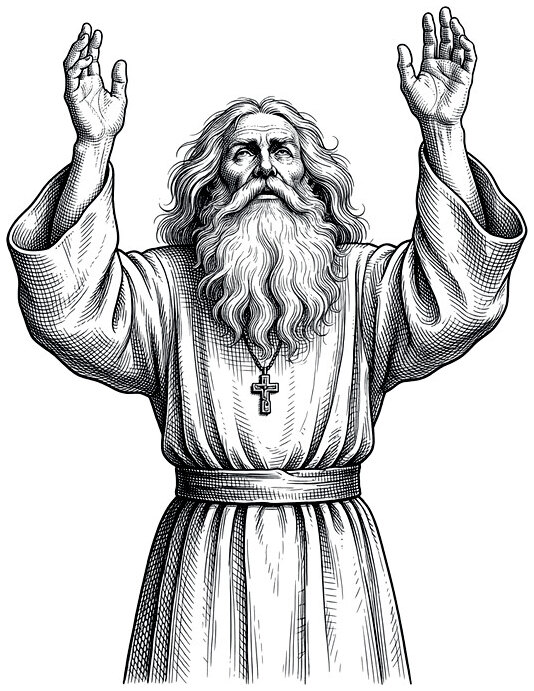
“Holy dziady, we call you, come to us! Here is everything God gave, what I have offered for you, everything the house is rich in. Holy dziady, we ask you, come, fly to us!”
A householder in the Minsk region of Belarus said these words at the table after sunset, once he had lit a candle before the icons and the family had prayed. Then he poured a little vodka onto the tablecloth, and a little of every dish went into a separate bowl that was set on the window sill or outside the window. The guests he was calling were the family’s dead. The Polish ethnologist Adam Fischer printed the words in 1923, in his survey of the feasts of the dead across Eastern Europe, taking them from the Polish folklore journal Wisła.
Supper for the forefathers
Dziady means “grandfathers” or “forefathers.” In Belarus the word named three things at once: the souls of the dead ancestors, the days on which they were fed, and the food cooked for them. The custom was kept in Belarus, Ukraine, eastern Poland and parts of Lithuania, and it was never a single day. In 1895 the Belarusian ethnographer A. E. Bogdanovich counted four memorial suppers a year: one in late winter, one after Easter, one on the eve of Trinity Sunday, seven weeks after Easter, and one in autumn. People believed, he wrote, that the dead needed food and drink, though rarely, and that three or four meals a year were enough for them.
The autumn supper was the great one. Orthodox villages kept it on the Saturday before the feast of St Demetrius of Thessaloniki, an early Christian martyr, whose day falls on 8 November in the everyday calendar, so in 2026 the Saturday is 7 November. Catholic families joined their Dziady to All Saints’ and All Souls’ Days on 1 and 2 November, and Belarus today marks its official day of remembrance on 2 November. The poet Adam Mickiewicz had already noticed the overlap in 1823, when he wrote that “All Souls’ Day falls around the time of this ceremony.”
Laying the table
Bogdanovich describes the day as solemn, with everyone “full of expectation of something mysterious.” Talk turned to the dead, to their habits and tastes. If a bird landed on the window, people took it for the soul of someone who wanted something from the family, and old men who already kept a shirt ready for their burial read it as a sign of their own end. The hut was cleaned “as if to receive dear guests.”
Late in the evening the table was covered with a white cloth, and bread, salt and kutia were set on it. Kutia is a wheat porridge, and the family prayed for the dead before a candle. Then the host went out of the door and called the dziady in to share the meal, which could run to seven dishes. After each spoonful the family laid their spoons down so that the dead could take theirs, and because there might be more dziady than spoons, a share of every dish was set aside. Nothing was cleared away afterwards, “so that the dziady have something to eat when they gather in the night.”
The details changed from district to district. Along the Svislach river the supper was held for “all the souls, kin and not kin, who died in this hut,” so a family that moved into a house where Dziady had been kept had to go on keeping them, or misfortune would follow. On the edge of the Białowieża forest, on today’s border with Poland, the host opened the window to call the dead in, and the housewife cooked only the dishes they had liked; nobody might eat from them before the supper, and when she tasted, she spat on the ground. In the Mozyr district in southern Belarus each person put the first bite of every dish into a separate bowl, and after supper the bowl was carried to the cemetery. Around Vilnius, today the capital of Lithuania, the head of the family named every dead relative in turn and after each name threw a small pancake under the table. A creaking door, the wind knocking at the window or a winged insect meant the guests had come. Weaving was forbidden that day, because “the dziady will get tangled in the loom.”
Sending them away
The supper ended with a dismissal. In the Minsk region the host said: “Holy dziady! You flew here, drank and ate, now fly back home! Say what more you need, but better fly to heaven: a kysz, a kysz, a kysz!” A kysz is the call people use to shoo away birds. The leftovers went to beggars, who in Poland and Belarus were often called dziady themselves and were asked to pray for a family’s dead in return for food. Then the candle was put out with a crust of bread or a pancake, and everyone watched the smoke rise. A straight plume meant all was well; one bent toward the door foretold a death in the family.
The dismissal is older than any of these village records. Around 1551 Jan Malecki, a Protestant pastor in Lyck, a town in the Duchy of Prussia that is now Ełk in north-eastern Poland, described in a letter the memorial meals held on the third, sixth, ninth and fortieth day after a funeral. The kin invited the dead person’s soul by praying in front of the door, then sat at the table in silence, “as if mute,” without knives, and threw something of every dish under the table to feed it. Whatever fell to the floor was left for the “deserted souls” that had no living relatives to feed them. After the meal the man who led the rite swept the house with a broom and drove the souls out “like fleas,” saying, in Malecki’s Latin: “You have eaten, you have drunk, souls, go out, go out.” Fischer noted that earlier scholars took this for an old Belarusian rite, and that it could just as well describe Lithuanian and Prussian ones, because all these peoples then kept very similar customs.
In the Vilnius region the word called out after each dead relative’s name was chautury. The Polish scholar Jan Karłowicz, writing in a Warsaw encyclopedia, traced it to the Latin chartularium, the list of the dead that the priest read aloud at the memorial service.
The poet in the chapel
In 1823 the Polish poet Adam Mickiewicz, who was born near Navahrudak in what is now Belarus, published a play in verse under the title Dziady, and its preface explained the name. It was a ceremony “still kept among the common people in many districts of Lithuania, Prussia and Courland,” the Baltic coast north of Lithuania, “in memory of the forefathers.” In old times, he wrote, the rite was led by a man called the Guślarz, the village sorcerer, “priest and poet at once.” Because “the enlightened clergy and the landowners” had tried to root it out, people now kept it in secret, “in chapels or empty houses near the cemetery.” He added that the songs and charms of his poem were “for the most part faithfully, and sometimes word for word, taken from folk poetry.”
The second part of the drama stages one such night. The Guślarz orders the chapel doors shut, with no lamp or candle and cloths over the windows so that the moon cannot shine in. He calls up three kinds of souls. Two dead children ask for two grains of mustard: “who has never once tasted bitterness will not taste sweetness in heaven.” The ghost of the village’s former lord appears at the window, starving, and the owls and ravens around him snatch every crumb offered to him. They were once his servants, people he let go hungry, and one of them is a woman he had thrown out into the snow with her child on Christmas Eve, where both froze. A shepherdess, Zosia, who died at nineteen without ever loving anyone, drifts on the wind and can “neither rise to heaven nor touch the earth.” The Guślarz sends each of them off with the sign of the cross and the words “A kysz, a kysz!”, the same words the householders of Minsk used to end their supper. When Fischer compared the play with the village records a century later, he found that Mickiewicz’s version agreed with them.
Across traditions
Mickiewicz himself thought that feeding the dead “seems to be common to all pagan peoples,” and named Homeric Greece and Scandinavia. Closer neighbours kept the same supper under other names. In Samogitia, in western Lithuania, the feast of the dead was called Ilgės, and according to Jan Łasicki, a Polish writer of the sixteenth century, the Samogitians invited their dead from the graves to the bathhouse and to the feast, preparing as many stools and shirts as they had invited guests. Lithuanians now observe the feast on 2 November, called Vėlinės. In eastern Lithuania food was laid on the graves on the evening of All Saints and left there overnight, and only the next day was it eaten and shared with the poor. A stranger who knocked on the door that night was received well, because he might be a messenger of the souls.
Serbs keep the same Saturday before St Demetrius as Mitrovske zadušnice, one of the Orthodox soul Saturdays on which families take candles and food to the graves; another of them is described in Miholjske Zadušnice. How a Polish school staged Dziady against Halloween is told in Halloween Comes Home.
The day today
In Belarus the day of the dead became, in the late 1980s, also a day to remember the victims of the Soviet regime. In 1987 two Belarusian cultural associations, Tutejshyja and Talaka, held Dziady in a park in Minsk. A year later, on 30 October 1988, thousands of people marched to Kurapaty, a forest on the edge of the city where people had been shot in the 1930s under the Soviet leader Joseph Stalin, after Zianon Pazniak and Yauhen Shmyhalyou had published an article about the site called “Kurapaty, the Road of Death.” The authorities broke up the march with gas sprays and arrests. Dziady became a day off in the 1990s and lost that status in 1996, because, as the Belarusian journalist Ryhor Astapenia wrote, people connected it with the struggle against Communism. Marches to Kurapaty have been held on Dziady every year since, often against the authorities’ resistance, and Astapenia records one more detail from the first of them: it was on Dziady 1988 that people raised the white-red-white flag of the short-lived Belarusian People’s Republic of 1918 for the first time in Soviet Belarus.