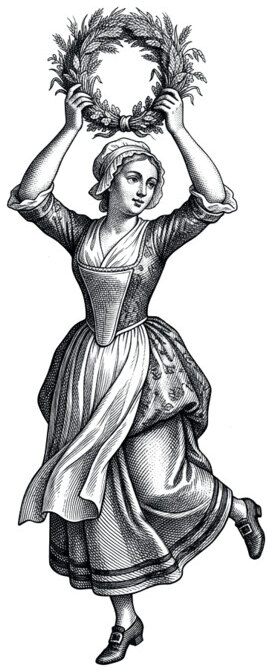
The best reaper, usually an unmarried girl in her Sunday clothes, carried the round harvest wreath ahead of the procession. Behind her came the reapers with scythes and sickles tied up in flowers, and the whole column sang as it walked: Plon niesiemy, plon, w gospodarza dom, we carry the crop to the host’s house. At the gate the boys threw water on the girl and the wreath, a charm to bring rain for the next year. The host laid the wreath on the table and danced the first dance with the wreath-bearer.
That is the dożynki, the harvest-close of the West Slavs. Polish country people still call it by old local names, wyżynki, wieńcowe, okrężne, the last from the custom of riding round the fields when the reaping ended. The name dożynki comes from dożynać, to finish the cutting. The festival has no fixed date; it happens when the last field is cut, any time from mid-August into September. The Czechs and Slovaks keep the same day as dožínky or dožatá, and the wider Slavic family knows it as obzhynky in Ukraine and Russia, dazhynki in Belarus.
The centre of it all is the last of the grain. Reapers left a tuft of standing stalks in the field, tied and decorated, and laid a piece of bread underneath. They called it the przepiórka, the quail, or the broda, the beard; the last handful stayed for the quail itself. Then they grabbed the farmer and dragged him three times round the tuft. The wreath was woven from those same last ears, one kind of grain for every crop the farm grew. Apples and rowan berries hung from it on a linen cord, and the whole was bound with ribbon. In old times a rooster or a duck was bound in the middle as an offering. The shape followed the region: a round sun in central Slovakia and Moravia, a great crown in western Slovakia, a bell further west.
The wreath went first to the church to be blessed, then to the farm. The girl who carried it spoke a rhymed verse at the door; one Moravian version promises the farmer as much fodder as ears, as many measures as grains. The feast ran to dawn at the host’s cost. Afterward the wreath was kept in the house or barn until the next sowing, and its fallen grains went into the seed corn. A year later the frame was burned.
The tuft left in the field was called przepiórka, Polish for quail. Reapers sang to it: “oj, przepiórecka w życie, ludzi nawołuje,” the quail in the rye calling the people to the harvest.
Under the ceremony sits a belief the whole grain-growing world once shared: the crop holds a life that shelters in the last sheaf. Czechs tied the leftover stalks into shapes they called the grandfather’s beard and the doll. They dressed the last sheaf in clothes and gave it names, the old woman, the bride, the beggar, and kept it under the ceiling beam until spring, when its grains went into the seed.
The oldest recorded form of the feast comes from the Baltic island of Rügen. There the Rani tribe kept the great temple of Arkona for the four-headed god Svetovid. Saxo Grammaticus, writing around 1200, described the yearly rite after the harvest. A cake made with honeyed wine, round and nearly the height of a man, was brought to the sacrifice. The priest set it between himself and the people and asked whether they could see him; they could. He wished that after a year they would not be able to see him from behind it, the next cake so large it hid him. Saxo notes that the priest’s prayer concerned only the harvest and the increases of the coming year. The god’s drinking horn was filled with mead each year; if some had vanished overnight, famine was foretold and the harvest was saved. In 1168 the Danes took Arkona, where they toppled the idol and burned the temple.
Frazer’s Golden Bough collected the same last-sheaf spirit across Europe. Near Danzig the last ears became a doll called the Corn-mother or the Old Woman. Holsteiners dressed the last sheaf in women’s clothes and drenched it with water as a rain charm. The Polish thresher who gave the last stroke was wrapped in corn and wheeled through the village as the baba. In Lithuania the reaper was said to have cut off the boba’s head. Saint Eligius, preaching in Flanders in the 600s, already scolded the heathen for their vetula, the old woman of straw.
Other grain-growing peoples gave the same thanks in late summer. The Celts opened it at Lughnasadh / Lammas. The church doors opened at the harvest-close too: Poles had their wreaths blessed on the Assumption of Mary in August, and Orthodox Slavs folded the feast into Velika Gospojina, the Dormition, which the Belarusians called the first feast of the Most Pure One.
In 1927 president Ignacy Mościcki turned the dożynki into a national ceremony at Spała. The Dożynki Prezydenckie has run, with interruptions, ever since.
Poland still keeps the dożynki at every level, from village to province, and the wreath is still the point of it. Farmwives’ circles weave it in the old way, and ethnographers judge it in competitions. In 2026 the two national festivals fall on September 6 at Jasna Góra in Częstochowa and September 13 at Spała, where the wreaths are carried to a field mass and blessed. The grain in those crowns goes back into the spring sowing.
