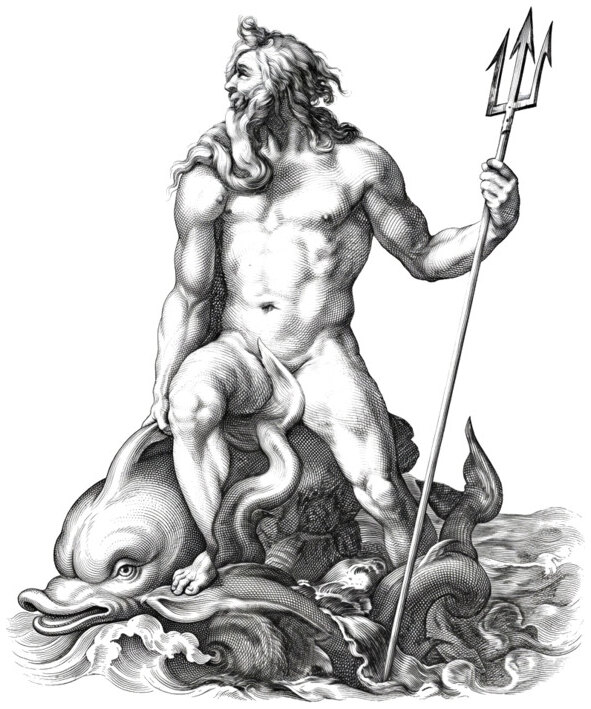
On 23 July, in the worst of the Roman summer, people left the city for the wood along the Tiber and built themselves huts out of leafy branches. They called the huts umbrae, shades. Inside them they drank spring water and wine and stayed out of the sun. This was the Neptunalia, the feast of Neptune, and it fell in the week of the year when there was least water to give thanks for.
What the day is
The Neptunalia was the feriae, the fixed holiday, of Neptune, Rome’s god of water. The antiquarian Varro, writing in the first century BCE, gives the date as the tenth day before the Kalends of August, which is our 23 July. On the old calendars the day was marked Nept. ludi et feriae, Neptune’s games and his holiday, so there were public games as well as a day off work. It also counted among the dies comitiales, the days on which the citizen assemblies could lawfully meet and vote.
For most of the year Neptune kept a low profile in the city. He had a single temple, near the Circus Flaminius in the southern Campus Martius, standing since at least 206 BCE. The festival was one of the few times the god of water came fully into public view, and it came at the moment Rome most needed him.
Neptune was also a god of horses. His Greek counterpart was worshipped as Poseidon Hippios, lord of horses, and Romans knew Neptune under the title Neptunus Equester, the Horseman, invoked at the races.
The customs
The distinctive thing people did was build the umbrae. The grammarian Festus records these as shelters made of branches and foliage, thrown up for the day. Later sources place the outings in a grove between the Tiber and the Via Salaria, the road that ran north out of Rome, where people escaped the heat, drank the cold spring water and mixed it with wine.
We have the mood of the day from a poem. Horace opens the twenty-eighth ode of his third book with a question a Roman would have understood at once: Festo quid potius die Neptuni faciam?, what better could I be doing on Neptune’s feast day? His answer is to send for a jar of old Caecuban wine and his companion Lyde, and to spend the afternoon on hymns to Neptune and the sea-nymphs until evening comes. It is a small private scene, a poet drinking through the hottest part of the year, and it is probably closer to how most Romans spent the Neptunalia than any grand rite would be.
Why a water god in the dry season
A festival of the water god held in the driest, hottest week of the year reads oddly, until you look at which water Neptune first ruled. The earliest Neptune seems not to have been a sea god at all. Servius, the late commentator on Virgil, calls him the god of rivers, springs and waters, and the likeliest reading is that he began as a deity of fresh water, of the springs and groundwater that fed the wells and the fields. Honoring him in late July was a way of pleading with the source that was failing: keep the springs alive through the canicula, the dog days, when the rivers ran low and the crops burned.
The calendar makes the point on its own. The Neptunalia sat inside a short run of midsummer festivals all turned toward water and drought. The Lucaria, festival of the grove, came a few days before it, and the Furrinalia, feast of the old spring-goddess Furrina, followed on 25 July. The scholar Georges Dumézil read the three together as Rome’s response to the high-summer crisis of water.
Neptune’s companions belonged to the same idea. His consort Salacia and the goddess Venilia were both figures of water, and Dumézil took Salacia to stand for the surging, overflowing kind and Venilia for the still or slow-moving kind. Between them they covered the water a farmer prayed for and the kind he feared.
Across traditions
The Neptune most people picture, the bearded king with the trident riding the waves, is largely borrowed. In 399 BCE Rome held a lectisternium, a ceremony that laid out couches and food for the gods, and brought in several Greek deities under Roman names. Poseidon arrived as Neptune. After that the vast Greek mythology of the sea god was grafted onto the older Italian water spirit, until the sea swallowed the springs and the freshwater god was half forgotten under it. Rome’s own Neptune and the Greek Poseidon became, for most purposes, one god with two names.
One possible survival runs south, across the sea, to Tunisia. The coastal city of Sousse holds a summer carnival called the Awussu, a parade of decorated chariots and folk troupes by the beach in late July, and some accounts trace it back to a Neptunalia kept in the Roman province of Africa, perhaps over even older Phoenician sea rites. The link is disputed. Others read the name Awussu as a North African word for the August heat rather than a form of Latin Neptunus, and no surviving text ties the modern carnival to the ancient feast.
The day today
The Roman festival ended with the temples. What keeps 23 July on any calendar now is revival. Reconstructionist groups who practice the old Roman religion, the Religio Romana, mark the Neptunalia with offerings and games, and every so often someone reads Horace’s ode aloud on the day it describes. The plainest way to keep it needs no group at all. It is the oldest instruction the festival carries: on the hottest day of the summer, find water and shade, and stay out of the sun.
