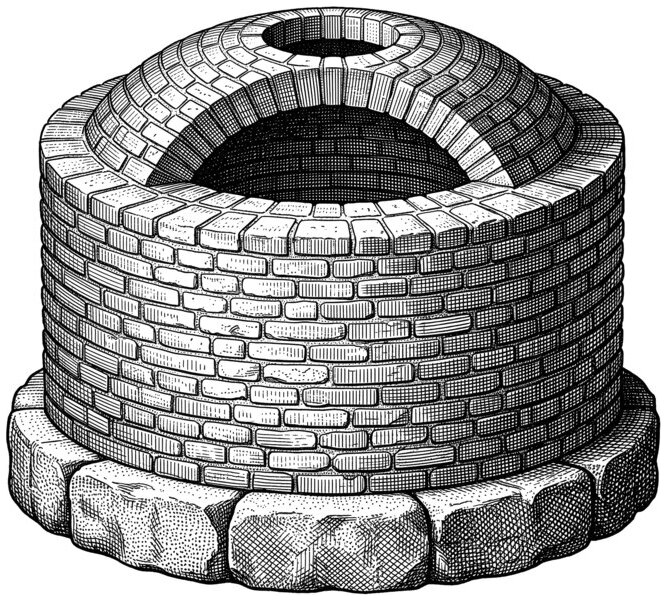
On the morning of August 24, someone in the Roman Forum lifted the stone off a round pit, and Rome changed how it behaved for a day. The formula that went out was short: mundus patet, the mundus is open. The pit was a vault in the earth, and the Romans called it the gate of the underworld. While it stood open, no one joined battle and no one took a wife; the dead were out.
What the day is
The mundus was one of the oldest things Rome kept. Festus, quoting the jurist Cato, says it took its name from the world above us, because its vault mirrored the dome of the sky. It stood open three times a year: August 24, October 5, and November 8. The first opening fell the day after the Vulcanalia, the fire festival Rome kept on August 23. Macrobius, quoting Varro, put the reason in one sentence: when the mundus is open, the door of the sorrowful gods of the underworld stands open.
The customs
Varro’s ban was exact. When the mundus stood open, the Romans held it religiously forbidden to join battle or to take a wife, and the same ban covered setting sail and calling up the army. The Romans classed the three days as dies religiosi, restricted days the city observed out of care; the courts stayed open.
What went into the open pit was the first of the harvest. Rome gave first-fruits to the dead, and the dead, so the belief ran, walked lawfully among the living. The opening was one of the few official moments the city dealt with its collective ancestors, the di Manes. The other two were the Parentalia in February and the Lemuria in May, both of which have their own pages.
The traditional date of the eruption of Vesuvius in AD 79 is August 24, the day the mundus stood open.
Legends & beliefs
The pit reached back to the founding. Plutarch says Romulus dug a circular trench with the help of Etruscan ritual men, at the place that later became the Comitium. Into it went first-fruits of everything good, and every settler threw in a handful of earth from his own homeland. Ovid gives the same scene: a trench dug to solid ground, first-fruits and homeland earth thrown in, and above it all an altar with a newly lit hearth. The word mundus, Plutarch noticed, was the same word the Romans used for the sky.
The stone that sealed the pit had a name of its own. Festus calls the stone lapis manalis and the pit ostium Orci, the gate of Orcus, whom our compendium keeps as Pluto. The same name, oddly, belonged to a second stone the priests carried out in drought to make rain. Warde Fowler, who studied the Roman festivals a century ago, thought the confusion started somewhere plainer: the mundus, he argued, began as a pit where a new city stored its seed corn, hidden from raiders. The underground altar of Consus, opened for the Consualia a few days earlier, points the same way. The three open days fit the reading: August 24 comes after the harvest and before the feast of finished storage, the old spelt went into the ground on October 5, and November 8 falls just before the Pleiads set, the sign for sowing wheat. On this reading the ghosts arrived later, when the city had outgrown its fields and a plain seed-cellar came to be read as a gate of the underworld. Fowler left the question open. He noted that the beginning of November is a great time for ghosts in many parts of the world, and that seed corn and first-fruits keep touching the dead across cultures.
Across traditions
Athens gave its dead an open season too: the three days of the Anthesteria let the souls walk abroad. The first day was called Pithoigia, the opening of the jars. A. W. Verrall read that name as an opening of grave-jars. The Greek word pithos could name a wine jar or a burial urn, so the dead, to his reading, were the ones coming up when the lids came off. He compared the festival directly to the mundus patet. Jane Ellen Harrison went further: the pithos, the jar Pandora opened on the world’s evils, was also a burial urn, and taking the lid off it was like lifting the stone off the mundus. The same season’s underground holes show up in the Greek Thesmophoria, where women lowered pigs into clefts and later mixed what came up with seed to make the crops grow.
Jane Ellen Harrison read Pandora’s jar as a burial urn. The pithos could mean a grave-jar, and opening it was like lifting the stone off the mundus.
The day today
A trace of the mundus survives in the Forum. The Umbilicus Urbis Romae, a circular brick drum beside the Arch of Septimius Severus, is the spot scholars point to as the above-ground part of the old pit. It looks like what it may well have been: the squat, hollow mouth of a cellar or a well. The stone that used to seal it is long gone, but the date kept its place in the record. August 24 still marks the first of the three, and the mundus stays shut until October.
