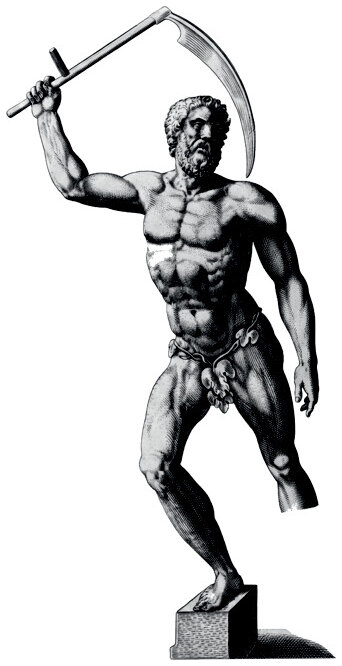
On the twelfth day of the first month of the Athenian year, a master might carry the food to the table and set it down in front of his own slaves. The Roman playwright Accius, writing about the custom, said that across the fields and the towns people held banquets and each man waited upon his servants. In the streets the slaves were let loose to run and shout, released from work for the day. This was the Kronia, and for those hours the order everyone lived under the rest of the year was simply switched off.
What the day is
The Kronia was an Athenian festival in honor of Kronos, the Titan who fathered Zeus and who ruled before the Olympian gods. It fell on the 12th of Hekatombaion, the opening month of the Attic civil calendar. That calendar was lunar, so the month began with the first new moon after the summer solstice, which puts the festival in late July or early August by our reckoning. The date drifts from year to year the way Easter does, and modern revivers still tie it to the moon rather than to a fixed square on the Gregorian grid.
It was a public holiday in the plain civic sense. In his speech Against Timocrates, the orator Demosthenes mentions in passing that the Council of Athens stood adjourned because it was the Kronia, and that a rival exploited the recess to push a law through while the normal machinery was closed. The detail is almost more useful than a description of a rite: the Kronia was the kind of day when Athens stopped.
It also sat at the end of the grain harvest. Kronos was shown holding a reaping hook, and the festival read as a harvest-home, the sickle laid down once the year’s cereal was in. Beyond these days there is not much sign of a standing cult of Kronos in Attica. He had a sanctuary he shared with Rhea near where the temple of Olympian Zeus would later rise, but for the most part he came out once a year, for this.
In parts of Ionia the whole month was named after the festival: not Hekatombaion but Kronion, the month of Kronos.
The reversal
The custom everyone remembered was the meal. Slaves and free citizens, rich householders and poor ones, sat down together and ate as equals, and played games. This was not a gesture of kindness toward the poor. For the length of the festival the categories that ran daily life were simply treated as if they did not apply.
We should be careful about how far this went. Athens did not free its slaves on the Kronia, and the next morning the household was a household again. What the sources describe is a licensed holiday from the rules, the sort of controlled inversion that societies build into their calendars precisely because it is temporary. The shouting in the streets and the master handing over the dish were permitted for a day because everyone knew the day would end.
The Golden Age underneath
The reason given for all this was a story about time. The Greeks held that Kronos had once ruled over a golden race of humans who lived, in Hesiod’s words, “like gods without any care in their hearts, free and apart from labor and misery,” while the earth gave up its fruit on its own. There was no work in that age because none was needed, and there was no master and no slave because there was nothing to compel. Then Kronos was overthrown, the ages of the world declined, and labor and hierarchy came in with them.
The folklorist William Hansen calls the Golden Age “a period of thorough harmony in which hierarchical, exploitative, and predatory relationships were nonexistent.” That is what the Kronia reached back to. Turning the household upside down for a day was a way of standing, briefly, inside the lost age of Kronos, when the arrangement being suspended had not yet been invented.
Across traditions
Greek writers looked at Rome’s Saturnalia and saw their own festival. Saturn was Rome’s Kronos, an old god of agriculture and the vanished Golden Age, and his December holiday ran on the same logic: slaves dined first while masters served, gambling was allowed, the ordinary rules went quiet. Ancient authors used the two names almost interchangeably.
It is tempting to draw a straight line and call the Kronia the parent of the Saturnalia, and popular retellings often do. The truth is looser. Saturn was a native Italic god with his own temple in the Roman Forum long before Greek learning shaped how Romans wrote about him, so the safer reading is that these were cognate festivals, two versions of the same midsummer-or-midwinter release that the ancients themselves recognized as one idea under two gods. The reversal did not have to be borrowed. It grew from the same seed.
Not every face of Kronos was gentle. On Rhodes a festival of the same name fell in a different month, and the philosopher Porphyry records that it had once involved the sacrifice of a condemned criminal, led out and killed. The god who presided over the kindly banquet in Athens was, elsewhere, the god who ate his own children in the myth. The Kronia held both.
The day today
The festival never became a Christmas the way the Saturnalia arguably fed into one. It stayed an ancient midsummer rite and then, with the temples, it stopped. What keeps it in the present is revival. Modern Hellenic polytheists mark the Kronia on 12 Hekatombaion with a small offering to Kronos, a reading from Hesiod, and the Orphic Hymn to Kronos, which asks the old Titan, father of the blessed gods, to bring a blameless end to a life. For one lunar day a year, someone still sets down food for the old Titan and reads Hesiod’s lines about the age when no one had to.
