On the twenty-first of August the earth was cleared away from an altar that lived underground. It stood near the first turning post of the Circus Maximus racetrack, buried for the rest of the year. It belonged to Consus, the god of the stored harvest, and this was the one day when he came up into the light.
What the day is
Consus watched over the grain once it was cut and put away. His name most likely comes from condere, to store. The festival came twice a year, on August 21 after the harvest and on December 15 after the sowing. The ancients quarreled over his name. Some derived it from conserere, to sow, which is why the goddess Ops carried the title Consivia. Others derived it from consilium, counsel, because his altar hid in the earth like a secret. Varro favored the counsel connection, but he kept the plainest fact in one line: Consualia dicta a Consus, the Consualia are named after Consus.
The August festival and the December festival bracketed the farmer’s year: the first came after the grain was in, the second after the seed was sown. The Vulcanalia fell two days after the August Consualia, and the festivals of the goddess Ops followed his by a few days in both seasons.
The altar under the earth
The altar of Consus sat underground at the first turning post of the Circus Maximus, and only on his festival days was the soil removed and the altar exposed. Tertullian, the early Christian enemy of the games, records an inscription on it: Consus consilio, Mars duello, Lares coillo potentes, Consus mighty in counsel, Mars in war, the Lares in the crossroads. Modern scholars doubt it was ancient at all. Wissowa, the historian of Roman religion, said the report was not free of suspicion.
Consus had no priest of his own. The sacrifice on August 21 was offered by the Flamen Quirinalis, the priest who tended the cult of the deified Romulus, with the Vestal Virgins present. Warde Fowler, the scholar of Roman festivals, read the lack of a priest as the sign of a god whose altar stayed underground and opened once or twice a year. Later Rome built a temple to Consus on the Aventine, but the buried altar in the circus remained the older home of the cult.
Why the earth
The likeliest answer is one the Romans themselves lived by: they stored grain in the ground. Varro describes underground granary caves called siri in Cappadocia and Thrace, and pits in Spain where wheat kept for decades, sealed away from air and weevils. The buried altar reads as a memory of that practice, a god who lived where the harvest lay. Warde Fowler offered a second reading: sacrifices to the gods of the underworld were sometimes buried, and a god kept underground was rich, since wealth at the time meant stored grain.
The races and the garlands
The day was a festival of animals and speed. Horses, mules and asses rested from work and were led out crowned with garlands of flowers. Chariots and horses raced in the Circus Maximus, and there was a race of mules as well, because, Festus says, mules were believed to be the most ancient beasts of burden. The calendar note for the day is fragmentary but vivid: a holiday for Consus, horses and mules crowned with flowers because they stand under his protection.
The old calendar note ends with a small regal detail: itaque rex equo vectus, and so the king rode a horse. On the day his working animals rested, the state’s own rider took part in their festival.
The abduction
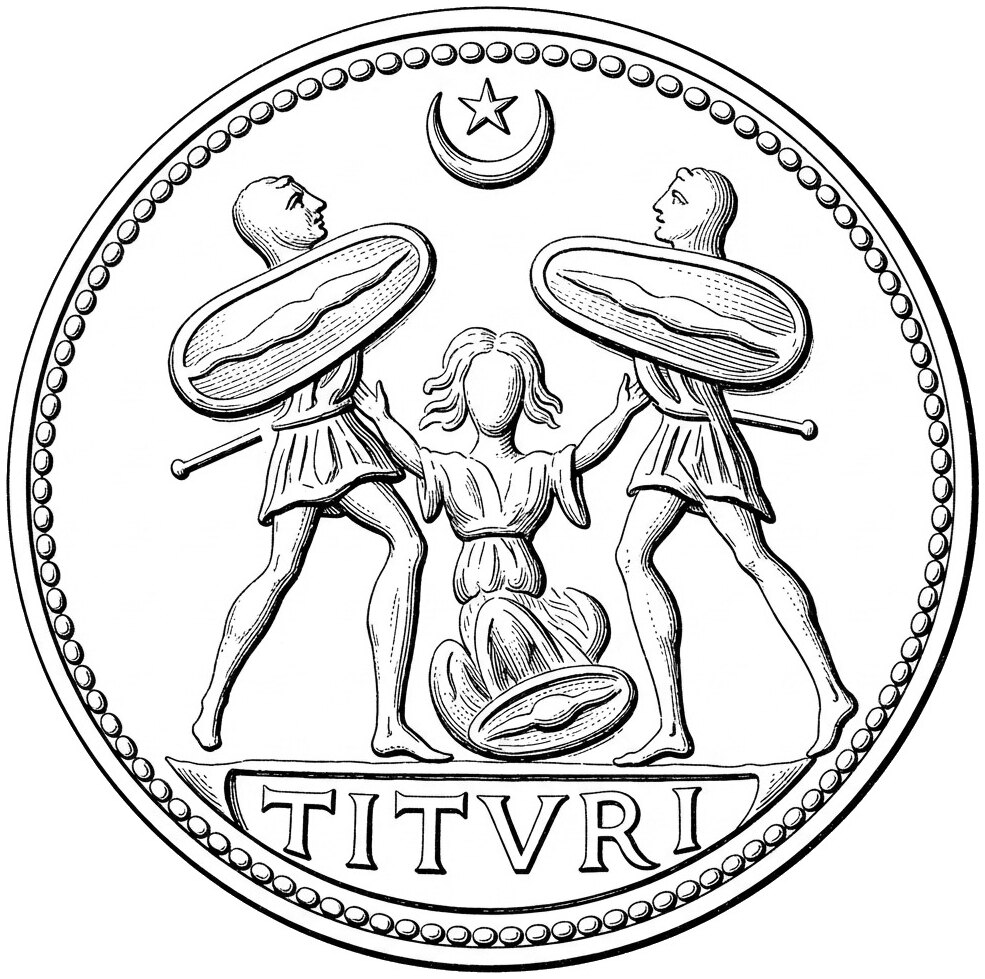
There is a darker story attached to this festival. The Romans said their city began its families at the Consualia. Livy tells it: Romulus, whose new city had no women, made ready solemn games in honor of the equestrian Neptune and called them Consualia, then invited the neighbors. The Sabines came with their wives and children. At a signal the young Romans seized the maidens. Plutarch adds that Romulus first spread word of an altar of a god hidden underground, and that the signal was the king rising and folding his cloak, then throwing it around him again.
The numbers differ, as they do in old stories: thirty women, some said, and that gave the thirty Roman wards their name; Valerius Antias counted five hundred and twenty-seven; Juba six hundred and eighty-three. One married woman, Hersilia, was taken by mistake. And when a group of Romans was asked where they were carrying one beautiful girl, they shouted the name of their leader, Thalassius, the origin of the wedding cry.
The Romans kept the memory in their own wedding rites. The bride was lifted over the threshold of her new house, Plutarch says, because the Sabine women had been carried in by force. Her hair was parted with the head of a spear, in memory that the first marriages had been concluded with war and fighting. Warde Fowler read the legend more gently: the story may preserve the real jollity and license of harvest festivals, when neighboring peoples met and found wives. He cites Frazer’s Golden Bough on the license that gathers around the end of harvest.
Across traditions
Greek writers saw their own gods in the festival. Livy and Plutarch both identify Consus with Poseidon Hippios, the horse god, and the horse races were the visible link. Dionysius of Halicarnassus records that some ancients explained the underground altar by saying Consus was Poseidon, the god who shakes the ground from inside the earth.
The underground seed is a wider story. At the Thesmophoria, the Greek women’s festival of Demeter, women cast piglets and cakes of dough into underground chambers, and the decayed remains were brought up the next year and mixed with the sowing seed to make the fields bear. The Greek rite and the Roman one differ in almost everything except the image at the center, the seed that goes down into the earth before it can come up. The Romans gave Consus a companion in the grain, the goddess Ops, whose festivals followed his in both seasons and whose December feast fell during the Saturnalia.
The day today
The Consualia died with the Roman religious calendar, and the altar has never been certainly found. The valley of the Circus Maximus is a public park in Rome now, a long green hollow where the races used to run. Modern Roman polytheists still mark the date as a reconstructed harvest festival, and they rest and garland their horses. The founding story became one of the most painted scenes in European art. Poussin’s L’Enlèvement des Sabines, painted in 1637 and 1638 for a cardinal, hangs in the Louvre, and it still shows the moment the festival became infamous, the games and the signal, then the women carried off.