For five days the fires of the Maya towns were left to die. Cooks let the hearths go cold, and families shut themselves in their houses. The five days belonged to no month, and in that gap the world’s ordinary protection was thin. The historian Lynn Foster writes that during the Wayeb the portals between the mortal realm and the underworld dissolved, and nothing held the ill-intending deities at a distance.
The nameless days
The Maya solar year, the Haab, was built from eighteen months of twenty days, which comes to 360. To reach 365 the year added five more days at the end, and those five were the Wayeb, Uayeb in the spelling of the sixteenth century. They carried no month name of their own, which is why they are called the nameless days, and the glyph that writes them reads simply “five unlucky days.”
The reckoning matters, because the Maya calendar does not sit on the modern civil year at a fixed spot. The date used here is the classic archaeological one, worked out through the Goodman-Martinez-Thompson correlation, the constant most calendar programs apply. In that reckoning the five Wayeb days of 2026 fall on August 8 to 12, and the Haab New Year opens on August 13, the day called the Seating of Pop. The living highland tradition of Guatemala keeps the same five days at a different point in the Gregorian year; that reckoning is told on the Wayeb, highland tradition page.
The bishop who described these rites, Diego de Landa, ordered the burning of Maya books at Maní in July 1562. Only four Maya codices survived, and the Dresden Codex, which pictures the year-bearer ceremonies, is one of them.
The closed house
During the five days the danger was met with stillness. People stayed inside their homes and did not wash their hair, in Foster’s account, and they avoided work and travel. By most accounts the fires went out, and the new fire for the coming year was drilled only after the danger had passed. Fasting belongs to the same complex of precautions, though the colonial sources are less uniform about it.
The fullest description comes from the Yucatan of the 1560s. Bishop Diego de Landa, the same friar who burned the Maya books, wrote down what the year’s turning looked like, and his account is the one scholars still read against the codices. The five days of Uayeb, he reported, were when the town began to prepare the new year. The townspeople shaped an image of the coming year’s god and carried it to a pile of stones at the edge of town. Copal burned, chickens were sacrificed, and men danced, some of them on stilts, in a dance Landa names Xibalbackot. Offerings of copal mixed with ground maize were laid out. Every four years the identity of the year-bearer changed, and with it the town’s luck. An Ix year, one account holds, brought drought and hunger; a Cauac year was worse, and Landa records that a skull and a dead man were set atop the year figure to carry the evil away.
The place of fright
The underworld that pressed close in those five days had a name and a geography. The K’iche’ Maya called it Xibalba, roughly “place of fright,” and its rulers were Hun Came, One Death, and Vucub Came, Seven Death, the senior pair of twelve death lords. The road there, in the Popol Vuh, crossed a river of scorpions, a river of blood, and a river of pus, then met a crossroads where the four roads spoke. Inside, the visitor faced trial houses: the Dark House, the Jaguar House, the Razor House, and the Bat House, where the death-bat Camazotz cut off the head of the hero Hunahpu. The Hero Twins survived the houses and, by pretending to die and come back, tricked the lords of Xibalba into dying for good.
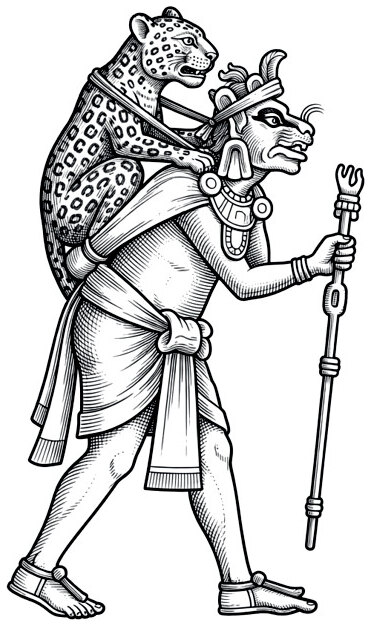
The way the danger was pictured connects directly to the new year. J. Eric S. Thompson, the great Maya scholar, wrote that the Maya thought of divisions of time as burdens carried through eternity by relays of bearers. On the year-bearer pages of the Dresden Codex that image is literal: an animal-priest in man’s clothing, walking erect, carries a god on his back. Tozzer and Allen, who studied the animal figures, read the carrier as a dog; Stempell argued for an opossum. On one page the load is the jaguar, and the caption names the whole scene ti cuch haab, the burden of the year. In their reading the animal carries the finished year, the one that has just died.
The same five days in other calendars
The Maya were not the only Mesoamerican people to break the year at the same seam. The Aztecs ended their 365-day count with the nemontemi, five days that “fill in vain,” and they read them the same way: no one washed or combed, serious work was set aside, and the days belonged to no god. Our Nemontemi page tells that story. The two calendars were cousins. The shared arithmetic of eighteen twenties plus five looks like a common inheritance of Mesoamerican timekeeping.
The same arithmetic appears far from Mesoamerica. The ancient Egyptians also ran a 360-day year and added five days to complete it, and they filled the gap with the birthdays of Osiris, Horus, Seth, Isis, and Nephthys. We tell that story on the Birth of Osiris page. No one is claiming a link between the Egyptian epagomenal days and the Maya Wayeb. What they share is a shape: two calendars that did not divide evenly, and a five-day hole at the end of the year that both peoples filled with the divine and the dangerous.
The year reborn
The Wayeb did not die with the old kingdoms. In 1977, in a hamlet called Kankixaja near Momostenango in highland Guatemala, the anthropologist Allen Christenson watched households close the ritual year the old way. Each family smashed its main maize-cooking pot, carried the pieces to an ancestral shrine, and had a day-keeper bless them clean of the old year. Then they bathed in the river, swept the house, and set out a new cooking pot, a sign that the world had begun again. The same world-renewal, Christenson argues, survives in the Holy Week ceremonies of Santiago Atitlán, where the Tz’utujil Maya keep the old turning under the cover of folk Catholicism.
In 2026, on the reckoning used here, the five days end on August 12. On the morning of the thirteenth the Haab year resets, the month Pop is seated, and the year-bearer takes up his load for another cycle; that day has its own page, the Maya Haab New Year. In the hamlet by Momostenango the new pot sits in the swept house, ready for the year that is about to begin.