“Skulls, niñas, skulls!”
The old women at the booths under the arcades of Mexico City kept up that cry over and over, in cracked voices, on the evening of All Saints’ Day, 1 November 1841. Niñas is Spanish for “girls,” and the booths were there “to the great edification of the children”: they were filled with sugar skulls, “temptingly ranged in grinning rows,” and sugar animals of every kind, “enough to form specimens for a Noah’s ark.” The woman who wrote this down was Frances Calderón de la Barca, born in Edinburgh in 1804 and married to a Spanish diplomat, whose letters from Mexico came out as a book, Life in Mexico, in 1843. The evening was cold, she added, so the ladies in their shawls went home early.
A year earlier she had seen the solemn side of the same feast. On the morning of 2 November 1840, “the day emphatically known as the ‘Día de Muertos,’” the churches all over Mexico, she wrote, were darkened and hung with black cloth. In the middle aisle stood a coffin, also covered in black and painted with skulls, and everyone came to church in mourning. So the feast that sold sugar skulls to children on the evening of the first put a black coffin in the church aisle on the morning of the second.
Two days, two kinds of dead
In the Catholic calendar, 1 November is All Saints’ Day and 2 November is All Souls’ Day, when the Church prays for all the dead. In Mexico the two days turned into days for each family’s own dead. The first belongs to the angelitos, the “little angels,” as children who died young are called, and the second to the adults.
In Mitla, a town of the Zapotec people in the southern state of Oaxaca, the church bells told everyone which of the dead were visiting. The anthropologist Elsie Clews Parsons described it in her 1936 book on the town, whose old Zapotec name, Lyoba’, means “Place of Tombs” and to which, people said, the souls of all Zapotecs come. At noon on 31 October the church bells rang fast, “double quick,” the way they rang at a child’s funeral, because the little angels were arriving. At noon on 1 November the children left and the adult dead came in. At noon on 2 November the bells tolled as they did at an adult’s funeral, and the visit was over.
UNESCO, the United Nations cultural organisation, which lists the festival among the living traditions it calls the intangible heritage of humanity, puts the belief in plain words: the days mark “the transitory return to Earth of deceased relatives and loved ones.” The dead are believed able to bring a family prosperity, such as a good maize harvest, or misfortune, such as illness or accidents, depending on how well the rituals are done.
The table for the visitors
The folklorist Frances Toor, in a large collection of Mexican customs published in 1947, wrote that the families who keep the custom “expect visits from their dead and receive them as honored guests.” They set up an ofrenda, an offering table, often on the same table as the image of the family’s saint, and cook the dishes each dead person liked best. “They believe that the dead partake of the food in spirit, and the living eat it afterward.” The table is decked with cempasúchil, a marigold she called “the traditional flower of the dead,” with incense and with a candle for each soul. When the candles are lit, the name of the person each candle is meant for is called out. For the children, parents set off firecrackers outside so that the little ones would find the right house, and in some villages of Veracruz and Puebla people laid a path of marigold petals from the house to the cemetery or to the street.
In Mitla, Parsons saw rolls of bread set out for the family’s dead by name, with a large decorated roll for a grandparent or parent, and mescal, the local agave spirit, for a man who had liked to drink. No other public celebration of the year, she wrote, cost the families so much. The souls were believed to come for what was set out for them, and some had been seen. Parsons wrote down one account: “A Mitleyena [a woman of Mitla] was living alone in her house. She prepared for the souls. That night she saw her father and mother come in to the house. They made the sign of the cross before the altar and knelt and began to pray. After their prayer they gathered up everything there was on the altar and filled a basket and went out.” Parsons added one line of her own: “The dead behave just like the living.”
House rules for the souls
Toor also gathered the rules of single villages. In Yalalag, a Zapotec village in Oaxaca, people said the souls “only take from the food their agreeable smells and tastes, carrying them off mounted on the wings of grasshoppers.” For that reason nobody ate the food from the offering table, and the family cooked other food for themselves. Anyone away from home tried to be back before 1 November, so as not to meet the souls on a lonely road.
In Chan Kom, a Maya village in Yucatán, only hens were cooked for the dead, because a rooster might crow and frighten the souls away. A bowl made from a dried gourd, filled with water and flowers, stood ready so the dead could wash their hands before and after eating, as the living do. For the souls nobody remembered, a gourd of chocolate, a piece of bread and a lit candle were set in the doorway.
In the Maya villages of X-Cacal, in Quintana Roo, a candle was lit on each child’s grave so the little angels could find their way back. The adults’ graves got none. The reason, as Frances Toor recorded it: grown souls are old enough to find their way back in the dark.
Where the day comes from
Historians give two answers, and both have evidence. The first is Catholic. Around the year 1000, Odilo, the abbot of the French monastery of Cluny, fixed 2 November as the day to pray for all the faithful dead, right after All Saints (see our page on All Souls’ Day). The day spread with the Catholic teaching of Purgatory, a place where souls are cleansed before heaven and where the prayers and alms of the living can shorten their stay. The Spanish brought the day and its customs to Mexico. In Spain, for example, people laid bread, wine and wax on the graves inside the churches for the dead.
The second answer points to Mexico before the Spanish conquest. The Aztecs held ceremonies for their dead many times a year, among them a feast of the little dead, the dead children. In the sixteenth century a Spanish friar, Diego Durán, who wrote about Aztec religion, already suspected that the Aztec and the Christian feasts had mixed. The Aztecs had one feast for the lesser dead and one for the greater, he wrote, and they had surely carried some of their old customs into the Christian one. When he asked why people brought an offering on All Saints’ Day, “they answered me that they did it for the children, that this was how it was done in the old days.”
The argument is still open. Elsa Malvido (1941-2011), a historian at Mexico’s national institute for anthropology and history, held that the Day of the Dead came from Spain and the Church, and that in the 1930s Mexican writers and scholars gave colonial Catholic customs a meaning from before the conquest. Two historians writing in 2023 for Mexico’s national university, Roberto Martínez González and Rocío Maza, concluded that the day has more than one origin, and that what families do today grew out of five hundred years of mixing since the conquest.
Skulls that make jokes
The laughing skulls belong to the city side of the day. In the last decades of the nineteenth century, Mexican newspapers began printing satirical verses called calaveras, “skulls,” which used death to mock public figures, and engravers such as Manuel Manilla and José Guadalupe Posada drew the followers of the long-ruling president Porfirio Díaz as skeletons. In Spanish, Toor explained, calavera means skull, but also daredevil and, in slang, a dead man, so many verses end with ya son calaveras, “now they’re dead ones.” They were printed on single sheets and sold in streets and markets for a few centavos.
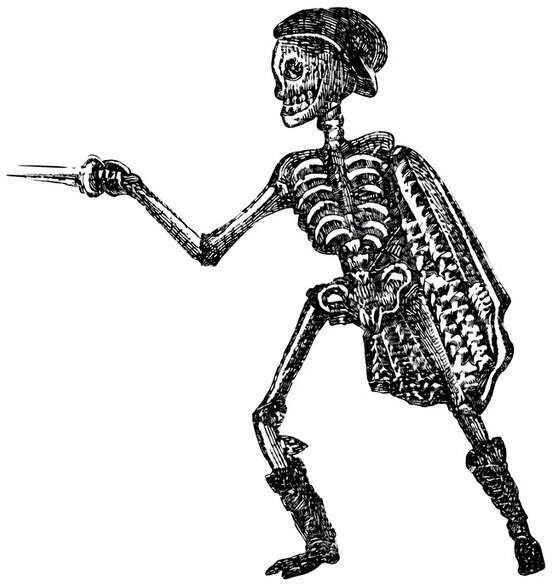
The skeleton at the top of this page is redrawn from one of those sheets, La calavera de Don Juan Tenorio, printed in Mexico City by the Vanegas Arroyo press, with printed pictures by Manilla and Posada, and priced “cinco centavos,” five centavos. Its hero comes from the theatre: every year around these days, Toor wrote, theatres and tent shows played José Zorrilla’s Don Juan Tenorio, in which the seducer Don Juan repents at the end and is carried to heaven by angels.
The elegant skeleton lady of today’s Day of the Dead began as a Posada etching from around 1910 to 1913, called the Calavera Garbancera. A garbancera was a woman who sold chickpeas and pretended to be European. The painter Diego Rivera dressed her up, named her Catrina and put her in his 1946-47 mural Dream of a Sunday Afternoon in the Alameda Central.
Across traditions
Calling the dead by name to a table set for them is a custom known far from Mexico as well. In Belarus, in Eastern Europe, families held an autumn supper for their ancestors, called Dziady, when they opened the door and called their dead to the table by name, much as Mexican families call each name when the candles are lit.
The day today
In the second half of the twentieth century the Mexican state promoted the festival as its own answer to the American Halloween, Martínez González and Maza write. In the 1980s the offering table went into the national schoolbooks under the heading “our traditions,” and cemetery tourism was encouraged, with the town of Mixquic and the island of Janitzio as the main destinations. UNESCO first proclaimed the festival in 2003 and inscribed it on its heritage list in 2008. By the 2010s the festival had incorporated a new element: the James Bond film Spectre (2015) opens with a Day of the Dead parade through Mexico City, though the city had never held one. The tourism minister, Enrique de la Madrid, said, as the French news agency AFP reported: “Now, based on the film, there will be this festival.” The first real parade marched on 29 October 2016, from the Angel of Independence monument to the Zócalo, the main square, and about 250,000 people came to watch.
Janitzio looked different when Toor described it in 1947. It is an island village of the Tarascan (Purépecha) people in Lake Pátzcuaro. On the evening of 1 November the women and children went to bed early. Just before midnight the women got up, dressed themselves and the children in their best clothes, and climbed to the cemetery in the churchyard above the houses, with baskets of food under embroidered napkins, arches of marigolds hung with bread shaped like animals, and a candle for each of the family’s dead. They sat around the graves for the rest of the night, “giving warmth and companionship to their dead.” When the first light came, Toor wrote, the women opened their baskets and offered their food “to the heavens, to the souls, and to persons,” the living people gathered around the graves.