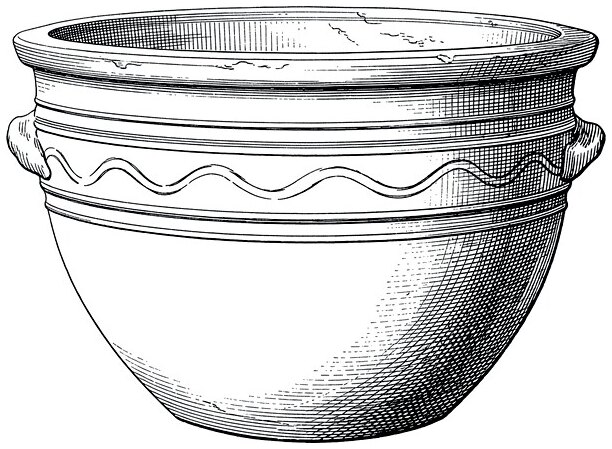
In a Korean farmhouse of the old kind, the rice cake steamed from the new harvest went to the gods before anyone ate it. It was made in a siru, a clay steamer with holes in its floor, and set out with rice wine for the gods who lived in the house. Then it was broken into small pieces. One piece went to the terrace where the sauce jars stood, one to the storeroom, one to the kitchen, one to the cowshed and one to the toilet. The rest was shared with the neighbours. Jeong Jong-su, a former director of the National Palace Museum of Korea, described the custom this way in a newspaper column in 2020.
The rite is called gosa, and its month begins on 9 November 2026. Each month of the Korean lunar calendar starts at a new moon, and the new moon of 9 November opens the tenth month, which has an old name of its own: sangdal, the “upper month”. The National Folk Museum of Korea gives the first day of that month as the date of the custom. Each house chose a lucky day within the month, often a Horse day or a Pig day, rather than holding it on a single fixed date. The old calendar gives every day one of the twelve animals of the zodiac in turn, so a Horse day comes round every twelve days.
Why the tenth month is the “upper” one
The Encyclopedia of Korean Culture, published by the Academy of Korean Studies, calls the tenth month the best month of the year for offering the new grain to the gods. By then the harvest is in. Kim Yeong-jin, who wrote the entry, points out that the tenth lunar month falls in November and sets it beside the Western Thanksgiving of the same month. Jeong quotes the historian Choe Nam-seon, who called it the month when the year’s farming is finished, people thank heaven and the ancestors, and gods and humans enjoy themselves together. The syllable sang, Jeong adds, means “above,” as well as “sacred” and “highest.”
People also had a plainer name for it: gongdal, the free month. The firewood was stacked, the paper strips were pasted over the gaps in the doors, the cabbage was salted into kimchi for the winter, and little work was left to do.
The encyclopedia traces the month back to the ancient kingdoms of the peninsula. Goguryeo held its great sacrifice to heaven, the Dongmaeng, in the tenth month, and so did the Ye people with a rite called Mucheon. Kim even sees an heir of those assemblies in South Korea’s National Foundation Day, Gaecheonjeol, kept on 3 October. The National Folk Museum is more careful: it says the household rite “appears to be” descended from the ancient harvest rites and that its origin is “related in some way” to them, and it goes no further.
In 1849 the writer Hong Seok-mo (1781 to 1857) put together the Dongguk sesigi, a record of the customs of the Korean year, month by month. Under the tenth month he wrote: “Households take the tenth month as the upper month. They call in shamans to welcome the god Seongjo, and set out rice cakes and fruit and pray for the peace of the house.”
Hong Seok-mo’s record of 1849 also has a rite for the stable. On the Horse day of the tenth month, red-bean rice cake was set out in the stable and the god was asked to keep the horses healthy. On some Horse days the rite was not held: the full name of those days begins with byeong, which sounds like the word for sickness. Horse days whose name begins with mu were the best of all.
The gods who live in the house
Hong’s Seongjo, “the builder”, is the god most Koreans call Seongju, a name that means “lord of the castle”. According to the folklorist Choi Gil-seong, who wrote several of the encyclopedia’s entries on the household gods, Seongju guards the building itself. A saying he records goes: “A tile house has a Seongju, a straw house has a Seongju, even a hut has a Seongju.” A house has only one, and lodgers live under the owner’s god, and only someone who owns a house can have a Seongju of his own. The tie between the god and the head of the family is so close that the man of the house is also called Seongju.
Seongju does not come unless he is invited. When the main roof beam was raised, the date and a blessing for the household were written on it, and at the ends of the beam the characters for sea, dragon or turtle, which were meant to keep fire away. Families that wanted more held a gut, a full ceremony led by a shaman. The head of the house held a pine branch until the god came down into it. The shaman then soaked white paper in rice wine, pressed it onto the main beam and threw rice at it so that it stuck. This moment is called “Seongju goes up”. According to Yang Jong-seung, another of the encyclopedia’s authors, everyone watching must close their eyes while it happens, because a god who is watched cannot settle on the beam. Then rice from the householder’s bowl is thrown three times with the shout: “A thousand seok, ten thousand seok, a hundred million seok!” A seok is an old measure of rice.
Choi writes that Seongju also leaves after a birth or a death in the house, which count as impure, and after a fire. Because small impurities pile up over a year without anyone noticing, families received him anew every New Year or every autumn. In the farming and fishing households of the centre and south, many kept him in a jar of rice in a corner of the wooden main hall, called the Seongju jar.
The British travel writer Isabella Bird Bishop described the paper form in 1898, in a book that labelled the whole Korean spirit world “demonism”. The god’s sign, she wrote, consisted of “some sheets of paper and a paper bag containing as many spoonfuls of rice as the household is years old”, hung from the crossbeam by the shaman, with a fresh sheet of paper added every year.
Outside, near the terrace with the sauce jars, lived Teoju, the god of the house site. His shrine was a little stack of straw over a jar of rice, and the rice was replaced with new rice every year. Teoju looks after the luck of the household, above all its wealth. In the kitchen there was Jowang, the goddess of the hearth, and in the inner room Jeseok, who is linked with childbirth.
How the rite was done
Choi describes the household gosa as it was held mainly in central Korea, around Seoul. After a good day had been chosen, a straw rope was hung up and yellow earth was spread, so that nothing impure could come into the house. The offerings were siru-tteok, the rice cake from the steamer, laid in layers with red beans, and rice wine, with a plain white cake that went to Jeseok in the inner room. The red of the beans is said to drive evil spirits away, the Korea JoongAng Daily explains.
A gosa is smaller than a gut, which needs a shaman, drums and dancing. The housewife set the offerings out, bowed, pressed her palms together and prayed to the main gods of the house: Teoju, Seongju, Jeseok and Jowang. The lesser gods of the yard, gate, and toilet, among others, were given food without prayers. In some regions the man of the house led the rite. Families who wanted a bigger ceremony called a shaman, who prayed while beating small cymbals, or a blind man who recited a scripture for the peace of the house. The palace held gosa too, and its offering lists name rice cake, wine and dried pollack.
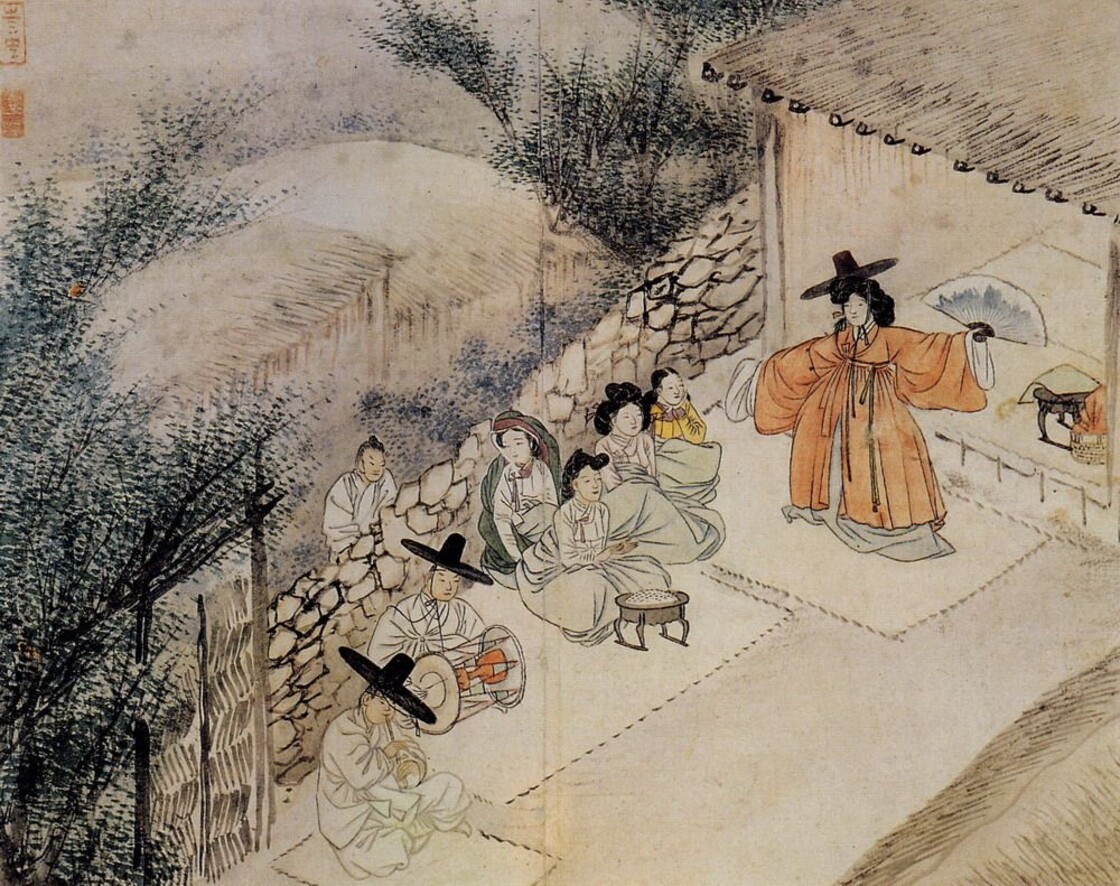
The god’s own story was sung at the larger rites. In a version recorded in Andong, in the south-east, Seongju is born in heaven, is exiled to earth for a wrong he did there, and sets out to build a house. Every time he goes to fell a tree something stops him, until in the end his axe sticks fast to the trunk. A diviner tells him to hold a rite for the mountain god. He does, the axe falls free, and he builds his house. Then he marries three maidens who have also been sent down from heaven, and they become three goddesses of the house: Samsin Halmoni, the grandmother who watches over childbirth, Jeseok and Jowang. The encyclopedia notes that this version tells the origin of the three goddesses along with Seongju’s own, and reads it as a sign of how closely the gods of the house belong together. A folk song from the same province names Seongju’s home: “Seongju, oh Seongju, where is Seongju’s root? In Andong in Gyeongsang province, Jebiwon is his root.” There the pine seeds were gathered, the song goes on, and they grew into the pillars and beams of houses.
Who may eat the cake
A rule often repeated about this rite says that only the family may eat the offerings, but in practice the custom split into two paths. Choi writes that the new cake went out of the house as a gift: families would share gosa cake with the neighbours, so that the houses of a village swapped cakes with each other, and cake offered to the village guardian god was not brought home at all but handed out to the children. A gosa, he adds, belongs to the house and its ground, not to a bloodline: only a householder can hold one.
The old grain, by contrast, stayed inside: the National Folk Museum describes how farming families took the grain kept for a year in the jars of the gods, such as the ancestors’ jar and the Seongju jar, ground it and mixed it with the new harvest. Rice and cakes made from last year’s grain could be eaten only by members of the family, while the new cake was shared. That grain was believed to hold the family’s good fortune, the museum explains, “for if they were eaten by people with bad energy, it would be bad for the family.”
The pig’s head
“The tenth month means gosa, and gosa means a pig’s head,” Jeong writes. So many gosa were held in this month that butchers in the markets hung up signs: “Pig heads for gosa available.”
For why it is a pig, he offers a folk tale and the calendar. The tale comes from Jeongeup, in the south-west. A householder once called his dog, ox, rooster, and pig and asked each what it had done for him. The dog guarded the gate and was told to eat and sleep there. The ox did the heavy work in the fields and was given a good diet and rest in the cowshed. The rooster woke the master early every morning, which made him work harder and grow richer, and was given a coop beside the men’s quarters. Only the pig had done nothing, and it grew ashamed. It spoke: “I have only been a burden to you. So that you may be happy and rich, I will give my life as an offering.” Jeong calls it “a very plausible story”. As for the calendar: in the old reckoning each month also has one of the twelve animals, and the tenth month belongs to the pig.
Today the pig’s head turns up far from any farmhouse. In 2011 the Korea JoongAng Daily reported boiled pig heads on sale at Seoul’s Namdaemun market for people opening a business, starting a project, moving house or buying a car, and the more the pig seems to smile, the better. Guests push banknotes into its mouth and ears, and the money goes to the host. They bow before the table, though some decline for religious reasons, and then everyone eats together, the pig’s head sliced and served with salted shrimp. The paper noted that fewer people held a gosa when moving house, and that some replaced the head with a sugar cake made in its shape.
Film crews in Korea hold a gosa when shooting starts. On the set of the 2013 film Snowpiercer, according to a Korean TV report picked up by Kotaku, the pig’s head was shown on a tablet computer instead, because some of the actors might have found a real one unpleasant.
On 1 November 2021 the South Korean Cultural Heritage Administration declared the making of tteok, the rice cake, a national intangible cultural heritage, the status the state gives to living traditions it protects. The designation covers the sharing of the cakes as well as the making. It names no master or guardian group, because the whole country keeps the custom.
In 2024 the Korea Herald asked a 36-year-old man, Yoon Jae-sang, about moving into his new home. On moving day he bought siru-tteok, because red beans are said to chase ghosts away. “When I was young, we used to distribute sirutteok to our neighbors (after moving to a new area),” he said, “but with all the old superstitions fading among young people, I didn’t do it this time.”