On the fifth day of the Hebrew month of Av, the steep old cemetery of Safed fills up. People climb the terraces of blue-painted graves in the Galilean heat, stop at one low tomb washed the same sky-blue as the rest, and stand there to pray. The man buried under it died young, in 1572, and left almost nothing in writing. Everything that made him famous was said out loud, in a small circle, over about two years. That is the day: the yahrzeit of Isaac Luria, the teacher his students called the Ari.
The lion of Safed
A yahrzeit is the anniversary of a death, kept each year on its Hebrew date. Luria’s is the 5th of Av, which in 2026 falls on July 19; because the Hebrew calendar is lunisolar, the civil date shifts a little from year to year.
Isaac ben Solomon Luria Ashkenazi was born in Jerusalem in 1534 to a family with German roots, which is where the “Ashkenazi” in his name comes from. His father died while he was a boy, and he was taken to Egypt and raised by an uncle in Cairo, where he studied under the chief rabbi, David ibn Zimra. By tradition he then spent years in seclusion, immersed in the Zohar and the older Kabbalah, coming home to his family only on the Sabbath. Chabad’s account gives the figure as seven years by the Nile.
Around 1570 he moved to Safed, then the center of Jewish mysticism, a hill town in the Galilee crowded with rabbis and refugees. The leading kabbalist there, Moses Cordovero, had just died, and Luria stepped into the gap. He gathered a circle of students and taught them for barely two years before he died, at thirty-eight, in an epidemic. He is buried in Safed still.
He wrote next to nothing. What we call Lurianic Kabbalah survives because one disciple, Chaim Vital, wrote down the lectures and spent years shaping the notes into a set of books, the most important of them the eight-volume Etz Chaim, the “Tree of Life.” The name Ari means “the Lion,” read as an acronym of “the divine [or Ashkenazi] Rabbi Isaac.” He is often called the father of Kabbalah as it has been practiced ever since.
Almost nothing we call “Lurianic Kabbalah” was written by Luria. It comes from the notes his student Chaim Vital took during roughly two years of talks, and edited for decades after the Ari was dead.
Contraction, shattering, repair
What Luria taught his circle was a story about how the world got broken. It begins before there is a world at all, with the infinite God, the Ein Sof. For anything finite to exist, Luria said, the infinite had to make room, withdrawing into itself to leave an empty space where a universe could stand. This first move is tzimtzum, contraction.
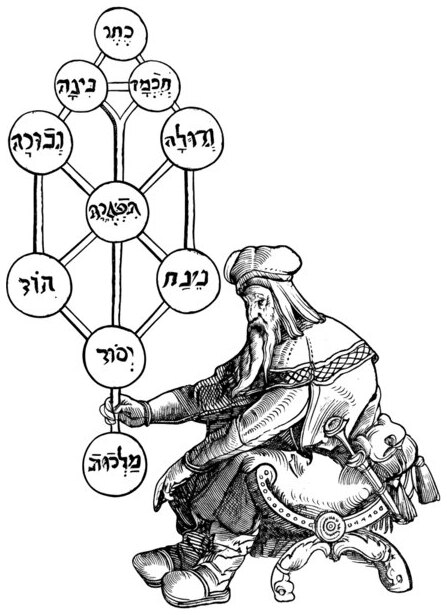
Into that space the divine light poured, held in vessels shaped by the ten sefirot, the emanations mapped on the old Tree of Life. The vessels could not bear the light. They cracked and burst. This is shevirat ha-kelim, the breaking of the vessels, and it scattered sparks of holiness everywhere, sparks that fell and lodged among the broken shards, the kelipot or “husks.” Luria’s cosmos is one where holiness is trapped inside the wrong things, and exile is written into creation itself.
The third idea is the answer to the first two: tikkun, repair. Every commandment kept, every prayer said with the right intention, lifts a fallen spark back toward its source and mends a little of the shattering. In this reading, ordinary human action is how the broken vessels get put back together.
Welcoming the bride
Not all of Safed’s mysticism stayed in the study house. The circle Luria joined had a habit that has outlived every argument about the sparks: on Friday afternoon they dressed in white and walked out into the fields to greet the Sabbath as if she were a bride, singing her in.
The song they used was Lekhah Dodi, “Come, my beloved,” written around 1540 by Shlomo Alkabetz, a Safed kabbalist close to Luria’s world. Luria took it into his own Sabbath practice, which did much to spread it. That field-walk became the service now called Kabbalat Shabbat, “receiving the Sabbath,” and Lekhah Dodi is still sung on Friday night in synagogues that have never heard of tzimtzum. It is the most widely kept thing to come out of that hillside.
How 5 Av is kept
The yahrzeit itself is quieter, and older in feel. Thousands come to the grave in Safed to pray; a tomb of a righteous teacher is treated as a place where prayers carry further. Some light a memorial candle. The custom that fits the Ari best, though, is study: the day is marked by learning his teachings, or teaching about him, in his merit.
In the nineteenth century the Baghdadi sage known as the Ben Ish Chai arranged a set order of study, a tikkun, to be gone through on the night of 5 Av in the Ari’s memory. To honor a man who taught that study repairs the cosmos, people repair a small corner of it by studying him.
What the repair became
Luria’s idea of repair did not stay inside Kabbalah. His term tikkun olam, the “repair of the world,” has traveled a long way from the sparks and the husks; in much of modern Jewish life it now names an ethic of social responsibility, mending the world through justice and good works. That ethical meaning grew out of the cosmic one, though the two are far apart.
The scholar Gershom Scholem, who did more than anyone to bring Kabbalah into the university, read Lurianic teaching as a myth built for a shattered people. Writing after the expulsions that scattered Sephardi Jewry from Spain in 1492, Luria gave exile a cosmic shape and a job: a world in pieces, and human beings tasked with gathering the pieces. Scholem traced the charge in that idea forward into the messianic movement around Sabbatai Zevi and into Hasidism, where the Baal Shem Tov’s followers carried a popular version of it across Eastern Europe. That reading is Scholem’s interpretation, argued rather than settled, but it explains why a rabbi who published nothing became one of the most consequential figures in the history of Jewish thought.
Some of his machinery reaches even the edges of folklore. The idea of gilgul, the transmigration of souls, ran through Lurianic Kabbalah and stands behind the later belief in the dybbuk, the clinging soul of the dead, while the same world of divine names and sefirot gave the golem its animating letters. On 5 Av, none of that is the point. The point is the climb up the blue terraces, and the night spent reading a dead man’s words in his memory.