Sukkot is the Jewish autumn festival when families eat for a week in a hut built outdoors. This year it starts on a Saturday, the Sabbath. On that day its two best-known objects stay untouched: a palm branch and a citron, a large fragrant fruit of the lemon family.
Jewish law forbids taking up the palm branch on the Sabbath, even on the festival’s first day; one commentary takes it further, ruling that the branch may not even be touched because on the Sabbath it counts like a stone. The citron, by contrast, may be picked up because it can be smelled.
What the day is
Sukkot means booths. The festival begins five days after Yom Kippur, the Day of Atonement, on the 15th day of the Jewish month of Tishrei. This year that is sundown on Friday 25 September 2026. The seven days run to Friday 2 October, and two closing holidays follow on 3 and 4 October.
The Torah sets it “when you have gathered in the yield of your land.” The festival works as both a harvest celebration and a history lesson: people live in booths for seven days so that later generations “may know that I made the Israelite people live in booths when I brought them out of the land of Egypt.”
What those desert booths were is an old argument. In the Talmud, the great book of rabbinic debate, two early rabbis disagreed: one held they were clouds of glory that sheltered the people, while Rabbi Akiva maintained they were real huts. Rabbinic law sides with the clouds, and so the roof of every booth is still modelled on one: it must be plant material that grew from the ground.
The booth
A sukkah needs at least three walls. Its roof of branches must give more shade than sun, and it may not stand higher than twenty cubits. The custom is to start building right after Yom Kippur ends, because a good deed that comes to hand should not wait.
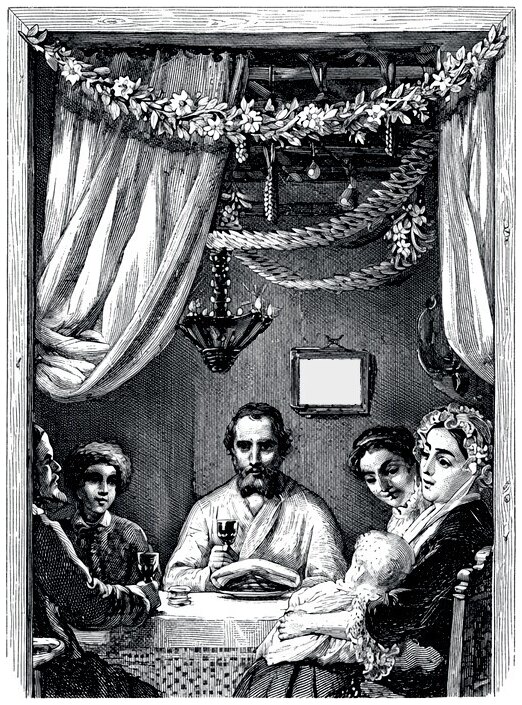
For seven days the booth counts as home and the house as the temporary lodging. Meals move out into the booth. Rain is the one excuse for going back indoors, and an old rabbinic picture explains why. A servant comes to pour his master’s wine, and the master throws a jug of water in his face. The servant knows his service is not wanted today.
The first night has no such excuse. On the evening that opens the festival, the rule is to eat at least an olive’s worth of food inside the booth, even if it is raining.
Four plants, one bundle
The second command is to take four plants and rejoice. Leviticus names “the product of hadar trees, branches of palm trees, boughs of leafy trees, and willows of the brook.” Nobody is sure what hadar means. Tradition reads it as the citron, the etrog. The palm branch is the lulav, bound with myrtle and willow, and it is waved during the psalms of praise at “Lord, please save us.”
A midrash reads the four as four kinds of people. The citron has taste and smell, like a person with learning and good deeds. The willow has neither. “To eradicate them is not possible,” God says in the midrash. So they are tied into a single bundle, “and they will atone for one another.”
On the Sabbath the bundle stays at home. The rabbis feared that someone would carry it through the street to find a teacher who could show him how to wave it. The same fear keeps the ram’s horn, the shofar, silent on the Sabbath.
In Temple times the first day overrode the Sabbath anyway, and today it no longer does. According to an Israeli rabbi’s 2026 guide, this year the command is kept only as rabbinic law, and the plants come out on Sunday.
The seven guests
The mystical layer of the day is the ushpizin, Aramaic for “guests.” In the central book of Jewish mysticism, the Zohar, a person who sits in the booth is never alone. God’s presence “spreads her wings over him from above.” Then “Abraham and five other righteous ones make their abode with him,” and King David makes seven.
Rav Hamnuna the Elder, an early teacher, used different words for the moment. He stood inside the door of his booth and said: “Sit, most exalted guests, sit; sit, guests of faith, sit.”
The guests come with a condition: “the portion of those guests whom he invites must go to the poor.” A host who invites Abraham and feeds nobody will see Abraham get up from the table. He leaves quoting Moses: “Depart, I pray you, from the tents of these wicked men.”
The practice of calling the guests in, with a different guest leading each night, emerged in the sixteenth century under the kabbalist Isaac Luria. His order follows the sefirot, the divine qualities of Kabbalah. Abraham, opening the week, stands for lovingkindness; Moses and Aaron arrive fourth and fifth, ahead of Joseph, with David last as kingship.
Chabad Hasidim invite a second set of seven guests alongside the biblical ones: the Baal Shem Tov, the founder of Hasidism, and six of the movement’s later leaders. In some communities today, women are invited too, most often Sarah, Rachel, Ruth and Esther, though no list is fixed. Some Sephardic families leave an empty chair in the booth for the night’s guest.
Water, fire and thrown fruit
In rabbinic teaching, Sukkot is when the world is judged for water, meaning next year’s rain. In the Temple a priest filled a golden jug at the pool of Siloam and poured it on the altar. A Sadducee priest once rejected this practice and poured the water over his own feet instead; the crowd responded by pelting him with citrons.
A larger version of the same scene comes from the historian Josephus. When King Alexander Jannaeus stood at the altar during the feast, the people “pelted him with citrons.” He had about six thousand of them killed.
The nights were loud. Golden lamps stood in the Temple’s Women’s Courtyard, with wicks torn from the priests’ worn-out trousers. The light reached every courtyard in Jerusalem. Pious men danced and juggled torches, and Levites played on the fifteen steps. “One who did not see the Celebration of the Place of the Drawing of the Water never saw celebration in his days.”
The festival looked outward too. Seventy bulls were offered over the seven days, and a Talmud sage says they stood for the seventy nations of the world. The prophet Zechariah pictured those nations coming to Jerusalem every year to keep the feast. Any nation that stayed home “shall receive no rain.”
During the Bar Kokhba revolt against Rome (132 to 135), the rebel leader wrote to one of his men asking him to send donkeys to En-gedi and bring back palm branches and citrons for the festival. The letter was found in 1960 in the Cave of Letters above the Dead Sea.
Across traditions
Outsiders noticed the booths. Plutarch, in his Table Talk, records a dinner guest arguing that the Jews’ “greatest, most sacred holiday” belongs to Dionysus, the wine god.
The guest points to tables of fruit “under tents and huts plaited for the most part of vines and ivy.” He mentions trumpets, and a procession into the temple with branches he calls thyrsi, the staffs carried in Dionysus’s rites. The god and his staff have their own entry in the Compendium: Dionysus.
The booth itself turns up in the Gospels. When Peter offers to build three tents at the Transfiguration, his word for tent is the one the Greek Bible uses for these booths. The story has its own page: Feast of the Transfiguration.
Samaritans read the four-plants verse in Leviticus another way. For them the four plants are what the booth is made of. Their booth is built indoors, as a frame hung from the living-room ceiling or set on four poles. It is covered in citrons, pomegranates, pomelos, quinces and peppers, about 350 kilograms of fruit.
The day today
The citrons have a harvest of their own. Every summer rabbis travel to the Riviera dei Cedri in Calabria, in southern Italy, to choose fruit for communities in America, Israel, Russia and Britain. Chabad families want the Diamante variety because the Lubavitcher Rebbe recommended it.
In 2017 a farmer got one or two euros a kilo from the food industry, while a rabbi paid three to twelve euros for a single citron.
The week ends with Hoshana Rabbah on 2 October, and the season closes with Simchat Torah. It opened with Rosh Hashanah and Yom Kippur. On that first Saturday the citron sits on the table in the booth. It can be lifted and smelled, and nothing more.