Simchat Torah is the Jewish festival of the Torah scroll. Every scroll leaves the ark, and people carry them around the synagogue in seven dancing circuits. Then comes the reading that gives the day its name. One reader finishes the last lines of the five books, where Moses dies at 120 with his eyes still clear. A few minutes later someone opens a second scroll and reads: “In the beginning.”
The second reading follows the first at once. By the fourteenth century a law code gave the reason: so that the devil could not say the reading had ended and nobody wanted to begin it again.
What the day is
The festival ends the long run of autumn holidays. It falls on the day after the week of booths, Sukkot. In 2026 that is Saturday 3 October in Israel. Most communities abroad keep the holiday for two days, and there Simchat Torah is the second, Sunday 4 October.
In the Bible the day is the “Eighth Day of Assembly,” Shemini Atzeret. Atzeret means holding back. The medieval commentator Rashi gives a picture for it. A king invited his children to a feast for several days. When they stood up to leave, he said: “Children, I beg of you, stay one day more with me; it is so hard for me to part with you!”
In ancient times the Jews of the Land of Israel read through the Torah in three years. Communities abroad finished it in one, on this day. The one-year cycle won out, and the name Simchat Torah came with it. The day is called that “because we rejoice on it, making a festive meal in honor of the finishing of the Torah.”
The last eight verses
The final page of the Torah tells of Moses’s death. God shows him the promised land from a mountaintop and tells him he will not cross into it. He dies there, and “no one knows his burial place to this day.”
The rabbis of the Talmud asked how Moses could have written “And Moses died there.” One answer gives the last eight verses to Joshua, his successor. The other holds that God dictated those lines as well, “and Moses wrote with tears.”
Because these verses are different, one reader takes all of them. That reader is the chatan Torah, the “bridegroom of the Torah.” The person who then begins Genesis is the “bridegroom of Genesis.” By old custom they each give money to the synagogue and invite everybody to a celebration.
Seven circuits
On the eve of the festival, and again in the morning, every scroll comes out of the ark. The circuits around the reading platform are the hakafot. Each round opens with the cry “Save us,” and the dancing can go on for hours, sometimes into the street.
Dancing on a holy day was normally avoided. The heads of the old Babylonian academies made an exception: on Simchat Torah “our practice is to dance, even the elderly,” because it honours the Torah.
The solemn night procession became common in the sixteenth century. The earliest source for the number seven is the sixteenth-century Jewish mystic Isaac Luria. He left no reason for it. Some communities make only three circuits.
Children found their own way to celebrate. By the end of the fifteenth century, children in some places tore down the festival booths and burned them on Simchat Torah. One rabbi of that century remembered his father scolding him as a boy for wrecking the booth on a holy day.
In many Eastern European synagogues the priestly blessing on Simchat Torah moves up to the first morning prayers, before the celebrations begin, and some places skip it; a priest may not bless the congregation while drunk, and on this day “drunkenness is common.”
Children under the prayer shawl
On Simchat Torah the children are called up to the Torah too. In many synagogues a large prayer shawl is spread over their heads. The congregation blesses them with the words Jacob spoke over his grandsons: “the angel who has redeemed me.”
The children also get food. A Latin book on Hebrew and Jewish matters, printed in Utrecht in 1657, shows cakes thrown to children on this day.
In nineteenth-century Eastern Europe, printers in cities such as Vilna and Warsaw made paper flags for the festival. Children carried them on sticks, sometimes topped with an apple and a small lit candle. The apple goes back to the old habit of throwing apples for children to gather. The candle comes from the candles that once escorted the two “bridegrooms” like a wedding couple.
The Torah before the world
The mystical layer of the day rests on an old idea: the Torah is older than the world. A teaching in the Talmud lists seven things made before creation, and the Torah comes first. In the biblical Book of Proverbs, Wisdom says: “The Lord made me as the beginning of His way.” The rabbis read that Wisdom as the Torah.
An early rabbinic commentary on Genesis goes further. A king who builds a palace works from an architect’s plans, with sheets and tablets that show where the rooms and doors go. In the same way, “the Holy One blessed be He looked in the Torah and created the world.”
The mystic Luria never explained his seven circuits, but his students used this idea: all seven days of creation existed for the sake of the Torah. They also tied the number to the seven circuits made on Hoshana Rabbah, the last day of the week of booths.
Seen this way, the jump from the death of Moses back to “In the beginning” turns the reading into a loop: the book that ends is the plan the world was built from.
Seen from outside
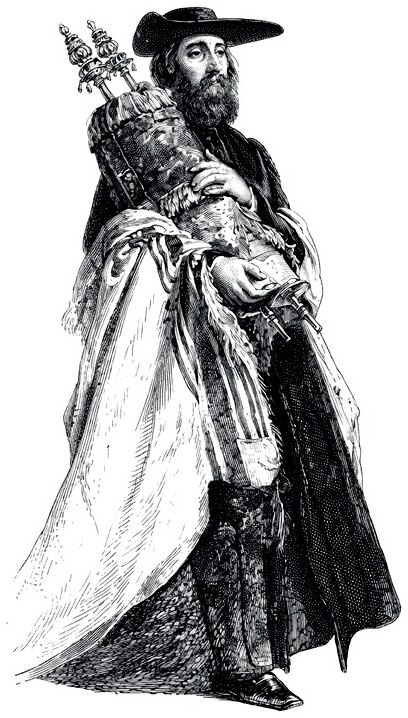
In 1850 a London painter, Solomon Alexander Hart, finished a large canvas of the procession in the synagogue of Livorno, Italy. At its centre a bearded man in a broad hat carries a scroll in a red mantle, the figure drawn at the top of this page.
In the Soviet Union the festival became a public show of Jewish identity. In October 1966 the writer Elie Wiesel stood on Arkhipova Street in Moscow, outside the city’s main synagogue. “Between thirty and forty thousand young Jews” filled the street, “singing and dancing in hasidic abandon” until almost dawn. When the floodlights went off near midnight, they lit newspapers as torches.
The young people knew the songs and the dances, Wiesel wrote, though most of them did not know how to pray.
The day today
Since 2023 the date carries a second weight. In Israel, 7 October 2023 was Simchat Torah, and a Saturday, as it is again this year. That morning Hamas-led gunmen crossed from Gaza and killed about 1,200 people. They took 251 hostages.
A year later many Israeli rabbis asked for quieter celebrations and no alcohol. The town of Shoham gave each of its seven circuits a theme, among them the release of the hostages and peace. Kibbutz Yavne prepared laminated cards with the names of all the dead, about 1,200 of them, to be read at the memorial prayer.