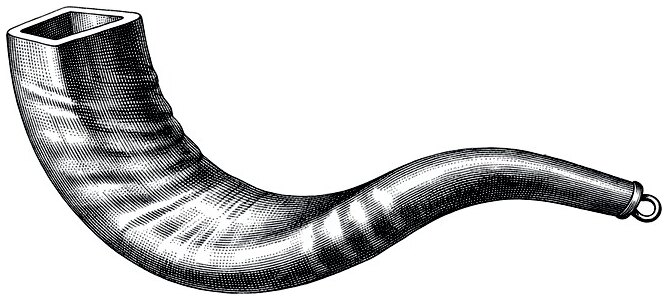
The ram’s horn stays in its bag on Saturday morning. Rosh Hashanah 5787 opens at sundown on Friday 11 September 2026, and the first of its two days falls on Shabbat, which means no shofar that morning in any synagogue that keeps the ruling, and the blasts wait for Sunday.
What the day is
Rosh Hashanah is 1 Tishrei, the head of the Jewish year. The names the Torah gives it describe the sound rather than a new year: Leviticus calls it zikhron teruah, a sacred occasion commemorated with loud blasts, and Numbers calls it yom teruah, a day when the horn is sounded.
The Mishnah counts four new years in the calendar, and this is the one for years. It also names four days on which the world is judged, and on Rosh Hashanah all creatures pass before God like sheep, benei maron, a line from Psalm 33:15.
The festival is commanded for one day and kept for two, an old fix for the difficulty of knowing when the new moon had been sighted. In Israel most holidays run a single day, and this one keeps a second; the two are called Yoma Arichta, one long day. They open the Ten Days of Repentance, which close with Yom Kippur (Day of Atonement / Sealing of Fate).
The horn
The Torah asks for a sound by name, and the Talmud asks why it should come out of a ram’s horn. Rabbi Abbahu answers with the scene at the thicket: sound a blast before Me with a ram’s horn, so that I remember the binding of Isaac, in whose place a ram was sacrificed.
A tekiah is one long unbroken note. The shevarim is three broken sighs, and the teruah is a run of short sobs. The order was once in doubt, so Rabbi Abbahu in his city of Caesarea ordained that all three be blown; thirty blasts became the obligation, and they are sounded before the Musaf prayer. A hundred blasts are a later custom, recorded in Geonic times and spread after the sixteenth-century kabbalist Isaac Luria attached a meditation to each blast. Between the sets the congregation says Hayom harat olam, today the world was conceived, and the line runs on: today all the world’s creatures stand in judgment.
The horn must come from the goat and cattle family, a ram’s horn for preference. Antlers are solid bone and cannot be hollowed; a shofar may be carved, though not painted. The Temple used a straight ibex horn with gold at the mouthpiece; the bent horn won later, on the Gemara’s reasoning that a curved shofar suits bent minds and bent bodies.
The shofar sounds every weekday morning of Elul and then stops before the holiday, so the voluntary blasts are not confused with the obligatory ones. The month of turning has its own page: Rosh Chodesh Elul (Beginning of the Month of Repentance).
The year the horn is silent
The Torah permits blowing the shofar on Shabbat, and the Sages forbade it anyway: not everyone knows how to work a shofar, and someone carrying one across the public domain to a teacher may end up walking four cubits with it, which is work. The Gemara found the hint in two verses read against each other: a weekday Rosh Hashanah is a day of teruah, and a Shabbat one is only a remembrance of the blast.
So in 2026 the horn is heard on Sunday 13 September, and tashlich moves with it. The rite takes its name from the verb in Micah, you will hurl all our sins into the depths of the sea, and it belongs to the afternoon of the first day; when the first day is Shabbat, the Ashkenazi custom sends it to the second. The first written mention comes from Rabbi Yaakov Moelin of Worms, the Maharil, who died in 1427. The Vilna Gaon opposed it, and Spanish and Portuguese Jews and the Yemenite Dor Daim do not do it.
The table
Ashkenazi households put out a round challah, often with raisins, and dip apples in honey. The round loaf is taken to stand for the cycle of the year; the apple and the honey are medieval additions.
Sephardic and Mizrahi families work from a longer list of foods, and the source behind the list is older than the custom: in the tractate Keritot, Abaye says a person should eat gourd, fenugreek, leeks, beets and dates at the start of the year, because they grow quickly and make a good omen. The later rite turns the list into blessings that play on the names: leeks are karti, close to karet, to cut off, and dates are tamar, close to tam, to end. A pomegranate is asked to fill the year with commandments the way its seeds fill the fruit.
The three books
Underneath the day a court sits in session: Rabbi Kruspedai said in the name of Rabbi Yoḥanan that three books are opened on Rosh Hashanah, one for the wholly wicked, one for the wholly righteous, and one for the people in the middle whose good and bad deeds balance out. The first two are sealed immediately, for life and for death, while the middle book stays open: those people are suspended from Rosh Hashanah until Yom Kippur, with ten days to change what is written, and the proof text is Psalm 69, let them be blotted out of the book of the living.
People avoid sleeping during the day as well: the Jerusalem Talmud has the line, whoever sleeps at the beginning of the year, his fortune sleeps, and the Rema records it in the Shulchan Aruch.
Unetaneh Tokef, said in the repetition of Musaf, turns on the line: who shall live and who shall die. A legend recorded in the thirteenth century says the poem was written by Rabbi Amnon of Mainz, martyred after refusing a bishop’s demand to convert. Later scholarship has taken the story apart: fragments of the prayer were found in the Cairo Geniza, centuries earlier and far from Ashkenaz, and a sixth-century poem of Elazar ha-Kalir echoes it. The chronicle has Amnon saying the prayer rather than writing it.
Across traditions
Assyriologists have traced the book of names back past the holiday itself, to Mesopotamia, where the Tablet of Destinies served as the seal of supreme authority and a “tablet of life” recorded the righteous. The argument goes back to Shalom Paul in 1973, and Leslie Baynes followed the motif through the Jewish and Christian apocalypses. They describe a shared ancient Near Eastern way of imagining divine record-keeping, and stop short of claiming that one text copied another.
Revelation has the books opened before a great white throne, and a second book opened with the names of the living. The Quran gives every person his record fastened to his own neck and read out on the day of resurrection: read your record, it says, you are sufficient as your own accountant.
The day today
The year 5787 begins with a quiet Saturday and a loud Sunday, and after the second morning the ten days run toward Yom Kippur and past it to the fast of Tzom Gedaliah (Fast of Gedaliah) on 14 September.
In the Brooklyn Museum there is an eighteenth-century shofar of the kind the Talmud argues for, a ram’s horn about fourteen inches long, and along its side a Hebrew inscription from the last century quotes the verse that gave the horn its job: and Abraham lifted up his eyes and looked, and behind him a ram caught in a thicket by his horns.