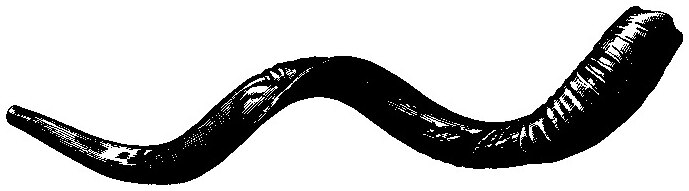
The first note of Elul comes after the morning prayers, on an ordinary weekday. Someone in the congregation lifts a ram’s horn and blows: one long note, then a broken wail, then another long note. From the second day of the month the sound repeats each weekday morning until the eve of the New Year.
What the day is
Rosh Chodesh Elul is the first day of Elul, the last month of the Jewish year, set aside for turning back, teshuvah, before the High Holy Days. In 2026 it runs from sundown on 13 August to nightfall on 14 August, two days, 30 Av and 1 Elul. The Hebrew calendar is lunisolar, so the civil date drifts from year to year. Elul has 29 days; when it ends, on the night of 1 Tishrei, Rosh Hashanah (Day of Cosmic Judgment) begins.
The month names are latecomers in the Hebrew calendar. They were adopted during the Babylonian exile; before that, the Bible mostly counts months by number.
The customs
The customs of the month are few and simple, and they repeat. The shofar is blown every weekday morning from the second day of Elul until the day before Rosh Hashanah, always in the same sequence: tekiah, shevarim, teruah, tekiah. The first day itself stays quiet. It is not blown on Shabbat, and it stops at the end of the month so the obligatory blasts of Rosh Hashanah are not confused with the voluntary ones of Elul. Psalm 27, “L’David Hashem ori,” is recited each day from Elul through Shemini Atzeret, which closes the festival season. The old reading maps its three images onto the holidays: “the Lord is my light” belongs to Rosh Hashanah, “my salvation” to Yom Kippur, and “He will conceal me in His succah” to Sukkot.
The letter-by-letter reading of Elul (aleph, lamed, vav, lamed) spells the start of a line from the Song of Songs, “Ani l’dodi v’dodi li,” which means I am my beloved’s and my beloved is mine. In the allegory the beloved is God and the speaker Israel; the human side moves first.
The penitential prayers called Selichot begin at different times in different communities. Sephardic Jews open them at Rosh Chodesh Elul itself and recite them through the month. Ashkenazic Jews wait for the Saturday night before Rosh Hashanah, after midnight, so that at least four days of Selichot fall before the holiday. The prayers circle one text: the Thirteen Attributes of Mercy from Exodus 34:6-7, the list of divine qualities spoken to Moses after the Golden Calf. A line in the Talmud, Rosh Hashanah 17b, records the formula: “whenever Israel sins, let them recite this and they will be forgiven.” See Leil Selichot (Night of Penitential Prayers) for the first of those nights.
The season has quieter customs too. People have their tefillin and mezuzot checked by a scribe. Letters written during Elul carry a blessing that the reader be inscribed and sealed for a good year. The Baal Shem Tov, the founder of Hasidism, taught his followers to read three extra chapters of Psalms each day so the whole book is finished by Yom Kippur (Day of Atonement / Sealing of Fate).
The second ascent
The reason for the horn goes back to the wilderness. The midrash says Moses went up Mount Sinai on the first of Elul to receive the second tablets, after the people made the Golden Calf. A shofar sounded in the camp to announce the ascent, so the people would not fall into the same confusion a second time. He stayed forty days, and on Yom Kippur he came down carrying the second tablets, the sign that the people were forgiven. The sages instituted the Elul blasts in memory of that ascent. Rashi, reading the calf episode, says that “Satan came and confused the world,” and the later authorities drew the same line: the blasts of Elul confuse the accuser.
The harvest month
Elul’s name reaches back beyond the Hebrew calendar. The month comes from Ulūlu, the Babylonian harvest month when produce was brought in, and the word survived the centuries: Arabic kept it as Aylūl, Turkish as Eylül, the plain name of September. The mystics found in the old harvest month a season of a different kind of gathering. The Alter Rebbe, Rabbi Schneur Zalman of Liadi, taught that during Elul God is like a king in the field, outside the palace and easy to approach, and that he smiles at everyone who comes; on Yom Kippur the king returns to the palace.
The day today
In 2026 the month runs from mid-August to mid-September, and Rosh Hashanah begins on the evening of 11 September. On the second day of Elul the shofar sounds again in the synagogues, the same note that once announced Moses’ second ascent of the mountain.