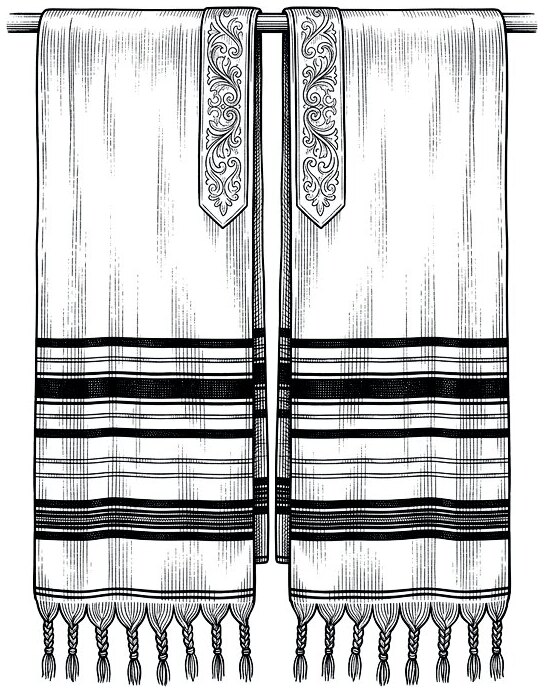
In the towns of Eastern Europe, on the Saturday night before Rosh Hashanah, the shamash walked the sleeping streets. He stopped at each Jewish home and knocked three times. “Israel, holy people, awake,” he called. “Arouse yourselves and rise for the service of the Creator.” The modern rabbi Reuven Hammer preserved the summons in his book Entering the High Holy Days, and the night it announced still comes every year.
The Saturday-night start
Leil Selichot is the first night of the penitential prayers that lead into the Jewish New Year. In the Ashkenazi tradition the service waits for the Saturday night before Rosh Hashanah and for halachic midnight. In 2026 that night is 5 September, 23 Elul 5786, when the prayers begin in the early hours of Sunday the 6th. Rosh Hashanah itself falls on Saturday 12 September this year, so the Saturday night before it leaves a full six mornings for Selichot, well past the rule that at least four days must precede the holiday. When Rosh Hashanah falls on a Monday or Tuesday, that Saturday would leave too few days, and the season opens a full week earlier.
Sephardic communities keep their own calendar. Their Selichot began at the start of Elul, the month of turning, and the customs of that month belong to our page on Rosh Chodesh Elul.
The service at midnight
The first half of the night belongs, in the old reckoning, to judgment. From halachic midnight the quality of mercy is said to stir again, so the congregation waits for that turn. The service has no Shema and no Amidah. It opens with Ashrei (Psalm 145) and a half-Kaddish, and then the cantor chants the hymn that gives the night its image: El Melekh Yoshev, “God, King, who sits upon a throne of mercy.” Around that image the prayers circle the Thirteen Attributes of Mercy from Exodus 34:6-7, the qualities of God that the Talmud says were shown to Moses after the Golden Calf. A leader sings the first and last line of each poem while the congregation reads the middle to itself, and the words return again and again through the hour.
Toward the end the ark is opened, and the congregation recites Shema koleinu, “hear our voice,” and then the Ashamnu, an alphabetical confession in which each sin is named and the chest is struck. The first night is the fullest service of the season: the cantor may wear the white kittel, a choir may join, and in a large congregation the whole thing can run past an hour. The nights that follow are shorter and come in the early morning before the daily prayers.
The poems of a Selichot service live in their own booklets, separate from the ordinary prayer book, and each day has a different selection at the heart of the service. Until the fifteenth century there was no fixed order at all; each community’s cantor chose the poems, and at least thirteen distinct Ashkenazi printed rites grew out of those local choices.
Why midnight
The hour has a story behind it. The Talmud says that a harp hung above King David’s bed, and at midnight the north wind played it by itself. David rose and studied Torah until dawn, keeping to his own line in Psalm 119: “At midnight I rise to give thanks for Your righteous laws.” Rashi sharpens the point: other kings wait for the dawn to wake them, while David woke the dawn. The Kabbalists took the image further: the harp stood for the Shekhinah, the indwelling presence of God, pictured as a queen in exile. At midnight she rises toward the King, and the gates of mercy open wide enough for hard judgments to soften. That reading of the night is the same one behind the midnight lament called Tikkun Chatzot, and it is why the penitential prayers wait for chatzot instead of starting at dusk.
The Hebrew word selichah means forgiveness, and the whole service is built on asking for it. When God spoke the Thirteen Attributes to Moses, the Talmud records the promise: whenever Israel sins, let them recite these words in order, and they will be forgiven.
A prayer leaf on the Silk Road
One of the oldest surviving Selichot texts came from a sealed Buddhist library cave at Dunhuang, on the Silk Road in western China, where tens of thousands of manuscripts in a dozen languages were walled up around the eleventh century. In 1908 the French explorer Paul Pelliot removed an eighteen-line fragment of a Hebrew penitential prayer from the same cave. The paper carries the superscript vowels of the Babylonian school, and its psalm verses run in an alphabetical acrostic. The leaf is usually dated to the eighth or ninth century. It sits today in the Bibliothèque nationale de France as Pelliot hébreu 1, one of very few Jewish documents in the whole Dunhuang hoard.
The leaf proves how old the genre is: Selichot began as prayers for fast days, and the Mishnah already describes the exhortations that closed with the cry “He will answer us.” Liturgical poetry flowered in Byzantine Palestine from the fifth century. There Yose ben Yose, the earliest paytan whose name survives, wrote poems for Rosh Hashanah and Yom Kippur, and Eleazar ben Kalir of Tiberias composed selichot and elegies that later generations built on. The specific poems of the Ashkenazi cycle came later, between the ninth and twelfth centuries, from authors whose names hide in acrostics: Saadiah Gaon, Gershom Meor ha-Golah, Rashi, and members of the Tosafist circles.
That a Hebrew prayer leaf reached a Chinese cave is less strange than it looks. Jewish merchants worked the same Silk Road routes as the Buddhist pilgrims, and the leaf is the clearest surviving sign that at least one of them reached the oasis. The prayer he carried was already fixed enough to be recognized a thousand years later. A Jew in the eighth century asked forgiveness with the same Thirteen Attributes that a congregation recites at midnight in 2026.
The night tonight
The summons changed address but not hour. On the night of 5 September 2026 the Western Wall in Jerusalem holds a Selichot gathering of its own, part of a season that runs from the start of Elul to the eve of Yom Kippur, and synagogues around the world open the same booklets after midnight. The shamash no longer walks the streets, yet the congregation still gathers in the dark while the cantor chants El Melekh Yoshev, and at the end of the service the chest is struck at every sin it names.