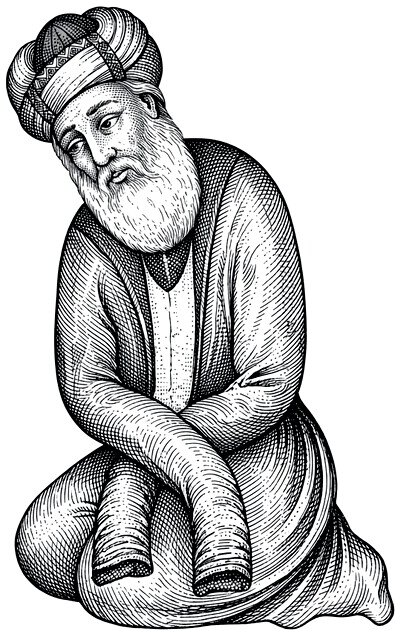
For five days every year, the lanes around a domed tomb in Delhi stay awake. Singers take turns in the courtyard until two in the morning. Pilgrims lay embroidered cloths over the grave. On the last day the shrine hands out yellow rice that has been blessed. The festival is the Urs of Nizamuddin Auliya, a Sufi saint who died in Delhi in 1325.
The wedding of a saint
An urs is the yearly festival at a Sufi saint’s grave, held on the day he died. The word comes from the Arabic for wedding. At the shrine the saint’s death counts as the moment his soul was united with God, so the day is kept with music and food.
The saint gave the word a second meaning himself. In July 1314 a visitor asked him what urs meant. He answered that it “may mean the celebration of a wedding, or it may mean the decamping of a caravan for the night.” A disciple kept the answer in the record of his conversations.
The date moves every year with the Muslim lunar calendar. The Urs starts on the 17th day of Rabi al-Thani, the fourth month of the Muslim year, in which he died. In 2025 that was 9 October. In 2026 it falls at the end of September, on the 29th or 30th in Delhi, depending on the moon.
The saint of Ghiyaspur
Nizamuddin was born in Badayun, in northern India, and came to Delhi as a boy with his widowed mother. As a young man he went west into the Punjab to study under a Sufi master, Baba Farid. Farid belonged to the Chishti order, one of the main Sufi orders in India, and he named Nizamuddin his successor.
He settled in Ghiyaspur, then a lonely village on the Yamuna some miles outside the capital. He taught there for about fifty years, and people called him Mahbub-e-Ilahi, the Beloved of God.
His house ran as a kind of welfare centre for the village. One hot summer day fire burned several houses nearby, and he stood barefoot on his roof until it was out. Afterwards each burnt house received two silver coins and two trays of food, with a pitcher of cold water.
Shelters with thatched roofs stood along the road from the city to the saint’s house. Each had water and a Qur’an reciter, so visitors could pray on the way.
The saint’s recorded conversations, the Fawa’id al-Fu’ad, cover about fifteen years of his life. Only 188 days of talk made it into the book, and the saint read and corrected it himself.
Music and the listener
The centre of the Urs is qawwali, the Sufi devotional song of South Asia. Its root is sama, “listening”: a gathering where Sufis listen together to spiritual music. Nizamuddin held such gatherings all his life. Any verse that moved him during sama soon spread through the lanes of Delhi.
He also set limits. When some disciples brought musical instruments, he asked: “Of what use are singers and musical instruments to a man who is a stranger to cosmic emotions?” Asked what sama is, he reportedly answered with another question: “First tell me, who is the listener?” For him the music was neither lawful nor unlawful in itself. The listener decided that.
Scholars of religious law disliked the practice. Under their pressure, Sultan Ghiyasuddin Tughlaq called the saint before a council to defend it.
His most famous disciple was the poet Amir Khusrau, often called the father of qawwali. Khusrau’s song “Aaj Rang Hai” tells his mother of his joy at finding his master. Qawwals at the Chishti shrines of Delhi traditionally sing it at the end of a session. For more on the practice, see Sufi Sama.
Legends at the shrine
Two legends tie the saint to that sultan. In the first, Ghiyasuddin was building his fortress of Tughlaqabad and wanted every worker for himself. He banned work on the saint’s stepwell, so the masons worked on it at night. When the sultan cut their supply of lamp oil, the legend says, the saint blessed the well and they lit their lamps with its water.
In the second, the sultan sent word from a campaign in Bengal that the saint should leave Delhi before he got back. The saint is said to have answered “Hunuz Dilli dur ast”, “Delhi is still far off.” Early in 1325 a wooden pavilion built to welcome the sultan home collapsed at Afghanpur, outside the city. The fall killed him, and he never reached Delhi.
The historian Khaliq Ahmad Nizami calls the message and the reply “highly improbable”. The sultan lay half-conscious after the fall and was in no state to send messages. The pious gossip of the age also blamed the saint’s curses, “which he never uttered against anyone,” for the murder of an earlier sultan.
The saint died that spring, on 3 April 1325. As he had wished, he was buried in the open, and the next sultan, Muhammad bin Tughlaq, built a dome over the grave.
Khusrau’s last verse
When the news reached Khusrau, tradition gives him one couplet:
Gori sove sej par, mukh par daare kes, Chal Khusrau ghar aapne, rain bhai chahun des.
“The fair one lies on the couch, black tresses scattered over her face. O Khusrau, go home now, for night has fallen over the world.” By tradition he wrote nothing after it. He died six months later, in October 1325, and he is buried beside his master. At the Urs, groups of hereditary qawwals sing his verses through the night.
More than seventy graves stand inside the shrine complex. Among them are Jahanara, the daughter of the Mughal emperor Shah Jahan, and the historian Ziauddin Barani.
Across traditions
Konya in Turkey keeps the same idea for the poet Rumi. His death day is Sheb-i Arus, his “wedding night”.
The saint’s own teacher has an urs too. At Baba Farid’s shrine in Pakpattan, a silver door called the Bahishti Darwaza, the Gate of Paradise, opens only during his urs in the month of Muharram. It stays open for five nights, from the night prayer to dawn. Devotees believe that walking through it washes away their sins. In 2001 a crowd rushing towards the door at the opening crushed 36 people to death.
At Nizamuddin a spring festival of the Hindu calendar has become part of the shrine year. In the legend, the saint grieved long for his dead nephew. Khusrau saw village women in yellow carrying mustard flowers to a temple to please their god. He put on yellow, brought mustard flowers to his master and sang until the saint smiled. On Basant Panchami the shrine still turns yellow, and it is reportedly the only day qawwali is sung inside the shrine.
The Urs today
In 2025 the 722nd Urs ran from 9 to 13 October. It opened with a recitation of the Qur’an at the tomb. The second night is Bari Raat, the Big Night. A collective prayer for world peace followed, and the Urs closed with a final prayer and the yellow rice.
Pilgrims tie coloured threads to the carved stone screens around the grave and bring rose petals and sweets. The free kitchen grows to feed the crowds. By custom, women do not enter the inner room of the tomb.
Some pilgrims cross a border to come. A 1974 agreement between India and Pakistan lists this shrine and Khusrau’s among the holy places each country opens to the other’s pilgrims. In 2024 eighty Pakistani pilgrims attended. In October 2025 diplomats from Pakistan’s High Commission laid the traditional cloth on the tomb.
The singing continues between festivals. Every Thursday night after sunset prayer, about 1,500 people sit in the courtyard for qawwali.