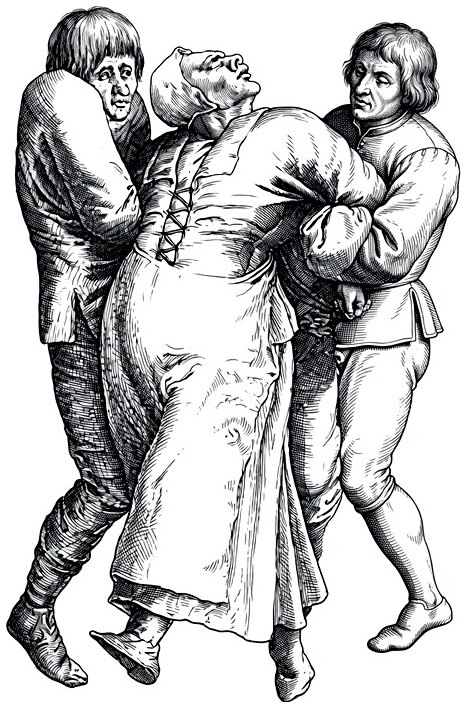
The woman who started it has a name, Frau Troffea. It comes from Paracelsus, who passed through Strasbourg around 1526, eight years after the outbreak, and set the story down in his Opus Paramirum, together with a diagnosis of his own: she was faking it, he decided; the hopping and singing were meant to annoy her husband. He filed her case as chorea lasciva, dancing born of lust. The city records surviving from that July never name her at all. They note that on July 14, 1518, a woman began to dance in the street and did not stop, and that within days others had joined her.
Four hundred in a month
By the end of the first week more than thirty people were dancing. The Imlin family chronicle, one of the Strasbourg accounts, counts about four hundred within a month. For a sixteenth-century marvel the paper trail is unusually good: council minutes and physicians’ opinions survive, along with chronicle entries connected to Sebastian Brant, the satirist of the Ship of Fools, who in 1518 was the city’s chancellor. The full case, from the first week to the carts that carried the dancers away, is told in our article The Dancing Plague of 1518: When Strasbourg Danced Itself to Death; this page stays with the day itself and what grew around it.
The cure that was more dancing
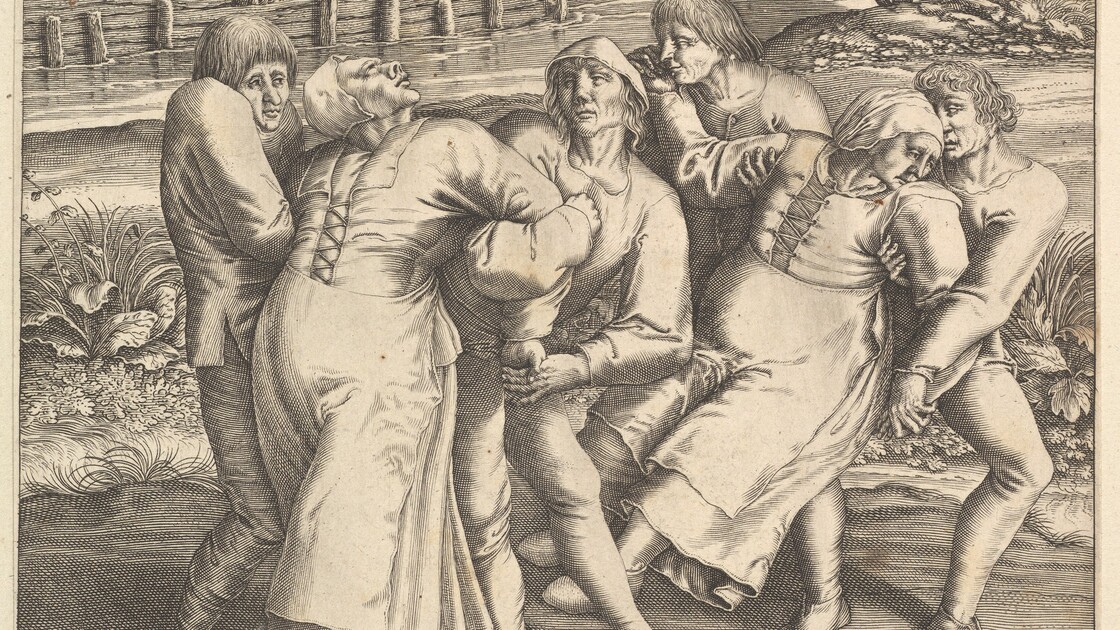
The physicians ruled first, and their verdict, preserved in the Annales associated with Brant, called the dancing “a natural disease, which comes from overheated blood.” The cure followed from the diagnosis: the afflicted had to dance themselves free of it. The council opened guild halls as dance floors and had a platform raised in the horse and grain markets, with hired pipers and drummers for the rhythm. It paid healthy dancers to hold the sick upright and keep them moving.
The plan failed: the music drew more dancers in, and by August the council reversed itself and banned public dancing and music outright. Brant’s orders seem to have allowed a single exception: stringed instruments could still be played at private celebrations.
Saint Vitus and the red shoes
Medicine had failed, and the city turned to the church. During an earlier dancing outbreak in Strasbourg, in 1418, sufferers had called on Saint Vitus, and the medical historians Thiago Cardoso Vale and Francisco Cardoso note that from then on he became the disease’s specific saint. On that logic, the saint who sent the compulsion could also lift it. The worst of the 1518 dancers were loaded onto carts and driven to his shrine above Saverne, in the Vosges foothills northwest of the city. Priests stood them beneath a wooden figure of the saint and gave each dancer a small cross and a pair of red shoes, sprinkled with holy water and marked with crosses in consecrated oil. The ritual went on in incense smoke and Latin, and by early September the dancing had faded out.
Chorea, the medical term, is the Greek word for dance. “St. Vitus’s dance” was later transferred to an unrelated childhood neurological disorder, today called Sydenham’s chorea, and the 1911 Encyclopædia Britannica already called that transfer an error.
Did anyone die?
Later chronicles say yes. A figure of fifteen deaths a day at the outbreak’s peak circulates through nearly every modern retelling, and a 1636 chronicle says the dancers “fell down unconscious and succumbed to death.” But the Strasbourg records surviving from 1518 itself mention no deaths, and never state whether there were any. The fifteen-a-day figure traces to accounts written generations after the event. Whether the dancing plague killed anyone is, on the primary evidence, an open question.
The older dance
Strasbourg was a recurrence: a dancing mania had broken out at Aachen on June 24, 1374 and moved through the Rhineland towns, and one period account, preserved in a later chronicle, has it lasting around sixteen weeks. Those dancers called on John the Baptist, and their affliction was known as St. John’s dance. A monk at Schaffhausen is said to have danced himself to death in 1428. Italy held onto the practice far longer: in Apulia, people bitten by the tarantula, or convinced they had been, danced for days to fiddle and tambourine, a cure with its own article, Tarantism: The Spider’s Bite and the Dance That Saved the Soul.
The same 1642 Hondius engraving is catalogued as “The Dancing Mania” by the Wellcome Collection in London and as “Pilgrimage of the Epileptics to the Church at Molenbeek” by the Metropolitan Museum of Art in New York.
Poison or trance
Two explanations dominate the modern literature, neither of them settled. The first is ergot, the rye fungus whose alkaloids are chemical relatives of LSD and whose long career as a historical suspect we covered in Ergot and Saint Anthony’s Fire: The Fungus Blamed for Everything. For 1518, John Waller, the historian who has studied the outbreak most closely, rejects it: ergot poisoning chokes off blood flow to the limbs, which makes days of sustained dancing hard to credit, and hundreds of people responding to a poison with the same coordinated behaviour is harder still. The outbreaks also cluster along the Rhine and Moselle, regions that shared saints’ cults but neither climate nor crops.
Waller’s own reading is trance: Strasbourg’s poor had come through the famine of 1517 and waves of disease, and they believed that Saint Vitus could impose a dancing curse. Under enough fear, he argues, that belief supplied the script: a dissociative state that spread from dancer to dancer because everyone watching knew what the affliction was supposed to look like. It fits the evidence well, though at five centuries’ distance nobody can prove it.
The day today
In Strasbourg the date now belongs to Bastille Day, like everywhere else in France. The dancing plague gets remembered in other seasons: for the five-hundredth anniversary, the Musée de l’Œuvre Notre-Dame mounted the exhibition “1518, la fièvre de la danse,” which opened in October 2018 and ran into the winter. Visitors filed past chronicles and engravings in the same city where, five hundred years earlier, a woman whose real name nobody wrote down stepped into the street and began to dance.