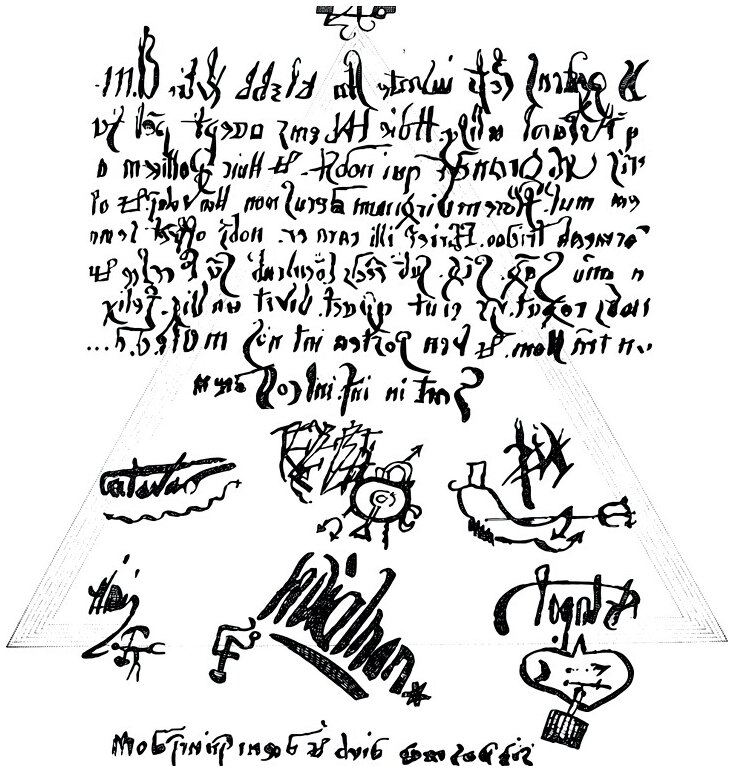
On the morning of 18 August 1634, Urbain Grandier was promised that he would be hanged before the flames reached him, and that he would be allowed to speak. At the square of Sainte-Croix in Loudun, the monks threw holy water in his face so that nobody heard his last words. By the account of the historian Robert Rapley, the exorcist Lactance lit the pyre before the hanging could take place. The rope caught fire, and Grandier fell alive into the burning wood.
He was forty-four years old, the parish priest of Saint-Pierre-du-Marché in Loudun and a canon of the church of Sainte-Croix. The case that killed him had begun two years earlier, when the nuns of the town’s Ursuline convent said they were possessed by the devil.
What the day is
August 18 is the anniversary of Grandier’s execution, the end of the most famous demonic possession case in French history. Between 1632 and 1637 Loudun became a pilgrimage site of a new kind. Priests, doctors, magistrates and spiritual tourists traveled to watch nuns writhe on a scaffold in the town centre while exorcists called the demons out of them by name.
The possession
The Ursuline convent opened in Loudun in 1626. In May 1632 plague swept the town. About five months later a young nun said she had seen the ghost of her dead confessor, and the visions spread through the house. By October the prioress, Jeanne des Anges, presided over seventeen nuns with an average age of twenty-five. They convulsed and screamed, laughed without stopping, recoiled from a consecrated wafer and showed a strength nobody could explain.
The nuns gave the demons names. Asmodeus, Zabulon, Isacaaron, Beherit, Leviathan, Balam, Behemoth. Some of them are familiar from the grimoires: Asmodeus has a bestiary entry, and Balam was the demon the exorcists later drove out of Jeanne des Anges by name. Then the nuns named a man: on 11 October 1632 they said the priest who had bewitched them was Urbain Grandier, though none of them had ever met him.
Grandier made an easy target. He was the priest who wrote a treatise against clerical celibacy. His affair with the daughter of the king’s prosecutor, Philippa Trincant, was said to have left her with his son, and his eloquence had earned the envy of the local monks. He opposed the demolition of Loudun’s walls that Cardinal Richelieu had ordered, and he was suspected of writing a satirical lampoon against the cardinal. The convent chaplain, Canon Jean Mignon, had his own quarrel: when the house needed a spiritual director, Grandier offered himself and was passed over in favor of Mignon. Huxley later wrote that Grandier refused the post and that the prioress, obsessed with him, turned to Mignon. The contemporary eye-witness account says he applied and was rejected; either way, the enmity was in place.
The exorcisms became a public theatre. The Bishop of Poitiers came to Loudun in person and spent two and a half months driving demons from the nuns. Capuchin friars and Jesuits took turns, and the presses of France filled with sensational pamphlets describing each expulsion. The possession outlasted the execution, and in December 1634 the Jesuit Jean-Joseph Surin arrived and took a quieter path. He sat with the prioress, read to her, whispered about peace, and offered himself to God to bear her evil in her place; he was possessed for the next twenty years. Jeanne des Anges recovered, and on her left arm the names Joseph and Mary appeared written in blood; the last devil, Behemoth, was said to leave in 1637. Surin recorded twenty years of seizures, paralysis, muteness and despair in a book he called La Science expérimentale. Jeanne des Anges carried her inscribed hand across France and exhibited it, and in 1638 she visited Richelieu and the king.
The pact produced at Grandier’s trial promised him “the love of women, the flower of virgins, the chastity of nuns, the respect of monarchs, honours, pleasures and powers.” In exchange he was to give a seal of blood once a year and trample the holy things of the church.
The trial and the pact
Grandier had been acquitted once already. In 1631 he appealed to the Archbishop of Bordeaux, who reinstated him and advised him to leave Loudun, but he returned in triumph. The possession case brought a new judge to the town: Jean de Laubardemont, a councillor of state sent to demolish the castle, and a relation of the prioress. In November 1633 Laubardemont took the case and Grandier was arrested. In May 1634 a decree of the royal council gave him sole authority, barred every other court from the matter and forbade appeals under a fine of five hundred livres. In June, Grandier was taken to the church of Sainte-Croix and ordered to perform an exorcism himself.
The evidence that condemned him was a document. It was a pact written in mirror-image Latin, signed by Urbain Grandier and by Lucifer, Satan, Beelzebub, Leviathan, Elimi and Astaroth, with the demon Baalberith as scribe. The story offered at the trial was that the demon Asmodeus, compelled by the exorcists, had fetched it from Lucifer’s cabinet in hell.
Nobody reads it today as the court did. It is widely taken for a forgery, produced to convict him. A copy survives in the Bibliothèque nationale de France, and a facsimile appeared in Collin de Plancy’s Dictionnaire infernal. Under the boot and the extraordinary question, Grandier’s legs were shattered. He confessed to the sins of his life. He never confessed to witchcraft.
On 18 August 1634 the court ordered him to make amende honorable before two churches and then burn alive, his ashes scattered to the wind. The pacts and his manuscript against clerical celibacy went into the fire with him.
Across traditions
Loudun followed an older pattern. In 1611 Father Louis Gaufridi was burned at Aix-en-Provence on the testimony of demons speaking through a possessed nun; the trial of Gaufridi is told in full on the Aix-en-Provence possessions page, and the convent at Aix-en-Provence has its own bestiary entry. Loudun ran on the same legal logic, and Louviers would follow in the 1640s. Moshe Sluhovsky counts at least forty-five mass possession cases in the era, most of them in convents that had recently been reformed. Possession and exorcism belong to the oldest documented strand of the battle between the visible and the unseen, which our history of exorcism across religions and cultures traces across the world.
The case has never stopped being explained. John Locke wrote in his journal in 1679 that the affair was “nothing but a contrivance of Cardinal Richelieu to destroy Grandier, a man he suspected to have wrote a book against him.” Augustin Calmet compared it to the faked possession of Martha Broissier in 1578. The historian Robert Rapley argues the conspiracy reached the king himself. Michel de Certeau read Loudun as a fault line of modernity, a public theatre where a society in crisis let the possessed say what the respectable could not. None of these readings settles what happened inside the convent, and all of them treat the trial as a political killing.
The day today
The walls Richelieu ordered down are gone. A square in Loudun still carries Grandier’s name. The story outlived the case as a durable subject of modern art: Eyvind Johnson’s novel, Huxley’s The Devils of Loudun, John Whiting’s play, Penderecki’s opera, Jerzy Kawalerowicz’s film Mother Joan of the Angels. Ken Russell’s 1971 film The Devils, with Oliver Reed as Grandier and Vanessa Redgrave as Jeanne des Anges, was cut so heavily before release that the most infamous sequence, the nuns desecrating a crucifix, was removed entirely and its footage was thought destroyed for decades. A restored director’s cut assembled from the original negative screened at Cannes in 2026, and a theatrical re-release is set for that autumn. And the pact that was supposed to prove the priest’s covenant with hell sits today in the manuscript collection of the Bibliothèque nationale de France, where it can still be consulted.